

If you are searching for “Families or Familys,” the correct spelling is families. It is the plural form of family and refers to two or more family groups, households, or sets of relatives. The spelling follows a common English grammar rule: when a noun ends in a consonant followed by y, the y changes to i before adding es.
The confusion often goes beyond spelling. Writers may also mix up families, family’s, and families’ when talking about plural nouns or possession. Understanding when to use each form can help you write clearer sentences, avoid common grammar mistakes, and choose the right word naturally in everyday English.
What Is the Difference Between Family’s and Families?
The difference between family’s and families is not simply spelling. The two forms perform different grammatical jobs. When people search Families or Familys, they are often also unsure about where an apostrophe belongs.Family’s is the possessive form of one family. It shows that something belongs to or is associated with that family.
Our family’s house is near the park.
Families is the plural of family. It refers to two or more family groups.
Several families live on this street.
So, when choosing between Families or Familys, use families when you mean more than one family. Use family’s when you need to show possession by one family.
Is It Familys or Families?
Families is correct. Familys is a spelling error in standard English.The reason comes from a common plural rule. When a noun ends in a consonant followed by y, remove the y and add -ies.
Family → Families
Baby → Babies
City → Cities
Party → Parties
This rule provides a quick answer whenever Families or Familys causes confusion. You do not normally create the plural simply by attaching an s to family.
For example:
Two families shared the same holiday cottage.
Here, families tells us that two separate family groups are involved. Therefore, Families or Familys has only one correct plural choice: families.
Family vs. Families: What’s the Difference?
Family is singular, while families is plural. The correct choice depends on how many family groups you are describing.
Use family for one group:
My family lives in Manchester.
Use families for more than one group:
Three families moved into the neighbourhood.
This distinction also explains part of the Families or Familys confusion. Although a family can contain many people, the word family itself can still represent one collective group.
For example, “my family” may include parents, children, grandparents, and other relatives, but grammatically it can still be treated as one family unit. If you are talking about several separate family units, families is appropriate.
Families vs. Families’: What’s the Difference?
The apostrophe changes the meaning.
Families means more than one family:
Many families attended the festival.
Families’ shows possession by more than one family:
The families’ children played together.
In the second example, the children are associated with several families. Because families already ends in s, possession is formed by placing the apostrophe after that s.
Readers researching Families or Familys should therefore remember three separate forms:
- Families = more than one family
- Family’s = belonging to one family
- Families’ = belonging to multiple families
Familys does not replace any of these forms.
When to Use “Families”

Use families whenever you are referring to two or more separate family groups. Of all the forms involved in Families or Familys, this is the standard plural noun.
You might write:
Local families were invited to the community centre.
Both families agreed to meet before the wedding.
The programme provides support to low-income families.
In each case, more than one family is being discussed. No apostrophe is necessary because these sentences do not use families to show ownership.A useful test for Families or Familys is to replace the word with another plural noun. If groups, households, or a similar plural idea makes sense, you probably need families.
When to Use “Family’s”
Use family’s when something belongs to, relates to, or is connected with one family. The apostrophe before the s indicates singular possession.
For example:
Our family’s tradition began many years ago.
The family’s car was parked outside.
Her family’s support helped her through a difficult year.
The Families or Familys spelling question should not cause family’s to be mistaken for a plural. An apostrophe does not normally make an English noun plural. Here, it signals possession.One simple check is to ask, “Does this belong to one family?” If the answer is yes, family’s may be the form you need.
Learn more…….Fiend vs Feen Meaning and Difference
When to Use “Families’”
Use families’ when something belongs to or concerns multiple families. First, family becomes the plural families. Then an apostrophe is added after the final s to indicate plural possession.
For example:
The families’ concerns were discussed at the meeting.
The families’ homes were damaged by the storm.
The two families’ holiday plans were surprisingly similar.
Understanding this form helps resolve the wider Families or Familys issue because it separates plural spelling from possessive punctuation. Families is plural; families’ is plural possessive.
Compare:
The families arrived early.
The families’ cars were outside.
The first sentence simply refers to multiple families. The second describes cars associated with those families.
How Do You Make “Family” Plural?
To make family plural, change the final y to i and add -es:
Family → Families
This happens because family ends with a consonant (l) followed by y. It is one of the most useful rules to remember when deciding between Families or Familys.
Compare it with:
- Story → Stories
- Country → Countries
- Lady → Ladies
- Puppy → Puppies
Not every word ending in y follows this pattern. If a vowel comes immediately before the y, you usually just add s:
- Boy → Boys
- Day → Days
- Key → Keys
- Toy → Toys
That contrast can make the Families or Familys rule easier to remember. Since family has a consonant immediately before its final y, its plural is families.
Family’s, Families, and Families’: Examples in Sentences
Looking at the forms side by side is one of the easiest ways to understand Families or Familys and the related apostrophe rules.
Family:
Our family gets together every December.
Families:
Many families travel during the school holidays.
Family’s:
My family’s favourite restaurant is nearby.
Families’:
The families’ opinions were included in the report.
Consider another set:
One family attended the meeting.
Five families attended the meeting.
One family’s representative spoke first.
The five families’ representatives later joined the discussion.
These examples show why Families or Familys is not only a spelling issue. Number and possession determine which form belongs in a sentence.
Common Mistakes With Family’s, Families, and Families’
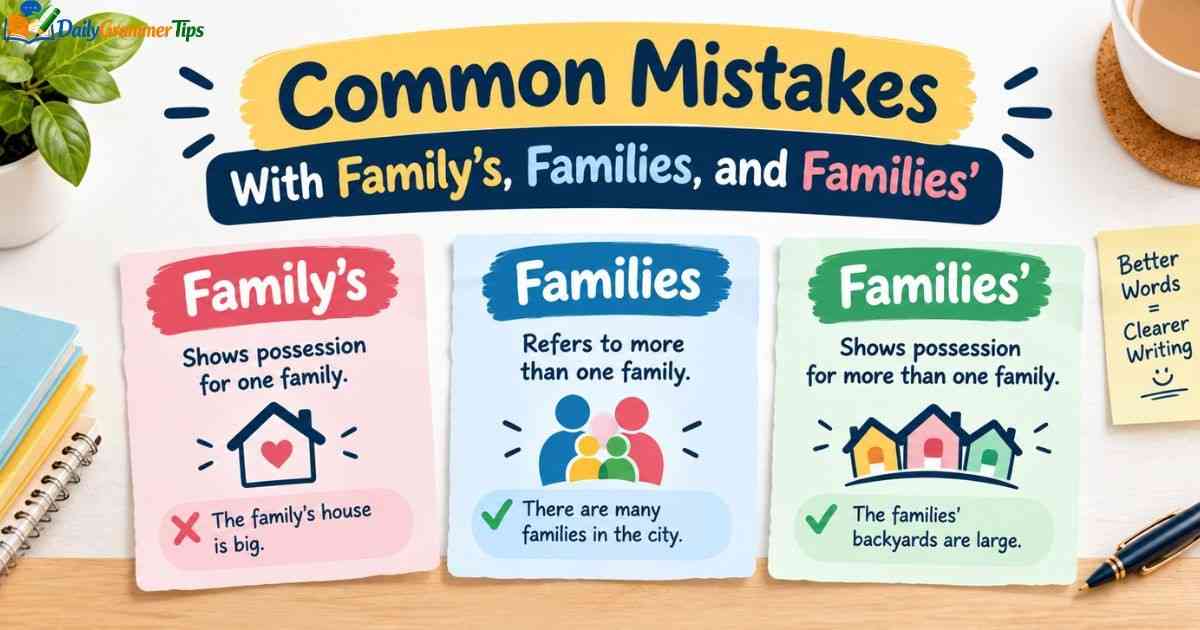
One frequent Families or Familys mistake is writing familys as the plural. English does not use this spelling as the standard plural of family.
Incorrect: The familys went on holiday.
Correct: The families went on holiday.
Another common error is using an apostrophe just because a word is plural.
Incorrect: Several family’s attended.
Correct: Several families attended.
The opposite mistake occurs when possession requires an apostrophe:
Incorrect: The family car was sold.
Correct: The family’s car was sold.
For multiple-family possession:
Incorrect: The families meeting was postponed.
Correct: The families’ meeting was postponed.
When proofreading Families or Familys, first decide whether you mean one family or several. Then decide whether you are simply naming them or showing possession. Those two questions usually reveal the correct form.
Family’s or Families Possessive
Family’s is the singular possessive form of family. It shows that something belongs to or relates to one family. For example, “The family’s house is nearby” refers to the house of one family.Families’ is the plural possessive form.
It refers to something connected with two or more families. For example, “The families’ children attend the same school” involves children from multiple households.The position of the apostrophe makes the difference. Use family’s for one family and families’ for more than one family. Families without an apostrophe is simply the plural noun.
Our Families or Our Family
Both our family and our families are correct, but their meanings depend on context. Our family refers to one family unit shared by the people speaking.
For example, siblings might say, “Our family lives in London.” Here, family works as a collective noun for one group of relatives.
Use our families when the speakers belong to different family groups. A married couple might say, “Our families are meeting this weekend,” meaning relatives from both sides. The plural families makes it clear that more than one household or family group is involved.
Is It Sorry for Your Family’s or Families Loss?
In most situations, “sorry for your family’s loss” is correct. The apostrophe comes before the s because the loss affects or belongs to one family.
For example: “I am deeply sorry for your family’s loss.”
If you are addressing several separate families who have experienced a shared tragedy, “sorry for your families’ loss” can be grammatically correct. The apostrophe follows the final s because families is plural.The intended number of family groups determines which possessive form to use.
Families Meaning
Families is the plural form of family. It means two or more groups of people connected by birth, marriage, adoption, partnership, or another recognised family relationship.The term can describe different households, parents and children, extended relatives, or other family units.
For example, a community programme may provide services to several families rather than one individual household.In grammar, families is a plural noun. It comes from family and does not require an apostrophe unless possession is being shown.
Family’s Loss or Families Loss
Family’s loss is correct when discussing a loss experienced by one family. The apostrophe shows a possessive relationship.
For example: “The community came together after the family’s loss.”
When several families experience the loss, write families’ loss, with the apostrophe after the s. Writing families loss without an apostrophe is normally incorrect when families is being used possessively.A simple rule helps: family’s means one family, while families’ means multiple families.
Your Families
Your families is grammatically correct when your refers to people who belong to two or more separate family groups. It is the plural form of the phrase your family.
For example, a teacher speaking to several students might say, “Share this information with your families.” Each student may have a different household or group of relatives.
If you are speaking to one person about one family unit, your family is usually more natural. The choice between family and families depends on whether one or multiple family groups are intended.
Families Spelling

The correct plural spelling of family is families, not familys. This follows the English spelling rule for many nouns ending in a consonant followed by y.
To form the plural, remove the final y and add -ies:
Family → Families
The same pattern appears in baby → babies, city → cities, and story → stories. Therefore, when choosing between Families or Familys, families is the standard English spelling.Do not add an apostrophe simply to make the word plural. Family’s indicates singular possession, while families indicates more than one family.
Families in a Sentence
Using families in sentences can make its plural meaning easier to understand. It should be used when two or more family groups, households, or sets of relatives are being discussed.
Examples include:
“Several families moved into the neighbourhood.”
“Local families attended the community event.”
“The charity provides food and support to families in need.”
“Both families met before the wedding.”
“Many families spend the holidays together.”
In each sentence, families functions as a plural noun. If ownership or association needs to be shown, the plural possessive form families’ is used instead.
Frequently Asked Questions
What is the difference between familys and families?
Families is the correct plural of family. Familys is a spelling mistake because words ending in a consonant + y usually change the y to ies in the plural.
What are family dynamics?
Family dynamics are the patterns of communication, relationships, roles, and behaviour between family members. They shape how people interact and handle problems together.
Is family’s grammatically correct?
Yes, family’s is grammatically correct when showing possession by one family. For example, “The family’s house is beautiful.”
What does it mean when family hurts you?
It means a family member’s words, actions, or behaviour have caused emotional or physical harm. How you respond depends on the situation and your relationship with them.
When to walk away from family?
Consider creating distance when a family relationship repeatedly harms your well-being, ignores reasonable boundaries, or involves abuse. If you feel unsafe, seek support from someone you trust or a qualified professional.
Conclusion
The answer to Families or Familys is straightforward: families is the correct plural of family, while familys is incorrect in standard English. The final y changes to i before -es is added because family ends in a consonant followed by y.
The important distinction goes further than Families or Familys. Use family for one family, families for multiple families, family’s for something belonging to one family, and families’ for something belonging to multiple families. Once you separate plural meaning from possession, choosing the correct form becomes much easier.
