

Many English learners pause when they need to write about cooking oil, sizzling pans, or crispy potatoes, because they are not sure whether the correct word is frie or fry. This small spelling puzzle trips up native speakers occasionally and confuses second language learners far more often.
The confusion around frie or fry usually comes from how English borrows words from other languages and then reshapes them over centuries. Once you understand the real answer, you will never second guess this word again, and this guide breaks the topic down piece by piece so you finish with total clarity.
Frie or Fry Quick Answer
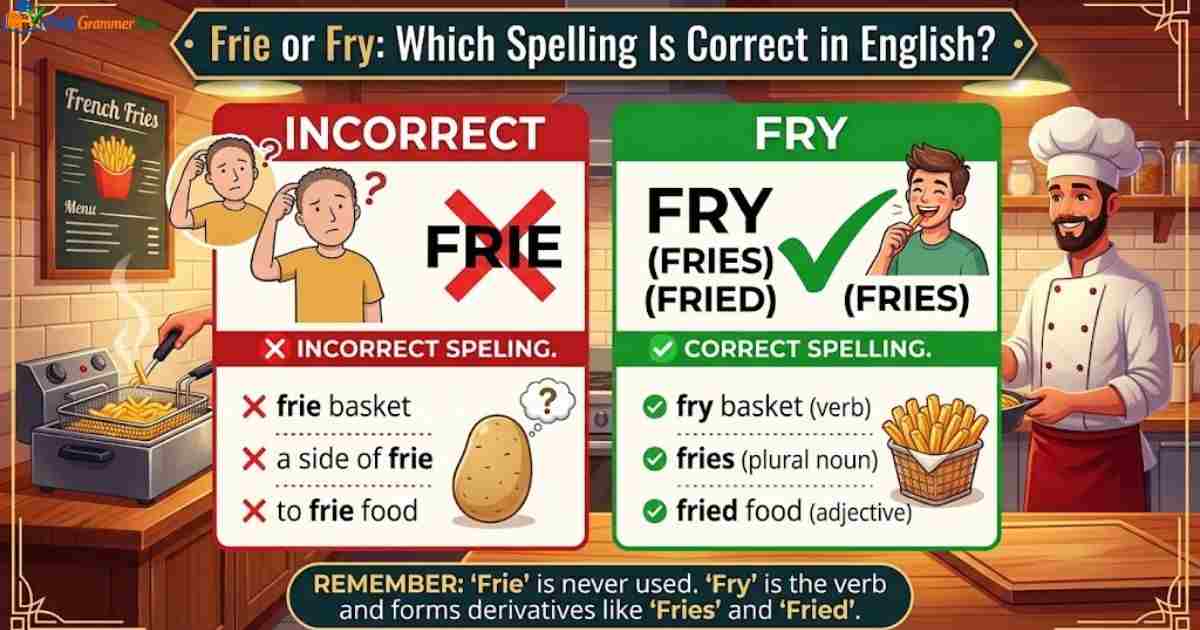
When people search for frie or fry, they want a fast and reliable answer. The correct spelling in modern English is fry, written with a single letter i. The alternate spelling frie does not appear in any recognized English dictionary and carries no official standing in grammar references.
Fry functions as both a verb and a noun. As a verb, it describes cooking something in hot oil or fat. As a noun, it can refer to the young offspring of fish, a term still used in fisheries and biology today. Some casual speakers also use fry informally to describe something moving through quickly or something overheating.
Frie or Fry Anyone still weighing frie or fry in their own writing can rely on one simple rule. Fry is always right, and frie is always wrong, regardless of the sentence or the context.
Examples
- My sister plans to fry the fish before the guests arrive.
- The chef uses a lower temperature to fry the potato slices evenly.
- Marine biologists tag the fry before releasing them back into the river.
- Please do not fry the circuit board by plugging in the wrong charger.
Frie or Fry Origin and Word History
Understanding where a word came from often clears up spelling doubts, and the story behind frie or fry is no exception. The word traces back to the Old French term frire, which itself descended from the Latin verb frigere, meaning to roast or to fry something over heat.
As this term moved into Middle English during the thirteenth century, its pronunciation slowly changed to match English speech patterns. By the fourteenth century, English writers had settled on the spelling fry, and dictionaries, grammar books, and teaching materials have kept that spelling consistent ever since.
Several factors explain why people still hesitate between frie or fry today. English spelling rarely follows strict phonetic logic, so learners cannot always predict a word from its sound alone. The plural form fries contains a letter i, and that visual pattern tricks many writers into assuming the singular form must include one too. Autocorrect tools occasionally suggest unusual alternatives as well, which adds another layer of confusion for anyone unsure about frie or fry.
British English versus American English Spelling
Regional spelling differences cause plenty of headaches in English, yet the frie or fry debate is refreshingly simple because both major dialects agree completely.
Main Takeaway
Both American English and British English spell this word as fry, without a single regional exception. Writers in London, New York, Toronto, or Sydney all use the identical spelling, so nobody needs to adjust this word based on their audience’s location.
Spelling Comparison
| Form | American English | British English | Accepted Spelling |
| Base verb | fry | fry | Yes |
| Plural noun | fries | fries | Yes |
| Past tense | fried | fried | Yes |
| Present participle | frying | frying | Yes |
| Alternate spelling frie | Not accepted | Not accepted | No |
Since every major English speaking region treats fry the same way, this particular word removes one layer of guesswork that often complicates other American versus British spelling comparisons.
Which Spelling Should You Choose
Choosing correctly between frie or fry becomes easy once you separate the accepted form from the incorrect one and apply that rule consistently.
Use Fry If
- You write formal letters, reports, or business documents.
- You compose academic essays or research papers.
- You publish blog posts, articles, or website copy.
- You send professional emails to colleagues or clients.
- You study English as an additional language.
- You edit or proofread someone else’s writing.
- You draft creative fiction, poetry, or scripts.
- You complete official forms or applications.
Avoid Frie Because
- No major dictionary lists it as a valid entry.
- Spell checking software flags it as an error every time.
- English textbooks and course materials never teach it.
- Formal, academic, and professional readers will view it as a mistake.
- It weakens your credibility and makes your writing look careless.
- It goes against long established English spelling conventions.
- Schools and universities will mark it wrong in assignments.
Whenever the word frie appears in a document, it almost always signals a typing slip, an autocorrect error, or a simple misunderstanding of English spelling rules.
Common Mistakes With Frie or Fry
Writers at every skill level occasionally stumble over this word, and recognizing the typical traps helps you avoid the frie or fry mistake permanently.
One frequent error happens when writers assume the singular word must mirror the plural fries, so they type frie instead of fry. This logic fails because English contains many mismatched singular and plural pairs, such as child and children, or mouse and mice.
A second common slip involves verb tenses. The base word always stays fry, yet writers sometimes misspell related forms. The present tense uses fry across all subjects, the past tense becomes fried, and the continuous form becomes frying rather than frieing or fryeing.
A third mistake comes from over applying phonetic reasoning. Some learners assume that because fry sounds like it could carry extra letters, it must be spelled with more than four characters. In reality, the letter y already performs the vowel sound needed at the end of the word.
A final trap appears when writers translate directly from French or another Romance language. Those languages use their own spelling systems, such as frire in French, and importing that spelling into English text creates the frie or fry confusion all over again.
Memory Tip
Picture fry alongside familiar rhyming words such as try, cry, and dry. All four words share the same consonant plus y pattern, and remembering this small family of words makes the correct spelling almost automatic.
Frie or Fry in Everyday Writing
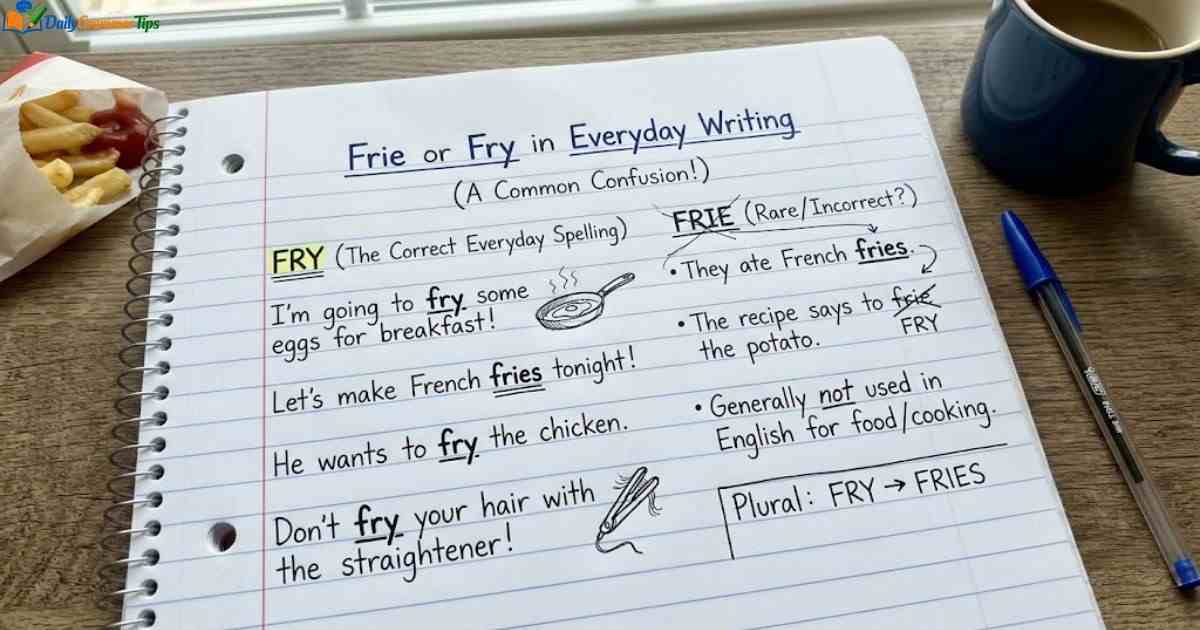
Seeing frie or fry used correctly across different writing styles helps cement the spelling in your memory far better than a rule alone ever could.
Read more:Lilies or Lillies: Which Is the Correct Spelling?
Emails
A workplace message might read, “Team, please remember not to fry the shared printer by running large jobs back to back. Thank you for your patience.” A casual note between friends might say, “Could you fry some plantains for tonight? I will bring drinks and dessert.”
News
A health article might state that researchers continue studying how oil quality can fry food unevenly at high heat, raising questions about acrylamide levels. A food section piece might explain how a local diner adjusted its method to fry onion rings at a gentler temperature for a crispier finish.
Social Media
A cooking influencer might caption a photo with, “Homemade fries always win! Who else loves to fry potatoes in a cast iron skillet?” A tech account might joke, “Reminder: do not fry your phone battery by leaving it in a hot car all afternoon.”
Formal Writing
An academic paper might note that controlled heat allows researchers to fry a sample evenly while preserving its internal texture for analysis. A corporate safety manual might instruct staff to avoid actions that could fry sensitive wiring inside shared equipment.
Frie or Fry Google Trends and Usage Data
Search behavior offers a useful window into how widely people misunderstand frie or fry, and the numbers tell a fairly clear story.
Search interest around the correct spelling of fry consistently dwarfs any interest in the alternate spelling frie. Queries comparing frie or fry directly have climbed at a steady pace over recent years, driven largely by learners studying English formally and by international students preparing academic work.
Popularity by Region
Search patterns vary somewhat by location, though fry remains dominant everywhere. In North America, fry appears in roughly ninety eight percent of correctly spelled instances. European writers use fry with similar consistency in formal contexts. Searches from the Asia Pacific region make up a notably large share of spelling related grammar questions overall, and writers in Australia and New Zealand almost never deviate from the standard spelling.
Context of Searches
People typically look up this spelling question while studying English formally, checking a document before submission, proofreading academic assignments, building website content, translating material from another language, or preparing lessons to teach English to others.
Comparison Table Frie vs Fry
| Feature | Frie | Fry |
| Standard English spelling | No | Yes |
| Found in dictionaries | Rarely, if ever | Every major dictionary |
| Suitable for formal writing | No | Yes |
| Flagged by spell checkers | Usually yes | No |
| Pronunciation | Unclear | Rhymes with try |
| Everyday usage | Mostly errors | Extremely common |
| Included in teaching materials | No | Yes, consistently |
| Professional acceptance | Unacceptable | Fully accepted |
| Academic acceptance | Rejected | Expected |
Expanded Usage Examples
This section gathers the word in its different grammatical roles side by side, so you can see how one consistent spelling, fry, adapts to verbs, nouns, adjectives, and compound expressions without ever changing form.
Different Parts of Speech
As a verb, someone might write, “He will fry the vegetables before adding them to the noodles.” As a noun describing young fish, a biology text might state, “The fry stayed close to the riverbank for protection.” As part of a derived adjective, a menu might read, “We recommend the fried shrimp over the grilled option.” Within compound expressions, a recipe might mention a stir fry dish or explain a deep fry technique for extra crunch.
Why This Spelling Matters

Spelling frie or fry correctly might seem like a minor detail, yet it quietly shapes how readers judge your writing. Job seekers submitting resumes, professionals building an online reputation, authors publishing content for wide audiences, teachers preparing learning materials, and anyone trying to establish credibility in their field all benefit from getting small details like this right. A correctly spelled word signals attention and competence, while an error in something as common as fry can distract readers and quietly undermine an otherwise strong piece of writing.
Tips for Mastering Fry Spelling
- Link fry mentally with rhyming words like try, dry, and cry.
- Practice by writing several original sentences using fry in different tenses.
- Turn on spell checking tools so any slip gets flagged immediately.
- Read widely, since repeated exposure to correct spelling reinforces memory naturally.
- Make flashcards if you are learning English through a structured course.
- Check a trusted dictionary whenever the slightest doubt creeps in.
Frie or Fry vs French Fries
The word French fries always uses the standard spelling fry as its base, never the incorrect form frie. When someone writes frie or fry while comparing it with french fries, the correct outcome stays the same in both cases, since fries is simply the plural of fry and follows identical spelling rules throughout.
Frie or Fry Meaning
The meaning behind frie or fry depends entirely on which spelling you use, since only one carries real meaning. Fry means to cook something in hot oil or fat, and it can also describe young fish in their earliest growth stage. Frie holds no meaning of its own because dictionaries do not recognize it as a genuine English word.
Frie or Fry in English
Within English grammar, frie or fry has one definitive answer. English writing, from casual messages to formal publications, accepts only fry as the correct spelling. Frie never appears in style guides, textbooks, or professional documents, which makes this comparison one of the simpler spelling questions in the language.
Fry Animal Meaning
In animal biology, fry describes newly hatched fish that have not yet reached their juvenile stage. Fisheries and aquaculture specialists use this term regularly when tracking fish populations, since fry represents a distinct and important life phase before fish mature into larger juveniles.
Fry Definition Fish
When applied to fish, fry defines the very young offspring that emerge shortly after eggs hatch. This definition appears frequently in scientific writing, conservation reports, and educational material about aquatic life, always using the standard spelling fry rather than any alternate form.
Fry Slang Meaning
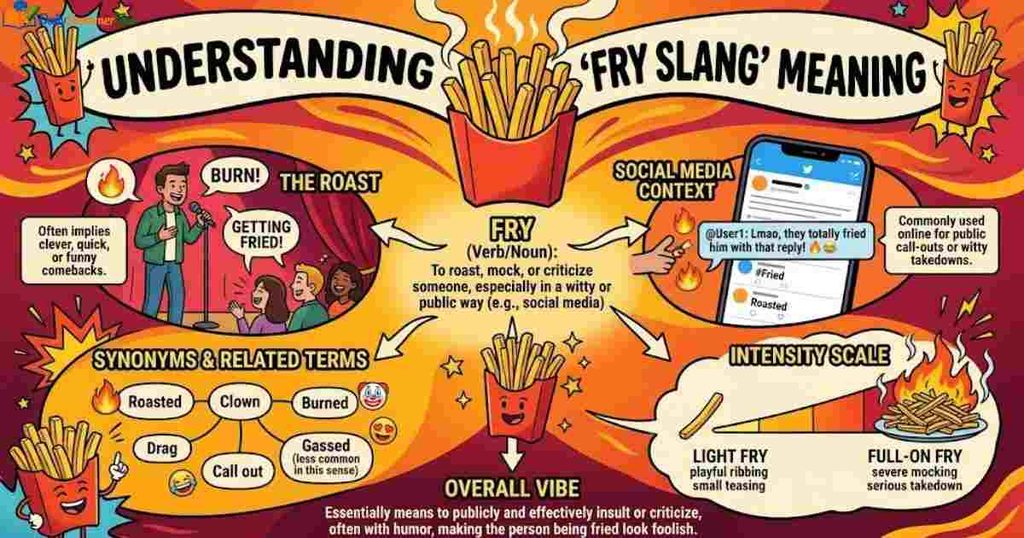
Outside formal definitions, fry sometimes appears in slang to describe something overheating, burning out, or breaking down under pressure. People also use the phrase feeling fried to describe mental exhaustion after a demanding day, giving the word a flexible, informal meaning beyond cooking.
Fry Mean
When someone asks what fry means, the simplest answer covers two main ideas. Fry means cooking food in hot oil, and it also names young fish shortly after hatching. Both meanings share the identical spelling, and context alone tells a reader which sense applies.
Fry Noun Meaning
As a noun, fry carries two established meanings. It can refer to a batch of fried food, such as a fish fry gathering, or it can describe juvenile fish in their earliest stage of development. Both noun uses rely on the same correct spelling, reinforcing why frie never fits as a valid alternative.
Frequently Asked Questions
Is it French Frie or fry?
The correct spelling is always fry, so the proper term is French fries rather than French fries with an alternate spelling. Frie never appears as an accepted form in English, whether alone or paired with the word French.
What is the meaning of Frie?
Frie has no accepted meaning in standard English because it is not a recognized word. Writers who use frie almost always intend to write fry, and dictionaries do not list frie as a valid entry or variant.
What is called fry?
Fry refers to the action of cooking food in hot oil or fat, and it also names the young offspring of fish shortly after they hatch. Both meanings rely on the exact same spelling, fry, regardless of which sense a sentence intends.
What does fry mean in slang?
In casual or slang usage, fry can describe something overheating or breaking down under pressure, such as saying a device might fry if it overheats. People also use fry loosely to describe someone feeling mentally exhausted, as in feeling fried after a long day.
What does “fry” mean?
Fry primarily means to cook something in hot oil or fat until it becomes crisp or browned. It can also describe young fish in their earliest stage of life, and in informal speech it sometimes describes overheating or burning out under stress.
Conclusion
After exploring every angle of this topic, the answer to frie or fry remains completely clear. Fry is the only accepted spelling across formal writing, casual conversation, academic work, and every major English speaking region.
Keep these key points in mind going forward. Fry is the sole correct spelling recognized by dictionaries and style guides. Frie carries no standing as a legitimate English word. American and British English both use fry without exception, and every verb form built from this word, including fried and frying, follows the same standardized base.
Mastering the difference between frie or fry strengthens your overall writing and helps you communicate with more confidence. Whether you are cooking dinner, drafting a professional email, or learning English from scratch, remembering that fry is always correct will save you from an easy and completely avoidable mistake.
