

If you have ever paused mid-sentence wondering whether it is “label” or “lable,” you are dealing with one of the most common spelling slips in English. It looks harmless, but a wrong keystroke like this can quietly chip away at how professional your writing appears, whether it’s on a resume, a product package, or a simple text message.
Settles the question for good, walks through where the word comes from, how British and American English treat it differently, and gives you enough real examples that you will never second-guess it again.
Label or Lable: Quick Answer
“Label” is the only correct spelling. “Lable” is not a recognized word in any dictionary, in any English-speaking country, in any style guide. There is no situation, casual texting, academic writing, or legal documents, where “lable” would be acceptable.
Label
“Label” functions as both a noun and a verb. As a noun, it refers to a tag, sticker, or strip of material attached to an item to identify it. Think of the care tag inside a jacket or the sticker on a jar of honey. As a verb, it means to attach such a tag, or more broadly, to categorize or describe someone or something.
Lable
“Lable” is simply a typo, the last two letters of “label” swapped around. It has no meaning, no dictionary entry, and no grammatical function. It shows up so often because writers mentally match “label” to the rhythm of words like “table” and “cable,” which genuinely do end in “le.”
Is Lable a Word?
No, “lable” is not a word in standard English, and it never has been. It does not appear in Merriam-Webster, Oxford, Cambridge, or Collins. Spell checkers flag it instantly, and most style guides don’t even bother listing it as a variant because it isn’t one. It is purely an error born from muscle memory and rhyme-based guessing.
This matters more than it might seem in professional settings. A resume, a product listing, or a client email with “lable” in it can quietly signal carelessness, even if the rest of the writing is excellent. Since the error involves swapping only two letters, it also tends to slip past a quick read-through, which is exactly why it keeps showing up in published content, packaging designs, and even printed signage.
Label Meaning
At its core, a label identifies or describes. On a physical product, it might list ingredients, warnings, or a brand name. Figuratively, “to label” someone means to assign them a category, sometimes unfairly, such as calling a quiet coworker “shy” without really knowing them. The word carries this dual life: a literal tag on an object and a metaphorical tag we place on people, ideas, or groups.
Label or Lable Meaning
When people search this exact phrase, they are usually trying to confirm two things at once: which spelling is right, and what the word actually means. The answer to both is straightforward. “Label” is correct, and it means an identifying tag, sticker, or descriptive marker, used as either a noun or a verb depending on the sentence. “Lable” carries no meaning at all because it isn’t a real word.
Label Pronunciation
“Label” is pronounced LAY buhl (/ˈleɪ.bəl/), with the stress on the first syllable. It rhymes loosely with “table” and “stable,” which is exactly why the spelling trips people up. The ear expects an “le” ending, but the word is spelled with “el” instead.
The Origin of Label
The word traces back to 14th century Anglo-French, where “label” (or a close variant) referred to a narrow ribbon or strip of cloth. Older still, it connects to Old French terms for a fringe or band sewn onto garments, and further back to Germanic roots describing a loose flap or scrap of fabric.
For centuries, a “label” was a literal object: a cloth strip dangling from a document to anchor a wax seal, or a decorative ribbon on clothing and coats of arms. By the late 1600s, the meaning had broadened to cover any tag or slip used to mark or identify an item, which is essentially the sense we still use today. The music industry sense of “record label” appeared much later, in the mid 20th century, borrowed from the printed paper disc at the center of a vinyl record.
Knowing this history actually helps with spelling, because the word came through French with an “el” ending, it never picked up the “le” pattern of native English words like “table” or “cable,” even though it sounds similar. Other words that share this French-derived “el” pattern include “channel,” “model,” “tunnel,” and “cancel,” all of which resist the temptation to end in “le” for the same historical reason.
Label or Lable in English
In standard English, British, American, Australian, or otherwise, there is exactly one correct spelling: “label.” “Lable” has no regional acceptance anywhere. Learners of English sometimes assume spelling confusion might be a dialect issue (similar to “colour” vs. “color”), but that logic doesn’t apply here. Every English speaking region agrees on “label” as the base word; the differences only appear once you start adding endings.
British English vs American English Spelling
This is where genuine regional variation exists, not in the base word, but in its inflected forms. American English follows a rule where a final consonant is doubled only if the last syllable is stressed. Since “label” stresses the first syllable, Americans keep a single “l”: labeled, labeling, labeler. British English (along with Australian and most Commonwealth English) doubles the final “l” regardless of stress, giving labelled, labelling, labeller.
Comparison Table
| Form | American English | British English |
| Base word | label | label |
| Past tense | labeled | labelled |
| Present participle | labeling | labelling |
| Person who labels | labeler | labeller |
| Action noun | labeling | labelling |
Both versions are fully correct within their own region; neither is a mistake.
Learn more………….Barrel or Barrell: Which Spelling Is Correct?
Label or Lable UK
In the UK, the base spelling is still “label”; “lable” is just as wrong there as it is anywhere else. The only UK specific difference shows up in the extended forms: British writers use “labelled,” “labelling,” and “labeller” with a double “l,” where American writers use a single one. So if you’re wondering about “label or lable UK,” remember the word itself doesn’t change, only the endings do.
Which Spelling Should You Use?
Always use “label” as the base word, no exceptions. For inflected forms, match your audience:
- Writing for American readers: use labeled, labeling, labeler
- Writing for British, Australian, or international readers: use labelled, labelling, labeller
- Unsure of your audience: American spelling (labeled) is a safe global default, since it’s widely understood everywhere
“Lable” should never appear in any version of your writing, regardless of audience.
Label or Lable Grammar
Grammatically, “label” behaves like any regular English noun-verb pair. As a verb, it conjugates normally: label, labels, labeled/labelled, labeling/labelling. As a noun, it takes a regular plural, “labels.” There is no grammatical form of “lable” because it simply doesn’t exist as a word; grammar rules can only apply to real vocabulary, and this isn’t one.
In a sentence, “label” can act as the subject, object, or even part of a compound noun. Examples include “the label peeled off,” “please label this file,” and “label maker,” where it functions as a modifier for another noun. Understanding this flexibility helps writers use the word confidently across formal reports, casual conversation, and technical documentation alike.
Common Mistakes with Label
Even confident writers slip up here. Watch for these:
- Typing “lable” instead of “label”: the most frequent error, driven by rhyme based guessing.
- Using “labelled” in American writing: should be “labeled” (single “l”).
- Using “labeled” in British writing: should be “labelled” (double “l”).
- Getting “mislabeled” vs. “mislabelled” wrong: the same US/UK rule applies here too.
- Forgetting label works as a verb: sentences like “please label the boxes” are perfectly grammatical.
Label or Lable Examples
Correct usage:
- Check the nutrition label before buying the snack.
- The customs officer inspected the shipping label carefully.
- Don’t label a whole team based on one person’s mistake.
- She peeled the price label off the new mug.
Incorrect usage (never do this):
- ~~Check the nutrition lable before buying.~~
- ~~The shipping lable fell off during transit.~~
Every one of these examples confirms the same rule: “label” is correct in every context, formal or casual.
Label in Everyday Examples
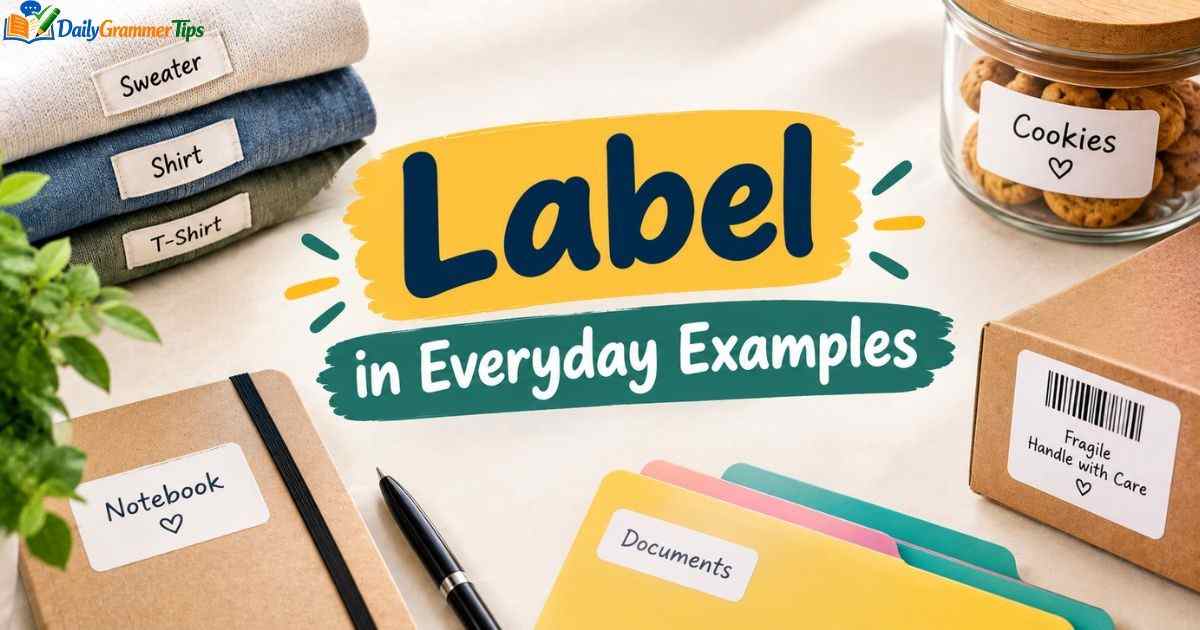
The word shows up across nearly every part of daily life:
Retail and packaging: Reading the ingredient label is essential for anyone managing allergies or dietary restrictions.
Shipping and logistics: A courier scans the barcode on a package’s label to track it through delivery.
Social contexts: People often label others based on limited information, a habit worth resisting.
Music industry: An artist might sign with an independent label rather than a major one, trading resources for creative control.
Science: Researchers use a radioactive or fluorescent label to track a substance’s movement through a system.
Fashion: A designer label on clothing often signals a premium price, tied to brand reputation rather than fabric alone.
Education and workplaces: Teachers label folders by subject, and offices label storage boxes to keep records organized and easy to locate later.
Label: Google Trends & Usage Data
Spelling confusion searches like “label or lable” behave similarly to other well known pairs such as “affect vs. effect” or “their vs. there.” Search interest for this exact query tends to stay steady year round rather than spiking seasonally, suggesting it’s an ongoing point of confusion rather than a passing trend. Interestingly, a notable share of this search traffic comes from regions where English is widely used as a second language, which lines up with how the word’s silent rhyme pattern (matching “table,” “cable,” “stable”) misleads non native spellers more often. “Label” itself is a high frequency word, appearing constantly in packaging, retail, and everyday conversation, which is exactly why the misspelling keeps resurfacing.
Keyword Comparison Table
| Search Query | Correct Form | Note |
| label or lable | label | “lable” is never correct |
| lable or label | label | Same question, reversed order |
| is lable a word | No | Not a recognized word anywhere |
| label meaning | Tag/identifier (noun); to categorize (verb) | Two related senses |
| labeled or labelled | Both correct | US = labeled, UK = labelled |
| labeling or labelling | Both correct | US = labeling, UK = labelling |
| mislabeled or mislabelled | Both correct | Same US/UK split applies |
| shipping label spelling | label | No regional variant exists |
Frequently Asked Questions
Is it label or lable in the UK?
It’s “label” everywhere, including the UK. Only the extended forms differ; the UK uses “labelled” and “labelling” with a double “l.”
Is it shipping label or lable?
“Shipping label” is correct. “Lable” is never valid, no matter what noun it’s paired with.
What does label mean?
As a noun, it’s a tag or sticker that identifies something; as a verb, it means to attach such a tag or to categorize something or someone.
Which is correct, labelled or labeled?
Both are correct; “labelled” is British/Australian English, and “labeled” is American English.
What is being labeled?
Anything that needs identification can be labeled: products, files, ingredients, samples, or even people in a social sense.
Conclusion
The rule is simple and permanent: label is correct, lable is not, anywhere, in any form of English. The confusion happens because “label” rhymes with “le” words like “table” and “cable,” but its French origin gave it an “el” ending instead. Once that mental anchor clicks (label ends like “channel” and “tunnel,” not like “table”), the mistake tends to disappear for good.
The only real flexibility in this word lies in its extended forms, where American English (labeled, labeling) and British English (labelled, labelling) part ways, and even that difference is easy to manage once you know your audience. Whether you’re writing packaging copy, a shipping form, or a school essay, getting this small detail right quietly signals careful, professional writing, and it takes just one memory trick to lock it in for good.
