


Conditionals exercises give you the fastest way to test whether you truly understand how English handles hypothetical situations. Instead of just reading rules about if clause structure, you actively apply zero, first, second, and third conditional patterns until they feel automatic. This kind of hands on practice exposes weak spots in verb tense agreement long before an exam or a real conversation does.
That gap is exactly what steady practice closes, one sentence at a time. Mixed conditionals exercises push you past textbook theory and into real, usable English you can trust under pressure. By the end, forming a counterfactual statement will feel less like translation and more like instinct.
What Are Mixed If Clauses?
English grammar usually teaches conditional clauses in four neat categories: the zero conditional for facts and general truths, the first conditional for real future possibilities, the second conditional for present or future unreal situations, and the third conditional for past events that never happened. A mixed conditional simply borrows the if clause structure from one type and the result clause from another. That is why they sound a little unusual at first: they describe a past unreal condition with a present unreal result, or the reverse.
Think about a sentence like “If I had studied medicine, I would be a doctor now.” The if clause looks back at a decision that was never made, while the main clause describes a present consequence. That blend is the heart of every mixed conditional, and it is exactly what these conditionals exercises are built to test.
Read Also: FintechZoom.com NASDAQ: Live Market Data & Analysis Guide
How Mixed Conditionals Work
Every mixed conditional pairs a condition with a result from a different time period. Two patterns show up most often.
The first pattern uses a past unreal condition with a present unreal result. The if clause takes the past perfect tense, and the main clause uses would plus the base verb. “If she had taken the job, she would live in Tokyo today” is a good example: the decision belongs to the past, but its effect is felt right now.
The second pattern flips this around. It places an ongoing or present unreal condition alongside a past unreal result, so the if clause uses the past simple tense and the main clause uses would have plus the past participle. “If he were more organized, he would have finished the report on time” shows a character trait that exists now shaping something that already happened.
Modal verbs such as would, could, and might carry most of the meaning in these sentences, and they work closely with the subjunctive mood to signal that the speaker is imagining something rather than stating a fact. Getting verb tense agreement right in both halves of the sentence is what separates a natural sounding mixed conditional from an awkward one.
If Clause and Main Clause: Condition and Result

Every conditional sentence rests on two parts: the if clause and the main clause. Together they express cause and effect grammar, where one event or state leads logically to another. Mixed conditionals often carry an emotional layer too. Many of them express past regret expressions, like wishing a different choice had been made, or they describe a present consequence of a past action, showing how an old decision still shapes life today.
Because these sentences describe imaginary situations grammar rather than real events, they rely heavily on counterfactual statements: ideas that are the opposite of what actually happened or is happening. Learning to combine tenses correctly, and recognizing the conditional markers that signal a mixed structure, is really about mastering English tense combinations rather than memorizing a formula. Once you understand the general grammar rules for conditionals, mixed sentences stop feeling like an exception and start feeling like a natural extension of what you already know.
Practice Time: Conditionals Exercises Test
Choose the correct form to complete each sentence below. The verb you need is shown in brackets.
- If she had saved more money, she would travel the world right now. (save) saved / saves / save / had saved
- If they were better organized, they would have met the deadline last week. (be) was / are / were / had been
- If he had listened to his mentor, he would run a successful business today. (listen) listened / listens / had listened / has listened
- If I spoke French fluently, I would have applied for that job in Paris. (speak) speak / spoke / had spoken / speaks
- If we had left earlier, we would be home by now. (leave) left / leaves / had left / leave
- If she were more confident, she would have spoken up in the meeting. (be) was / were / had been / is
- If he had trained harder, he would be competing at the national level today. (train) trained / trains / had trained / has trained
- If they lived closer to the city, they would have visited more often. (live) live / lived / had lived / living
- If I had listened to the weather report, I would not be soaked right now. (listen) listened / listens / had listened / listen
- If she were taller, she would have made the basketball team. (be) was / were / had been / is
- If he had invested early, he would be financially independent today. (invest) invested / invests / had invested / has invested
- If we spoke the local language, we would have avoided that misunderstanding. (speak) speak / spoke / had spoken / speaks
- If they had planned ahead, they would not be scrambling right now. (plan) planned / plans / had planned / plan
- If I were more patient, I would have handled that conversation better. (be) was / were / had been / am
- If she had finished her degree, she would be working in that field today. (finish) finished / finishes / had finished / finish
Why Practice Conditionals Exercises Online
Working through conditionals exercises online lets you check your answers instantly and repeat the patterns until they feel automatic. Mixed conditionals rarely appear in textbooks as often as the four standard types, yet native speakers use them all the time in everyday conversation, from casual regrets to serious reflections on choices. The more you expose yourself to real examples through mixed conditionals exercises, the faster your brain starts recognizing which tense belongs where.
Keep practicing a few sentences at a time rather than rushing through a long list. Grammar sticks better when you slow down and actually picture the situation each sentence describes. Come back to these conditionals exercises whenever you want a quick refresher, and soon mixing tenses across time frames will feel just as natural as using a single conditional on its own.
2020 Mixed Conditionals Exercises PDF
Learners often search for a downloadable version because a printed page is easier to mark up than a screen. A PDF also lets you carry your practice offline, whether you are on a train, in a classroom, or somewhere without reliable internet. That convenience is exactly why so many teachers hand out these conditionals exercises as printed sheets before moving to digital review.
On this site, every set of mixed conditionals exercises comes with a matching worksheet you can save and print. You get the same sentences, the same verb prompts, and the same if clause structure you would see on screen, just formatted for paper. It keeps your practice consistent whether you study online or offline.
2020 Mixed Conditionals Exercises With Answers PDF

A worksheet without answers only tells you what to practice, not whether you got it right. That is why an answer key matters so much when you are working through conditional clauses on your own, without a teacher checking your work in real time. Seeing the correct verb tense agreement next to your own answer helps you catch small mistakes before they become habits.
This site pairs its conditionals exercises with a downloadable answer sheet, so you never have to guess whether your response fits the past unreal condition or the present unreal result. You can self mark instantly, spot the patterns you keep missing, and go back to review just those specific sentences.
2020 Mixed Conditionals Exercises With Answers
Not everyone wants a file to download. Plenty of learners prefer checking their answers directly on the page, right after finishing a set of questions, without opening a separate document. That instant feedback loop makes conditionals exercises online feel more like a conversation with a tutor than a static test.
Every quiz here reveals its answers on demand, so you can attempt a full set of mixed conditionals exercises first and only check afterward, keeping the challenge honest. This approach suits learners who want to test their instinct for hypothetical situations before confirming whether their grammar held up.
Mixed Conditionals Exercises PDF
Beyond the timestamped 2020 version, plenty of learners simply want a general, undated worksheet they can reuse year after year, since the grammar rules for conditionals do not change with the calendar. A clean, well formatted PDF remains one of the most requested formats for self study and classroom handouts alike.
The mixed conditionals exercises on this page follow that same evergreen approach. Each sentence tests a real combination of tenses, from past perfect tense conditions to present unreal results, so the practice stays relevant no matter when you download it.
Mixed Conditionals Exercises With Answers PDF
Combining a printable format with a built in answer key saves learners a second search. Instead of hunting for the questions on one page and the solutions on another, everything sits together in a single, tidy download. That saves time, especially for teachers preparing a full lesson on conditional markers and tense combinations.
This site keeps its conditionals exercises and their answer keys bundled the same way, so downloading one file gives you both the practice and the confirmation you need. It also means you can hand the same sheet to a student and let them mark their own work.
Mixed Conditionals Examples
Before jumping into a quiz, many learners want to see a few clear examples first, just to get a feel for how a past unreal condition can sit beside a present unreal result in the same sentence. Real examples make abstract grammar rules for conditionals click in a way that definitions alone rarely do.
Sentences like “If she had studied law, she would be a judge today” or “If he were more careful, he would not have lost his keys” show exactly how counterfactual statements blend two different time frames. Once you see a handful of these mixed conditionals in context, the exercises on this page start to feel far more intuitive.
Mixed Conditionals 2+3 3+2 Exercises PDF
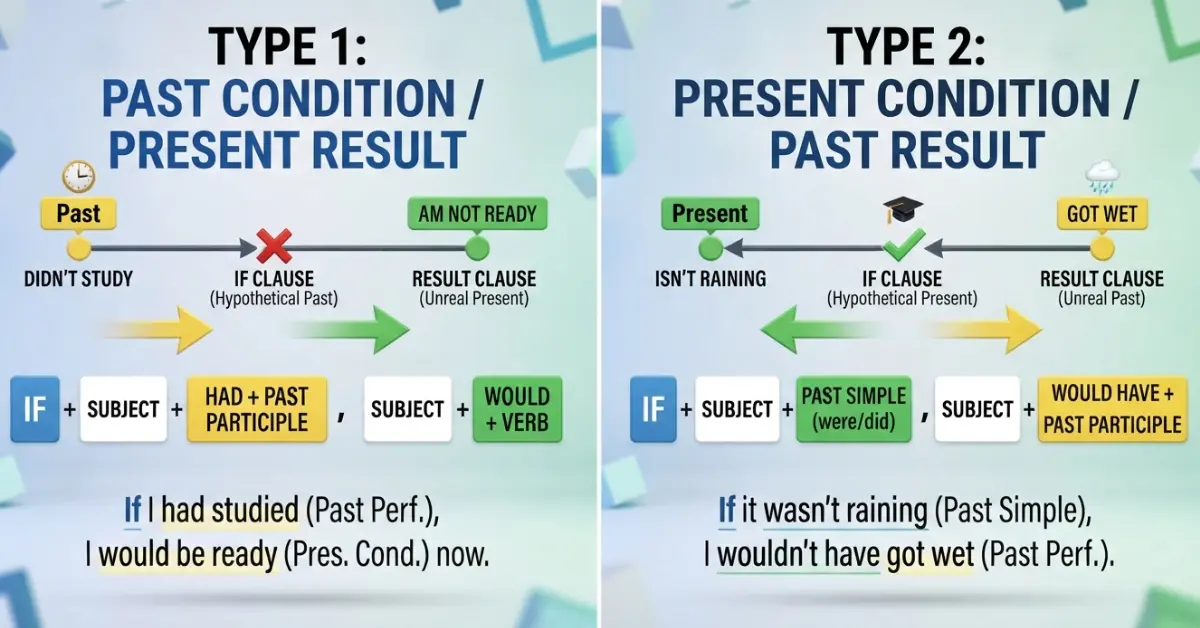
Grammar teachers often label these patterns by number, calling one version a 2+3 mix and the other a 3+2 mix, based on which conditional type supplies the if clause and which supplies the main clause. That shorthand helps learners quickly identify whether a sentence describes a present condition with a past result, or the other way around.
The practice sentences in this article cover both directions, even though they are not labeled by number. Working through a full set of mixed conditionals exercises naturally trains you to recognize both patterns without needing to memorize the numbering system at all.
2020 Mixed Conditionals Exercises Multiple Choice
Multiple choice questions remove the pressure of producing an answer from scratch and instead ask you to recognize the correct form among a few options. That format works especially well for testing verb tense agreement, since seeing the wrong choices next to the right one makes the difference between them much clearer.
The conditionals exercises above follow this exact multiple choice style, listing several verb forms under each sentence so you can pick the one that fits the if clause structure correctly. It is a quick way to test yourself without writing full sentences every time.
Frequently Asked Questions
Is “if I was” or “if I were” correct in a mixed conditional?
“If I were” is the grammatically correct form in formal writing, even for singular subjects. “If I was” shows up in casual speech but sounds less polished.
Can I start a mixed conditional with the main clause instead of the if clause?
Yes, you can flip the order without changing the meaning. Just make sure you drop the comma when the if clause comes second.
Do mixed conditionals always need “would”?
Not always. You can also use could or might depending on how certain or possible the result feels.
How many types of mixed conditionals are there?
Grammar teachers usually recognize two main types: past condition with present result, and present condition with past result.
Are mixed conditionals tested in exams like IELTS or TOEFL?
Yes, they often appear in speaking and writing sections since they show a learner’s control over complex tense combinations.
Conclusion
Mixed conditionals feel tricky at first because they ask you to hold two different time frames in your head at once, but they follow a logic you can actually learn, not just memorize. Once you understand how a past unreal condition can shape a present result, or how a present situation can explain a past outcome, the grammar stops feeling random and starts feeling like a tool you can reach for whenever you want to describe regret, consequence, or an imagined version of events.
Real progress comes from steady practice rather than a single read through. Return to these conditionals exercises whenever you want to sharpen your instinct for tense combinations, check your answers honestly, and notice which patterns still slow you down. With enough repetition, forming a mixed conditional will feel as natural as any other sentence you speak.
