

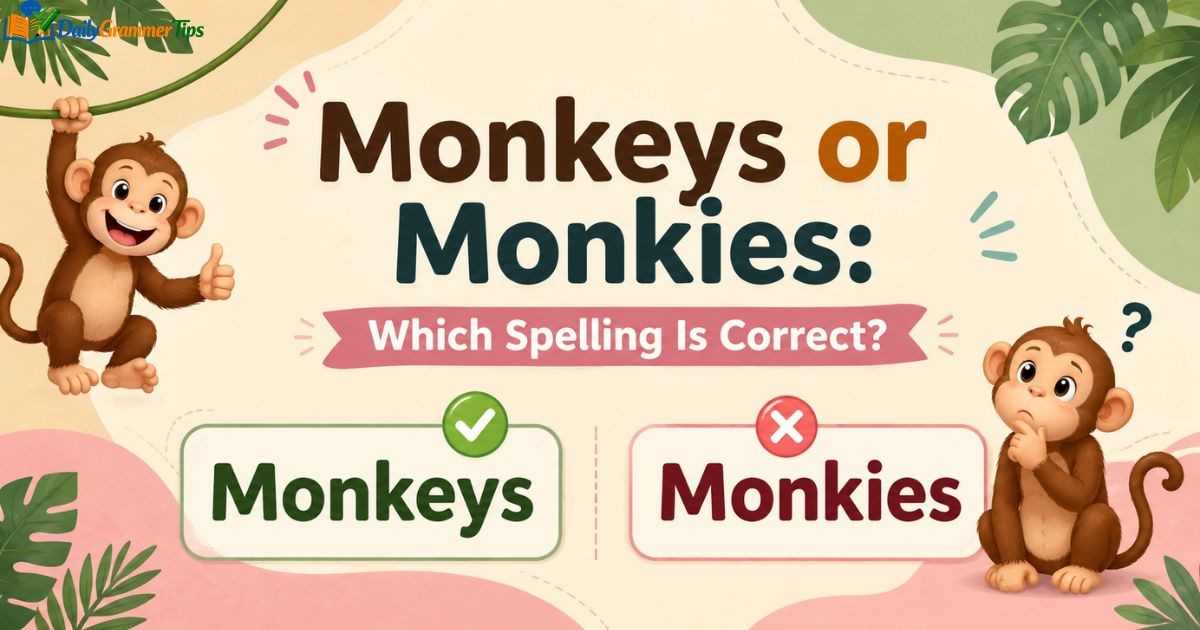
If you have ever stopped while writing and wondered, Monkeys or Monkies, you are not alone. The two forms look surprisingly similar, especially because English has several nouns that change a final y to ies when they become plural. However, the correct spelling follows a simple grammar pattern. The correct form is monkeys, while monkies is an incorrect spelling in standard English. Understanding the letters before the final y makes the difference much easier to remember.
The question of Monkeys or Monkies often appears in schoolwork, online writing, animal descriptions, social media posts, and everyday English. The confusion usually comes from applying the y to ies rule too broadly. Words such as baby, city, and party become babies, cities, and parties, but monkey belongs to a different group. Because the letter before the final y is a vowel, the plural is formed by adding s. Once you understand that pattern, the spelling becomes straightforward.
Monkeys or Monkies: Quick Answer
The correct answer is monkeys. The form monkies is an incorrect spelling in modern standard English. When you need the plural form of monkey, simply keep the original spelling and add s.
Correct: We saw several monkeys at the zoo.
Incorrect: We saw several monkies at the zoo.
The question of Monkeys or Monkies has a clear answer because monkey ends with ey. The e is a vowel, and the y remains unchanged when the noun becomes plural. Therefore, monkey becomes monkeys.This pattern is useful beyond one animal name. English uses different plural rules depending on the letter that comes before a final y. Recognizing that pattern can prevent many common spelling mistakes.
Is It Spelled Monkeys or Monkies?
When deciding between Monkeys or Monkies, look closely at the singular noun first. The singular form is monkey. Its final two letters are e and y. Since e is a vowel, the plural is created by adding s rather than changing y into ies.
The spelling of monkeys therefore keeps every letter from the singular form:
monkey + s = monkeys
There is no need to remove the y, replace it with i, or add es. The word simply receives the regular plural ending s.The confusion happens because English also has many words ending in consonant plus y. For example, baby becomes babies and city becomes cities. In those cases, the y changes to i before es is added. That rule does not apply to monkey.
When comparing Monkeys or Monkies, the easiest method is to inspect the letter directly before y. If that letter is a vowel, normally add s. If it is a consonant, the y often changes to ies.
The Origin of Monkeys or Monkies
The word monkey has a long history in the English language, and older English spelling could be much less standardized than modern spelling. Historical texts sometimes contain spellings that look unusual to modern readers. Such historical variations do not determine the spelling used in contemporary standard English.
Today, monkeys is the established plural form. Modern dictionaries, educational resources, and edited English use monkeys when referring to more than one monkey. The form monkies may occasionally appear because someone has made a spelling mistake, but that does not make it a standard plural form.
Understanding the history also helps explain why old examples should not automatically be copied into modern writing. English spelling has developed over centuries, and many older forms disappeared as spelling conventions became more consistent.The important point for everyday writing is simple. When the singular noun is monkey, the standard plural is monkeys. The historical background may be interesting, but it does not change the modern rule.
British English vs American English Spelling
Some spelling differences between British English and American English are well known. Examples include colour and color, organise and organize, and centre and center. That can make learners wonder whether Monkeys or Monkies might also depend on regional English.
It does not. British English uses monkeys, and American English also uses monkeys. The same spelling applies in standard Australian English and other major varieties of English.
| Variety of English | Standard plural | Incorrect form |
| British English | monkeys | monkies |
| American English | monkeys | monkies |
| Australian English | monkeys | monkies |
| General standard English | monkeys | monkies |
So, the spelling of monkeys does not change according to the English speaking country. If you are writing for a British audience, use monkeys. If your audience uses American English, use monkeys as well.
Which Spelling Should You Use?

Always use monkeys when you mean more than one monkey. The word works naturally in formal and informal writing, including school assignments, essays, reports, articles, stories, captions, and everyday messages.
A simple sentence can demonstrate the correct usage:
The monkeys climbed the trees.
Here, monkeys is a plural noun because the sentence refers to more than one animal.
If you are writing about wildlife, you may use monkeys when discussing several species, groups, populations, or individual animals. For example, researchers may observe monkeys in a forest, while tourists may watch monkeys near a protected area.The form monkies should not replace monkeys simply because it looks familiar. If a spelling checker highlights the word, check the singular form and apply the correct plural rule. Learning the pattern is more useful than memorizing one isolated word.
Why Is It Monkeys and Not Monkies?
The answer becomes easy once you understand the difference between vowel plus y and consonant plus y. Monkey ends in ey. The e is a vowel, so the y stays in place when the plural ending is added.
That gives us:
monkey → monkeys
Compare that with:
baby → babies
city → cities
party → parties
The difference is the letter before y. In baby, the letter before y is b, a consonant. In city, it is t, also a consonant. In monkey, the letter before y is e, a vowel.This small spelling detail controls the plural formation. That is why the correct spelling of monkeys contains y followed by s rather than i followed by e and s.
Why “monkeys” ends in a y and s letter
The final part of monkey is ey. Because the y follows a vowel, English normally preserves the y when forming the plural. The plural ending s is then attached directly to the existing word.This gives monkey, monkeys, and the pronunciation remains closely connected to the singular form. Replacing y with ies would incorrectly treat monkey as though it belonged to the consonant plus y group.
Other examples follow the same pattern:
key → keys
donkey → donkeys
journey → journeys
turkey → turkeys
chimney → chimneys
valley → valleys
These examples make the rule easier to recognize. When a noun ends with vowel plus y, adding s is generally the correct plural pattern.
Why is the plural of monkey monkeys and not monkies?
The plural of monkey is monkeys because the y is preceded by e. The letter e is a vowel, so the noun follows the vowel plus y pattern.A useful comparison is baby and monkey. Baby becomes babies because b is a consonant. Monkey becomes monkeys because e is a vowel.
This distinction is one of the most important English spelling rules involving words ending in y. The rule is not simply “words ending in y become ies.” Instead, you must check the letter immediately before y.That explains the entire difference between Monkeys or Monkies. The spelling monkies incorrectly applies the consonant plus y pattern to a word that actually ends in vowel plus y.
Monkeys or Monkies Plural
When someone asks about Monkeys or Monkies plural, the answer is monkeys. The singular noun is monkey, and the plural noun is monkeys.
The plural form does not require any spelling change inside the original word. Simply add s:
One monkey.
Two monkeys.
Many monkeys.
Several monkeys.
A group of monkeys.
The same principle applies when monkeys appears after numbers or quantity words. You can say five monkeys, many monkeys, several monkeys, or different types of monkeys.Remembering the plural of monkey becomes easier when you treat monkey as part of a larger group of vowel plus y words. The pattern is not unusual. It appears in words such as key, donkey, journey, and turkey.
Learn more…….Historic vs. Historical | When to Use Each
Why Is It Monkeys and Not Monkies
The most common reason for the confusion is an incomplete understanding of plural rules. Many English learners first learn that nouns ending in y often change y to ies. That information is useful, but it needs an important condition.
The y to ies rule usually applies when a consonant comes immediately before y.
Examples include:
baby → babies
city → cities
country → countries
family → families
But when a vowel comes before y, the normal pattern is to add s:
key → keys
boy → boys
toy → toys
day → days
monkey → monkeys
The letter e in monkey is therefore the key to the answer. Checking that single letter can help you avoid the spelling mistake.
Monkeys or Monkies Meaning
The word monkey refers to a type of primate. Monkeys are animals that belong to the broader primate group and are found in many parts of the world. Depending on the species, they may live in forests, grasslands, mountains, or other environments.When we use monkeys, we are referring to more than one monkey. For example, “The monkeys were moving through the trees” describes multiple animals.
The difference between Monkeys or Monkies is therefore not a difference in meaning. Monkeys is the correct plural spelling, while monkies is an incorrect spelling of the same intended plural word.You may see monkeys used in discussions about monkey species, wildlife, animal behaviour, habitats, conservation, and population changes. The spelling remains the same regardless of the topic.
Plural of Monkey and Donkey
Monkey and donkey are useful words to compare because they follow the same plural pattern. Both end in vowel plus y, so both take s in the plural.
Monkey → monkeys
Donkey → donkeys
This comparison provides an easy memory aid. If you already know that donkey becomes donkeys, you can use the same pattern for monkey.
Other related examples include:
Turkey → turkeys
Chimney → chimneys
Journey → journeys
Trolley → trolleys
Attorney → attorneys
These words show why the spelling of monkeys follows a consistent English grammar pattern. The final y does not automatically mean that the noun should receive ies.
Monkey Plural
The monkey plural is monkeys. It is a regular plural noun and follows a predictable spelling pattern.
You can use the word in many different sentence structures:
The monkeys are eating fruit.
Several monkeys live in the forest.
We watched the monkeys from a safe distance.
Young monkeys often stay close to their mothers.
Scientists study different monkey species.
In each example, monkeys refers to more than one animal. The singular form remains monkey.
A common spelling mistake occurs when writers remember only the general idea that y sometimes changes to ies. Checking the preceding letter solves the problem immediately.
Monkeys or Monkies Funny
The confusion around Monkeys or Monkies can sometimes produce funny spelling situations. A person may confidently write monkies because the form appears to follow the same pattern as babies or puppies. The mistake becomes noticeable only when someone checks the rule.
For example, imagine a sentence saying:
“The monkies were playing in the trees.”
The intended meaning is understandable, but the spelling is still incorrect. The correct sentence is:
“The monkeys were playing in the trees.”
The funny part is that English has enough exceptions and patterns to make simple words surprisingly confusing. The solution is not to rely on how a word looks. Instead, identify the spelling pattern behind it.
Once you learn why monkey becomes monkeys, the mistake becomes much less likely.
Is Monkies a Word?

In standard modern English, monkies is not the correct plural spelling of monkey. It is generally encountered as an incorrect spelling rather than as the accepted plural noun.
This means that if you are writing an essay, article, school assignment, professional document, or formal message, you should use monkeys.
You may encounter monkies online because people make spelling mistakes, type quickly, or are unsure about English plural rules. An incorrect form appearing on a website does not automatically make it a valid standard word.
For language learners, the safest approach is to remember the standard form and use it consistently. If you are unsure, check a reliable dictionary and compare the singular and plural entries.
Plural of Monkey in British English
The plural of monkey in British English is monkeys. There is no special British form that changes the spelling to monkies.
British English follows the same vowel plus y pattern:
monkey → monkeys
The same rule applies to other words such as donkey, journey, and turkey.
This is useful for learners because they do not need to memorize separate British and American spellings for this noun. Whether the writing is intended for London, Manchester, New York, Toronto, Sydney, or another English speaking audience, monkeys remains the standard plural.
Common Mistakes with Monkeys or Monkies
Several mistakes can lead writers toward the incorrect form. The first is applying the y to ies rule without checking the preceding letter. Remembering only half of a grammar rule can create more errors than it prevents.
The second mistake is comparing monkey with words such as baby and city. Those nouns look similar because they end in y, but their preceding letters are consonants. Monkey belongs to the vowel plus y group.
The third mistake is relying completely on visual memory. Because monkies looks familiar, a writer may accept it without checking. Reading the singular form aloud and examining the final two letters can help.
The fourth mistake is assuming that regional English changes the plural. It does not. Both British and American English use monkeys.
A final mistake is thinking that a spelling mistake becomes correct because it appears frequently online. Search results can contain user generated content, comments, unedited pages, and typing errors. Standard English rules remain the better guide.
Monkeys or Monkies in Everyday Examples
Seeing the correct form in different contexts can make the rule easier to remember.
Academic writing:
Researchers observed several monkeys during the study.
Wildlife writing:
The protected area provides a suitable habitat for several monkey species.
Everyday conversation:
The monkeys at the zoo were very active.
Children’s writing:
The little monkeys climbed from one branch to another.
News writing:
Officials rescued several monkeys from the damaged facility.
Travel writing:
Visitors often see monkeys near the forest entrance.
Scientific discussion:
Different types of monkeys have different diets and social behaviours.
In each example, monkeys is used because the sentence refers to multiple animals. The spelling remains unchanged regardless of whether the context is formal, casual, scientific, educational, or creative.
Monkeys or Monkies: Comparison Table
| Question | Correct answer |
| Monkeys or Monkies? | Monkeys |
| What is the singular? | Monkey |
| What is the plural? | Monkeys |
| Is monkies correct? | No |
| Why does monkey take s? | It ends in vowel plus y |
| Does British English use monkeys? | Yes |
| Does American English use monkeys? | Yes |
| Does y change to i? | No |
| What is the related word donkey plural? | Donkeys |
| What spelling should learners use? | Monkeys |
The table shows that the answer is consistent across the main questions. The most important detail is the letter e before the final y.
Monkeys or Monkies in Grammar
From an English grammar perspective, monkey is a singular countable noun. When the noun refers to more than one animal, it takes the regular plural ending s.
For example:
One monkey is sitting on the branch.
Three monkeys are sitting on the branches.
The singular and plural forms therefore have a clear grammatical relationship. Monkey identifies one animal, while monkeys identifies multiple animals.
This is why the plural form does not require an unusual spelling transformation. The noun simply takes the regular plural suffix.
Understanding the grammatical category also helps with sentence agreement. A singular subject takes a singular verb, while a plural subject takes a plural verb.
The monkey is eating.
The monkeys are eating.
The spelling and grammar work together to show whether the sentence refers to one animal or several.
Monkey or Monkeys
Monkey and monkeys are both correct words, but they serve different grammatical purposes. Monkey is singular, while monkeys is plural.
Use monkey when referring to one:
A monkey climbed the tree.
Use monkeys when referring to more than one:
Several monkeys climbed the trees.The choice between them depends on quantity. The question of Monkeys or Monkies is different because monkies is not the standard plural form.
This distinction is especially useful for beginner English learning. First identify whether the noun is singular or plural. Then apply the appropriate spelling rule.
Difference Between Monkeys and Monkies
There is no difference in meaning between the intended uses of monkeys and monkies. The real difference is correctness.
Monkeys is the standard plural form.
Monkies is an incorrect spelling.
The reason is based on word formation. Monkey ends in vowel plus y, so the plural is created by adding s. Words ending in consonant plus y often use ies instead.This simple distinction explains why the two spellings should not be treated as alternatives. Only monkeys should be used in standard written English.
How to Remember the Correct Spelling
A quick memory trick can make the rule easier.
Look at the final two letters of monkey: ey.
Because e is a vowel, keep y and add s.
You can remember it as:
Vowel plus y means add s.
Consonant plus y usually means change y to ies.
Then compare:
monkey → monkeys
baby → babies
donkey → donkeys
city → cities
This comparison helps reinforce the pattern instead of requiring you to memorize monkeys as an isolated spelling.
Frequently Asked Questions
Is banana an uncountable noun?
No. Banana is normally a countable noun. You can say one banana, two bananas, or several bananas, depending on the quantity.
What is the plural of monkey?
The plural of monkey is monkeys. The noun ends in vowel plus y, so you add s without changing the y.
Are monkeys animals?
Yes. Monkeys are animals and belong to the primate group. Different monkey species live in a variety of habitats around the world.
Is it monkeys or monkeys?
The correct form is monkeys. Both forms shown in the question are spelled the same, so there is no spelling difference between them.
Is a monkey countable?
Yes. Monkey is a countable noun because you can refer to one monkey, two monkeys, several monkeys, or many monkeys.
Conclusion
The answer to Monkeys or Monkies is simple: monkeys is correct, while monkies is incorrect in standard English. The spelling follows the vowel plus y plural rule. Because the letter before y in monkey is e, the y remains unchanged and the plural ending s is added.The easiest way to remember the rule is to avoid assuming that every word ending in y changes to ies. Check the letter immediately before y.
The spelling of monkeys becomes much easier once the underlying grammar rule is clear. Whether you are writing about wild animals, primates, cute monkeys, baby monkeys, monkey species, or everyday animal vocabulary, use monkeys when you mean more than one monkey.Monkies may look plausible because words such as babies and cities use ies, but the spelling pattern is different.
