

Many writers pause mid sentence and wonder whether to type occasion or ocassion. This hesitation happens to native speakers, students, and professional writers alike, usually because of how the word sounds when spoken quickly. The good news is that the occasion or ocassion confusion has one simple, permanent answer.
This guide covers every angle of the occasion or ocassion debate, including the meaning, the pronunciation, the plural form, the background in other languages, and how the word behaves in legal writing. By the end, occasion or ocassion will never trip you up again.
Occasion or Ocassion: Quick Answer
The correct spelling is occasion. Ocassion is a misspelling that appears in no recognized dictionary, so between occasion or ocassion, only one version passes as real English. The accepted word carries two letters c and a single letter s, and people often flip this pattern by mistake.
| Spelling | Correct | Quick Note |
| Occasion | Yes | Standard spelling across all English dialects |
| Ocassion | No | Common typing error with no dictionary listing |
A simple trick settles the occasion or ocassion question for good. Remember double c, single s, and the occasion or ocassion confusion disappears almost instantly.
Occasion or Ocassion: What’s the Difference?
There is no real difference in meaning between these two forms, because only one qualifies as an actual word. Occasion describes a specific event, moment, or reason behind something happening. Ocassion carries no meaning at all since it simply misplaces the doubled letter.
The mistake usually comes from how quickly people speak the word. The sound blends the middle letters, so many writers guess the s doubles instead of the c. Seeing the occasion or ocassion pair side by side makes the correct pattern easy to remember.
A few quick pointers make the difference obvious.
- The doubling always happens right after the letter o
- Ocassion places the extra letter in the wrong spot
- Dictionaries and grammar guides only recognize occasion
Once this pattern locks into memory, the occasion or ocassion mix up rarely happens again.
Is Occasion or Ocassion a Grammar, Vocabulary, or Usage Issue?
The occasion or ocassion confusion sits entirely inside spelling, not grammar. Both words would occupy the same spot in a sentence if ocassion were real, yet the problem never touches sentence structure. Writers sometimes assume a spelling slip reflects a grammar weakness, but the occasion or ocassion debate is strictly about letters, not sentence construction.
Are They Interchangeable?
No, these two forms never substitute for each other. Only occasion carries accepted meaning in English. Anyone who writes ocassion in a resume or professional email risks looking careless, since readers and spell checkers will flag the occasion or ocassion error instantly.
Formal vs Informal Usage
Formal writing such as legal documents, academic papers, and business reports demands flawless spelling. A slip like ocassion inside a formal document can undercut your credibility, which is why the occasion or ocassion choice matters most in professional settings.
Casual writing, including texts and social posts, tolerates small errors more easily. Even so, practicing the correct spelling everywhere builds a habit that protects you when formal situations arrive.
Academic vs Casual Writing
Academic writing rewards precision, and a spelling slip can affect how a grader perceives your work. Casual writing forgives more, but repeating the wrong pattern can become a habit that surfaces at the worst time.
Understanding the Word “Occasion”
Occasion works mainly as a noun describing a particular time, event, or set of circumstances, often one that carries importance. It can also function as a verb meaning to bring about or cause something. Anyone researching occasion or ocassion should start with this core meaning before moving to spelling rules.
Occasion Meaning
At its core, occasion refers to a specific moment or event, frequently one worth remembering. It can also point toward a reason for something, an opportunity to act, or a celebration marked by tradition. Writers use the word in business updates, wedding invitations, court documents, and casual conversation without ever changing its spelling.
Workplace Example
“The quarterly review gives us a strong occasion to introduce the new marketing plan.” Here, occasion points toward a suitable moment for a professional task.
Academic Example
“Students should adopt formal language on the occasion of a thesis defense.” In academic settings, occasion often signals a formal moment.
Technology Example
“On occasion, the update forces a full system restart.” This phrase means from time to time.
Everyday Example
“We save the nice dishes for special occasions, like birthdays and anniversaries.” This points toward celebratory events families mark together.
Learn more………..Forest or Forrest: Which Spelling Is Correct?
Occasion Pronunciation
Occasion is pronounced uh KAY zhun, with stress on the second syllable. The letters ssi produce a soft zh sound, similar to the middle of vision. Many learners misspell the word because this blended sound hides which letter doubles. Breaking the word into three parts while speaking helps lock in the spelling too, and once the rhythm of oc CA sion feels natural, the occasion or ocassion mistake becomes far less likely.
Occasion Plural
The plural form of occasion is occasions, formed simply by adding an s. English speakers use the plural constantly in phrases such as special occasions and rare occasions. No spelling shift happens between the singular and plural forms, so the double c pattern stays exactly the same, which keeps the occasion or ocassion rule easy to apply.
Occasion Examples
Seeing the word inside full sentences often helps more than any rule. A few natural examples include the following.
- This dress feels perfect for a formal occasion.
- There is no occasion for such harsh criticism.
- The award ceremony was a memorable occasion for everyone involved.
- He rarely drinks, except on special occasions.
Each example keeps the same spelling and simply shifts the surrounding context, which shows how the occasion or ocassion rule stays constant across styles.
Occasion in a Sentence
Building strong sentences with occasion becomes easy once you recognize common patterns like on this occasion, for the occasion, or a fitting occasion. A short sample might read, “On this occasion, the committee decided to postpone the vote.” Practicing patterns like this removes any lingering doubt about occasion or ocassion.
Why “Ocassion” Is Incorrect
Ocassion breaks the standard spelling pattern that traces back to the word’s Latin roots, which call for a doubled c rather than a doubled s. No dictionary lists ocassion as an accepted variant, so anyone weighing occasion or ocassion will find that only one choice survives a check.
A few reasons explain why this error spreads so widely.
- The blended pronunciation hides which letter should double
- Similar words such as passion, mission, and session double the s instead
- Fast typing and weak autocorrect settings sometimes miss the error
Spell checkers and grammar tools almost always flag ocassion, which confirms it has no place in professional writing.
British English vs American English Spelling
Unlike words that shift between British and American spelling, such as colour versus color, occasion keeps one identical spelling across every major dialect, which removes one layer from the occasion or ocassion debate.
Comparison Table
| Region | Correct Spelling | Note |
| American English | Occasion | Standard spelling |
| British English | Occasion | Identical to American spelling |
| Australian English | Occasion | Follows the same pattern |
| Canadian English | Occasion | Matches both major dialects |
This consistency makes the word easier to master since writers never adjust spelling for a different audience.
Which Spelling Should You Use?
The answer stays consistent everywhere. Always choose occasion, since no style guide or regional dialect accepts the occasion or ocassion alternative as legitimate.
Business Writing
Emails, proposals, and reports all benefit from correct spelling, since attention to detail shapes how clients view your professionalism. Getting the occasion or ocassion choice right in a client email protects your credibility.
Academic Writing
Universities and journals expect flawless spelling throughout every submission. A misspelled word such as ocassion inside a research paper can distract readers and affect grading, so the occasion or ocassion choice deserves a final proofread pass.
Online Content & SEO
Bloggers and content writers should treat spelling accuracy as part of their SEO strategy. Search engines and readers both connect correct spelling with quality and authority.
International English
Since occasion never changes across dialects, it remains a safe, universal choice for global audiences and translators producing content for multiple markets.
Occasion Meaning in Law
Legal writing uses occasion in a narrower, more technical sense than everyday speech. Courts sometimes reference the occasion of an event when determining liability or the circumstances around a dispute, and insurance contracts often use phrases such as occasion of loss. Because legal documents demand exact language, getting occasion or ocassion right matters even more here.
Common Mistakes and Decision Rules
Most spelling errors here follow a small set of repeating patterns. Knowing these patterns, and applying one quick mental check, makes the correct choice between occasion or ocassion automatic.
Mistake 1: Swapping the “a” and “s”
Many writers accidentally double the s instead of the c, producing ocassion by mistake. Remembering that the double letter falls early, right after the o, solves this quickly.
Mistake 2: Misspelling Related Words (Occasional, Occasionally)
The error rarely stops at the base word. Writers also misspell related forms.
- Ocassional instead of occasional
- Ocassionally instead of occasionally
- Ocasion instead of occasion
Every related form keeps the same double c, single s pattern found in the root word.
Decision Rule
A short mental checklist settles the occasion or ocassion question whenever doubt creeps in.
- Does the word contain two letters c? If not, it is wrong.
- Does the word contain only one letter s? Two signals an error.
- Say the word slowly as oc CA sion. The stress hints that the doubling happens there.
Occasion in Everyday Examples
Emails
“Thank you for joining us on this special occasion to celebrate ten years in business.”
News Articles
“On the occasion of the town’s founding anniversary, officials opened a new public park.”
Social Media
“Finally dressed up for a rare occasion, and date night did not disappoint.”
Formal Writing
“The board convened on the occasion of the annual shareholders meeting to review results.” Across every format, the spelling never shifts, only the tone and audience change.
Occasion in Modern Technology and AI Tools
Spell checkers and tools such as Grammarly almost always catch ocassion and suggest the correct form. This helps, but understanding the occasion or ocassion rule yourself keeps writing accurate in tools without spell check support. Modern AI writing assistants are trained to consistently produce occasion rather than ocassion, reinforcing it as the standardized choice everywhere.
The Origin and History of “Occasion”
The word occasion traces back to the Latin term occasio, meaning opportunity, itself rooted in occidere, a blend of ob meaning toward and cadere meaning to fall. That idea of something falling toward a moment evolved into today’s meaning of a specific event. This history explains why occasion or ocassion is not really a fair fight, since only one form respects the word’s ancestry. The word entered Middle English through Old French, keeping its Latin influenced double c spelling ever since.
Occasion in French
French still uses the word occasion today, and it carries a slightly broader meaning than in English. Beyond describing an event, the French word often refers to a bargain or secondhand item, as in the phrase une bonne occasion. Shoppers across France see the word on car listings and thrift store signs, and this shared root is part of why the occasion or ocassion spelling has stayed stable across centuries of change.
Occasion Synonyms
Writers looking for variety can rely on several close synonyms depending on context, including event, occurrence, incident, moment, opportunity, circumstance, and celebration. Event suits formal writing, moment feels casual, and celebration works when the occasion involves a milestone. Rotating between options keeps writing fresh while avoiding the occasion or ocassion trap entirely.
Occasion or Ocassion: Google Trends & Usage Data
Search data consistently shows that far more people search for the correct spelling than for ocassion. Even so, ocassion still generates noticeable traffic, largely from people typing it incorrectly and then searching for a correction.
This pattern shows up often with commonly misspelled words, and the incorrect version sometimes appears inside autocomplete simply because so many people type it that way. For content creators, acknowledging both occasion or ocassion inside an article helps readers land on accurate information regardless of which version they typed.
Comparison Table: Occasion vs Ocassion
| Feature | Occasion | Ocassion |
| Correct spelling | Yes | No |
| Found in dictionaries | Yes | No |
| Accepted in formal writing | Yes | Never |
| Recognized by spell checkers | Yes | Flagged as an error |
| Regional spelling differences | None | Not applicable |
| Appears in search queries | Yes | Yes, mostly due to typing errors |
Similar Commonly Misspelled English Words
Occasion is far from alone when it comes to tricky double letter patterns. A few similar examples include the following.
- Accommodate, not acomodate, with a double c and double m
- Definitely, not definately, often misspelled due to pronunciation
- Separate, not seperate, where the a gets swapped for an e
- Necessary, not neccessary, with one c and two s letters
- Embarrass, not embarass, featuring a double r and double s
Interestingly, necessary follows the opposite doubling pattern from occasion, which is part of why writers confuse both words together.
How to Remember the Correct Spelling of “Occasion”
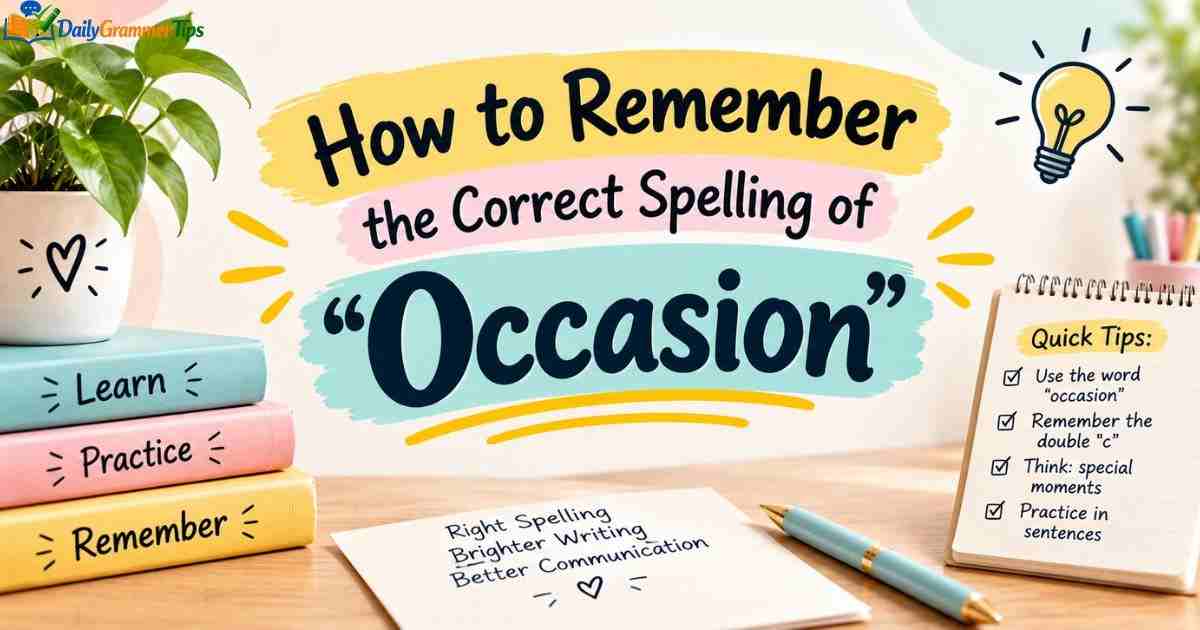
A handful of memory tricks make the correct spelling permanent. Breaking the word into syllables as oc CA sion highlights the stress near the doubled c, and comparing it with necessary, which doubles the s instead, creates a useful mirror image. Practicing related forms such as occasional and occasionally reinforces the same pattern until it becomes automatic, and with a little repetition, the occasion or ocassion question stops being a question at all.
Frequently Asked Questions
What does “occasion” mean?
Occasion refers to a particular event, time, reason, or opportunity. It sometimes describes a special or celebratory moment worth remembering, which is why the occasion or ocassion question comes up so often in writing.
Which is the correct spelling: “occasionally” or “occasionally”?
The correct spelling is occasionally, written with a double c and a single s, matching the pattern found in occasion.
How do British people say occasion?
British speakers pronounce it the same way as American speakers, roughly uh KAY zhun, with stress on the second syllable.
What’s the correct spelling for occasion?
The correct spelling is occasion, with two letters c and one letter s. Between occasion or ocassion, only the first option is ever correct.
Is “occasional” spelled correctly?
Yes, occasional is the correct spelling, following the same double c, single s pattern as its root word occasion.
Conclusion
The debate between occasion or ocassion has one clear answer. Occasion is correct, and ocassion is always a mistake. The confusion makes sense given how the word sounds out loud, but remembering the double c, single s pattern removes any lingering doubt.
You write a business email, a legal document, a school essay, or a social media caption, choosing the correct spelling reflects care and professionalism. Keep this guide close by, and the occasion or ocassion mix up will never slow down your writing again.
