


Language is constantly evolving, and English is one of the best examples of a language shaped by history, geography, and culture. One of the most common sources of confusion for English speakers around the world is the difference between American and British spelling. A perfect example is the word “optimize” and its alternative spelling “optimise.” Both forms are widely used, both are understood, and both are considered correct depending on the variety of English being used.
The difference between “optimize” and “optimise” is not about meaning. Both words describe the process of making something as effective, efficient, or successful as possible. The only difference is the spelling convention followed by different English-speaking regions.
Understanding when to use “optimize” and when to use “optimise” can help writers communicate more clearly, especially in professional writing, academic work, software documentation, marketing, and international communication.
The Meaning of Optimize and Optimise
The words optimize and optimise come from the same root word: optimal, which means the best possible or most effective condition. When something is optimized, it has been improved to achieve the best result.
For example:
- A company may optimize its website to improve user experience.
- A programmer may optimize code to make an application run faster.
- A student may optimize their study schedule to improve productivity.
- A business may optimise its resources to reduce waste.
The pronunciation and meaning remain the same regardless of whether the word is spelled with a “z” or an “s.” The difference is simply a regional spelling preference.
Read Also: 20+ Other Ways to Say “Thank You for Your Generosity” (With Examples)
Optimize: The American English Spelling

Optimize is the preferred spelling in American English. In the United States, words ending in “-ize” are generally favored over “-ise” forms.
Examples include:
- Optimize
- Organize
- Realize
- Recognize
- Analyze
American English commonly uses the letter combination “-ize” because it reflects the original Greek influence behind many of these words. The suffix comes from the Greek ending “-izein,” which means “to make” or “to become.”
For example, “optimize” originally carries the idea of making something optimal or bringing it closer to the best possible state.
American companies, universities, software developers, and publications typically use “optimize.” If you are writing for an American audience, using “optimize” is the safest choice.
Examples:
- “We need to optimize our website for search engines.”
- “The engineers optimized the system to improve performance.”
- “The application has been optimized for mobile devices.”
Optimise: The British English Spelling
Optimise is the preferred spelling in British English and is also common in many countries influenced by British English, including Australia, New Zealand, India, and South Africa.
British English often uses “-ise” endings in many words where American English uses “-ize.”
Examples include:
- Optimise
- Organise
- Realise
- Recognise
- Analyse
However, it is important to note that British English does not always avoid “-ize.” Some British dictionaries accept both forms, and many British publishers use “-ize” endings because they are closer to the historical origin of these words.
Still, “optimise” remains a very common and accepted spelling in British English writing.
Examples:
- “Businesses must optimise their websites for international customers.”
- “The team optimised the software to improve efficiency.”
- “The company aims to optimise energy consumption.”
Why Are There Two Spellings?
The existence of “optimize” and “optimise” is the result of the historical development of English. English has always borrowed words from other languages and adapted them over time.
Many words ending in “-ize” come from Greek roots. When these words entered English, different regions developed different spelling preferences. American English generally standardized the “-ize” form, while British English increasingly adopted “-ise” in many cases.
The differences between American and British spelling became more noticeable in the 18th and 19th centuries. American dictionaries, especially those influenced by lexicographer Noah Webster, encouraged simplified spelling patterns. Webster promoted spelling reforms that helped create a distinct American style of English.
Some examples of American and British spelling differences include:
- Color vs Colour
- Center vs Centre
- Analyze vs Analyse
- Optimize vs Optimise
Neither version is more correct universally. They are simply different standards within the English language.
Which Spelling Should You Use?

The correct spelling depends mainly on your audience and the style of English you are following.
Use “Optimize” When:
You should choose optimize if:
- You are writing for an American audience.
- Your organization follows American English standards.
- You are creating software, technical documentation, or marketing content for the US market.
- You are following American style guides.
Examples:
- “Optimize your website speed.”
- “Optimize database performance.”
- “Search engines reward optimized content.”
Use “Optimise” When:
You should choose optimise if:
- You are writing for British English readers.
- Your organization follows UK spelling conventions.
- You are publishing content in countries that commonly use British English.
- You are following British academic or professional standards.
Examples:
- “Optimise your workflow.”
- “Optimise your digital strategy.”
- “The system has been optimised successfully.”
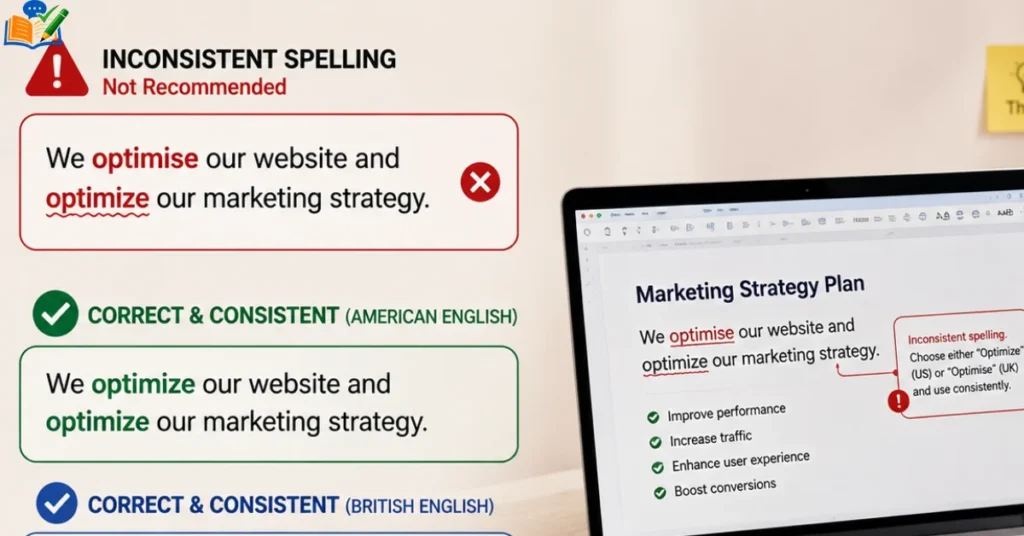
The most important rule is consistency. Mixing American and British spelling in the same document can look unprofessional.
For example, writing:
“Optimize your website and analyse your traffic data”
combines American “optimize” with British “analyse.” While readers will understand the meaning, maintaining one spelling style creates a more polished impression.
Optimize vs Optimise in Technology and SEO
The word “optimize” is especially common in technology because of terms like search engine optimization (SEO) and code optimization.
In the technology industry, American spelling is often dominant because many major software companies and online platforms originated in the United States.
Common technical phrases include:
- Search engine optimization
- Performance optimization
- Image optimization
- Database optimization
- Conversion rate optimization
However, British English users often write:
- Search engine optimisation
- Performance optimisation
- Image optimisation
- Database optimisation
- Conversion rate optimisation
Both versions refer to the same concepts.
For websites targeting a global audience, the choice usually depends on branding, location, and the preferred style of the organization.
Is “Optimise” Incorrect in American English?
No. American readers will understand “optimise,” and many people may not even notice the difference. However, if you are writing professionally for an American audience, “optimize” is the standard choice.
Similarly, “optimize” is not wrong in British English. Some British organizations and publications use “-ize” spellings, especially when following certain style guides.
The important point is that spelling preferences are not rules of correctness in the same way grammar rules are. They are conventions that help maintain consistency.
Common Mistakes With Optimize and Optimise
Many writers become uncertain because they assume one spelling must be universally correct. The reality is simpler: both are correct.
Some common mistakes include:
Mixing Spellings
Avoid switching between forms:
Incorrect style:
- “We optimise our website and optimize our marketing strategy.”
Better:
- “We optimise our website and optimise our marketing strategy.” or
- “We optimize our website and optimize our marketing strategy.”
Changing Spelling Without Considering the Audience
A British company publishing content for UK customers may prefer “optimise,” while a US technology company may prefer “optimize.”
Always consider who will read your content.
Assuming One Version Is More Professional
Neither spelling is more intelligent, modern, or professional. Professional writing comes from clarity, accuracy, and consistency.
A Simple Rule to Remember
A simple way to remember the difference is:
- Optimize = American English
- Optimise = British English and many international varieties
If you are unsure, check the spelling style used by the organization, publication, or audience you are writing for.
Frequently Asked Questions
1. Is “optimize” or “optimise” the correct spelling?
Both optimize and optimise are correct spellings. The choice depends on the type of English being used. “Optimize” is preferred in American English, while “optimise” is commonly used in British English and many other countries.
2. What is the difference between optimize and optimise?
There is no difference in meaning between optimize and optimise. Both mean to improve something so that it works as effectively or efficiently as possible. The only difference is the spelling convention used in different regions.
3. Is optimize American spelling?
Yes. Optimize is the standard spelling in American English. It is commonly used in the United States in business, technology, education, and digital marketing.
4. Is optimise British spelling?
Yes. Optimise is widely used in British English and countries that follow British spelling standards, including the UK, Australia, New Zealand, India, and South Africa.
5. Which spelling should I use for SEO content?
Use the spelling that matches your target audience. If your website targets American readers, use optimize. If your audience follows British English, use optimise. Consistency throughout your content is more important than choosing one version over the other.
Final Thoughts
The debate between “optimize” and “optimise” is not really about right versus wrong. Both spellings are correct and represent different traditions within the English language.
“Optimize” is the preferred form in American English, while “optimise” is commonly used in British English and other regions influenced by British spelling. The meaning, pronunciation, and usage remain the same.
For writers, the most important lesson is consistency. Choose the spelling that matches your audience and use it throughout your work. Whether you write “optimize” or “optimise,” your goal is the same: to communicate clearly and effectively.
Language differences are part of what makes English rich and adaptable. Rather than seeing these variations as mistakes, they can be viewed as examples of how languages change and develop across cultures.
