


Spelling mix-ups happen to even experienced writers, and the retailor or retailer debate is one of the most searched examples in business English. A single letter separates the two words, yet only one carries real meaning in professional writing today.
This guide breaks down exactly why the confusion exists, where the words come from, and how to use the correct spelling with total confidence. By the end, you will never hesitate over retailor or retailer again, whether you are writing a business email, a marketing page, or a school assignment.
Getting this small detail right matters more than most writers realize. A single misplaced letter can shift how professional your content looks to readers, editors, and even search engines scanning your page for quality signals.
Retailor or Retailer – Quick Answer
Many writers pause and wonder whether they should write retailor or retailer. The correct word is retailer. Retailor does not exist as a standard modern English term, and dictionaries do not list it as an active entry.
People type retailor or retailer into search engines every day because the two words sound almost identical when spoken aloud. Once you see them side by side in writing, the choice becomes obvious. Retailer carries a recognized meaning across every industry.
Retailor, on the other hand, carries none in everyday use. If you remember one rule from this entire guide, remember this simple line. Whenever you sell goods to a customer, you write retailer, never retailor, no matter the context.
Is Retailor a Real Word?
The retailor or retailer question actually has a small historical twist worth knowing. Retailor did appear centuries ago as an old spelling variant, and it also once described the act of tailoring a garment again for a second fitting.
That old meaning has almost completely vanished from modern writing. You will not find retailor listed as a common business term in any current dictionary that writers reference today. Editors treat it as a clear error whenever it appears in a manuscript or draft.
So when people ask retailor or retailer for business content, the honest answer stays exactly the same across every source. Retailor survives only as a forgotten fragment of language history, while retailer remains the living, working word people rely on daily.
Retailer Meaning and Definition
A retailer is a business or person who sells products straight to the final customer for personal or household use. Retailers usually handle smaller quantities meant for individual buyers rather than large scale resale.
Retailers show up in many shapes across the modern economy. Physical shops, online stores, specialty boutiques, department chains, and discount outlets all count as legitimate retailers under this definition.
They sit at the last stop in the supply chain, closest to the everyday shopper. A retailer buys stock from a manufacturer or a wholesaler, adds a reasonable markup, and sells the item directly to shoppers who need it.
Retailor or Retailer Meaning

When people search retailor or retailer meaning, they usually want a plain answer without heavy grammar jargon attached. Retailer means a seller of goods to the general public. Retailor carries no accepted business meaning in current usage.
This distinction matters for students, marketers, and business owners alike who write professionally. Using the wrong spelling in a report, pitch deck, or resume can quietly damage how professional your writing appears to readers.
Keep the meaning simple inside your head going forward. Retailer equals seller. Retailor equals mistake. That short equation alone solves most confusion instantly.
Retailor vs Retailer: What’s the Difference?
The gap between retailor and retailer is not really a matter of style or regional preference. One spelling is accepted everywhere across English writing, and the other is not accepted anywhere in modern professional use.
| Point | Retailer | Retailor |
| Correct spelling | Yes | No |
| Found in dictionaries | Yes | No |
| Used in business writing | Yes | No |
| Accepted by spell checkers | Yes | Flagged |
| Valid in British English | Yes | No |
| Valid in American English | Yes | No |
Whenever the retailor vs retailer debate comes up in an office meeting or a classroom discussion, the table above settles the matter quickly and clearly for everyone involved.
Retailer vs Distributor
Retailer and distributor sound like close cousins in casual conversation, but their roles inside a supply chain differ sharply. A retailer sells finished goods directly to the shopper who will actually use them.
A distributor works earlier in the chain, further from the end customer. It buys large volumes from a manufacturer and moves that stock toward retailers or wholesalers rather than selling to individual customers directly.
Think of the flow this way to keep it simple. A manufacturer makes the product, a distributor spreads it efficiently across regions, and a retailer finally places it in front of the buyer at the counter.
Learn more………Withdraw or Withdrawal? The Simple Rule Nobody Explains Properly
Retailers and Wholesalers
Retailers and wholesalers both move products forward through the supply chain, yet they serve very different types of customers. A wholesaler sells in bulk to other businesses, while a retailer sells single units to everyday shoppers.
Prices reflect this difference clearly in most industries. Wholesalers offer lower per unit prices because buyers purchase large amounts at once. Retailers charge higher per unit prices since they handle smaller transactions and additional service costs.
Many small business owners actually play both roles at the same time. They may buy wholesale in bulk and resell as a retailer under one small storefront or online shop.
What Is Retailer in Business
In a business context, a retailer functions as the essential bridge between supply and everyday consumer demand. It absorbs the cost of storage, staffing, and customer service so shoppers enjoy a smooth buying experience.
A retailer in business terms also carries real financial risk. It must forecast demand accurately, manage inventory carefully, and price goods correctly to remain profitable each quarter.
Every retail business, from a small corner shop to a global chain with thousands of locations, follows this same basic model even though scale and strategy vary widely between them.
What Is Retailer in Marketing
In marketing language, a retailer is often called the final touchpoint before a purchase decision happens. It shapes how a brand feels through store layout, packaging, website design, and overall customer service quality.
Marketing teams study retailer behavior closely because shelf placement and online visibility can decide whether a product sells briskly or sits unnoticed on a page.
A retailer also acts as a valuable feedback channel for manufacturers. Sales data collected at the retail level tells brands exactly which products customers actually want to buy.
Why Do People Spell Retailer as Retailor?
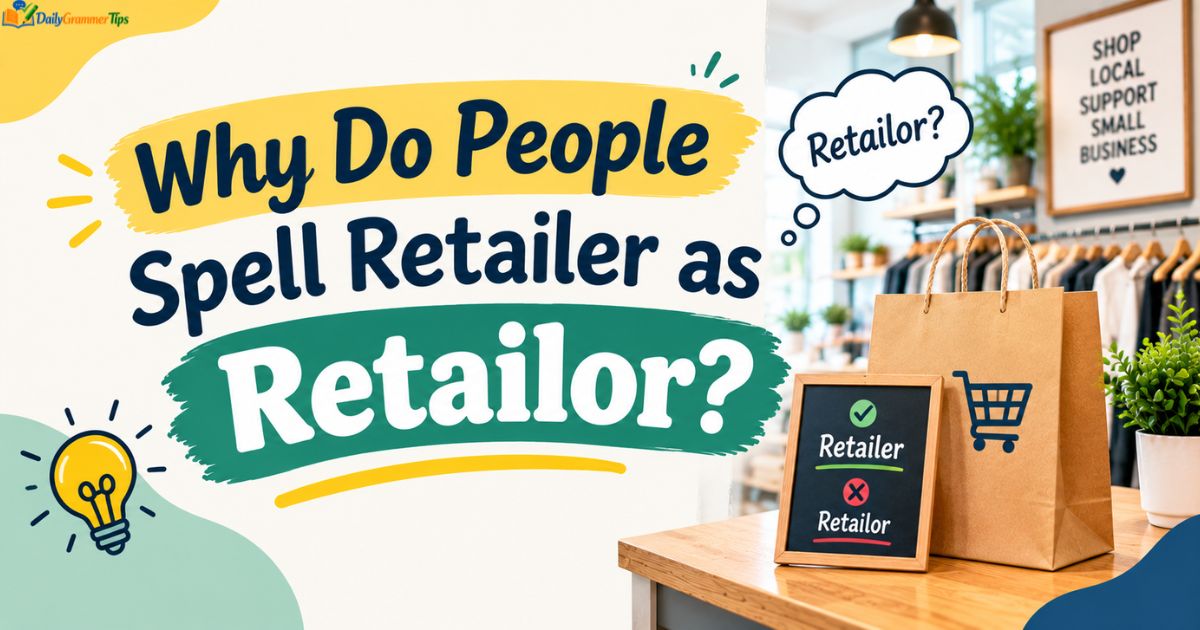
The retailor or retailer confusion has a few clear causes rooted in sound patterns and habit rather than pure carelessness on the writer’s part.
Similar pronunciation Spoken quickly, retailer and retailor sound almost the same, which tricks the ear during fast writing, dictation, or informal typing on a phone.
Familiar or endings English contains many job titles ending in or, such as doctor, editor, and contractor. Writers sometimes borrow that familiar pattern out of pure habit rather than checking the rule.
Influence from the word tailor Since tailor ends in or and shares a distant word history with retail, some writers blend the two together without realizing the mistake.
Weak autocorrect tools Some older keyboards and word processors fail to catch retailor, letting the mistake slip through unnoticed into finished documents and emails.
The Origin of Retailor or Retailer
The story behind retailor or retailer starts far back in Old French centuries ago. The verb retaillier meant to cut again or to divide something into smaller pieces for distribution.
That root combines re, meaning again, with taillier, meaning to cut cleanly. The same root eventually produced the English word tailor as well, which explains the visual similarity many writers notice.
Historical records trace the noun retailer back to the late fifteenth century, appearing in English parliamentary documents of that era. The idea always centered on breaking large stock into smaller portions for individual buyers, much like a tailor cuts cloth into fitted pieces.
Which Spelling Should You Use?
Choose retailer every single time you write about selling goods to consumers. This simple rule holds no matter which country your intended audience lives in.
British English and American English agree fully on this specific point. Neither major dialect offers retailor as an acceptable alternative spelling in any formal context.
A simple test helps when doubt creeps in during writing. Swap the word for seller or merchant inside your sentence. If the sentence still makes complete sense, retailer is the spelling you need to use.
How to Pronounce Retailer Correctly
Retailer is pronounced REE tay lur, with the stress landing firmly on the first syllable of the word.
Break the pronunciation into three easy sounds to remember it. REE rhymes with free, tay rhymes with day, and lur rhymes with blur or her.
Both retailer and the mistaken retailor sound alike out loud in most conversations, which explains why so many people misspell the word in writing even though they say it correctly every single day without noticing.
Retailor or Retailer Synonym
Looking for a retailor or retailer synonym can help writers vary their sentences without repeating the same noun constantly throughout a document.
Common alternatives to retailer include seller, merchant, vendor, shopkeeper, and store owner depending on the tone you want. Larger retailers are sometimes called chains or outlets depending on their size and reach.
No accepted synonym exists for retailor, since the word itself carries no standard modern meaning left to substitute into a sentence naturally.
Retailor or Retailer in Everyday Examples

Seeing correct sentences in context helps the proper spelling stick permanently inside your memory over time.
- Amazon operates as the largest online retailer in the entire world today.
- The retailer processed a full refund within thirty days without any hassle.
- Independent retailers support local economies in many small towns across the country.
- This retailer focuses heavily on sustainable, eco-friendly clothing lines for shoppers.
Avoid sentences shaped like these incorrect versions found in casual writing.
- The retailor offered a discount on electronics last weekend.
- She works as a fashion retailor in a downtown shopping district.
Retailor or Retailer Examples
More retailor or retailer examples across different industries make the correct pattern even clearer for everyday writing situations.
A grocery retailer stocks daily household items for nearby families every week. A fashion retailer curates seasonal clothing collections for shoppers throughout the year. A furniture retailer displays showroom pieces before arranging home delivery.
None of these industries ever use the spelling retailor in professional catalogs, invoices, or marketing copy sent to customers.
Retailers Example
Real world retailers example lists help readers connect the abstract term to brands they already recognize from daily life.
Well known retailers include large supermarket chains, pharmacy chains, electronics stores, and popular clothing brands with physical or online storefronts.
Small independent shops count as retailers too, even without national recognition or brand fame, since the definition depends on business function rather than company size.
Common Mistakes with Retailor or Retailer
Beyond the simple spelling slip itself, writers often make a few related errors worth flagging here as well.
Mistake 1: Using retailor in professional documents
A misspelling inside a business proposal or resume can quietly damage your credibility with readers. Always proofread any document containing retail terminology before sending it out.
Mistake 2: Assuming British English allows retailor
It does not, despite what some writers assume. Both British and American English rely exclusively on retailer as the standard spelling.
Mistake 3: Trusting outdated autocorrect
Older software sometimes misses this specific error entirely. Modern grammar tools catch it reliably and flag it immediately for correction.
Mistake 4: Mixing up retailer and wholesaler
A retailer sells to individual consumers in small quantities. A wholesaler sells in bulk to other businesses further up the chain.
Memory Trick to Remember the Correct Spelling
A short memory trick can lock the correct spelling into place quickly for future writing.Picture the phrase, a retailer sells to the buyer, and notice that both words end in er. Buyer and seller share that same ending, and retailer follows the identical familiar pattern.You would never write buyor or sellor in a sentence, so avoid writing retailor for that exact same simple reason going forward.
Retailor or Retailer – Google Trends & Usage Data

Search behavior confirms that retailer dominates global usage by a wide and consistent margin across regions.Retailer generates millions of monthly searches across English speaking regions worldwide every single year. Retailor mostly appears only when people type it to double check the correct spelling before publishing something.
Major news outlets and business publications use retailer consistently and almost never publish retailor in professional content. Search engines also tend to favor correctly spelled terms, so choosing retailer supports stronger visibility for your content online.
Comparison Table: Retailor vs Retailer
| Category | Retailer | Retailor |
| Spelling status | Correct | Incorrect |
| Dictionary entry | Present | Absent |
| Grammar role | Standard noun | Not recognized |
| Regional variation | None | None |
| Media usage | Universal | Almost never |
| Search engine impact | Favorable | Unfavorable |
Frequently Asked Questions
What is the meaning of retailer?
A retailer is a business or person who sells goods directly to consumers for personal use.
What is the exact meaning of retail?
Retail means selling goods in smaller quantities directly to the end customer rather than in bulk.
What is the difference between a retailer and a retailer?
There is no real difference, since both terms describe the same seller; the correct spelling in every case remains retailer, not retailor.
What is the difference between retail and wholesale?
Retail involves selling small quantities to individual customers, while wholesale involves selling large quantities to other businesses.
Who is known as a retailer?
Anyone who sells products directly to the public, from a small shop owner to a large chain store, is known as a retailer.
Conclusion
The retailor or retailer question has one clear and consistent answer across every source available today. Retailer is correct, and retailor holds no real place in modern professional writing anywhere.This rule stays consistent across British English, American English, and every other regional dialect spoken worldwide.
You write a business report, a product page, or a school assignment, choosing retailer protects your overall credibility as a writer.Keep this guide handy the next time doubt creeps in during your writing process, and you will never second guess the spelling again with confidence.
