


You are typing up a memo, a school note, or a work email, and suddenly your fingers freeze. Is it roll call or role call? The Roll Call vs Role Call question trips up even confident writers, because both versions look believable on the page and sound completely identical the moment they leave your mouth.
Here is the short version before we go deeper: roll call is the correct spelling, and role call is simply a mistake that happens because the two words are pronounced the same way. Once the logic clicks, the Roll Call vs Role Call mix up disappears for good, and you will never second guess yourself again.
Roll Call vs Role Call: The Fast Answer
If you only read one section of this guide, make it this one. In the Roll Call vs Role Call comparison, roll call wins every single time. It describes the act of reading out a list of names so that someone can confirm who showed up and who is missing.
Role call, on the other hand, is not a phrase that exists in standard English. People type it because “roll” and “role” are pronounced the same way, so the brain grabs whichever spelling feels familiar in the moment.
Remember this one simple rule and the Roll Call vs Role Call puzzle solves itself instantly: attendance always uses roll, never role. Every section below will keep circling back to that same Roll Call vs Role Call rule from a different angle.
What Roll Call Really Means
Roll call describes the process of calling out names, one after another, from a written or digital list, so that a teacher, officer, or manager can confirm attendance. The word “roll” here refers to a register, a record, or a list, in the same sense that a payroll is a list of everyone a company pays.
A teacher performing roll call each morning is reading through her class list to see who is present. A drill sergeant performing roll call before dawn is doing the exact same thing with a squad. The setting changes, but the meaning behind roll call never does. Keep that image in mind whenever the Roll Call vs Role Call question resurfaces, because it settles the matter faster than any rulebook.
This is really the heart of the Roll Call vs Role Call comparison. Roll refers to a physical or digital list, and calling that roll simply means reading it aloud.
Understanding Role Call and Why It Falls Short
Role call tries to fuse two words that do not belong together in this particular phrase. A role is a part someone plays, whether that is a job title, a character on stage, or a responsibility inside a team.
There is no dictionary entry, no grammar guide, and no accepted style manual that lists role call as a legitimate phrase. It shows up online almost exclusively as a spelling slip, never as an approved alternative.
Picture it this way: during attendance, nobody is asking about anyone’s job duties or their part in a play. They are asking for a name to be read from a list. That is why the Roll Call vs Role Call debate always ends the same way, with roll call as the winner.
Writers who research the Roll Call vs Role Call topic online will notice that credible dictionaries and grammar sites agree on this point without exception. None of them list role call as an accepted variant, which removes any lingering doubt from the Roll Call vs Role Call discussion.
Where Roll Call Came From: A Short History

The word roll traces back to the Latin term rotulus, which described a small rolled up scroll or wheel. Long before notebooks and spreadsheets existed, names and records were written on parchment that was then rolled for storage, which is exactly why we still talk about a “roll” of names today.
Ancient texts echo this same idea. In the Book of Numbers, Moses is told to count and record the people of Israel tribe by tribe, an early version of what we would now call a census roll. Armies, courts, and religious groups all relied on rolled documents to track their members, and that habit is the true root of the phrase we use today.
By the time military traditions took shape in the 1600s and 1700s, calling the roll before a battle, a ship’s departure, or a morning formation had become standard practice. Schools, courts, and offices later borrowed the same habit, and the exact wording survived intact: roll call.
This long history is one more reason the Roll Call vs Role Call debate favors roll call so strongly. Centuries of documented use simply outweigh a modern typo, no matter how common that typo has become online.
Roll Call vs Role Call: Quick Comparison Table
| Term | Correct spelling | What it means | Example sentence |
| Roll call | Yes | Checking attendance by reading names from a list | The coach opened practice with roll call. |
| Role call | No | Not a recognized phrase in standard English | Usually a typo for roll call |
| Roll | Yes | A list, register, or something rolled up | Add her name to the roll. |
| Role | Yes | A job, duty, or character someone plays | He accepted a new role at the firm. |
Tables like this one make the Roll Call vs Role Call difference easy to scan at a glance, especially if you are checking quickly before hitting send on an email.
Roll Call Attendance in Everyday Situations
Roll call attendance shows up far more often than most people realize, and recognizing the pattern helps settle the Roll Call vs Role Call question once and for all.
- Classrooms: Teachers use roll call attendance every morning to confirm which students are present.
- Workplaces: Remote teams often open Monday meetings with a fast roll call attendance check to see who has joined the call.
- Courtrooms: Clerks perform roll call attendance before a jury is seated, confirming every juror is accounted for.
- Sports teams: Coaches run roll call attendance before practice starts, so nobody slips through unnoticed.
In every case, the goal is identical: confirm who is there by reading a list of names, which is exactly what separates true roll call attendance from the nonexistent phrase role call. Keeping these four settings in mind makes the Roll Call vs Role Call answer easy to recall under pressure, whether you are proofreading a memo or drafting a school announcement.
Learn more……Ballon or Balloon: Which Spelling Is Correct?
Roll Call Example Sentences You Can Use
Seeing a Roll Call vs Role Call comparison in real sentences tends to lock the correct usage into memory faster than any rule alone.
- “The sergeant conducted roll call at five in the morning, before the sun was even up.”
- “Congress settled the vote through a formal roll call, with every representative’s name read aloud.”
- “The substitute teacher fumbled through roll call because she could not pronounce half the names.”
- “Our manager starts every stand up with a short roll call so latecomers do not go unnoticed.”
Notice that a roll call example always involves a list and a name being read from it, which is the opposite of what role call would describe if it existed at all. Each roll call example above reinforces the same lesson at the core of the Roll Call vs Role Call comparison: names, lists, and attendance belong to roll, never role.
Roll Call in a Sentence: A Closer Look
Writing roll call in a sentence becomes effortless once you remember that the word always pairs with checking attendance rather than describing a job or duty.
Compare these two sentences: “The teacher called roll before the exam began” versus “She plays an important role in the department.” Both use words that sound alike, yet only one of them belongs in a Roll Call vs Role Call context, and it is clearly the first. Practicing with a handful of pairs like this trains your ear to catch the Roll Call vs Role Call difference instantly, even when you are typing quickly.
Roll Call Meaning in the Army
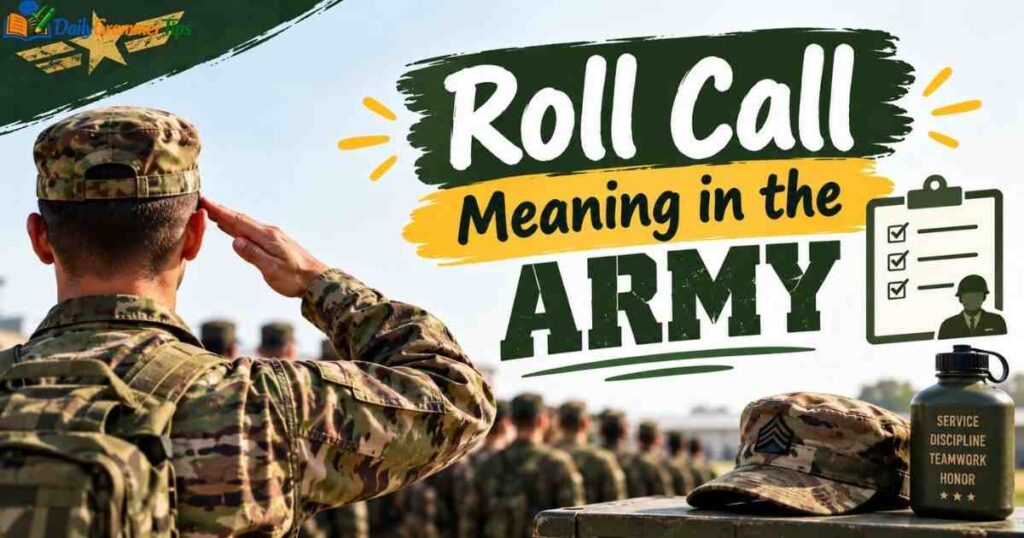
The roll call meaning in the army carries extra weight compared to a classroom setting, because missing a name during roll call can signal a genuine emergency rather than a simple tardy slip.
Military units perform roll call multiple times a day: at dawn, before deployment, after drills, and following combat exercises. Every soldier answers immediately when their name is read, and a missing response triggers an urgent search. This is where the Roll Call vs Role Call distinction becomes more than a grammar rule; it becomes a matter of safety and accountability.
Historically, roll call meaning in the army also extended to naval traditions, where sailors were counted before a ship left port to confirm the full crew was aboard. Military writing style guides settle the Roll Call vs Role Call question the same way civilian dictionaries do, treating role call as an error rather than an alternate spelling.
Why People Keep Mixing Up Roll Call With Role Call
Blame your ears, not your intelligence. Roll and role are homophones, meaning they sound exactly the same out loud despite carrying entirely different spellings and meanings.
English is packed with these traps: there and their, write and right, cell and sell. Your brain processes the sound first and guesses at the spelling second, and sometimes that guess lands on the wrong word.
There is also a subtle logical trap buried inside the Roll Call vs Role Call confusion. Because attendance often involves people who have specific roles at work or school, the brain tries to connect the two ideas even though they have nothing to do with each other. Understanding this psychological shortcut is often the missing piece that finally resolves the Roll Call vs Role Call mix up for good.
Row Call or Roll Call: Clearing Up Another Mix-up
Some people type row call instead of roll call, usually because of a quick typo or a regional pronunciation quirk. Row call is not a standard phrase either, so if you were searching row call or roll call hoping to settle the question, the answer lines up with everything already covered here: roll call is correct.
This small detour matters because it shows that the wider Roll Call vs Role Call confusion is not an isolated mistake. Any word that sounds close to “roll” tends to get pulled into the same orbit of doubt.
Mistakes Writers Commonly Make
Here are the slip ups that show up most often, so you can catch them before they reach a reader:
- Typing role call in a school newsletter or company memo
- Assuming role call describes checking someone’s job responsibilities, which it does not
- Reversing the words elsewhere, such as writing “he has an important roll at the company” when role was intended
- Trusting autocorrect too much, since both roll and role are spelled correctly on their own, just used incorrectly
A simple filter works every time: if the sentence is about attendance, reach for roll. If the sentence is about a job or duty, reach for role. Running every sentence through this filter is the fastest way to avoid the Roll Call vs Role Call trap in professional writing, where a single typo can undercut an otherwise polished document.
Roll Call Synonym Options You Can Use Instead
Sometimes a writer wants variety instead of repeating the same phrase throughout a document. A helpful roll call synonym can keep your writing fresh without sacrificing accuracy.
- Attendance check
- Name check
- Muster
- Headcount
- Check in
Each roll call synonym above communicates the same basic idea: confirming who is present by working through a list of names, which keeps the meaning intact even when the exact wording changes. None of these alternatives change the outcome of the Roll Call vs Role Call comparison, since they all describe the same action as roll call rather than anything resembling role call.
Is There a Role Call Game?
A quick web search shows a Role Call game does exist as a branded product name or party game title used by certain publishers, but that is a proper noun and a marketing choice, not evidence that role call is a standard English phrase.
Trademarked titles and product names often bend grammar rules on purpose to be catchy or memorable. That branding choice has no bearing on the Roll Call vs Role Call debate in everyday writing, where roll call remains the only correct option for attendance. Anyone quoting the Roll Call vs Role Call game title should still spell roll call correctly in every other sentence of their writing.
Roll vs Role: Other Word Pairs Worth Knowing
Since we are already untangling one set of homophones, a few related pairs are worth remembering too.
- Roll vs role: roll is a list or something physically rolled, such as a bread roll or a rolled up scroll; role is a part or job someone holds.
- Payroll vs payrole: only payroll exists, describing the list of employees a company pays. Payrole is not a real word.
- Enroll vs enrole: enroll, meaning to register or join, is the accepted spelling in American English. Enrole is outdated and incorrect.
Learning these related pairs helps the entire Roll Call vs Role Call rule stick permanently, since the same logic about lists versus jobs applies across all of them. Widening your view beyond a single Roll Call vs Role Call example makes the underlying pattern impossible to forget.
Roll Call Synonym in the Army and Beyond
Beyond the general roll call synonym list mentioned earlier, military and workplace settings sometimes use more specific terms. A muster, for instance, is common in naval and military contexts, while a check in call is more typical in modern office settings. Regardless of the label used, the underlying action mirrors roll call exactly: confirming presence from a known list of names, which keeps every version of the Roll Call vs Role Call comparison pointing to the same correct answer.
Simple Tricks to Remember the Difference Forever
A few memory tricks make the correct choice automatic:
- Roll has two Os, just like a rolled up scroll has a round shape, so round equals roll.
- Role relates to acting a part, and both role and sole share that same “ole” ending, since a sole purpose is also a kind of role.
- If the word can be swapped for “list” or “attendance,” use roll. If it can be swapped for “job” or “duty,” use role.
Once one of these tricks clicks, the Roll Call vs Role Call confusion stops being a recurring headache and becomes second nature instead, and you will spot the correct spelling automatically from then on.
Frequently Asked Questions
Is role call the same as roll call?
No. Role call is not a recognized phrase in standard English. It is a misspelling of roll call, which is the only correct term for checking attendance.
Is it roll call or role call?
It is roll call. The word roll refers to a list of names, and calling that list aloud to check attendance is what roll call means.
What does “roll call” mean?
Roll call means reading names aloud from a list, one by one, to confirm who is present and who is missing.
Is it role or roll for a job?
A job or position is always called a role, never a roll. A roll refers to a list, while a role refers to a duty or part someone plays.
What is the difference between “role” and “roll”?
Role describes a job, duty, or character, while roll describes a list, register, or something physically rolled up, such as a scroll or a bread roll.
Conclusion
The entire Roll Call vs Role Call disagreement comes down to two words that sound identical but carry completely different meanings. Roll connects to lists and attendance, while role connects to jobs and responsibilities, and once that link is clear, the confusion never returns.
So the next time a teacher, a sergeant, or a meeting host starts reading names out loud, you will already know the answer to the Roll Call vs Role Call question, and you will spell it correctly without a second thought. Bookmark this guide if the Roll Call vs Role Call question ever slips your mind again, and you will have the answer in seconds.
