

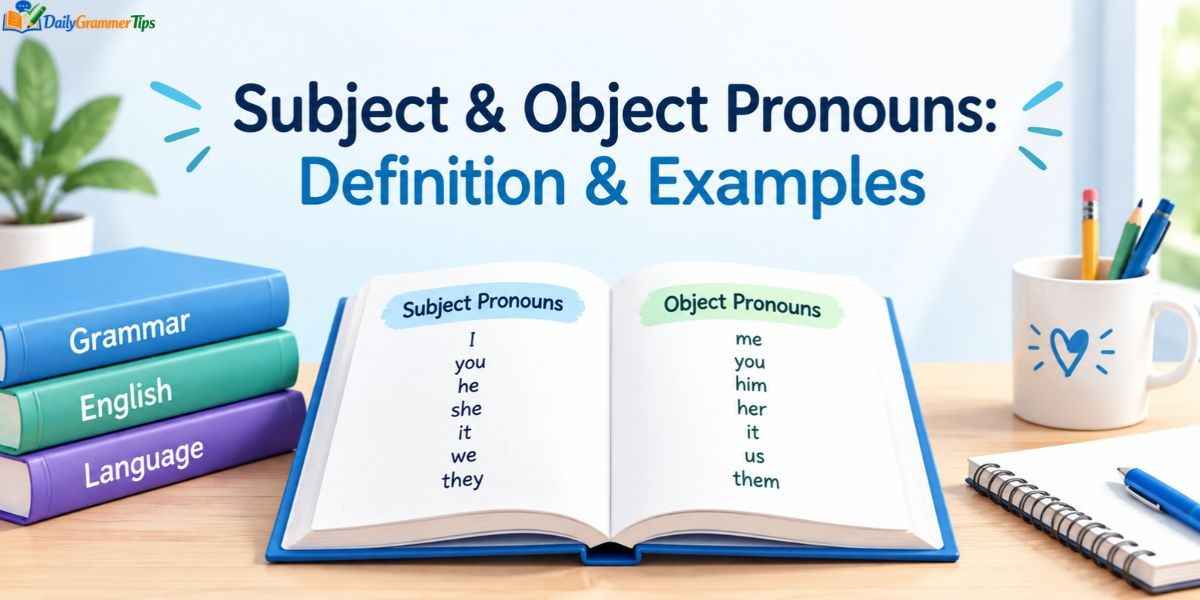
Subject and object pronouns are words that replace nouns and help make sentences clear. Subject pronouns act as the subject, while object pronouns act as the object of a verb or preposition.
Subject & Object Learning the difference helps you write correct sentences, avoid common grammar mistakes, and communicate more naturally in English.
What Are Subject Pronouns?
Subject pronouns are pronouns that act as the subject of a sentence or clause. They usually tell us who performs an action or who or what the sentence describes.
The seven subject pronouns in English are I, you, he, she, it, we, and they.
Examples:
- I study English every day.
- She works at a school.
- They play soccer after class.
In each sentence, the bold pronoun is the subject. It tells us who performs the action.
What Are Object Pronouns?
Object pronouns are pronouns that act as the object of a verb or preposition. They often identify the person or thing that receives an action or is affected by it.
The seven object pronouns are me, you, him, her, it, us, and them.
Examples:
- Sarah called me.
- We invited him to dinner.
- The teacher spoke to them.
Here, the bold pronouns function as objects. Their roles depend on how they are used in each sentence.
Subject Pronouns vs. Object Pronouns: What Is the Difference?
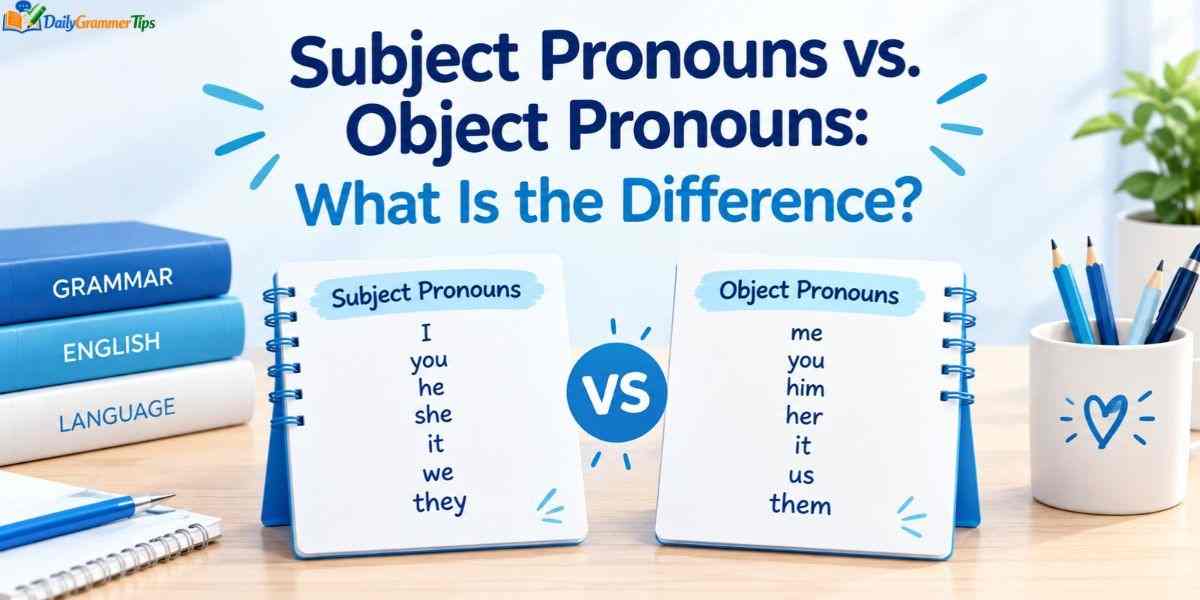
The main difference is their grammatical role. Subject pronouns act as subjects, while object pronouns function as objects of verbs or prepositions.
| Subject pronoun | Object pronoun | Example |
|---|---|---|
| I | me | I helped her. She helped me. |
| You | you | You called me. I called you. |
| He | him | He saw them. They saw him. |
| She | her | She invited us. We invited her. |
| It | it | It surprised him. He noticed it. |
| We | us | We thanked them. They thanked us. |
| They | them | They know me. I know them. |
Some pronouns, such as you and it, have the same form in both roles. You must look at their function in the sentence to identify them.
What Are Subjective and Objective Pronouns?
Subjective pronouns are another name for subject pronouns. They are used when a pronoun acts as the subject of a verb.
Objective pronouns are another name for object pronouns. They are used when a pronoun functions as the object of a verb or preposition.
For example, in “She called him,” she is subjective, and him is objective.
List of Subject and Object Pronouns With Examples
Each subject pronoun has a corresponding object pronoun. Learning these pairs makes it easier to choose the correct form when speaking or writing.
| Subject pronoun | Object pronoun | Example |
|---|---|---|
| I | me | I taught me? No. She taught me. |
| You | you | You helped me. |
| He | him | He thanked him. |
| She | her | She called her. |
| It | it | It hit it. |
| We | us | We joined them. |
| They | them | They invited us. |
The examples show how pronoun forms work in sentences. A pronoun’s role, not just its meaning, determines which form to use.
How to Use Subject Pronouns in Sentences
Use a subject pronoun when it acts as the subject of a verb. It may appear at the beginning of a sentence or inside a clause.
Examples:
- He runs every morning.
- We are ready for the meeting.
- Maria and I finished the assignment.
When a sentence has a compound subject, choose the pronoun that fits the subject’s role. In standard English, “Maria and I finished the assignment” is correct because I is part of the subject.
Learn more………..What Does Callitos Mean? Spanish Slang From Mexico
How to Use Object Pronouns in Sentences
Use an object pronoun when it functions as the object of a verb or follows a preposition.
Examples:
- The coach praised her.
- Dad gave us a ride.
- This gift is for you.
- Alex sat beside me.
Object pronouns can serve as direct objects, indirect objects, or objects of prepositions. Their exact role depends on the sentence structure.
Direct Objects
A direct object receives the action of a verb.
Example: “Mia saw him.”
Ask, “Mia saw whom?” The answer is him, so it is the direct object.
Indirect Objects
An indirect object identifies the person or thing that receives something or benefits from an action.
Example: “The teacher gave us homework.”
The teacher gave homework to whom? The answer is us, making it the indirect object.
Objects of Prepositions
An object of a preposition follows a preposition such as to, with, for, from, or between.
Example: “The teacher sat beside her.”
The pronoun her follows the preposition beside, so it is an object of a preposition.
Common Mistakes With Subject and Object Pronouns
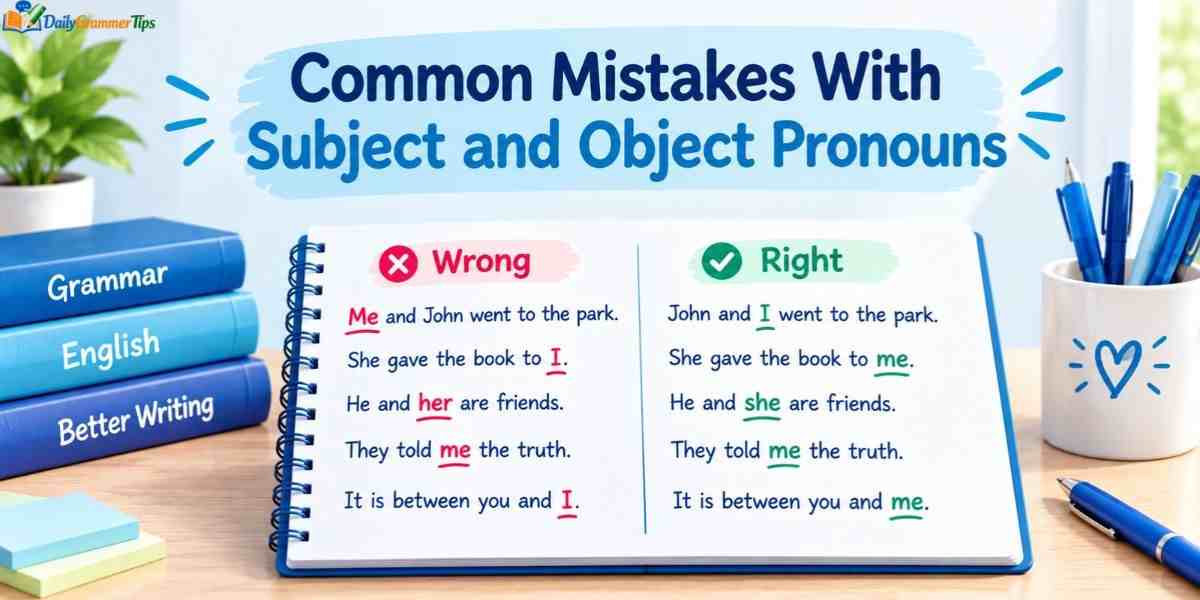
Choosing between subject and object pronouns can be confusing, especially in compound phrases and formal writing.
Using “Me” Instead of “I”
Incorrect: “Me and John went shopping.”
Correct: “John and I went shopping.”
The pronoun is part of the subject, so I is the correct choice.
Using “I” Instead of “Me”
Incorrect: “The manager spoke to John and I.”
Correct: “The manager spoke to John and me.”
The phrase follows the preposition to, so the object pronoun me is required.
Using “Her” Instead of “She”
Incorrect: “Her is my best friend.”
Correct: “She is my best friend.”
The pronoun acts as the subject of is, so use she.
Using “Him” Instead of “He”
Incorrect: “Him plays basketball.”
Correct: “He plays basketball.”
The pronoun performs the action, so the subject form he is correct.
How to Identify Subject and Object Pronouns
You can identify the correct pronoun by examining its role in the sentence.
- Find the verb: Identify the action or state.
- Find the subject: Ask who or what performs the action or is described.
- Find the object: Ask whom or what the verb affects, or look for a pronoun following a preposition.
- Choose the correct form: Use a subject pronoun for the subject and an object pronoun for the object.
Example: “They invited us.”
The verb is invited. The people doing the inviting are they, and the people receiving the invitation are us.
Subject and Object Pronouns Practice
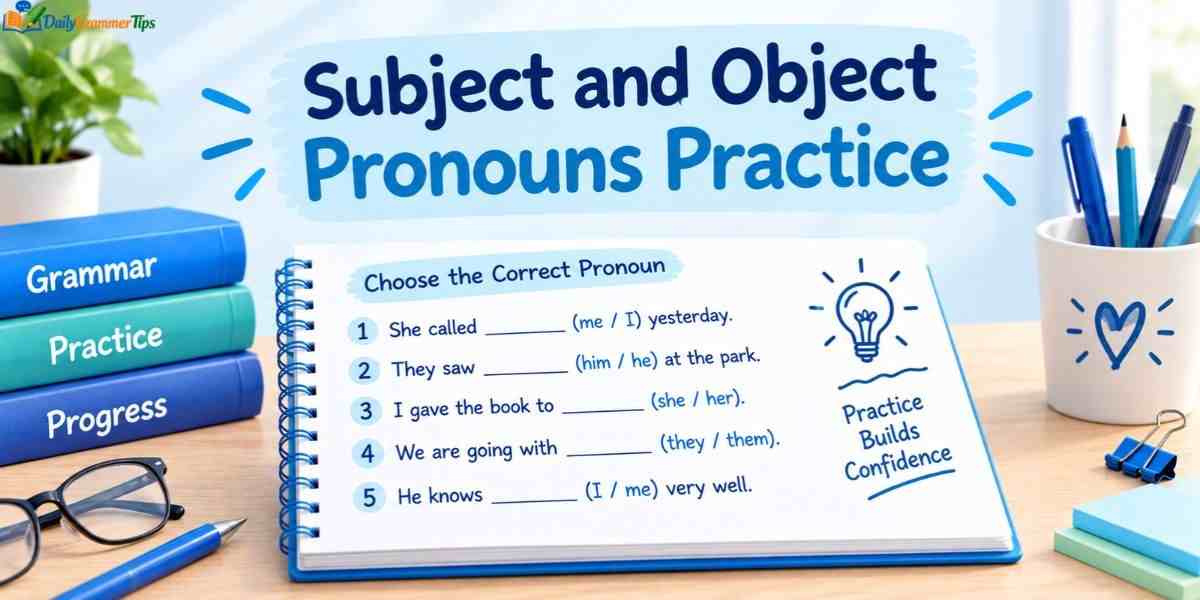
This section helps readers practice the difference between subject pronouns and object pronouns. By completing these exercises, they can learn to choose the correct pronoun in everyday English sentences.
A subject pronoun performs an action or acts as the subject. An object pronoun receives an action or follows a preposition.
For example:
- She called me. — She is the subject pronoun.
- She called me. — Me is the object pronoun.
Practice choosing the correct pronoun in each sentence to improve your grammar and avoid common mistakes.
Frequently Asked Questions
What is the difference between subject and object pronouns?
Subject pronouns act as the subject of a sentence or clause. Object pronouns function as the object of a verb or preposition. For example, “She helped him.”
What are the seven subject pronouns?
The seven common subject pronouns are I, you, he, she, it, we, and they.
What are the seven object pronouns?
The seven common object pronouns are me, you, him, her, it, us, and them.
Is “me and him” grammatically correct?
It depends on how the phrase is used. “The teacher called me and him” uses object pronouns correctly. However, in the subject position, standard English requires “He and I went home.”
Should I say “between you and I” or “between you and me”?
“Between you and me” is correct in standard English because between is a preposition and must be followed by object pronouns.
Can the same pronoun be both a subject and an object?
Yes. Some pronouns have the same form in both roles. For example, you is the subject in “You called me” and the object in “I called you.” The pronoun it works similarly.
What are examples of subject and object pronouns in one sentence?
“She gave them a book” contains both types. She is the subject pronoun, and them is the indirect object pronoun.
Why are subject and object pronouns important?
They help make sentences clear, reduce repeated nouns, and support correct grammar. Using the right form also makes writing easier to understand.
Conclusion
Subject and object pronouns have different roles in English sentences. Subject pronouns act as subjects, while object pronouns function as objects of verbs or prepositions.
Learn the seven pronoun pairs, study how they work in examples, and practice identifying their roles. These simple steps will help you use pronouns more accurately in everyday speaking and writing.
