


Medical language often trips people up when two words look nearly identical but carry different weight in professional writing. The pair Symptomology vs Symptomatology is a perfect example. Most speakers use them as if they mean exactly the same thing, yet only one of them holds up as the standard, technically correct form in medical and scientific writing.
Getting this right actually matters. Precise language builds trust, especially in healthcare, psychology, research, and academic settings, where a single word choice can shape how seriously your writing is taken. This guide walks through what each term means, why the Symptomology vs Symptomatology mix-up happens so often, which version experts recommend, and how to use the right word with confidence.
What Does Symptomatology Actually Mean?
Before diving deeper into Symptomology vs Symptomatology, it helps to nail down the correct definition first. Symptomatology is the formal, medically accepted term. It refers to:
- The full set of symptoms tied to a particular disease or condition
- The organized study and analysis of those symptoms
Doctors, researchers, and medical textbooks lean on this word constantly when describing how an illness shows up in a patient.
A couple of examples make it clearer:
- The symptomatology of the flu typically includes fever, fatigue, and body aches.
- A research team documented the symptomatology of generalized anxiety disorder.
You’ll find this term firmly rooted in medicine, psychiatry, psychology, and clinical research writing.
Is “Symptomology” Actually a Word?

Yes, technically people do say and write “symptomology,” especially in casual conversation. But when you look closer at the Symptomology vs Symptomatology debate, most medical professionals and language experts treat “symptomology” as a shortened, nonstandard cousin of the proper term.
A handful of dictionaries note the word exists, but “symptomatology” still wins out as the preferred choice in professional and academic circles.
Put simply:
- Symptomatology formally correct, widely accepted everywhere
- Symptomology informal, looser, less precise
That gap explains why nearly every serious healthcare publication steers clear of “symptomology.”
Why Do People Mix These Two Terms Up?
The Symptomology vs Symptomatology confusion isn’t really a mystery. English speakers have a habit of trimming long, technical-sounding words down over time, and the Symptomology vs Symptomatology pair fell into that pattern naturally.
A few reasons the shorter version keeps showing up:
- It simply rolls off the tongue faster
- The familiar “-ology” ending feels right on its own
- Plenty of scientific fields follow similar naming patterns
- Everyday conversation tends to flatten technical vocabulary
Even so, professional writing still leans toward the fuller, more historically accurate form.
Read Also: 20+ Other Ways to Say “Thank You for Your Generosity” (With Examples)
Breaking the Word Down Piece by Piece
Looking at where these words come from clears up a lot of the confusion around Symptomology vs Symptomatology.
Getting familiar with these building blocks makes the Symptomology vs Symptomatology comparison much easier to remember later on.
What “Symptom” Actually Refers To
A symptom is any physical or psychological sign that points toward a condition, illness, or disorder.
Common examples include:
- Headache
- Fatigue
- Nausea
- Anxiety
- Fever
What the Suffix “-Logy” Means
The suffix “-logy” generally signals “the study of” whatever comes before it.
You’ll recognize this pattern in words like:
- Biology
- Psychology
- Neurology
Where “Symptomatology” Came From
Understanding this origin is key to settling Symptomology vs Symptomatology once and for all. The word is built from several linguistic pieces working together symptom, a connecting element, and the “-logy” suffix. Over time, this longer structure came to represent the systematic study and classification of symptoms, not just a casual look at them.
That history is exactly why the medical field never trimmed it down.
How Doctors Actually Use Symptomatology
Away from the Symptomology vs Symptomatology debate itself, it’s worth seeing how the correct term functions in real clinical settings. You’ll see this term constantly in healthcare and research settings because symptoms are the main clues professionals rely on to identify what’s going on with a patient.
Medical teams evaluate symptom patterns to:
- Reach an accurate diagnosis
- Track how a disease is progressing
- Compare notes across patient cases
- Judge whether a treatment is actually working
- Support ongoing medical research
For instance, the symptomatology tied to depression can involve a low mood, disrupted sleep, and a noticeable loss of interest in everyday activities.
Symptomatology in Psychology and Mental Health Work

The Symptomology vs Symptomatology question comes up in mental health writing too, not just general medicine. Mental health professionals reach for this term often when they’re describing emotional, behavioral, or cognitive symptoms in a patient.
Common examples include:
- Anxiety symptomatology
- PTSD symptomatology
- ADHD symptomatology
- Depressive symptom patterns
Within psychology, paying close attention to how symptoms present themselves helps clinicians build more accurate assessments and stronger treatment plans.
Why Getting the Term Right Actually Matters
At this point, the Symptomology vs Symptomatology stakes should be clear: precise medical terminology isn’t just a technicality it shapes how professional your writing sounds.
Choosing the correct word helps you:
- Communicate more clearly
- Cut down on misunderstandings
- Strengthen academic or clinical writing
- Come across as more credible
- Stay consistent across healthcare documentation
Even a small wording slip can change how your writing lands in a clinical or academic setting, which is why the Symptomology vs Symptomatology distinction isn’t just pedantic it’s practical.
Mistakes Writers Commonly Make
Plenty of writers slip up on the Symptomology vs Symptomatology distinction without even realizing it.
Typical mistakes look like this:
- Dropping “symptomology” into academic papers
- Assuming both spellings carry equal weight
- Blending casual language into formal writing
- Copying an incorrect spelling straight from an unreliable source online
If you’re writing formally, “symptomatology” is always the safer bet.
Examples That Show Correct Usage
A few sample sentences make the Symptomology vs Symptomatology usage rules obvious.
- Researchers examined the symptomatology of chronic fatigue syndrome closely.
- The symptomatology of this condition can vary quite a bit from patient to patient.
- Doctors keep studying neurological symptomatology across different age groups.
- Accurate symptomatology genuinely improves both diagnosis and treatment outcomes.
These examples reflect exactly how the term shows up in everyday medical communication.
Is “Symptomology” Ever Okay to Use?
Not every situation demands strict adherence to the Symptomology vs Symptomatology rule. In relaxed, everyday conversation, plenty of people use “symptomology” without anyone batting an eye. Most listeners still catch the intended meaning without issue.
That said, it can sound noticeably less polished in:
- Academic papers
- Healthcare documentation
- Research publications
- Clinical conversations
- Medical journals
When accuracy matters most, “symptomatology” remains the stronger choice.
A Simple Trick to Remember the Right Term
One easy memory trick can settle the Symptomology vs Symptomatology question for good, especially if the two spellings keep tripping you up.
Think about other well-known medical terms:
- Dermatology
- Cardiology
- Pathology
Medical vocabulary tends to hold onto its full, historical structure rather than getting simplified over time.
So when you’re writing professionally, reach for the complete form: symptomatology.
Symptomatology Synonym

Several words work as reasonable stand-ins for “symptomatology” depending on context. Terms like symptom profile, symptom complex, clinical presentation, and symptom picture all describe roughly the same idea the overall pattern of symptoms tied to a condition. In casual writing, “symptom pattern” often does the job just as well without sounding overly technical.
That said, none of these alternatives carry quite the same formal weight as “symptomatology” in a clinical or academic setting. When precision matters most, sticking with the original medical term is usually the safer choice, even if a synonym feels easier to reach for in everyday writing.
Symptomatology PDF
Many medical schools, research journals, and health organizations publish symptomatology reference guides as downloadable PDFs, often breaking down symptom clusters for specific conditions like depression, anxiety, or PTSD. These documents are commonly used by students, clinicians, and researchers who need a structured reference during coursework, diagnosis, or case studies.
If you’re looking for a reliable symptomatology PDF, university websites, peer-reviewed journal archives, and official health organization portals are usually the safest sources. Avoid random third-party sites, since medical terminology and symptom classifications can vary in accuracy outside of vetted academic or clinical publications.
Symptomatology in a Sentence
Seeing the word used in context makes it much easier to apply correctly in your own writing. For example: “The physician documented the patient’s symptomatology in detail before recommending a treatment plan.” Another common usage: “Researchers compared the symptomatology of two related autoimmune disorders to identify overlapping symptoms.”
Notice how the word always pairs with a condition or disorder, describing the full symptom picture rather than a single symptom on its own. Practicing with a few sentences like these helps the correct usage feel natural rather than forced.
Symptomatology Examples
Real-world examples make the term much easier to understand than a dictionary definition alone. The symptomatology of the common cold, for instance, typically includes a runny nose, sore throat, coughing, and mild fatigue. Similarly, the symptomatology of major depressive disorder often involves persistent sadness, low energy, appetite changes, and difficulty concentrating.
Clinicians rely on examples like these daily when comparing a patient’s presentation against known symptom patterns for a given condition. Building familiarity with common symptomatology examples across different illnesses also makes medical reading and research far easier to follow.
Types of Symptomatology
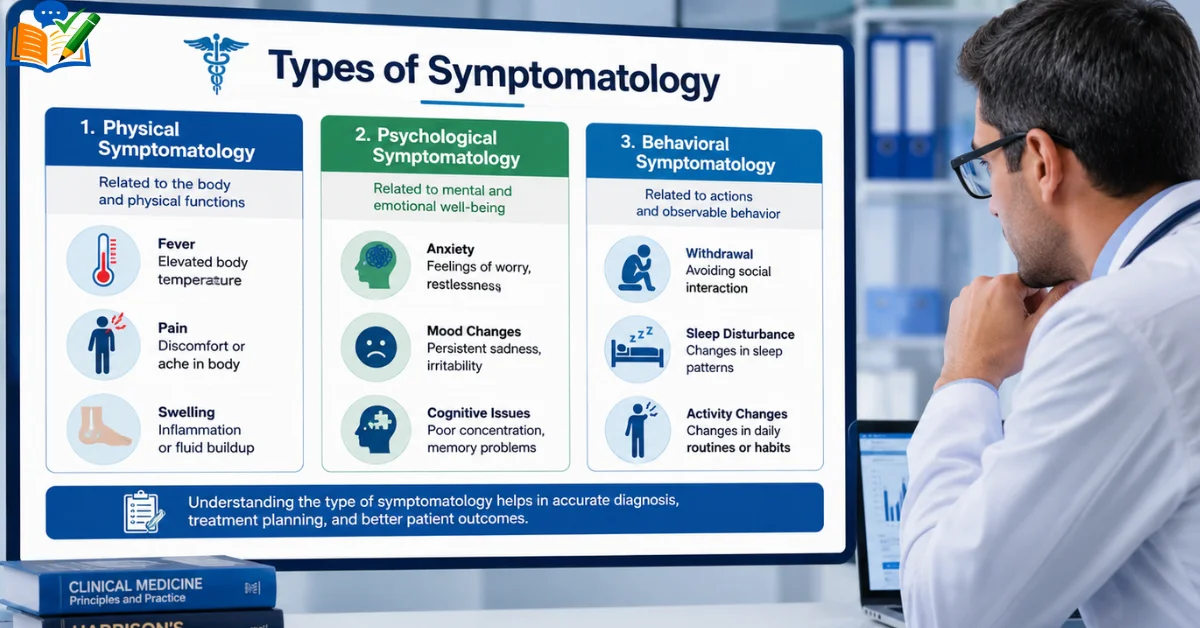
Symptomatology isn’t a single, uniform category it typically gets grouped based on how symptoms present. Physical symptomatology covers visible or measurable signs like fever, pain, or swelling, while psychological symptomatology includes mood changes, anxiety, or cognitive difficulties. Behavioral symptomatology, meanwhile, focuses on observable actions or changes in behavior tied to a condition.
Some conditions involve overlapping types, which is common in disorders that affect both the body and mind, such as chronic illness or trauma-related conditions. Recognizing which type of symptomatology applies helps clinicians choose the right diagnostic tools and treatment approach for each patient.
Symptomatology Plural
The plural form of “symptomatology” is simply “symptomatologies,” used when referring to more than one distinct set of symptoms, often across different conditions or patient groups. For example, a researcher might compare the symptomatologies of two separate anxiety disorders within the same study.
This plural form appears far less often than the singular, since most writing discusses the symptom pattern of a single condition at a time. Still, it’s useful to know when comparing multiple diagnoses or reviewing symptom clusters across a broader patient population.
Symptomatological
“Symptomatological” is the adjective form of “symptomatology,” used to describe something related to or characterized by symptoms. For instance, a “symptomatological assessment” refers to an evaluation focused specifically on a patient’s symptom presentation rather than broader diagnostic testing.
You’ll come across this adjective most often in academic or clinical writing, where precision matters and a more descriptive form of the word is needed. While less common in everyday conversation, recognizing “symptomatological” helps when reading research papers or formal medical documentation.
Frequently Asked Questions
What is an example of symptomology?
An example would be the symptomology of the flu, which typically includes fever, fatigue, body aches, and a sore throat. Doctors use these patterns to help identify what condition a patient may have.
What is meant by symptomology?
Symptomology generally refers to the collection of symptoms linked to a specific disease or condition. It’s an informal variation of “symptomatology,” the more formally accepted medical term.
Is symptomology a word?
Yes, it does appear in casual and informal writing, though most professionals consider it a nonstandard shortening. “Symptomatology” remains the preferred term in academic and clinical settings.
What is another word for symptomology?
Common alternatives include symptom profile, symptom pattern, symptom complex, and clinical presentation. None of these carry quite the same formal weight as “symptomatology” in medical writing.
What is symptomatology in medical terms?
In medical terms, symptomatology refers to the systematic study and classification of symptoms associated with a disease or condition. It’s widely used across medicine, psychiatry, and psychology to describe how an illness presents in a patient.
Conclusion
Sorting out Symptomology vs Symptomatology comes down to more than just spelling it’s about writing with real precision. The shorter version might slip into casual conversation without much pushback, but “symptomatology” stays the correct, widely respected term across medicine, psychology, and scientific research.
Sticking with the proper terminology strengthens how clear, credible, and precise your writing feels, especially in academic or healthcare contexts. Even a small distinction like Symptomology vs Symptomatology can genuinely shape how readers interpret and trust what you’ve written.
Now that the Symptomology vs Symptomatology question is fully settled, if you want to sharpen your grasp of medical language even further, digging into other commonly confused healthcare terms is a great next step for building stronger, more confident writing habits.
