


Tech companies face growing legal pressure over data use. AI firms are training models on copyrighted material. Software vendors are being sued for trade secret theft. Courts are now setting major precedents in this space.
These lawsuits affect developers, businesses, and everyday users. Verdicts like CSC v. TCS show real financial risk. Cases like the GitHub Copilot lawsuit test copyright law limits. This guide covers the biggest cases shaping 2026.
Why Tech And Computer Science Data Lawsuits Are Rising
Every tech computer science data lawsuit filed today adds to an unprecedented wave of legal battles centered on data, code, and intellectual property. From AI companies training models on copyrighted material to trade secret theft between competing software vendors, these disputes are multiplying fast.
This guide breaks down the most significant tech computer science data lawsuit cases shaping the industry today. It covers landmark verdicts, ongoing litigation, and what each ruling means for developers, enterprises, and everyday users.
The Scale Of The Problem
Litigation tracking groups have noted a sharp rise in filings tied to AI training data, cloud based scraping, and cross border trade secret disputes since 2023. Three forces are driving this surge.
- Generative AI systems require training data at a scale that makes licensing every source impractical, pushing companies toward scraping public content.
- Enterprise software vendors increasingly share source code access with contractors, creating more chances for confidential material to leak.
- State legislatures have passed new data privacy statutes, giving plaintiffs fresh legal theories that did not exist five years ago.
What Is A Tech Data Lawsuit? Definition And Scope
A tech computer science data lawsuit broadly refers to any legal action involving the unauthorized collection, use, or misappropriation of digital information by a technology company. This includes source code, trade secrets, copyrighted content, and personal data.
Every tech computer science data lawsuit case typically proceeds under a handful of well established statutes, summarized below.
| Statute | What It Covers | Typical Plaintiff |
| Defend Trade Secrets Act (DTSA) | Theft or misuse of confidential business information | Competing companies |
| Digital Millennium Copyright Act (DMCA) | Removal of copyright management information, safe harbor disputes | Content creators, publishers |
| Federal Copyright Act | Unauthorized reproduction or use of protected works | Authors, publishers, artists |
| Computer Fraud and Abuse Act (CFAA) | Unauthorized access to protected computer systems | Government agencies, companies |
| State privacy statutes such as Washington’s My Health My Data Act | Collection of personal or health data without consent | Consumers, state attorneys general |
Because these statutes were largely written before generative AI existed, much of today’s litigation tests how older legal concepts apply to new technology.
Types Of Tech Litigation: Copyright, Trade Secrets And Data Privacy
A tech computer science data lawsuit generally falls into three major categories, each with a distinct legal theory and burden of proof.
Copyright Lawsuits
A copyright focused tech computer science data lawsuit deals with the unauthorized use of protected creative or written works, most often in AI model training. Plaintiffs must generally show the defendant copied a protected work and that the copying was not excused by fair use.
Trade Secret Lawsuits
A trade secret tech computer science data lawsuit involves confidential business information, such as source code or technical manuals, being stolen or misused by a competitor or contractor. Unlike copyright, trade secret protection does not require registration.
The owner must instead show it took reasonable steps to keep the information secret.
Data Privacy Lawsuits
A data privacy tech computer science data lawsuit focuses on companies collecting personal or health related information without proper consent. These often arise under state laws such as Washington’s My Health My Data Act or the California Consumer Privacy Act.
These suits have grown quickly because several state statutes allow individuals, not just regulators, to sue directly.
| Category | Core Legal Question | Common Statute Used |
| Copyright | Was the work copied and is the use excused by fair use? | Copyright Act, DMCA |
| Trade Secrets | Was confidential information misappropriated? | Defend Trade Secrets Act |
| Data Privacy | Was personal data collected or shared without consent? | State privacy statutes |
Computer Sciences Corp. v. Tata Consultancy Services: Case Overview
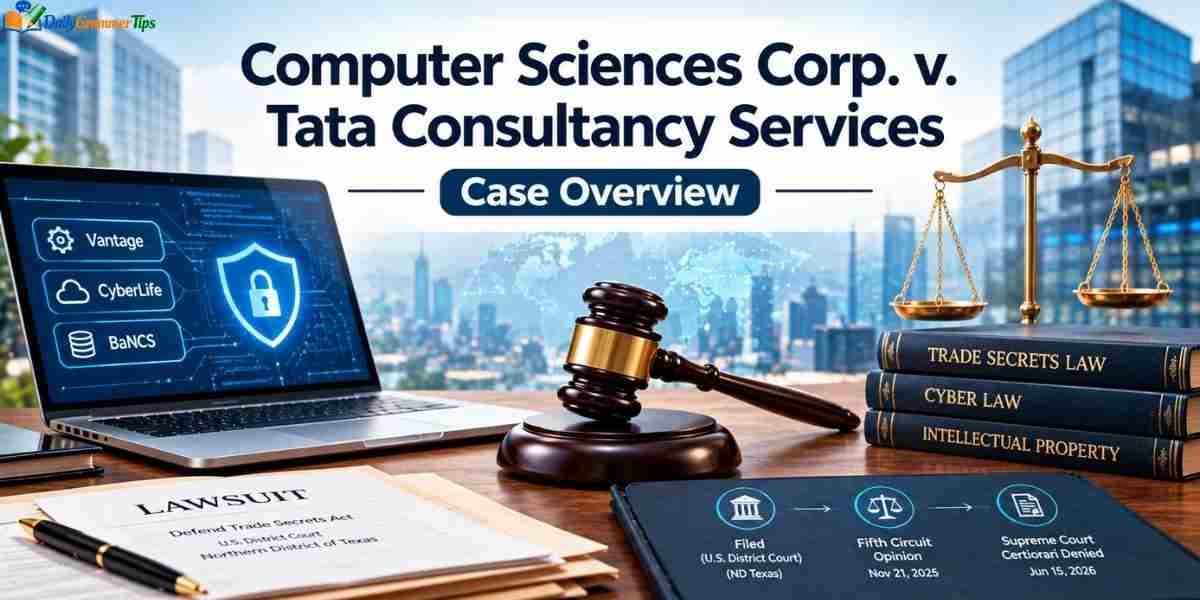
One of the most significant recent tech computer science data lawsuit rulings came from the Fifth Circuit Court of Appeals in November 2025. Computer Sciences Corporation, known as CSC, had licensed its insurance software platforms, Vantage and CyberLife, to the insurer Transamerica.
Tata Consultancy Services, known as TCS, was later brought in as a third party maintenance contractor for those platforms. The problem was that TCS was simultaneously trying to win Transamerica’s broader business for its own competing platform, called BaNCS.
How TCS Misappropriated CSC’s Trade Secrets
This tech computer science data lawsuit began in March 2019, when a CSC employee was accidentally copied on an internal TCS email chain. In that thread, TCS employees were sharing excerpts of CSC’s source code and technical manuals with the team developing BaNCS.
This accidental disclosure revealed that TCS had been using CSC’s confidential trade secrets to help build a rival product. That material was only authorized for use on Transamerica’s behalf, and TCS used it to help win a 2.6 billion dollar contract.
The 168 Million Dollar Verdict Explained
Following an eight day trial in this tech computer science data lawsuit, the district court found TCS liable for trade secret misappropriation and awarded CSC substantial damages. The table below breaks down the final judgment.
| Damages Category | Amount | Basis |
| Compensatory Damages | 56 million dollars | Avoided development costs TCS saved by using CSC’s trade secrets instead of building BaNCS independently |
| Exemplary (Punitive) Damages | 112 million dollars | Twice the compensatory amount, the maximum ratio allowed under the DTSA |
| Total Judgment | Approximately 168 million dollars | Combined compensatory and punitive award |
| Additional Remedies | Permanent injunction and ten year monitorship | Ordered separately from the monetary award |
Why The Fifth Circuit Called TCS’s Conduct Willful And Malicious
On appeal in this tech computer science data lawsuit, TCS argued it had not acted with the intent required to justify punitive damages. The Fifth Circuit disagreed with that argument.
The appellate panel pointed to evidence that TCS misrepresented to Transamerica that it was not using any third party intellectual property. TCS also kept circulating CSC’s confidential material internally and never disciplined the employees involved.
The court found this pattern of deception met the DTSA’s willful and malicious standard, justifying the full punitive damages award.
The Importance Of Clean Room Procedures In Tech Development
A central lesson from this tech computer science data lawsuit is the value of clean room development, a process where engineers build new products without ever being exposed to a competitor’s proprietary information. TCS never followed this process for BaNCS.
Legal experts note that a proper clean room process likely would have significantly reduced the exemplary damages award, even accounting for TCS’s other misconduct. This case is now widely cited as a warning for companies handling a partner’s confidential data.
GitHub Copilot Lawsuit (Doe v. GitHub): Background
Perhaps the most closely watched AI related tech computer science data lawsuit is Doe v. GitHub, filed in November 2022 by programmer and lawyer Matthew Butterick alongside the Joseph Saveri Law Firm. It was described as the first class action case in the US to directly challenge how an AI system was trained.
What Developers Accused Microsoft, GitHub And OpenAI Of
This tech computer science data lawsuit alleged that GitHub Copilot, an AI coding assistant built on OpenAI’s technology, was trained on billions of lines of open source code without honoring the license terms attached to that code. Plaintiffs claimed Copilot could reproduce recognizable code snippets without preserving attribution.
They argued this violated the DMCA and various open source licensing agreements. The suit originally raised twenty two separate claims and sought roughly one billion dollars in damages.
Ninth Circuit’s September 2026 Ruling On DMCA Claims
This tech computer science data lawsuit has narrowed considerably since it was first filed. By mid 2024, a district court had already dismissed all but a few claims, including the central DMCA Section 1202(b) allegation.
On September 16, 2026, the Ninth Circuit Court of Appeals affirmed that dismissal. The panel ruled that Section 1202(b) applies to removing copyright management information from an existing work, not to an AI system generating new output that never contained that information in the first place.
| Milestone | Date | Outcome |
| Lawsuit filed | November 2022 | Twenty two claims, roughly 1 billion dollars sought |
| District court dismissal | Mid 2024 | Most claims dismissed, including central DMCA claim |
| Ninth Circuit appeal ruling | September 16, 2026 | Dismissal of DMCA Section 1202(b) claim affirmed |
| Remaining claims | Ongoing | Breach of contract and open source license violation |
What’s Left Of The GitHub Copilot Case Today
Following the Ninth Circuit’s ruling, only breach of contract and open source license violation claims remain active in this tech computer science data lawsuit. This is a significant setback for the developers who filed suit.
The case is not fully resolved, though. The surviving contract claims could still test how courts interpret open source licensing obligations in the context of AI model training.
Learn more………….Top Computer Tech Companies in Pakistan (2026 List)
AI Training Data Lawsuits: Google, Microsoft And Publishers
The GitHub Copilot tech computer science data lawsuit is just one front in a much broader legal battle over AI training data. Google and its parent company Alphabet have faced class action lawsuits alleging they scraped user data and copyrighted material to train their AI systems without consent.
This scraped material reportedly includes social media content, blogs, and photographs, all used without compensation to the original creators.
Separately, publishers including the Seattle Times and Newsday have sued OpenAI and Microsoft. They allege paywalled news content was used to train ChatGPT, Copilot, and Bing without permission.
Plaintiffs point to chatbots reproducing close paraphrases of original reporting as evidence that copyrighted journalism was ingested during training.
Why Publishers Are Central To This Fight
News publishers occupy a unique position in this kind of tech computer science data lawsuit because their business model depends directly on web traffic and subscription revenue. When a chatbot can summarize an article closely enough, readers may skip the original page entirely.
Publishers argue this causes direct financial harm on top of any copyright violation.
Other Major Tech Copyright Lawsuits: Historical Overview
Tech giants have a long history of copyright litigation predating the current AI boom, and every early tech computer science data lawsuit continues to shape how courts approach newer disputes.
| Case | Company Involved | Outcome |
| Authors Guild v. Google | Google Books scanning project | Google won after a decade of litigation, ruled fair use |
| Viacom v. YouTube | YouTube DMCA safe harbor dispute | Billion dollar suit settled in 2013 |
| Recording industry v. Grooveshark | Music streaming copyright infringement | Service shut down, settlement in the hundreds of millions |
| Recording industry v. Limewire | Peer to peer file sharing | Service shut down, settlement in the hundreds of millions |
Google’s Google Books tech computer science data lawsuit is particularly relevant to the current AI training debate. Courts ultimately ruled that scanning copyrighted books to build a searchable index constituted fair use.
AI companies frequently cite this precedent when defending their own training practices. Critics argue that generative output is fundamentally different from a search index, so the comparison may not hold up.
Section 230 And Data Related Tech Litigation Trends

Beyond copyright and trade secrets, every Section 230 focused tech computer science data lawsuit is reshaping how the Communications Act applies to technology platforms. A notable 2025 Ninth Circuit ruling involving Grindr found that Section 230 shielded the platform from product liability claims related to how it connected users.
That decision appeared to depart from the circuit’s own recent precedent on the issue. Legal observers consider it a strong candidate for further review, possibly even at the Supreme Court level.
Why Section 230 Still Matters For Data Cases
Section 230 was written in 1996 to protect platforms from liability for content posted by third parties, but a modern tech computer science data lawsuit often tests that shield differently. Plaintiffs are now increasingly framing claims around data handling and algorithmic design rather than pure content moderation.
Courts are being forced to decide whether Section 230 immunity should extend that far.
Recent Developments In Tech Antitrust And Data Cases
Data collection practices are increasingly intersecting with antitrust law in this kind of tech computer science data lawsuit. Chegg has sued Google and Alphabet, alleging that Google’s AI generated search summaries use publisher content to reduce traffic to original websites.
Chegg claims this leverages Google’s search monopoly to divert that traffic. Meanwhile, dozens of lawsuits have been filed against the federal Department of Government Efficiency over its access to sensitive government data systems.
These suits rely on decades old laws, including the Privacy Act of 1974 and the Computer Fraud and Abuse Act, arguing that access to citizen data exceeded lawful authorization.
Key Lessons For Tech Companies From These Lawsuits
Every major tech computer science data lawsuit covered here points to a consistent set of lessons for any organization that handles third party data, licensed code, or confidential business information.
- Contractual language defining authorized use of data will be interpreted strictly by courts in a tech computer science data lawsuit, so vague terms create real legal exposure.
- Internal communications and employee testimony can make or break a trade secret case, as shown by the accidental email disclosure in CSC v. TCS.
- Courts remain willing to let novel AI related claims proceed even when the underlying legal theories are still developing.
- Clean room development processes meaningfully reduce legal risk when building a product that could compete with a partner or client.
Companies handling third party data or code should document authorization clearly and train employees on what constitutes permitted use.
How Developers Can Protect Their Code And Data Rights

For individual developers and smaller companies, each tech computer science data lawsuit discussed above highlights several practical steps worth taking.
| Protective Step | Why It Matters |
| License code with clear AI training restrictions if desired | Prevents ambiguity over whether a model owner had permission to train on the code |
| Document original authorship and timestamps | Creates evidence of ownership if a dispute arises later |
| Monitor whether proprietary code appears in AI generated outputs | Helps detect potential infringement early |
| Use written contracts for any contractor or vendor access to source code | Establishes a clear authorized use standard, as emphasized in CSC v. TCS |
Enforcement remains legally complex. Still, courts are increasingly signaling that clear licensing terms and documented ownership matter a great deal in any tech computer science data lawsuit.
Frequently Asked Questions
Should AI companies get permission before using copyrighted data?
Most experts say yes, otherwise the fair use defense stays uncertain.
Is registration required to win a trade secret case?
No, trade secret protection is automatic if the company took reasonable steps to keep it secret.
Can open source code be freely used for AI training?
It depends on the license terms; many licenses explicitly restrict AI training.
Does Section 230 also cover data privacy claims?
This is unclear; courts are currently split on the question.
Does a case like CSC v. TCS apply to smaller developers too?
Yes, the principle stays the same: confidential data can only be used for its authorized purpose.
Can publishers demand royalties from AI companies?
Many lawsuits aim for exactly this, but no binding precedent has been set yet.
Conclusion
Tech computer science data lawsuits are no longer a niche legal issue. They are actively reshaping how companies build products, train AI systems, and handle sensitive information.Cases like CSC v. TCS are setting precedent for trade secret damages, while the GitHub Copilot litigation tests the limits of copyright law in the AI era.
2026 is proving to be a pivotal year for technology law.Companies and developers alike should watch these cases closely. Their outcomes will likely shape data and intellectual property practices across the industry for years to come.
