


If you are unsure whether to write Trys or Tries, the correct form in standard English is tries. The spelling trys is incorrect when you mean the third person singular form of the verb “try” or the plural form of the noun “try.” The confusion usually happens because many English words simply take s when they become plural or change into a third person singular verb. However, words ending in a consonant followed by y follow a different spelling pattern. Understanding that small rule makes the correct spelling much easier to remember.
The Trys or Tries question becomes especially important when writing sentences such as “She tries to help,” “He tries again,” or “They made several tries.” In each example, tries is the correct form, but its grammatical role changes. As a verb, tries describes an action performed by one person or thing. As a noun, tries refers to multiple attempts or efforts. This guide explains the spelling rule, grammar rules, meanings, examples, rugby usage, common mistakes, and practical ways to remember the correct form.
Trys or Tries
The answer to Trys or Tries is simple: tries is the correct spelling, while trys is not the standard English spelling for this word.
The word try ends with a consonant, r, followed by y. When a word has this ending and needs a plural form or a third person singular verb form, English normally changes the y to i and adds es.
The pattern looks like this:
try → tries
The same pattern appears in many other English words:
| Base Word | Correct Form |
| try | tries |
| cry | cries |
| fly | flies |
| carry | carries |
| study | studies |
| reply | replies |
| worry | worries |
| deny | denies |
Therefore, the correct spelling of tries follows a regular English spelling pattern rather than being an unusual exception.
Trys or Tries Grammar Rules
The main grammar rule behind Trys or Tries is based on the final letters of the base word. When a word ends in a consonant followed by y, change the y to i and add es when forming the plural noun or the third person singular present tense.
For example:
“Try” becomes “tries.”
“Cry” becomes “cries.”
“Study” becomes “studies.”
“Carry” becomes “carries.”
This is often called the consonant y spelling rule. It helps English language learners understand why simply adding s does not work with every word.You need to distinguish consonant y words from words ending in a vowel followed by y. If the letter before y is a vowel, English normally keeps the y and adds s.
For example:
“day” becomes “days.”
“boy” becomes “boys.”
“key” becomes “keys.”
“toy” becomes “toys.”
So the important question is not simply whether a word ends in y. You must check the letter immediately before the y.
Why the Y Changes
The spelling rule makes the word easier to form according to established English spelling patterns. In try, the letter before y is r, which is a consonant. Therefore, the y changes to i before es is added.
That gives us:
try + es → tries
The same idea works with other words ending in consonant plus y. For instance, “reply” becomes “replies,” while “play” becomes “plays.” The difference comes from the letter before y.Understanding this distinction is much more useful than memorizing every individual word.
Trys or Tries Rules
The basic rules for Trys or Tries can be remembered through three simple steps.
First, find the base word. In this case, the base word is try.
Second, check the letter immediately before y. The letter r is a consonant.
Third, change y to i and add es.
The result is tries.
This spelling rule applies both when try is used as a noun and when it functions as a verb.
As a noun:
“She made three tries before solving the problem.”
As a verb:
“She tries to solve the problem every morning.”
The grammatical purpose changes, but the spelling remains the same.
A Simple Formula
You can remember the rule like this:
Consonant + y → change y to i + es
Examples include:
try → tries
fly → flies
cry → cries
spy → spies
reply → replies
deny → denies
This pattern is one of the most useful spelling patterns for English vocabulary and grammar lessons.
Is It Tries or Trys?

If you are asking is it tries or trys, choose tries in standard English.The form trys may appear in quick messages, informal posts, comments, or other writing where someone has typed the word incorrectly. Seeing the spelling online does not make it grammatically correct.
For example:
Incorrect: “She trys to finish her work.”
Correct: “She tries to finish her work.”
Incorrect: “He trys again after failing.”
Correct: “He tries again after failing.”
The correct spelling of tries uses ies because try ends in consonant plus y.
Correct Spelling of Tries
The correct spelling of tries is t r i e s.
It is not spelled t r y s.
A useful way to remember it is to connect tries with other words such as cries, flies, and spies. All of these words contain ies after a consonant plus y ending.
If you are learning English spelling rules, learning groups of words with the same pattern can make word formation easier. Instead of memorizing tries separately, remember the larger spelling pattern.
Try Plural
The try plural is tries.
When try is used as a noun, it can refer to an attempt, effort, or opportunity to do something. When you talk about more than one attempt, you use tries.
Examples include:
“I gave it two tries.”
“She needed several tries to open the jar.”
“After three tries, he solved the puzzle.”
“The player had two tries to complete the challenge.”
The plural of try therefore follows the same consonant y spelling rule.
You should not write “two trys” or “several trys.” Those forms are incorrect in standard English.
Plural of Try
The plural of try is tries because the base word ends in consonant plus y.
The rule applies to nouns as well as verbs. This point is important because some learners understand the spelling change in verbs but forget that the same pattern applies to plural nouns.
Compare these examples:
One try, two tries.
One reply, several replies.
One story, many stories.
One country, several countries.
The word changes from y to i before es because the base word ends with a consonant followed by y.
Tries as a Verb
The word tries is also a third person singular present tense verb.The base verb is try. When the subject is he, she, it, or another singular noun, the verb becomes tries.
Examples:
“She tries to stay calm.”
“He tries to arrive early.”
“The child tries to open the box.”
“The machine tries to restart.”
“Maria tries a different method.”
The subject determines the verb form. With I, you, we, and they, the base form try remains unchanged.
I try.
You try.
We try.
They try.
He tries.
She tries.
It tries.
This distinction is an important part of verb conjugation and present tense grammar.
About your research……..Cosy or Cozy: Which Spelling Is Correct?
Try vs Tries
The difference between try vs tries depends mainly on the subject and grammatical structure.
Use try with I, you, we, and they.
Use tries with he, she, it, or a singular noun.
| Subject | Correct Verb |
| I | try |
| You | try |
| We | try |
| They | try |
| He | tries |
| She | tries |
| It | tries |
| The student | tries |
| My brother | tries |
For example:
“I try to exercise regularly.”
“They try to solve the problem.”
“She tries to exercise regularly.”
“The student tries a new method.”
This is why Trys or Tries is not simply a spelling question. It is also connected to verb conjugation.
Try or Tries
Knowing when to use try or tries helps prevent many common grammar mistakes.
Use try after plural subjects and after I or you.
“I try my best.”
“We try different approaches.”
“They try again.”
Use tries after a singular third person subject.
“He tries his best.”
“She tries again.”
“The system tries to reconnect.”
The important point is that the base verb does not become tries with every subject. Only the third person singular present tense requires this form.
Trys or Tries Examples
Clear examples make the Trys or Tries distinction easier to understand.
| Incorrect | Correct |
| She trys to help. | She tries to help. |
| He trys again. | He tries again. |
| The student trys a new method. | The student tries a new method. |
| It trys to connect. | It tries to connect. |
| I made three trys. | I made three tries. |
| The player scored two trys. | The player scored two tries. |
The incorrect examples show the common mistake of adding s directly to try. The correct examples apply the y to i spelling change and add es.
Examples of Tries in Sentences
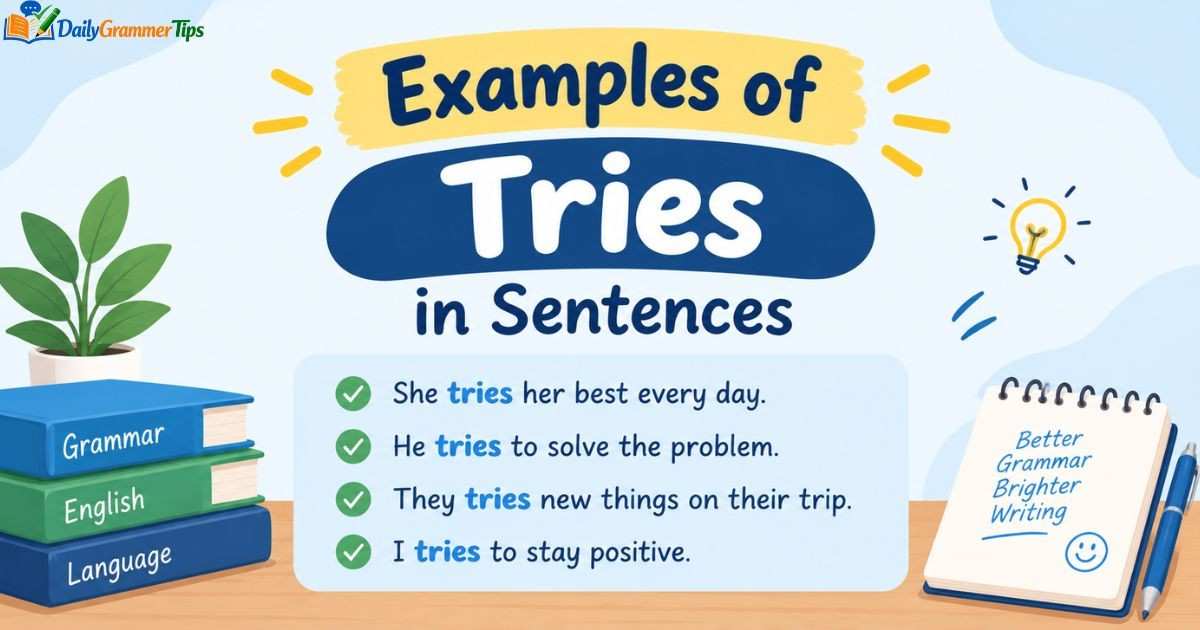
Here are additional examples showing how tries works in ordinary English:
- She tries to learn something new every day.
- He tries to remain patient during difficult conversations.
- The teacher tries a different approach with the class.
- My brother tries to fix the computer himself.
- The application tries to connect to the server.
- She made several tries before completing the task.
- The athlete had three tries to improve the result.
- After two tries, I finally opened the package.
- The child tries the experiment again.
- The team tries a new strategy during practice.
These examples show that tries can describe an action or refer to multiple attempts.
Trys or Tries in Rugby
One common question is whether Trys or Tries changes when discussing rugby. It does not.In rugby, the correct plural spelling is tries.A try is a scoring play in rugby. When a team scores more than one, the plural form is tries.
Examples:
“The team scored three tries.”
“The player scored two tries during the match.”
“Those tries helped the team win.”
“The visitors scored four tries in the second half.”
So the rugby meaning does not create a special spelling. The noun still follows the same spelling rule.If you see “trys” used in a rugby discussion, it is normally an incorrect spelling rather than a special sports term.
Trys or Tries Meaning
The meaning behind Trys or Tries becomes clearer when you understand the word try itself.As a verb, try means to make an attempt, make an effort, test something, or work toward a particular result.
For example:
“She tries to improve her writing.”
Here, tries means makes an effort.
As a noun, try means an attempt or opportunity to do something.
For example:
“He had three tries to solve the puzzle.”
Here, tries means three attempts.The word can also have a sports meaning, especially in rugby, where a try is a scoring play.
Try Meaning
The try verb meaning usually involves making an attempt or putting effort into an action.
For example:
“I will try to call tomorrow.”
The speaker plans to make an attempt.
Try can also mean testing something:
“Try this method.”
In that sentence, the speaker suggests testing or using a method to see whether it works.
The word can also describe an effort toward success:
“She will try again.”
This means she will make another attempt after an earlier effort did not produce the desired result.Understanding the meaning of try makes the meaning of tries easier to recognize.
Is Tries a Word?
Yes, tries is a word.
It is a standard English form used as both a verb and a noun.
As a verb, it is the third person singular present tense of try.
Example:
“He tries to help.”
As a noun, it is the plural of try.
Example:
“She made four tries.”
Therefore, if someone asks, “Is tries a word?” the answer is definitely yes.The confusion often comes from the fact that tries looks different from the base word try. However, the change from y to i is a normal spelling pattern in English.
Trys Meaning
The spelling trys does not have a standard English meaning when someone intends it as the third person singular form of try or as the plural of try.If a writer uses trys in a sentence such as “She trys again,” the intended word is tries.
The same applies to a sentence such as “He made three trys.” The correct word is tries.Occasionally, unusual spellings can appear as names, labels, usernames, or other special forms. Such uses do not change the standard grammar rule. In ordinary English writing, use tries.
Trying vs Tries

Another useful distinction is trying vs tries.Trying is the ing form of try. It describes an action in progress or can function as a gerund.
Examples:
“She is trying to learn French.”
“They are trying to solve the problem.”
“Trying new methods can improve your skills.”
Tries is the third person singular present form or the plural noun.
Examples:
“She tries every morning.”
“He made several tries.”
The spelling patterns are different because the words perform different grammatical functions.
Past Tense of Try
The past tense of try is tried.The y changes to i before ed is added because try ends in consonant plus y.
Try becomes tried.
Examples:
“I tried to call you yesterday.”
“She tried three different methods.”
“They tried to solve the problem.”
This gives you an important group of related forms:
Try: base form.
Tries: third person singular present tense or plural noun.
Tried: past tense and past participle.
Trying: present participle and gerund.
Learning these forms together makes verb conjugation easier.
Verb Forms of Try
The main verb forms of try can be organized simply.
| Verb Form | Example |
| Base form | I try to help. |
| Third person singular | She tries to help. |
| Past tense | She tried to help. |
| Past participle | She has tried to help. |
| Present participle | She is trying to help. |
This table also shows why Trys or Tries causes confusion. The spelling changes depending on the grammatical form, but trys is not one of the correct forms.
Common Spelling Mistakes
One of the most common mistakes is adding s directly to try.
Incorrect:
“She trys to understand.”
Correct:
“She tries to understand.”
Another mistake occurs with plural nouns.
Incorrect:
“I made three trys.”
Correct:
“I made three tries.”
Some writers may also confuse tried and tries.
Incorrect:
“She tried every day” is not wrong when referring to the past.
“She tries every day” describes a present or habitual action.
The tense and context determine whether you need tries or tried.
Why Is Tries Spelled With IE?
A common question is why is tries spelled with ie instead of simply adding s.The answer comes from the consonant y spelling rule. Because try ends with r followed by y, the y changes to i before es is added.
Try becomes tries.
The same spelling pattern appears in:
Cry becomes cries.
Fly becomes flies.
Carry becomes carries.
Study becomes studies.
Reply becomes replies.
Once you recognize this pattern, the spelling becomes much easier to predict.
British and American English
The spelling does not change between British and American English.
Both varieties use tries for the third person singular form of try and the plural noun form.
For example:
British English: “She tries again.”
American English: “She tries again.”
British English: “He made three tries.”
American English: “He made three tries.”
There is no regional spelling variation that makes trys acceptable in standard English.
Common Mistakes With Trys or Tries
Writers often make the same errors because they apply a general rule too quickly. They know that many verbs form the third person singular by adding s, so they write trys without checking the ending.The better approach is to look at the final two letters.
If the word ends in consonant plus y, think of the y to i rule.
For try:
r + y → r + i + es
Result:
tries
Another common mistake is assuming that the rule applies only to verbs. It also applies to plural nouns such as tries, replies, stories, and activities.
Trys or Tries Exercises
Practice is one of the easiest ways to remember the correct form. Choose either try, tries, tried, trying, or another appropriate form.
- She ___ to arrive early every morning.
- They ___ to finish the project on time.
- He made three ___ before solving the puzzle.
- I will ___ again tomorrow.
- The machine ___ to restart automatically.
- We ___ a different approach yesterday.
- She is ___ to improve her pronunciation.
- The team scored two ___ during the match.
Answers:
- tries
- try
- tries
- try
- tries
- tried
- trying
- tries
The exercises show how the correct form depends on both spelling and grammar.
Tips for Remembering the Correct Spelling
A simple memory trick is to remember the phrase:
Consonant plus y becomes ies.
Think of try, cry, fly, study, and carry.
You can also remember the sentence:
“She tries.”
That short sentence gives you the most common verb use.
For the noun, remember:
“Three tries.”
These two examples cover the major uses of the word.
Another useful technique is proofreading. Whenever you see trys in your writing, stop and check the base word. If you mean try, the standard form will usually be tries when the grammar requires the third person singular or plural noun.
Tries in Everyday Writing
The word tries appears in many types of communication.
In an email:
“She tries to respond to every customer.”
In school writing:
“The student tries several methods before choosing the best solution.”
In everyday conversation:
“He tries again after lunch.”
In sports:
“The team scored three tries.”
In technology:
“The program tries to reconnect when the connection fails.”
The context changes, but the spelling remains tries whenever that grammatical form is required.
Trys or Tries and Correct English Usage

Correct English usage depends on more than recognizing individual words. You also need to understand how spelling interacts with grammar.
In this case, the spelling follows the grammatical form.
Try is the base form.
Tries is the third person singular present form.
Tries is also the plural noun.
Tried is the past form.
Trying is the ing form.
Once you understand the complete word family, the spelling becomes much more predictable.
Quick Comparison
| Feature | Trys | Tries |
| Standard English spelling | Incorrect | Correct |
| Third person singular verb | No | Yes |
| Plural of try | No | Yes |
| Ends with consonant plus y pattern | No | Yes |
| Used in rugby | Incorrect | Correct |
| Formal writing | Avoid | Use |
| Example | She trys again. | She tries again. |
The comparison makes the answer to Trys or Tries clear. When standard English requires this form of try, choose tries.
Frequently Asked Questions
Why does “try” mean?
Try means to make an attempt, put in effort, test something, or work toward a particular result. The exact meaning depends on the sentence.
What is the plural of try?
The plural of try is tries. For example, “She made three tries before completing the task.”
Is it trys or tries in rugby?
It is tries. In rugby, a try is a scoring play, and the plural form is tries.
What does “tries” mean?
Tries can mean makes an attempt when used as a verb, or multiple attempts when used as a noun. In rugby, it can also mean multiple scoring plays.
What is the difference between tries and trys?
Tries is the correct standard English form. Trys is an incorrect spelling when referring to the third person singular verb or plural noun.
Conclusion
Do not use trys as the standard spelling in these situations. The spelling rule is straightforward: when a word ends in consonant plus y, change y to i and add es.Remember the pattern with similar words such as cries, flies, replies, carries, and studies. Once the pattern becomes familiar, choosing tries becomes automatic.
You are writing a grammar lesson, an email, a school assignment, a sports report, or an everyday message, the same rule applies. Correct spelling comes from recognizing the word form and its role in the sentence. Trys or Tries may look confusing at first, but tries is the form you need in standard English.
