


Breath vs breathe is a common English grammar confusion because both words relate to breathing but serve different roles. Breath is a noun that refers to the air you inhale or exhale, while breathe is a verb that describes the action of inhaling and exhaling. Understanding this noun and verb difference also makes pronunciation, spelling, and correct usage much easier.
The tricky part is that breath and breathe look almost the same, so writers often mix them up in everyday sentences. Once you learn a simple grammar rule and see a few clear examples, choosing the right word becomes much easier in both spoken and written English.
What Is the Difference Between Breath and Breathe?
The main difference between breath and breathe is grammatical. The breath vs breathe rule starts with parts of speech. Breath is a noun that names the air you take into or release from your lungs, or it can refer to the act of breathing itself. Breathe is a verb that describes the respiratory action of inhaling and exhaling. If you are naming something, breath is usually correct. If you are describing an action, breathe is usually correct.
This is the core breath vs breathe grammar rule. You take a breath, hold your breath, catch your breath, or notice someone is out of breath. You breathe deeply, breathe in, breathe out, breathe easily, or breathe freely. That simple noun form and verb form distinction solves most cases.
When choosing breath vs breathe, ask one question: do I need the name of the air or the action of moving air? If you need a noun, use breath. If you need a verb, use breathe. If the blank needs a thing, choose breath. If it needs an action, choose breathe. That breath vs breathe test is usually enough.
Breath Meaning and Breath Definition
The basic breath meaning is the air taken into or expelled from the lungs. In breath vs breathe, this meaning belongs to the noun. A breath can also mean one complete breathing cycle, from inhalation to exhalation. In another sense, breath can refer to the ability to breathe. For example, someone may struggle to get their breath after running.
It can describe respiration, a short pause, a faint movement of air, or even a figurative sign of freshness or change. The expression a breath of fresh air uses breath in a figurative meaning rather than a literal meaning.
In breath vs breathe usage, breath stays a noun. You can count breaths, describe a deep breath, or talk about someone losing their breath. You cannot normally use breath as the action word in standard English grammar.
Common breath examples include “Take a deep breath before you speak,” “He was out of breath after climbing the stairs,” and “She spoke under her breath.” These sentence examples show how the noun form works naturally.
Once you recognize breath is a noun, correct usage becomes much easier.
Breathe Meaning and Breathe Definition
The basic breathe meaning is to draw air into the lungs and send it out again. In breath vs breathe, this action belongs to the verb. In simple terms, to breathe means to inhale and exhale. Because breathe is a verb, it describes an action rather than a thing. This is the most important point in breath vs breathe.
The breathe definition can also extend beyond literal respiration. A fabric can breathe if air passes through it. A room can breathe when it has enough open space. Wine may be allowed to breathe before serving. A person may finally breathe easily after a stressful problem ends. Writers can also breathe new life into an old idea.
The literal meaning relates to respiratory action, breathing air, lungs, oxygen, inhalation, exhalation, and the breathing cycle. The figurative meaning describes freedom, openness, renewal, or relief.
Useful breathe examples include “Try to breathe deeply,” “Breathe in through your nose,” “Breathe out slowly,” and “Open the window so the room can breathe.” In breath vs breathe grammar, all of these require the verb form.
Breathe Pronunciation and Breath Pronunciation

Breathe pronunciation and breath pronunciation are different even though the spelling looks similar. Breath vs breathe also differs clearly in sound. Breath has a shorter vowel sound, while breathe has a longer vowel sound. The final e in breathe helps signal that pronunciation difference.
For breath pronunciation, think of a short sound similar to “breth.” For breathe pronunciation, think of a longer sound similar to “breeth.” The final consonant sound also changes slightly in natural English pronunciation.
This sound contrast is one of the fastest ways to understand breath vs breathe in spoken English. If you hear “Take a breath,” the noun has the short sound. If you hear “Breathe slowly,” the verb has the long sound.
Repeating simple word pairs aloud can help: breath and breathe, bath and bathe, cloth and clothe, teeth and teethe, sheath and sheathe. These similar words reveal a recurring English pronunciation pattern.
How to Use Breath Correctly in a Sentence
Learning how to use breath starts with recognizing that breath is a noun. Breath vs breathe becomes easier when you identify the noun first. A noun can act as the subject or object of a sentence, and it can follow articles such as a or the. You can say “a breath,” “the breath,” “his breath,” or “several breaths.”
One common pattern is take a breath. You might say, “Take a breath before answering.” Another is take a deep breath, as in “She took a deep breath and opened the door.” You can also hold your breath, catch your breath, lose your breath, or be out of breath.
In breath vs breathe, these expressions are strong clues because they need a thing rather than an action. Breath names what is taken, held, caught, or lost.
More breath examples include “His breath was visible in the cold air,” “I could hear her breath become faster,” and “The runner stopped to catch his breath.”
How to Use Breathe Correctly in a Sentence
Learning how to use breathe is about recognizing action. Breath vs breathe becomes easier when you identify the verb. Breathe is a verb, so it changes form depending on tense. You can breathe now, breathed yesterday, and be breathing at this moment.
In breath vs breathe, the verb often follows a subject directly. You can say “I breathe,” “she breathes,” “they breathe,” or “we breathe.” You can also use an infinitive, as in “Try to breathe slowly.”
Common usage examples include “Breathe deeply before the test,” “He could finally breathe freely,” and “The doctor told her to breathe in and breathe out.” Each sentence describes an action.
The form breathed is the past tense and past participle. For example, “He breathed slowly until he felt calm.” The form breathing drops the final e before adding ing. For example, “She is breathing normally.”
Breath vs Breathe Examples in Everyday English
The best way to master breath vs breathe is to compare sentence examples side by side in your mind. Breath vs breathe examples make the grammar visible. “Take a breath” uses the noun because breath is the thing being taken. “Breathe slowly” uses the verb because breathe describes the action.
Consider another pair. “She was short of breath after the climb” uses breath as a noun. “She stopped to breathe after the climb” uses breathe as a verb. The meanings are related, but the grammatical form changes.
Here are more breathe vs breath examples in natural sentences. “Hold your breath for a moment.” “Breathe in through your nose.” “He was out of breath.” “Try to breathe deeply.” “I could see her breath in the winter air.” “The open windows allowed the room to breathe.”
When checking breath vs breathe, look at what the sentence needs. If the blank needs a thing, choose breath. If it needs an action, choose breathe.
Common Expressions With Breath
Many common expressions use breath because breath is a noun. Breath vs breathe is easier to remember through these phrases.
Take a breath means to inhale once, often before speaking or acting. Take a deep breath means to inhale more fully. Hold your breath means to stop breathing for a short time. Catch your breath means to recover normal breathing after effort. Out of breath means breathing heavily after physical activity. Short of breath means having difficulty getting enough air.
A breath of fresh air has both literal and figurative meaning. Literally, it may mean fresh outdoor air. Figuratively, it describes someone or something pleasantly new. Under your breath means speaking very quietly so others may not hear clearly.
Take your breath away means to amaze or impress someone strongly. It can describe a beautiful view, an emotional moment, or a surprising experience.
These phrases are useful in breath vs breathe grammar because they repeatedly show the noun form after verbs such as take, hold, catch, and lose.
Common Expressions With Breathe

Breathe appears in many common expressions because breathe is a verb. Breath vs breathe also appears in everyday idioms. These phrases often describe literal breathing or a figurative sense of relief, freedom, and renewal.
Breathe deeply means to take air into the lungs in a slow, full way. Breathe in means inhale, while breathe out means exhale. Breathe easily can describe comfortable respiration or relief after a problem disappears. Breathe freely can refer to easy airflow or having freedom from pressure.
Room to breathe usually means having enough physical or emotional space. If someone is breathing down your neck, that person is watching or pressuring you too closely. To breathe new life into something means to make it active, fresh, useful, or exciting again.
In breath vs breathe, these expressions clearly need a verb because they describe an action or process. The same principle applies even when the meaning is figurative rather than literal. Breath vs breathe still follows the noun and verb distinction.
Literal and Figurative Uses of Breath and Breathe
Both words can move beyond simple respiratory action. Breath vs breathe can therefore have literal and figurative uses. Literal breath vs breathe usage relates to lungs, oxygen, airflow, respiration, inhalation, exhalation, and the ability to breathe. Figurative usage uses the same words to describe emotions, space, freshness, pressure, or renewal.
A literal example is “Her breath became faster after running.” Another is “He tried to breathe through his nose.” Both relate directly to the act of breathing.
A figurative example is “The redesign gave the page room to breathe.” No lungs are involved. The phrase means the layout has more open space. Another example is “The new coach breathed new life into the team.” Here, breathed means renewed energy or activity.
A breath of fresh air can also be figurative. It often describes a welcome change. Breathing down your neck describes pressure or close supervision, not actual respiration.
Understanding both literal meaning and figurative meaning helps readers interpret context correctly.
Easy Memory Tricks for Breath vs Breathe
A simple memory trick is to connect the final e in breathe with the fact that breathe is the verb form. This breath vs breathe memory trick is easy to recall. Breath has no final e and works as the noun form.
Another memory trick is sound based. Breath has a short vowel sound. Breathe has a longer vowel sound. If you can hear the pronunciation difference, you can often remember the spelling difference.
You can also compare related word pairs. Bath and bathe follow a similar pattern. Cloth and clothe do too. Teeth and teethe and sheath and sheathe also show how a final e can change both grammatical use and pronunciation.
Not every English word follows the same system. Pairs such as life and live or speech and speak work differently. That is why breath vs breathe should be learned as a specific noun and verb pair rather than as a universal English spelling law.
For English learners, the best memory trick is practical: “I take a breath, but I breathe.” That short contrast teaches both meaning and grammatical form.
Why Breath and Breathe Are Commonly Confused Words
Breath vs breathe is a classic example of confusing English words. Breath and breathe belong to a group of commonly confused words because they share spelling, meaning, and sound features. They are not true homophones, since their pronunciations differ, but they look similar enough to cause mistakes in written English.
The confusion also comes from meaning. Both words relate to the same breathing cycle. Breath names the air or the act, while breathe describes the action. Because the concepts are closely connected, writers sometimes choose the wrong grammatical form.
English grammar contains many similar words that create the same problem. Bath and bathe, cloth and clothe, teeth and teethe, and sheath and sheathe are useful comparisons. Other noun and verb relationships, such as life and live or speech and speak, show that English word formation is not always predictable.
In breath vs breathe, the safest strategy is to identify the job of the word in the sentence. Grammar is more reliable than guessing from appearance.
Common Mistakes With Breath vs Breathe
Breath vs breathe mistakes usually come from choosing the wrong part of speech. One common error is writing “take a breathe.” This is incorrect because take needs a noun as its object. The correct expression is “take a breath.” Another common error is writing “I cannot breath.” Here, the sentence needs a verb, so the correct form is “I cannot breathe.”
A similar mistake appears in “breath deeply.” Deeply modifies an action, so the sentence needs the verb: “breathe deeply.” In contrast, “deep breath” is correct because breath is a noun modified by the adjective deep.
Writers may also confuse breathing and breathe. Breathing is the present participle form of breathe and can also function as a noun in some contexts. For example, “His breathing became slow” treats breathing as a process. “He is breathing slowly” uses it as part of a verb phrase.
Checking whether the sentence requires a noun form or verb form is the simplest way to fix these mistakes.
A Practical Grammar Test for Choosing Breathe or Breath
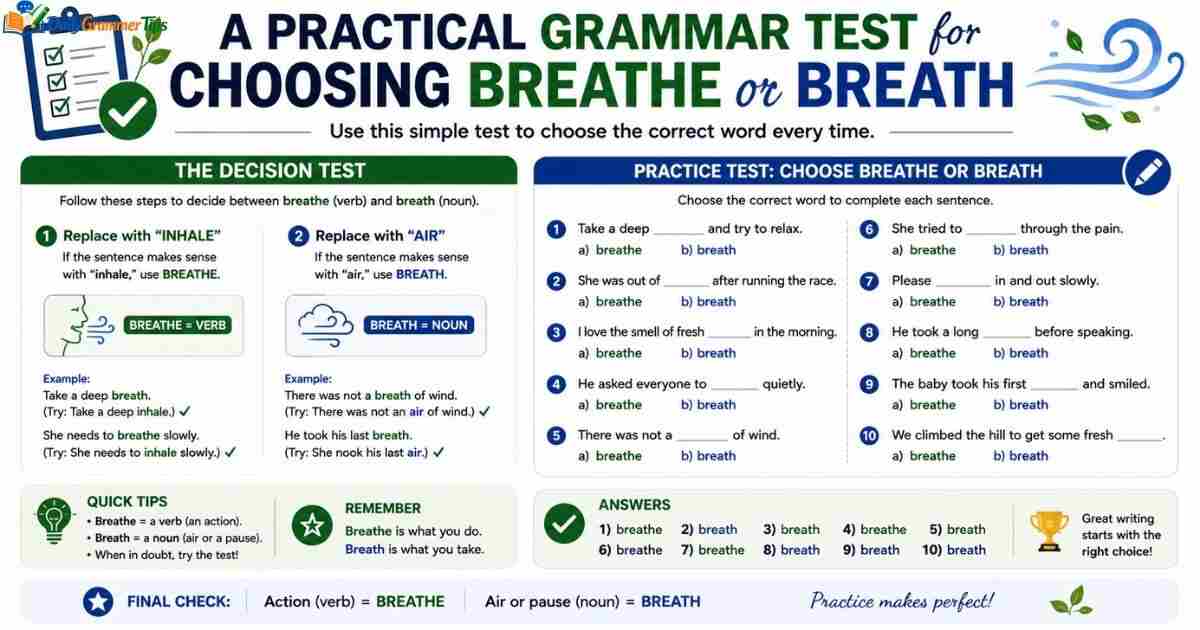
When you wonder whether to write breathe or breath, use a quick grammar test. This breath vs breathe test works well in everyday writing. First, ask whether you are naming air, a breathing cycle, or a condition. If yes, use breath. Second, ask whether you are describing inhaling and exhaling or another action. If yes, use breathe.
You can also test the sentence with substitutes. Replace breath with “air” or “breathing cycle.” If the sentence still works, breath may be correct. Replace breathe with another verb such as inhale, exhale, rest, or move. If the structure still works, breathe is likely correct.
For example, “Please breathe slowly” can become “Please inhale slowly,” so the verb form is right. “She took a breath” can become “She took in some air,” which confirms the noun idea.
With regular practice, breath vs breathe stops feeling like a difficult pair and becomes a simple noun and verb choice.
Breathe vs Breath Pronunciation
The breathe vs breath pronunciation difference becomes easy to notice when you say both words slowly. Breath pronunciation uses a short vowel sound and sounds roughly like “breth,” while breathe pronunciation uses a longer vowel sound and sounds more like “breeth.” This pronunciation difference also supports the main breath vs breathe grammar rule because breath is a noun and breathe is a verb. Understanding both English pronunciation and grammatical form makes these commonly confused words easier to use correctly.
A simple pronunciation guide can also improve your spoken English and word choice. Say “take a breath” with the shorter sound, then say “breathe deeply” with the longer sound. The first phrase uses the breath definition as a noun related to air, while the second uses the breathe definition as an action involving inhaling and exhaling. Practicing these sentence patterns helps English learners remember both the spelling difference and the difference between breath and breathe.
Breath vs Breathe of Fresh Air
The correct expression is “a breath of fresh air,” not “a breathe of fresh air.” In breath vs breathe usage, breath is a noun, so it correctly names the fresh air or refreshing feeling being described. The phrase can have a literal meaning when someone steps outside for clean air, but it often has a figurative meaning too. A new idea, person, or experience can feel like a breath of fresh air when it brings a welcome change.
Understanding the breathe meaning makes it clear why breathe does not fit this expression. Breathe is a verb and describes the action of taking air into and releasing it from the lungs. You can breathe fresh air, but you experience or enjoy a breath of fresh air. This noun and verb difference is an important part of breath vs breathe grammar and shows how correct usage depends on the role each word performs in a sentence.
I Can’t Breathe or Breath
“I can’t breathe” is the correct expression because the sentence needs a verb after “can’t.” Breathe is a verb that describes the act of breathing, including inhaling and exhaling air. Therefore, “I can’t breathe” means that a person cannot perform the respiratory action normally. In the breathe vs breath distinction, writing “I can’t breath” is incorrect because breath is a noun and cannot perform the required verb function.
You can understand the difference more clearly by comparing two sentence examples. “I can’t breathe properly” uses the verb form, while “I am short of breath” uses breath as a noun. Both relate to breathing, lungs, oxygen, inhalation, and exhalation, but their grammar is different. When deciding between breathe or breath, check whether the sentence needs an action or a thing. That simple rule usually gives you the correct answer.
Breath vs Breathe Meaning
The breath vs breathe meaning difference comes mainly from their grammatical roles. Breath meaning refers to the air inhaled or exhaled from the lungs, one breathing cycle, or the ability to breathe. Breath is a noun, so expressions such as “take a breath,” “hold your breath,” and “catch your breath” use it correctly. The breath definition can also appear in figurative expressions, but its basic grammatical form remains a noun.
Breathe meaning refers to the action of moving air into and out of the lungs. Breathe is a verb, so you can breathe deeply, breathe in, breathe out, or simply breathe normally. The difference between breath and breathe therefore comes down to a clear noun and verb difference. Remembering this grammar rule makes correct usage easier in both written English and spoken English.
Breathe vs Breath Examples
Breathe vs breath examples make the difference between these similar words much easier to understand. Consider the sentences “Take a deep breath before speaking” and “Breathe deeply before speaking.” In the first sentence, breath is a noun because it names what you take. In the second sentence, breathe is a verb because it describes what you do. Both relate to the same breathing process, yet each word performs a different grammatical job.
More breathe examples include “Breathe in slowly,” “Breathe out through your mouth,” and “She breathed deeply before entering the room.” Useful breath examples include “He was out of breath,” “She held her breath,” and “I stopped to catch my breath.” These usage examples show that breath vs breathe becomes much simpler when you focus on sentence structure rather than only looking at the similar English spelling.
Learn More…….Immigrate vs. Emigrate: What’s the Real Difference and Does It Matter?
Take a Deep Breath or Breathe
“Take a deep breath” is the correct expression when you are telling someone to complete one deep inhalation. Breath is a noun here because it acts as the object of the verb “take.” The phrase describes one breathing cycle in which someone draws air into the lungs, often before speaking, relaxing, or starting an activity. This common expression is one of the easiest ways to remember how to use breath correctly.
You can also say “breathe deeply,” but the grammatical structure changes. In this sentence, breathe is a verb and deeply describes how the person performs the action. For example, “Take a deep breath before the interview” and “Breathe deeply before the interview” are both correct, but they use different grammatical forms. This breathe vs breath comparison shows why understanding the noun form and verb form matters more than simply memorizing spelling.
Breath Meaning
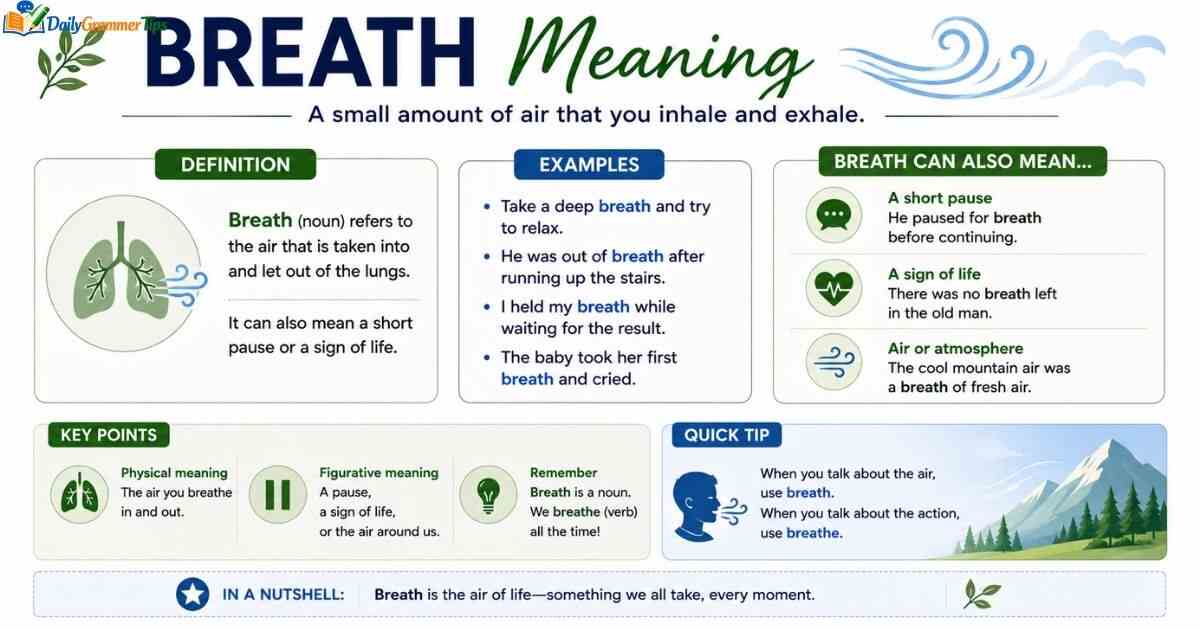
The basic breath meaning is the air that enters or leaves the lungs during respiration. Breath is a noun and can describe one inhalation, one exhalation, or a complete breathing cycle. You can take a breath, hold your breath, catch your breath, or become out of breath after physical activity. These common expressions show how the breath definition works naturally in English vocabulary and everyday communication.
Breath can also carry a figurative meaning. A person may describe a pleasant change as a breath of fresh air, or something beautiful may take your breath away. Even in these idiomatic expressions, breath still works as a noun. Understanding how to use breath in both literal and figurative contexts helps English learners improve their grammar rules, word choice, and correct usage.
Last Breath or Breathe
“Last breath” is the correct expression because breath is a noun. The phrase usually refers to the final breath a person takes at the end of life or, in figurative writing, the final moment of something. For example, “He remained with his family until his last breath” uses breath as the thing being described. In breathe vs breath grammar, “last breathe” is incorrect because breathe is a verb and cannot normally follow the adjective “last” in this structure.
Breathe can still appear in sentences about a final respiratory action, but the sentence must use it as a verb. For example, “He continued to breathe quietly” correctly uses breathe to describe an action. This distinction shows again that breath is a noun while breathe is a verb. Remembering the grammatical form makes phrases such as last breath, take a breath, breathe deeply, and breathe in much easier to write correctly.
Frequently Asked Questions
When to use breath or breathe?
Use breath when you need a noun for the air you inhale or exhale. Use breathe when you need a verb for the action of inhaling and exhaling.
Is it hold my breath or breathe?
“Hold my breath” is correct because breath is a noun. For example, you can say, “I held my breath underwater.”
Which is correct, breathe in or breath in?
“Breathe in” is correct because breathe is a verb. It means to inhale air into your lungs.
What does breathe mean?
Breathe means to take air into your lungs and release it again. It describes the action of inhaling and exhaling.
What do we mean by breath?
Breath means the air you inhale or exhale, or one complete breathing cycle. It functions as a noun in English grammar.
Conclusion
Understanding breath vs breathe becomes simple once you remember the basic grammar rule: breath is a noun, while breathe is a verb. Breath refers to the air you inhale or exhale, while breathe describes the action of inhaling and exhaling. Knowing this difference helps you improve word choice, sentence structure, English pronunciation, and correct usage in both spoken and written English.
The easiest way to avoid confusion is to check whether your sentence needs a thing or an action. Use breath in phrases like take a deep breath, hold your breath, and catch your breath, and use breathe in phrases like breathe deeply, breathe in, and breathe out. With a little practice, the breath vs breathe difference becomes natural and easy to remember.
