


Have you ever stopped while writing a sentence and wondered whether you should use immigrate or emigrate? You are not alone. Immigrate vs. Emigrate is one of the most commonly confused English word differences, especially when talking about people who move abroad or settle in a foreign country.
At first glance, the two words seem almost identical. Both relate to international migration, both describe people who move from one country to another, and both are connected to the idea of leaving one place and starting a new life somewhere else. However, there is a small but important difference in perspective.
Immigrate vs. Emigrate: The Basic Difference
The easiest way to remember Immigrate vs. Emigrate is to think about the first letters.
Immigrate starts with “I.” Think “In.”
When someone immigrates, they move into a new country.
Example:
Maria immigrated to Australia after receiving a work visa.
This means Maria entered Australia and became a resident there.
The word immigrate meaning is connected to entering a foreign country with the intention of living there permanently or for a significant period of time.
On the other hand:
Emigrate starts with “E.” Think “Exit.”
When someone emigrates, they exit their original country.
Example:
Maria emigrated from Brazil before moving to Australia.
This means Brazil was the country she left.
The emigrate meaning focuses on departure rather than arrival.
That is the main difference between emigrate and immigrate.
One describes moving to a new country, and the other describes moving away from the country where someone originally lived.
What Does Emigrate Mean?
Many English learners ask, “What does emigrate mean?”
The answer is simple:
To emigrate means to leave your own country and move to another country where you plan to live.
The person who does this is called an emigrant.
For example:
Thousands of people emigrated from Ireland during difficult economic periods.
The focus is Ireland, the country of origin, because those people left Ireland.
The emigrant definition is:
A person who leaves their home country to settle in another country.
An emigrant is usually described from the viewpoint of the country they departed from.
Common examples:
- An Indian citizen who leaves India to live in the United States is an emigrant from India.
- A person leaving Germany to settle in Canada is an emigrant from Germany.
- Someone leaving their home country for better opportunities abroad is an emigrant.
Immigrate vs emigrate reddit
The immigrate meaning is the opposite side of the same movement.
To immigrate means to enter a foreign country and establish residence there.
The person is called an immigrant.
The immigrant definition is:
A person who comes into another country to live.
Example:
John immigrated to the United Kingdom after completing his education.
The focus is the destination country, which is the United Kingdom.
An immigrant is viewed from the perspective of the country they entered.
Examples:
- Someone who moves to America from Japan is an immigrant in America.
- Someone who settles in France after leaving Spain is an immigrant in France.
- A foreign national who gains permanent residence in another country becomes an immigrant.
The Difference Between Immigrate and Emigrate Depends on Perspective
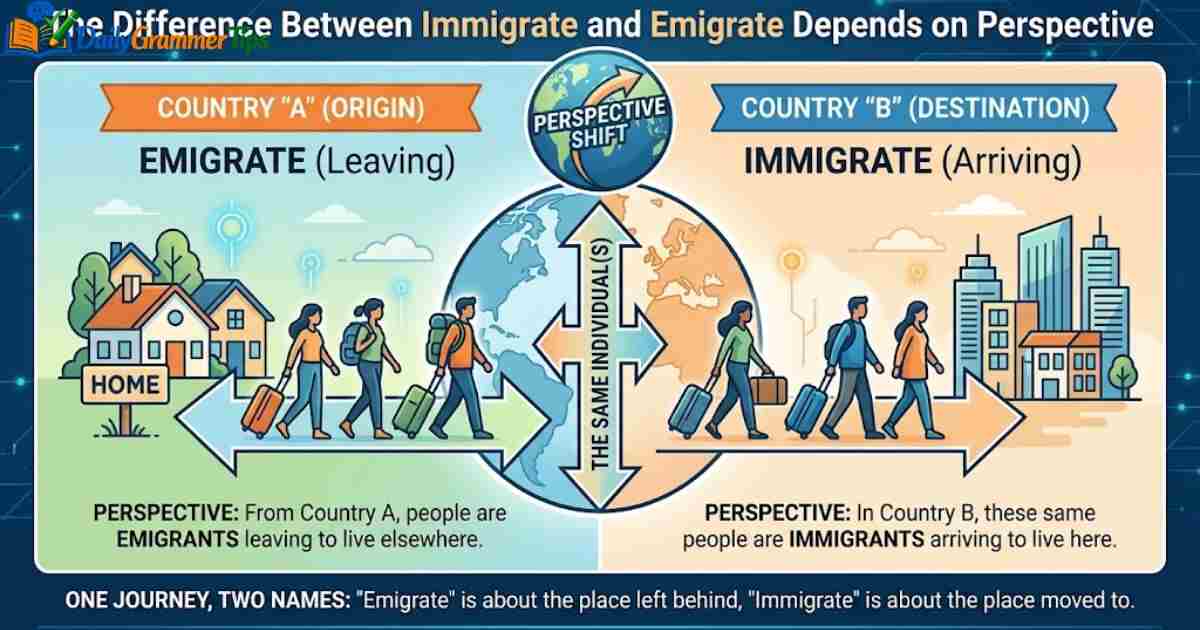
The biggest reason people struggle with Immigrate vs. Emigrate is because both words describe the same event.
Imagine a person named Daniel.
Daniel was born in Argentina.
Later, he moves to Canada.
From Argentina’s perspective:
Daniel emigrated from Argentina.
Argentina is his country of origin.
From Canada’s perspective:
Daniel immigrated to Canada.
Canada is his destination country.
So was Daniel an immigrant or an emigrant?
The answer is:
He was both.
He was an emigrant when viewed from Argentina.
He was an immigrant when viewed from Canada.
This is why the difference between immigrant and emigrant is not about different people. It is about the direction of movement and the observer’s viewpoint.
Why Are Immigrate and Emigrate Commonly Confused Words?
The reason immigrate vs. emigrate causes confusion is because the words share the same Latin roots.
Both words come from Latin origins related to movement.
The prefix meaning helps explain their differences:
- “Im” relates to movement inward.
- “E” relates to movement outward.
These English prefixes provide a helpful vocabulary lesson for understanding word origins.
Many English learners struggle with words that have similar spelling but different meanings. These are called commonly confused words.
Other examples include:
- accept and except
- affect and effect
- advice and advise
Learning these differences improves English grammar and overall language usage.
Historical Examples of Immigrate vs. Emigrate
Although grammar books often teach a strict rule, language usage has always been more complicated.
Historical records show that people sometimes used emigrate and immigrate differently than modern grammar rules suggest.
For example, old immigration documents sometimes described people as having “emigrated to” a country instead of “emigrated from” a country.
At first, this may seem incorrect.
However, language changes over time. Words are shaped by culture, historical events, and everyday communication.
The movement of people across borders has existed for thousands of years. Human migration, relocation, resettlement, and global movement have always influenced language.
People have moved because of:
- economic opportunities
- religious freedom
- political changes
- wars
- family connections
- education
- safety
These migration patterns created new words and different ways of describing movement.
Immigration vs. Emigration: Understanding the Bigger Picture
The terms immigration and emigration describe larger processes.
Immigration focuses on people entering a country.
Example:
Immigration policies determine who can enter a nation.
Emigration focuses on people leaving a country.
Example:
Economic problems increased emigration from the region.
The difference between immigration vs emigration is the same as the difference between immigrate and emigrate.
Immigration = entering.
Emigration = leaving.
Both are parts of international migration.
Sentence Examples: Immigrated or Emigrated?
A common question is:
Should I say someone immigrated or emigrated?
The answer depends on what you want to emphasize.
Examples:
Correct:
My grandfather emigrated from Italy in 1920.
Focus: Italy was the country he left.
Correct:
My grandfather immigrated to America in 1920.
Focus: America was the country he entered.
Also possible:
My grandfather moved abroad from Italy to America.
This avoids choosing between the two words.
Another example:
Millions of migrants have immigrated to different countries seeking new opportunities.
Focus: arrival.
Millions of migrants have emigrated from their home countries because of economic challenges.
Focus: departure.
Does the Difference Between Immigrate and Emigrate Really Matter?
Yes, but not in every situation.
Understanding Immigrate vs. Emigrate helps you communicate clearly, especially in formal writing, journalism, academic work, and discussions about international migration.
However, language is flexible.
Sometimes speakers choose one word because it sounds more natural or because the focus is obvious from context.
The important thing is understanding the meaning behind the words.
Knowing the difference between immigrate and emigrate helps prevent writing mistakes and improves word choice.
For English learners, mastering these migration vocabulary terms makes communication more accurate.
Immigrate vs emigrate vs migrate
Understanding Immigrate vs emigrate vs migrate can help English learners avoid confusion when talking about international movement. All three words describe movement, but they have different meanings. Migrate is the general term for moving from one place to another, while immigrate and emigrate describe movement between countries from different perspectives.
The main difference is direction. People immigrate when they enter a new country to live there, and they emigrate when they leave their home country to settle somewhere else. Learning these migration terms makes it easier to understand human migration, relocation, and international movement.
Immigrate vs migrate
The difference between immigrate vs migrate is that immigrate is a specific type of migration. The immigrate meaning focuses on entering a foreign country and becoming a resident, while migrate simply means moving from one location to another.
For example, a person who moves from Mexico to the United States is migrating, but they are also immigrating to the United States because they are entering a new destination country. Migration can include seasonal movement, relocation, or an overseas move.
Immigrate vs emigrate meaning
The immigrate vs emigrate meaning depends on whether you are focusing on arrival or departure. The difference between immigrate and emigrate is that immigrate means moving into a country, while emigrate means leaving a country.
When people ask what does emigrate mean, the answer is that it describes someone leaving their country of origin to live somewhere else. The emigrate meaning focuses on the place a person leaves and the journey toward a new homeland.
Immigrate vs emigrate vs immigrant
The difference between immigrate vs emigrate vs immigrant is that immigrate and emigrate are actions, while immigrant describes a person. An immigrant is someone who enters another country to live, while an emigrant is someone who leaves their original country
.
A person can be both an immigrant and an emigrant at the same time. For example, someone who leaves India and moves to Canada is an emigrant from India and an immigrant in Canada. The difference depends on the viewpoint being used.
Immigrate vs emigrate examples
Looking at immigrate vs emigrate examples makes the difference easier to understand. For example, “She immigrated to Australia” focuses on Australia because it describes the country she entered.
Another example is “She emigrated from France.” This sentence focuses on France because it explains the country she left. Understanding whether someone immigrated or emigrated depends on whether you are talking about entering a country or leaving one.
Immigrate vs emigrate pronunciation
The pronunciation of Immigrate vs emigrate can be confusing because both words look and sound similar. However, the first syllable is slightly different. Immigrate begins with an “im” sound, while emigrate begins with an “em” sound.
For English learners, learning pronunciation together with meaning improves language usage and vocabulary skills. Correct pronunciation helps avoid misunderstandings when discussing immigration, emigration, and migration topics.
Immigrate vs emigrate reddit
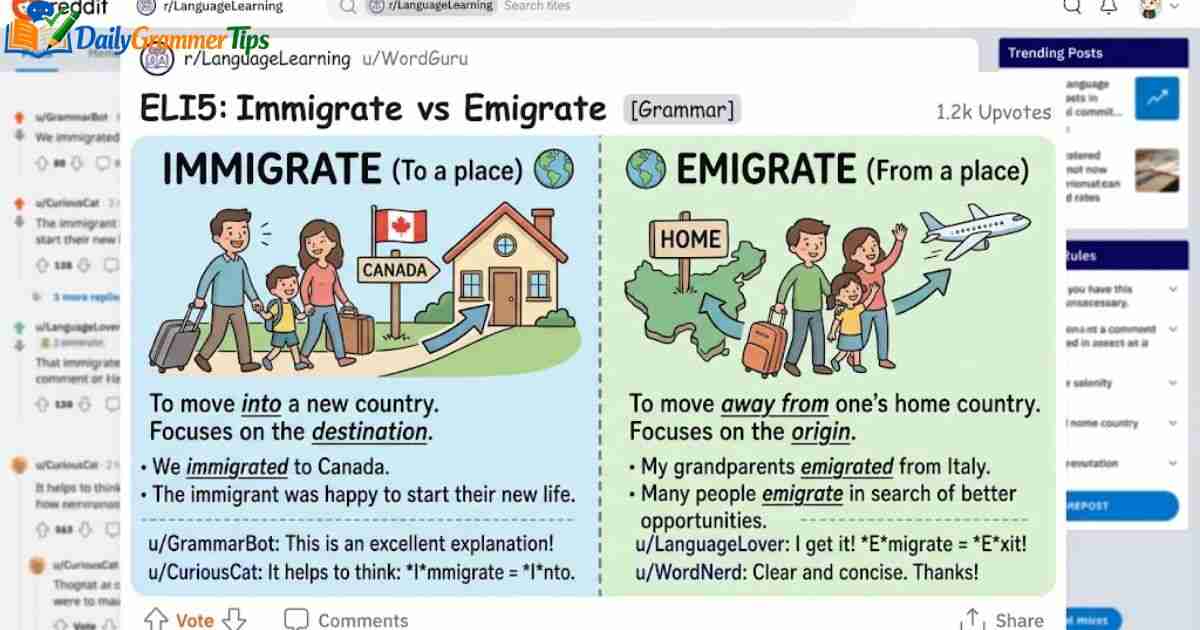
Discussions about Immigrate vs emigrate Reddit often show that many people have questions about the correct usage of these words. Some explain traditional grammar rules, while others discuss how people use these words in everyday conversations.
The general rule remains simple: people immigrate to a country and emigrate from a country. However, language can sometimes change depending on context, perspective, and common usage. Understanding the meaning is more important than memorizing only one rule.
Immigrate emigrate and migrate
The relationship between immigrate emigrate and migrate becomes clear when you understand that migration is the broad concept. Migration describes movement, while immigration and emigration describe specific directions of that movement.
When someone moves abroad, they migrate. They immigrate into their new country and emigrate from their previous country. These terms help explain global movement, international migration, and the experiences of migrants around the world.
Frequently Asked Questions
What Does “Complimentary” Mean?
Complimentary means something given free of charge, such as a complimentary meal at a hotel. It can also describe a positive comment that shows praise or admiration.
What Are the Four Types of Complements?
The four types of complements are subject complements, object complements, adjective complements, and verb complements. They add extra information and complete the meaning of sentences.
What Are Different Types of Compliments?
Different types of compliments include personality, appearance, skill, and achievement compliments. People use them to show appreciation, respect, or admiration.
Is It Correct to Say Compliments?
Yes, “compliments” is the correct plural form when talking about multiple expressions of praise. For example, “She received many compliments on her work.”
What’s the Difference Between Complementary and Complimentary?
Complementary means two things that complete or match each other, while complimentary means free or showing praise. The difference depends on whether you mean “complete” or “compliment.”
Conclusion
Understanding Immigrants vs. Emigrate becomes much easier when you remember that both words describe the same movement but from different perspectives. Immigrate focuses on entering a new country, while emigrate focuses on leaving a country of origin. Whether someone is an immigrant or an emigrant depends on the viewpoint, destination, and direction of the international migration.
By learning the difference between immigrate and emigrate, you can improve your English grammar, vocabulary, and everyday communication. These migration terms are commonly used when discussing relocation, moving abroad, citizenship, and global movement. Once you understand the meaning behind these commonly confused words, choosing the correct word becomes simple and natural.
