

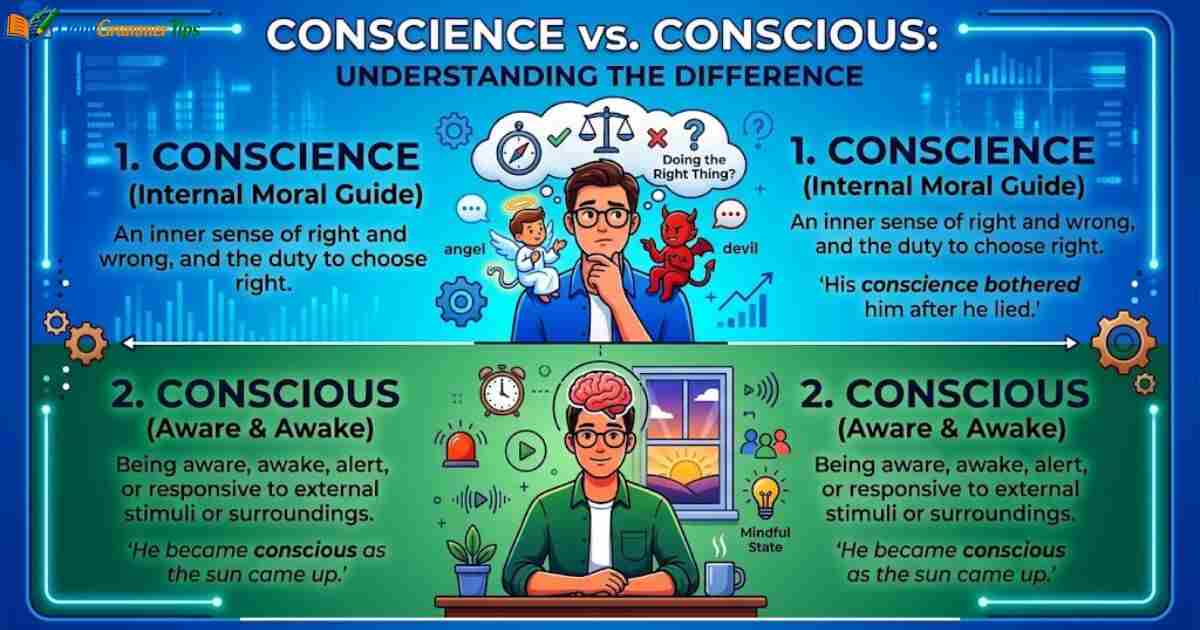
Conscience vs. Conscious explains the difference between two commonly confused English words with distinct meanings and grammatical roles. Conscience is a noun that describes your inner sense of right and wrong, while conscious is an adjective that means awake, aware, or mentally alert.
Mixing these words can completely change the meaning of a sentence, even though their spelling and pronunciation look similar. Once you connect conscience with your moral compass and conscious with awareness, you can confidently choose the right word in everyday writing and conversation.
Conscience vs. Conscious
Conscience vs. Conscious is a common English grammar topic because these two words look and sound similar, but they have very different meanings. Understanding their grammatical usage makes the correct word choice much easier.
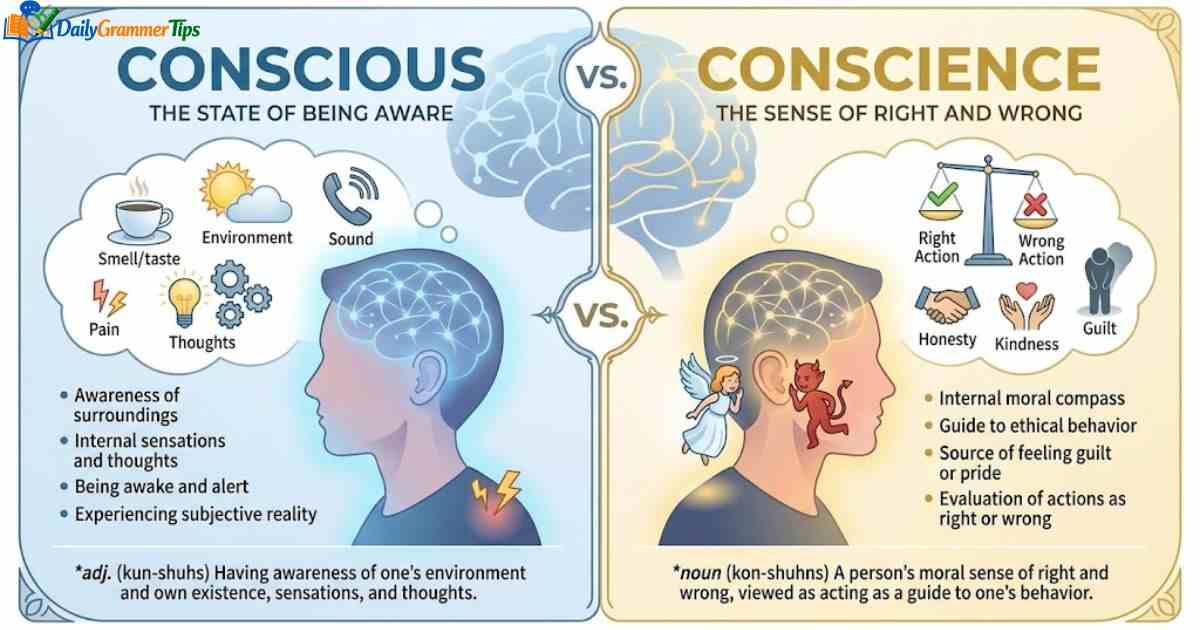
A conscience is the inner sense that helps a person judge whether an action is morally right or wrong. It connects with morality, ethics, personal values, responsibility, guilt, integrity, and moral judgment. You can think of your conscience as an inner voice or moral compass that influences your decision-making and ethical behavior.
Conscious, on the other hand, describes awareness. When someone is conscious, that person is awake and alert and can recognize what is happening around them. The word may also describe intentional awareness of thoughts, feelings, actions, or surroundings.
The basic difference between conscience and conscious also appears in grammar. Conscience functions as a noun, while conscious normally functions as an adjective. This distinction is one of the easiest ways to understand Conscience vs. Conscious.
Consider these examples:
She had a guilty conscience after telling the lie.
He remained conscious after the accident and answered every question.
In the first example, conscience refers to a sense of right and wrong. In the second, conscious describes someone’s mental state and awareness.
Because they have similar spelling and pronunciation, learners often mix them up. However, once you connect conscience with ethical judgment and conscious with awareness, Conscience vs. Conscious becomes much easier to understand.
Using Conscience in a Sentence
To understand Conscience vs. Conscious, it helps to look closely at how conscience in a sentence works. The conscience meaning relates to a person’s internal understanding of morality and ethical choices.
Because conscience is a noun, it can serve as the subject or object of a sentence. People commonly use it when discussing guilt, remorse, responsibility, principles, personal beliefs, and moral decisions.
Here are some examples of conscience in a sentence:
- Her conscience told her to return the money she had found.
- He could not lie to his family with a clear conscience.
- His guilty conscience kept bothering him after he broke his promise.
- My conscience would not allow me to take credit for another person’s work.
- She followed her conscience and admitted the mistake.
These example sentences show that conscience is not simply about thoughts and feelings. It specifically involves moral judgment and a person’s sense of right and wrong. When studying Conscience vs. Conscious, ask whether the sentence refers to ethics or moral principles. If it does, conscience will often be the correct choice.
You can also use expressions such as clear conscience, guilty conscience, and moral conscience. Practicing conscience in a sentence several times can improve your English vocabulary and help you remember the correct spelling.
Using Conscious in a Sentence
The other half of Conscience vs. Conscious deals with awareness. The conscious meaning describes someone who is aware, awake, or mentally alert. It can also describe an intentional or deliberate action.
Since conscious is an adjective, it usually describes a person, thought, decision, effort, or mental state. A simple conscious sentence might describe whether someone is awake or aware of something.
Examples of conscious in a sentence include:
- The patient remained conscious while the doctor examined him.
- She became conscious of everyone looking at her.
- He made a conscious effort to arrive on time.
- I was conscious of the noise coming from the next room.
- She stayed conscious and attentive throughout the conversation.
Each conscious sentence shows some form of awareness, alertness, perception, or intentional behavior. When you use conscious in a sentence, remember that the word describes a condition or quality rather than naming a moral faculty.
Another useful distinction in Conscience vs. Conscious involves consciously and consciousness. Consciously is an adverb that describes doing something with awareness or intention. Consciousness is a noun referring to a state of awareness.
For example:
He consciously changed his daily routine.
She regained consciousness a few minutes later.
Learning these related forms can strengthen your understanding of Conscience vs. Conscious and make each conscious sentence easier to construct.
Remembering the Difference Between Conscious and Conscience
A useful memory trick can make Conscience vs. Conscious much easier to remember. Start with the central meanings.
- Conscience deals with morality.
- Conscious deals with awareness.
When you face these commonly confused words, ask yourself one simple question. Am I talking about a moral compass or about being aware?
If the sentence involves ethics, guilt, integrity, moral principles, responsibility, or right and wrong, choose conscience. If it involves wakefulness, alertness, mental awareness, mindfulness, perception, or an intentional action, choose conscious.
Another helpful mnemonic comes from the spelling. Conscience contains the word science at the end. This visual pattern can help you remember how to spell conscious differently from conscience. When trying to spell conscious, notice that it ends in ious, while conscience ends in ience.
Repeated practice is especially useful. Write one conscious sentence, then write one sentence about conscience. Comparing the two forms reinforces both their spelling and meaning.
The central rule for Conscience vs. Conscious remains simple: conscience judges right and wrong, while conscious describes awareness.
Conscious Conscience
The words can even appear close together because they describe different ideas. Understanding this possibility gives you a deeper grasp of Conscience vs. Conscious.
A person can be conscious of their conscience. In other words, someone can be aware of the moral judgment happening in their own mind. For example, a person might consciously consider whether a decision agrees with their personal values and principles.
Think about someone who finds a lost wallet. The person’s conscience may encourage them to return it because keeping it would feel wrong. At the same time, they may be conscious of the choice they are making and the possible consequences.
This illustrates the difference clearly. Conscience represents the moral compass involved in decision-making. Conscious describes awareness of the situation, thoughts, feelings, or actions.
Therefore, Conscience vs. Conscious is not simply a spelling issue. The two words represent separate concepts that can sometimes operate together.
Are You Conscious?
When someone asks, “Are you conscious?” they are normally asking whether you are awake, alert, and responsive. This meaning is important when learning Conscience vs. Conscious because conscious often describes a person’s state of awareness.
Someone who is conscious can usually perceive and respond to their surroundings. The opposite condition is unconscious, which refers to a lack of conscious awareness. Related concepts include unconsciousness, subconscious thought, cognition, perception, and mental awareness.
However, conscious does not only refer to wakefulness. It can also mean being aware of something.
For example:
- She was conscious of the time.
- He was conscious of his responsibilities.
- They made a conscious decision to reduce unnecessary spending.
In these examples, conscious refers to awareness or deliberate intention. This is why practicing conscious in a sentence helps learners recognize its different uses.
When learning how to spell conscious, connect the spelling with the idea of being aware. If you can remember that conscious is an adjective associated with awareness, Conscience vs. Conscious becomes easier to manage.
Mind Your Conscience

Your conscience concerns moral judgment rather than physical or mental alertness. In Conscience vs. Conscious, this distinction is essential.
People often describe conscience as an internal guide that influences ethical choices. It can produce guilt or remorse when someone acts against their moral principles. It may also create peace of mind when a person believes they have acted fairly and responsibly.
For example:
- His conscience bothered him until he apologized.
- She had a clear conscience because she had told the truth.
- He followed his conscience instead of choosing the easier option.
These examples of conscience in a sentence show how the word connects with morality, ethics, values, responsibility, and integrity.
Your conscience does not physically speak, but people often describe it as an inner voice because it can influence judgment and behavior. Remembering this association provides another practical way to master Conscience vs. Conscious.
Conscience Definition
A simple conscience definition is a person’s internal sense of what is morally right or wrong. The word is a noun and often refers to the moral principles that influence someone’s actions and decisions.
For example, if someone feels guilty after behaving dishonestly, that feeling may come from their conscience. If someone refuses to do something unethical because it conflicts with their values, their conscience has influenced the decision.
The conscience meaning therefore connects naturally with:
- morality
- ethics
- guilt
- remorse
- integrity
- moral judgment
- personal values
- ethical behavior
- responsibility
- right and wrong
When comparing Conscience vs. Conscious, remember that a conscience evaluates behavior from a moral perspective. It does not mean general awareness or wakefulness.
Understanding the conscience definition also makes expressions such as guilty conscience, clear conscience, and moral conscience easier to understand.
In Good Conscience Meaning
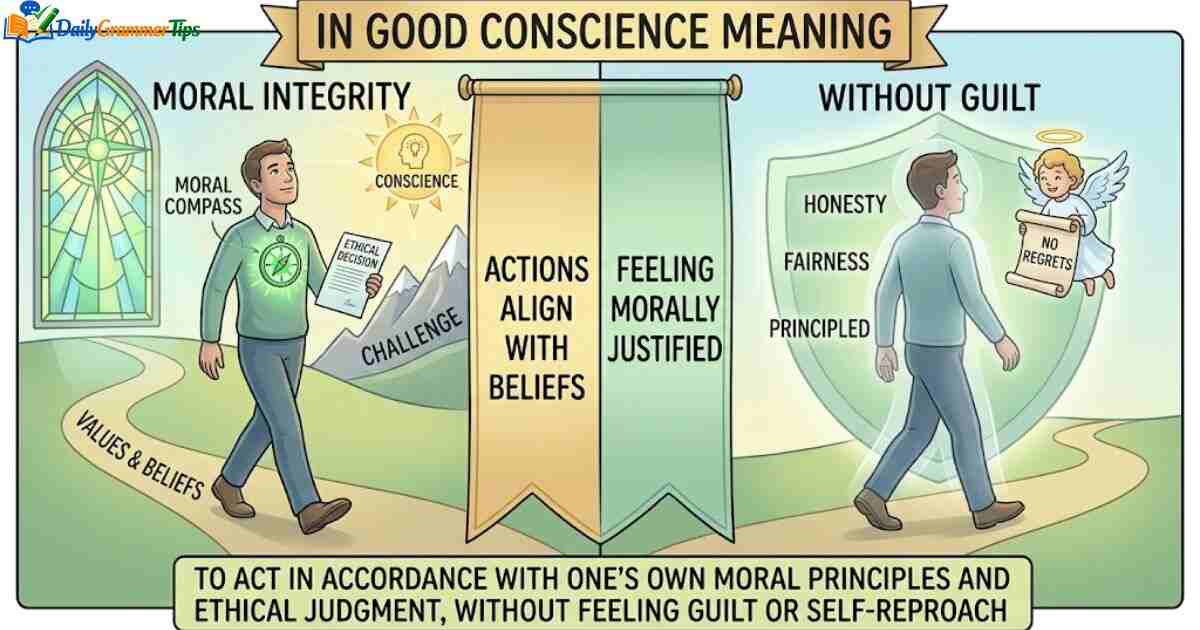
The phrase in good conscience refers to doing or accepting something while believing that it is morally right, fair, or acceptable. People often use the expression when discussing difficult decisions.
For example:
I cannot in good conscience support a dishonest decision.
She could not in good conscience blame someone else for her mistake.
He felt he could accept the offer in good conscience.
The phrase is closely connected to ethical judgment, personal beliefs, moral principles, and responsibility. Someone who says they cannot do something “in good conscience” usually means that the action conflicts with their values or sense of right and wrong.
This expression provides another useful way to understand Conscience vs. Conscious. The phrase relates to morality, so it requires conscience, not conscious.
The in good conscience meaning becomes easier to remember when you connect it with having a clear conscience after making an ethical choice.
Conscious Definition
A straightforward conscious definition is awake, aware, or able to recognize what is happening. Conscious is an adjective, which separates it grammatically from the noun conscience.
- The conscious meaning can refer to physical awareness:
- The injured man was still conscious.
- It can refer to awareness of something:
- She was conscious of a change in his voice.
- It can also describe an intentional or deliberate action:
- He made a conscious choice to exercise every morning.
These uses involve awareness, alertness, wakefulness, mindfulness, cognition, or intention rather than morality.
The conscience pronunciation and conscious pronunciation can contribute to confusion because the words sound somewhat similar. Their spellings are also close. However, focusing on their grammatical roles and meanings makes Conscience vs. Conscious much clearer.
If you are wondering how to spell conscious, remember its ending: conscious ends with ious. Practicing how to spell conscious alongside its definition can prevent common spelling mistakes.
Learn more about…..Oversite vs Oversight: Meaning, Usage, and Differences
Conscientious Meaning
Conscientious is another related word that can make Conscience vs. Conscious seem more complicated. However, its meaning becomes easier once you understand its connection with conscience.
A conscientious person takes responsibilities seriously and tries to do things correctly and carefully. The word can describe someone who is diligent, responsible, attentive, and guided by a desire to do what is right.
For example:
- She is a conscientious employee who checks her work carefully.
- He was conscientious about completing every assignment on time.
- The nurse remained conscientious in caring for her patients.
Although conscientious resembles both conscience and conscious in spelling, it has its own grammatical usage. It functions as an adjective.
A useful way to remember the conscientious meaning is to associate it with responsibility and careful behavior. This connection also expands your English vocabulary while helping you distinguish Conscience vs. Conscious.
Self Conscious Meaning
Self-conscious describes being strongly aware of yourself, particularly how you appear or how other people may perceive you. This awareness can sometimes make a person feel uncomfortable, nervous, embarrassed, or awkward.
For example:
- He felt self-conscious about speaking in front of the class.
- She became self-conscious when everyone looked at her.
- I felt self-conscious about my pronunciation during the presentation.
The self conscious meaning therefore relates to awareness rather than moral judgment. It comes from the idea of being conscious of yourself.
This distinction matters when studying Conscience vs. Conscious. Being self-conscious does not mean that your conscience is judging whether your behavior is morally right or wrong. Instead, it describes heightened awareness of yourself.
The word also demonstrates why understanding related vocabulary is more useful than simply memorizing spelling. Consciousness, consciously, self-conscious, subconscious, unconscious, awareness, perception, and mindfulness all connect in some way with mental awareness.
A final memory trick can keep Conscience vs. Conscious clear. Use conscience when you mean the inner moral compass that deals with ethics and right and wrong. Use conscious when you mean awake, aware, attentive, or intentional.
Whenever you hesitate between Conscience vs. Conscious, identify the grammatical role first. If you need a noun for moral judgment, choose conscience. If you need an adjective for awareness, choose conscious. This simple grammar rule, combined with regular example sentences, makes Conscience vs. Conscious much easier to remember.
Conscience vs Conscious Pronunciation
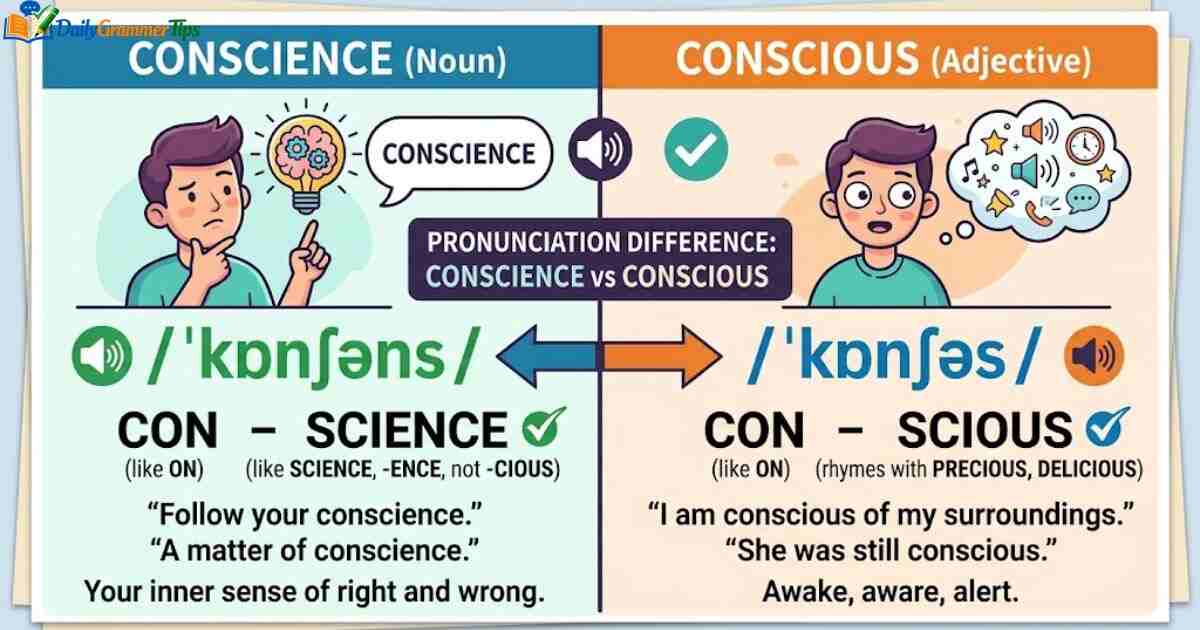
The Conscience vs. Conscious pronunciation difference is small but important. Conscience is pronounced roughly as “KON shuhns,” while conscious sounds like “KON shuhs.” The words begin almost the same way, which explains why English learners often confuse them. The ending provides the easiest clue. Conscience has an extra “n” sound near the end, while conscious finishes with a softer “shuhs” sound.
You can improve pronunciation by connecting each word with its meaning. Conscience is a noun linked with morality and a sense of right and wrong, while conscious is an adjective connected with awareness and alertness. If you struggle with how to spell conscious, repeat the word while writing a short conscious sentence. Practicing conscious in a sentence and conscience in a sentence also helps you remember their different sounds, spellings, and grammatical roles.
Conscience vs Conscious Meaning
The Conscience vs. Conscious meaning becomes easier once you separate morality from awareness. Conscience refers to the inner sense that helps you decide whether your behavior is right or wrong. It works like a moral compass and can influence decision making, ethical behavior, responsibility, and personal values. A guilty conscience may create remorse after a dishonest action, while a clear conscience suggests that you believe you acted according to your principles.
Conscious means awake, aware, or able to recognize what is happening. It can also describe something done deliberately. For example, making a conscious choice means making that choice intentionally. The main difference between conscience and conscious is therefore straightforward: conscience deals with moral judgment, while conscious deals with awareness or intention. Remembering this distinction makes Conscience vs. Conscious much easier to use correctly in everyday English.
Conscience vs Conscious Examples
Looking at Conscience vs. Conscious examples shows how the words function differently. A correct conscience in a sentence would be, “Her conscience told her to return the money.” You could also say, “He developed a guilty conscience after lying to his friend.” In both examples, conscience acts as a noun and represents an inner voice that evaluates actions according to morality, ethics, personal beliefs, and principles.
A conscious sentence focuses on awareness or deliberate action. For example, “The patient remained conscious during the examination” describes someone who stayed awake and alert. “She made a conscious decision to speak more carefully” describes an intentional choice. Writing conscious in a sentence several times can help you spell conscious correctly and recognize when the adjective belongs in a sentence instead of conscience.
Conscience vs Conscious Psychology
From a psychological perspective, Conscience vs. Conscious involves different aspects of human experience. Being conscious generally refers to having awareness of thoughts, feelings, sensations, or surroundings. Conscious awareness allows a person to notice information, direct attention, process experiences, and make deliberate choices. Related ideas include consciousness, cognition, perception, mindfulness, wakefulness, alertness, and a person’s current mental state.
Conscience has a narrower moral meaning. It involves the internal standards people use when evaluating whether their own actions agree with their values or beliefs about right and wrong. When behavior conflicts with those standards, a person may experience guilt or remorse. Therefore, conscience should not be treated as another word for consciousness. In Conscience vs. Conscious, conscience concerns moral judgment, while conscious describes awareness.
Conscience vs Conscious vs Subconscious
The difference in Conscience vs. Conscious vs. subconscious becomes clearer when each term has a separate role. Conscience relates to ethical judgment and your sense of right and wrong. Conscious describes what you currently notice or recognize. Someone who is conscious is aware of their surroundings, thoughts, or actions and may make intentional decisions based on that awareness.
The subconscious generally refers to mental activity outside immediate conscious awareness that may still influence thoughts, feelings, habits, or behavior. It should not be confused with a moral conscience. A simple memory trick is to associate conscience with your moral compass, conscious with present awareness, and subconscious with mental processes outside immediate awareness. These associations make Conscience vs. Conscious easier to remember without relying only on spelling.
Guilty Conscience vs Conscious
A guilty conscience means feeling guilt or remorse because you believe you have done something wrong. Imagine that someone knowingly tells a lie and later regrets it. Their conscience may trouble them because their behavior conflicts with their moral principles or personal values. In this expression, conscience is a noun representing moral judgment rather than a general mental state.
Conscious cannot replace conscience in the expression “guilty conscience.” However, someone can be conscious of their guilt, meaning they are aware of that feeling. This difference demonstrates why grammatical usage matters when learning Conscience vs. Conscious. If the idea involves ethics, responsibility, integrity, or right and wrong, conscience is usually appropriate. If it involves being aware, awake, attentive, or deliberate, conscious is the better word.
Conscience vs Conscious Etymology
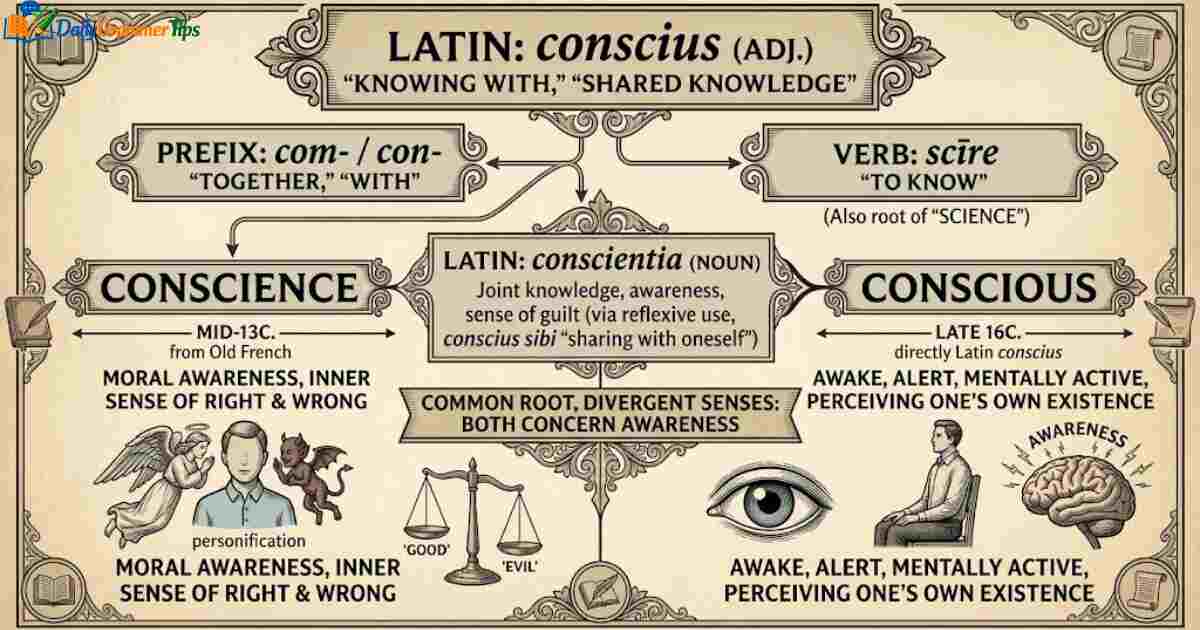
The Conscience vs. Conscious etymology explains why these two English words have such similar forms. Both ultimately trace back to Latin roots associated with knowing or being aware of something. Conscience developed a specialized connection with inner moral knowledge, which eventually gave the word its modern association with morality, ethical choices, guilt, integrity, and judgments about right and wrong.
Conscious developed from related linguistic roots but came to describe awareness or knowledge of one’s surroundings, thoughts, and actions. Their shared history helps explain the similar spelling, yet their modern meanings remain distinct. If you are learning how to spell conscious, pay attention to its “ious” ending. Connecting that spelling with awareness gives you a practical mnemonic and makes the Conscience vs. Conscious distinction easier to recall.
Conscience Pronunciation
Conscience pronunciation can initially seem difficult because its spelling does not perfectly reveal how English speakers normally say it. The word is pronounced approximately “KON shuhns,” with the main stress on the first syllable. Saying it slowly and then repeating it naturally can help learners become comfortable with both its sound and spelling.
Sentence practice makes the pronunciation easier to remember. Try a conscience in a sentence such as, “My conscience told me to apologize.” Then compare it with a conscious sentence such as, “He was conscious of the people around him.” Using conscious in a sentence while practicing how to spell conscious strengthens pronunciation, vocabulary, and word choice together. This approach can help you master Conscience vs. Conscious instead of memorizing each word in isolation.
Frequently Asked Questions
What is the difference between conscience and consensus?
Conscience is your inner sense of right and wrong, while consensus means general agreement among a group of people. The two words have completely different meanings.
Is it on my conscious or conscience?
The correct phrase is “on my conscience.” It means something is causing you guilt, worry, or moral concern because of an action or decision.
What is the difference between a conscious decision and a conscience decision?
A conscious decision is a deliberate, intentional choice you make with full awareness. Conscience decision is not the usual phrase; instead, say a decision guided by your conscience when morality influences your choice.
What does having a conscience mean?
People usually mean “having a conscience,” which means having a sense of right and wrong. Being conscious means being awake, aware, and responsive to your surroundings.
What is conscious vs conscience?
In Conscience vs. Conscious, conscience is a noun related to moral judgment, while conscious is an adjective describing awareness or alertness. Think of conscience as your moral compass and conscious as being aware.
Conclusion
Understanding Conscience vs. Conscious becomes simple when you connect each word with its main purpose. Conscience is a noun that reflects your moral compass, personal values, ethical judgment, and sense of right and wrong. Conscious, however, is an adjective that describes awareness, alertness, wakefulness, or an intentional action. This basic difference helps you choose the correct word naturally.
To remember Conscience vs. Conscious, associate conscience with morality, guilt, responsibility, and ethical choices, while linking conscious with the conscious mind, perception, mindfulness, and mental awareness. Practice using conscience in a sentence and conscious in a sentence to strengthen your spelling, pronunciation, and grammatical usage. With regular practice, these commonly confused words become much easier to recognize and use correctly.
