


Active vs passive voice explains how a sentence connects the subject with the action. In active voice, the subject performs the action, while in passive voice, the subject receives the action. Understanding active vs passive voice helps writers control sentence structure, grammatical voice, sentence focus, clarity, and readability in academic writing, professional writing, creative writing, and everyday communication.
A small change in voice can completely change how a sentence feels. One version can sound direct, confident, and clear, while another can shift attention toward the receiver of the action or hide the agent entirely. Once you learn how active and passive voice work, you can write with more purpose, reduce wordiness, improve sentence clarity, and choose the structure that gives your message the strongest impact.
What Active vs Passive Voice Means in English Grammar
In English grammar, voice shows the relationship between the grammatical subject and the action expressed by the verb. Active vs passive voice therefore describes two different ways to organize the same basic event.
In active construction, the subject performs the action. Consider this active sentence: “The editor revised the article.” The grammatical subject is “the editor,” the active verb is “revised,” and “the article” is the grammatical object.
In passive construction, the object of the active sentence moves into the subject position. The same idea becomes: “The article was revised by the editor.” Now “the article” receives the action. The phrase “was revised” combines a form of “to be” with a past participle, and the by phrase identifies who performed the action.
The event remains similar, but active vs passive voice changes the sentence emphasis. Active construction emphasizes the actor. Passive construction can emphasize the action, emphasize the recipient, or remove attention from the actor.
How Active Voice Builds Direct and Clear Writing
Active voice usually supports clear writing because readers quickly see who performs an action. When writers use active vs passive voice intentionally, they can reduce unnecessary complexity and improve readability.
This does not mean every active sentence is automatically strong writing. However, active construction often makes effective writing easier because active vs passive voice makes the relationship between the subject, verb, and object easier to evaluate.
Active vs passive voice also affects reader engagement. “Our team solved the problem” has more energy than “The problem was solved by our team.” An active construction identifies the doer immediately and moves the reader toward the action without unnecessary wordiness.
This quality makes active voice especially valuable in professional writing, persuasive writing, narrative writing, and informal writing. Readers generally understand a sentence faster when the actor, active verb, and grammatical object appear in a logical order.
Active voice can also increase accountability. When you write “The manager changed the schedule,” readers know who made the decision. A vague passive construction such as “The schedule was changed” removes that information.
How Passive Voice Changes Sentence Focus
Passive voice changes what the reader notices first. That makes active vs passive voice a question of rhetorical emphasis as much as grammar rules.
Consider these two sentences: “The storm damaged three homes.” “Three homes were damaged by the storm.” The first sentence emphasizes the subject that caused the damage. The second sentence emphasizes the recipient of the action.
In active vs passive voice, a passive sentence often uses a helping verb or auxiliary verb followed by a past participle. A be verb frequently appears in passive construction, although writers should not assume that every form of “to be” creates passive voice.
When writers compare active vs passive voice, they should ask what information deserves attention. If the actor matters most, active voice usually works better. If the result matters more, passive voice can create useful sentence emphasis without weakening the message.
This difference becomes important when sentence focus affects the meaning of a paragraph. A writer may want readers to concentrate on a person receiving an action rather than the person performing it. In that situation, passive construction can provide deliberate rhetorical emphasis.
How to Identify Active Voice Correctly

Writers who want to know how to identify active voice should begin with a simple question: who performed the action? If the grammatical subject is also the doer, the sentence probably uses active construction.
Take this sentence: “The researcher collected the samples.” The researcher performs the action, so this is an active sentence. “Collected” is the active verb, and “the samples” is the grammatical object. In active vs passive voice, the structure follows subject verb object order.
This arrangement is commonly described as SVO sentence structure. The subject comes first, the verb follows, and the object receives the action.
Another example is “The journalist interviewed the mayor.” Again, the grammatical subject performs the action. No auxiliary verb is required to create the voice, although active sentences can still contain helping verbs.
“The journalist will interview the mayor” remains active because the journalist still performs the action.
Understanding active vs passive voice requires more than scanning for specific words. Verb tense does not decide voice by itself. “She wrote the report” is past tense and active. “She is writing the report” is present progressive and active.
The key question remains simple: who performed the action?
How to Identify Passive Voice Without Guessing
Learning how to identify passive voice becomes easier when you look for both grammar and meaning. A passive sentence usually contains a form of “to be” plus a past participle, but the most important clue is that the grammatical subject receives the action.
Consider “The report was written by Maya.” The subject “the report” does not perform the writing. It receives the action. “Was” works as an auxiliary verb, “written” is the past participle, and “by Maya” is the by phrase that names the actor.
This distinction is essential when studying active vs passive voice because a be verb alone does not prove that a sentence is passive. “The report is useful” contains a form of “to be,” but it does not describe an action performed on the report.
For active vs passive voice, a passive voice checker or grammar checker can help, but human judgment still matters.
You should also check whether the sentence contains an omitted agent. “The package was delivered this morning” does not tell readers who delivered it. The missing actor does not make the construction active. The grammatical subject still receives the action, so the sentence remains passive.
Active Voice Rules That Improve Sentence Clarity
The most useful active voice rules are practical rather than rigid. First, place the known actor in the subject position when that actor matters. Second, choose a strong active verb instead of hiding the action inside a long phrase. Third, remove unnecessary words that weaken directness.
For instance, “The committee made a decision to revise the policy” can become “The committee decided to revise the policy.”
When reviewing active vs passive voice, writers should also examine accountability. “Mistakes were made” hides who made them. “The accounting team made three mistakes” identifies the responsible actor.
Active vs passive voice should support meaning, not become a mechanical rule. If an active construction sounds awkward or shifts attention away from the real topic, passive voice may be better.
Strong active voice also depends on verb choice. Replacing weak expressions with a precise active verb can strengthen prose and improve sentence clarity. “The team conducted an investigation of the issue” can often become “The team investigated the issue.”
The second version supports concise writing, direct writing, and better readability without sacrificing meaning.
Passive Voice Rules and Common Grammatical Patterns
About your research…..Complement vs Compliment: What’s the Difference?
Passive voice rules usually depend on a transitive verb because the active version needs an object that can move into subject position. “The chef prepared the meal” can become “The meal was prepared by the chef.”
In active vs passive voice, the passive verb form normally contains a form of “to be” and a past participle. Different verb tense patterns create forms such as “is written,” “was written,” “has been written,” and “will be written.” The auxiliary verb carries much of the tense information while the past participle expresses the main action.
A by phrase may identify the actor, but it is optional. “The window was broken by a child” names the actor. “The window was broken” leaves the actor unstated. This omitted agent can be an unknown agent, an irrelevant agent, or a person the writer chooses not to name.
Understanding these patterns makes active vs passive voice easier to diagnose. Careful study of active vs passive voice also makes sentence revision more accurate.
A helping verb can appear in both voices, so writers should not identify passive construction merely because they see “is,” “was,” “were,” or another be verb. Meaning and grammatical structure must work together.
How to Change Passive Voice to Active Voice
Writers often ask how to change passive voice to active voice. The process becomes simple when you identify the doer first. Find who performed the action, move that person or thing into the subject position, then adjust the verb form and place the former subject after the verb when needed.
Consider “The final design was approved by the client.” The by phrase tells us who performed the action. To convert passive voice to active voice, write: “The client approved the final design.”
If the passive sentence uses an unknown actor, sentence transformation may require more thought. “The documents were stolen overnight” cannot become a specific active sentence unless the writer knows who stole them. You could write “Someone stole the documents overnight,” but that introduces a vague actor. In this case, the passive sentence may actually be more natural.
A good understanding of active vs passive voice prevents careless rewriting. The goal is not simply to avoid passive voice. The goal is to strengthen prose while preserving accuracy, sentence emphasis, and information flow.
When you rewrite passive sentences, always check the verb tense afterward. A careless sentence revision can accidentally move an event from the past to the present or alter its meaning.
When to Use Active Voice in Everyday and Professional Writing
Knowing when to use active voice helps writers produce clear writing in emails, reports, websites, instructions, and other forms of professional writing. Active construction works especially well when responsibility, speed, and simplicity matter.
“Please send the invoice by Friday” is direct and easy to understand. “The invoice should be sent by Friday” sounds less personal and may leave responsibility unclear.
Active vs passive voice also matters in informal writing and persuasive writing because active structure often creates energy. “We help small businesses reduce costs” feels more immediate than “Small businesses are helped by us to reduce costs.” The active sentence uses fewer words and creates better reader engagement.
Active voice also works well when you need strong writing with a clear call to action. Marketing copy, instructions, business communication, and persuasive writing often depend on directness.
“Download the report” communicates an action immediately. “The report can be downloaded” creates more distance between the reader and the desired action.
When to Use Passive Voice for Better Emphasis

Knowing when to use passive voice matters just as much. Passive construction can improve a sentence when the action or recipient matters more than the actor. It can also help when the writer does not know the actor.
“The museum was built in 1892” works well if the discussion focuses on the museum, not the builders. “Two paintings were stolen overnight” makes sense if investigators do not yet know who committed the theft.
Passive voice can also create an objective tone or impersonal tone in formal writing.
Writers should not use passive construction simply because it sounds formal, and they should not reject it simply because a grammar checker highlights it. The best sentence is the one that places attention where the reader needs it.
This principle explains why active vs passive voice cannot be reduced to one universal grammar rule. Sometimes writers need to emphasize the action. Sometimes they need to emphasize the recipient. Sometimes the known actor provides crucial information, while an irrelevant agent would only distract readers.
Active vs Passive Voice in Academic and Scientific Writing
Academic writing often uses both voices. Older style advice sometimes encouraged heavy passive construction because writers wanted an objective tone. Modern academic writing increasingly accepts active voice when the researcher or author performs a relevant action.
Compare “We analyzed the survey results” with “The survey results were analyzed.” The active sentence names the researchers and creates direct writing. The passive sentence emphasizes the results and removes the actor.
Passive voice in scientific writing can also help maintain continuity when a paragraph discusses the same experiment, sample, or result across several sentences. This improves sentence cohesion and information flow.
Writers should evaluate active vs passive voice sentence by sentence. If naming the researcher improves clarity, use active construction. If the process or result matters more, passive construction may create better rhetorical emphasis.
Research writing also benefits from variety. Repeating passive sentence after passive sentence can make a study feel distant and difficult to read. On the other hand, forcing “we” into every sentence can distract from the data. Effective academic writing chooses the grammatical voice that fits the information.
Active vs Passive Voice in Journalism, Technical, and Formal Writing
Passive voice in journalism can serve a legitimate purpose when reporters do not know who caused an event. “Three vehicles were damaged overnight” may be accurate when authorities have not identified a suspect. However, journalists should avoid passive construction when it unnecessarily hides a known actor.
Technical writing often prioritizes procedures, systems, and results. A sentence such as “The device is calibrated before each test” may fit because the procedure matters more than the technician. Yet active voice can make instructions clearer: “Calibrate the device before each test.”
Journalistic writing may need to identify the doer. Technical writing may need to emphasize the action. Formal writing may need a controlled formal tone. The right voice depends on purpose.
This makes active vs passive voice especially important when accountability matters. Compare “Police arrested the suspect” with “The suspect was arrested.” The first sentence identifies who performed the action. The second directs attention toward the suspect.
Neither construction automatically wins. Context determines which sentence communicates the relevant information more effectively.
Active vs Passive Voice in Creative, Fiction, and Narrative Writing
Active voice usually creates movement because characters perform visible actions. “Lena opened the door and stepped into the room” moves quickly and supports narrative momentum.
Passive voice in fiction can slow the pace or hide information intentionally. “The door had been opened before Lena arrived” shifts attention toward the mysterious event rather than the person responsible.
Narrative writing also depends on sentence emphasis. If a character suffers an important event, passive construction may keep the emotional focus on that character. “He was betrayed by his closest friend” emphasizes the person who experienced the betrayal. “His closest friend betrayed him” gives more power to the betrayer as the subject.
This is why active vs passive voice matters to writing style. Good fiction writing does not reduce active vs passive voice to a simple command to avoid passive voice. Writers choose structures that support pacing, reader engagement, emotional focus, and the desired writing impact.
Creative writing especially benefits from this flexibility. Sentence structure affects rhythm, suspense, perspective, and narrative momentum. An active sentence can accelerate a scene, while a carefully placed passive sentence can delay information and redirect the reader’s attention.
Common Problems With Passive Voice and Practical Editing Strategies

The main disadvantages of passive voice appear when writers use it too often or without a clear reason. Excessive passive voice can increase wordiness, weaken directness, hide accountability, and make prose harder to follow.
Consider “A decision was made that the project would be delayed.” The sentence does not identify the person responsible. “The directors decided to delay the project” is clearer and more concise. The active sentence improves readability and makes responsibility visible.
Writers studying active vs passive voice should also watch for repeated passive patterns. Too many helping verb and past participle combinations can flatten rhythm. During sentence revision, vary structure, choose stronger verbs, and decide whether each passive construction serves a purpose.
Editing sentences for active vs passive voice works best when writers focus on meaning first. Start by identifying the grammatical subject, the main action, and the person or thing responsible for that action. Then decide which element deserves sentence focus.
When a passive construction feels weak, ask who performed the action. If the answer is known and relevant, rewrite sentences in active voice. Change “The campaign was created by our marketing team” to “Our marketing team created the campaign.” The active version improves sentence clarity and directness.
When passive voice serves a clear purpose, keep it. A sentence such as “The patient was moved to another room” may be appropriate if the patient remains the topic and the staff member who moved the patient is irrelevant. Good writing does not require writers to avoid passive voice at all costs.
A passive voice checker and grammar checker can help identify patterns, but automated tools cannot fully understand sentence focus, rhetorical emphasis, context, or reader engagement. Writers still need to decide whether a passive sentence strengthens or weakens the surrounding paragraph.
The most effective approach to active vs passive voice is intentional control. Use active construction when it produces stronger, clearer, and more concise writing. Use passive construction when it helps emphasize the recipient, preserve sentence cohesion, maintain an objective tone, or accurately describe an unknown actor.
Good sentence transformation should also preserve meaning. Do not convert passive voice to active voice only because software marks the sentence. First identify the doer, examine the verb form, check the auxiliary verb, recognize the past participle, and determine whether the by phrase adds useful information.
When the active construction follows a natural subject verb object pattern, it often improves sentence clarity. When the recipient deserves the strongest emphasis, passive construction may provide better information flow.
That balance allows writers to improve readability without sacrificing meaning. It also turns active vs passive voice from a basic English grammar lesson into a practical writing skill that supports clear writing, concise writing, direct writing, strong writing, professional writing, academic writing, scientific writing, technical writing, creative writing, and effective communication.
Active vs Passive Voice Examples
Active vs passive voice examples help learners understand how grammatical voice changes the structure and focus of a sentence. In active voice, the subject performs the action, which makes the performer of the action easy to identify. For example, “The teacher explained the lesson” uses active voice because the sentence subject “the teacher” performs the action expressed by the verb “explained.” The word “lesson” works as the object and receives the action. This sentence structure gives readers a direct path from subject to verb to object, which makes the meaning clear and easy to follow.
Passive voice changes the focus by making the receiver of the action the sentence subject. For example, “The lesson was explained by the teacher” uses passive voice because the subject receives the action instead of performing it. The agent “the teacher” appears later in the sentence, while “the lesson” becomes the main focus. These active vs passive voice examples show that active and passive voice can describe the same event while creating different emphasis. Writers can use active voice when the performer matters and passive voice when the receiver of the action deserves more attention.
Active and Passive Voice Examples With Answers
Active and passive voice examples with answers give learners a practical way to test their understanding of subject, verb, object, and agent. Consider the sentence, “The manager approved the proposal.” The correct answer is active voice because the subject performs the action. “The manager” acts as the performer of the action, “approved” serves as the verb, and “the proposal” functions as the direct object. This type of example helps learners understand active vs passive voice by showing exactly how the grammatical parts work together inside a complete sentence.
Now consider the sentence, “The proposal was approved by the manager.” The correct answer is passive voice because the sentence subject receives the action. “The proposal” becomes the receiver of the action, while “the manager” appears as the agent who performed it. Active and passive voice examples with answers help learners see how sentence structure changes when the object of an active sentence becomes the subject of a passive sentence. This approach makes active vs passive voice easier to understand because learners can analyze real sentences instead of relying only on grammar rules.
Active vs Passive Voice Worksheet
An active vs passive voice worksheet gives learners structured practice with grammatical voice and sentence analysis. A useful worksheet may ask students to identify whether a sentence uses active voice or passive voice, underline the subject, circle the verb, and identify the object when one appears. For example, a worksheet might include the sentence, “The scientist recorded the results.” The learner can identify “the scientist” as the subject, “recorded” as the verb, and “the results” as the direct object. This type of practice strengthens the learner’s understanding of how the subject performs the action in active voice.
A strong active vs passive voice worksheet should also include sentences where the subject receives the action. For instance, “The results were recorded by the scientist” gives learners an opportunity to identify passive voice and recognize the agent. Worksheets can also ask students to convert active sentences into passive sentences and reverse passive constructions into active forms. This kind of practice helps learners understand active and passive voice through repetition, sentence transformation, and careful attention to the relationship between the performer of the action and the receiver of the action.
Active vs Passive Voice Exercises
Active vs passive voice exercises help learners move from understanding grammar rules to using them correctly in real writing. A useful exercise may ask students to change “The company launched the product” into passive voice. The correct transformation would be “The product was launched by the company.” In the active sentence, the subject performs the action, while in the passive sentence, the subject receives the action. Exercises like these show how the subject, verb, and object can change grammatical positions without changing the basic event being described.
More advanced active vs passive voice exercises can ask learners to choose which grammatical voice fits a specific context. For example, “The police arrested the suspect” may work better when the performer of the action matters, while “The suspect was arrested” may work better when the writer wants to emphasize the receiver of the action. These exercises teach learners that active and passive voice involve more than mechanical sentence conversion. Writers must also think about sentence focus, emphasis, clarity, and which participant in the action deserves the reader’s attention.
Active vs Passive Voice Rules
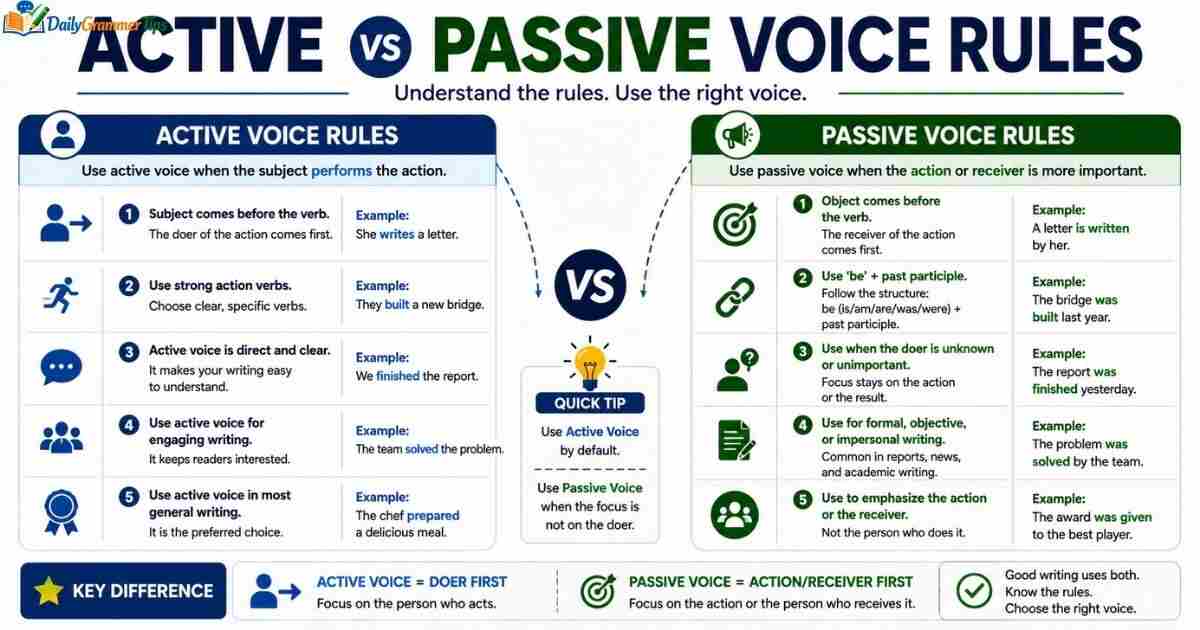
Active vs passive voice rules begin with the relationship between the subject and the action. In active voice, the subject performs the action and usually appears before the verb and object. For example, “The designer created the logo” follows a clear pattern because “the designer” is the subject, “created” is the verb, and “the logo” is the object. This structure makes the performer of the action immediately visible. Active voice often works well when writers want clear sentence structure, direct communication, and a strong connection between the subject and the action.
In passive voice, the receiver of the action becomes the sentence subject. A passive sentence often uses a form of “to be” with a past participle, although the main grammatical rule depends on whether the subject receives the action. For example, “The logo was created by the designer” uses passive voice because “the logo” receives the action. The agent may appear in a by phrase, or the writer may omit it completely. Understanding these active vs passive voice rules helps writers recognize grammatical voice and choose the form that best supports the meaning of a sentence.
100 Examples of Active and Passive Voice
A collection of 100 examples of active and passive voice can help learners recognize repeated sentence patterns across different subjects, verbs, and objects. For example, “The student completed the assignment” uses active voice because the student performs the action. The passive version becomes “The assignment was completed by the student,” where the assignment becomes the receiver of the action. Repeating this kind of comparison with many different verbs helps learners understand how grammatical voice works across different sentence structures instead of memorizing only one or two examples.
Studying 100 examples of active and passive voice also helps learners notice how sentence focus changes from one form to another. “The storm destroyed several trees” emphasizes the storm as the performer of the action, while “Several trees were destroyed by the storm” emphasizes the trees as the receiver of the action. A large set of active and passive voice examples gives learners enough variety to recognize patterns involving people, objects, institutions, events, and unknown agents. This repetition makes active vs passive voice easier to identify in both simple and complex sentences.
Active vs Passive Voice Scientific Writing
Active vs passive voice scientific writing requires careful attention to what information matters most in a research sentence. Scientists often use active voice when they want to identify the researcher or team responsible for an action. For example, “We analyzed the samples using a digital microscope” clearly states who performed the action. The subject “we” performs the verb “analyzed,” while “the samples” function as the object. This active sentence creates direct communication and can make scientific writing easier to understand when the performer of the action is relevant to the research process.
Passive voice also appears frequently in scientific writing because researchers sometimes want to emphasize the procedure, material, or result rather than the agent. For example, “The samples were analyzed using a digital microscope” places the sentence focus on the samples instead of the researchers. In this context, the subject receives the action, and the agent may remain unstated because the research process matters more than who performed it. Good active vs passive voice scientific writing uses both forms carefully and chooses the grammatical voice that gives the reader the clearest and most useful information.
Active Voice
Active voice describes a grammatical structure in which the subject performs the action expressed by the verb. For example, “The author wrote the article” uses active voice because the sentence subject “the author” acts as the performer of the action. The verb “wrote” expresses the action, while “the article” works as the object that receives it. This structure usually follows a clear subject verb object pattern and gives readers immediate information about who performed the action and what that person or thing affected.
Writers often prefer active voice because it creates direct, clear, and natural sentence structure. Active voice can also make sentences easier to understand because readers do not need to search for the agent or determine who caused the action. However, understanding active vs passive voice helps writers avoid treating active voice as an absolute rule. Active and passive voice serve different purposes, and writers should choose active voice when the performer of the action matters most, while passive voice may work better when the receiver of the action deserves the main emphasis.
Frequently Asked Questions
How do I say “I hate you” in a passive voice?
A natural passive form is “You are hated by me.” However, English speakers usually prefer the active sentence “I hate you” because it sounds more direct and natural.
What is the difference between active and passive voice?
In an active voice, the subject performs the action. In passive voice, the subject receives the action, which changes the sentence focus.
What are the 5 rules of active and passive voice?
Identify the subject, verb, object, action, and receiver first. In active voice, the subject performs the action, while passive voice usually uses a form of “to be” with a past participle.
What are the differences between passive and active?
Active voice emphasizes the performer of the action and usually sounds clearer and more direct. Passive voice emphasizes the action or receiver and may omit the agent completely.
What is the passive of “I love you”?
The passive form of “I love you” is “You are loved by me.” The meaning stays similar, but the sentence shifts its focus from “I” to “you.”
Conclusion
Understanding active vs passive voice helps writers control sentence structure, sentence focus, and overall readability. Active voice usually creates clearer, more direct writing because the subject performs the action and the reader can quickly identify the agent, verb, and object. Passive voice remains useful when the receiver of the action deserves more emphasis or when the performer of the action is unknown, unimportant, or intentionally omitted.
Strong writing comes from choosing a grammatical voice with purpose rather than following rigid grammar rules. When you understand active vs passive voice, you can improve sentence clarity, reduce unnecessary wordiness, strengthen prose, and create better information flow. Whether you are working on academic writing, scientific writing, professional writing, creative writing, or everyday communication, the right voice can improve readability and make every sentence more effective.
