

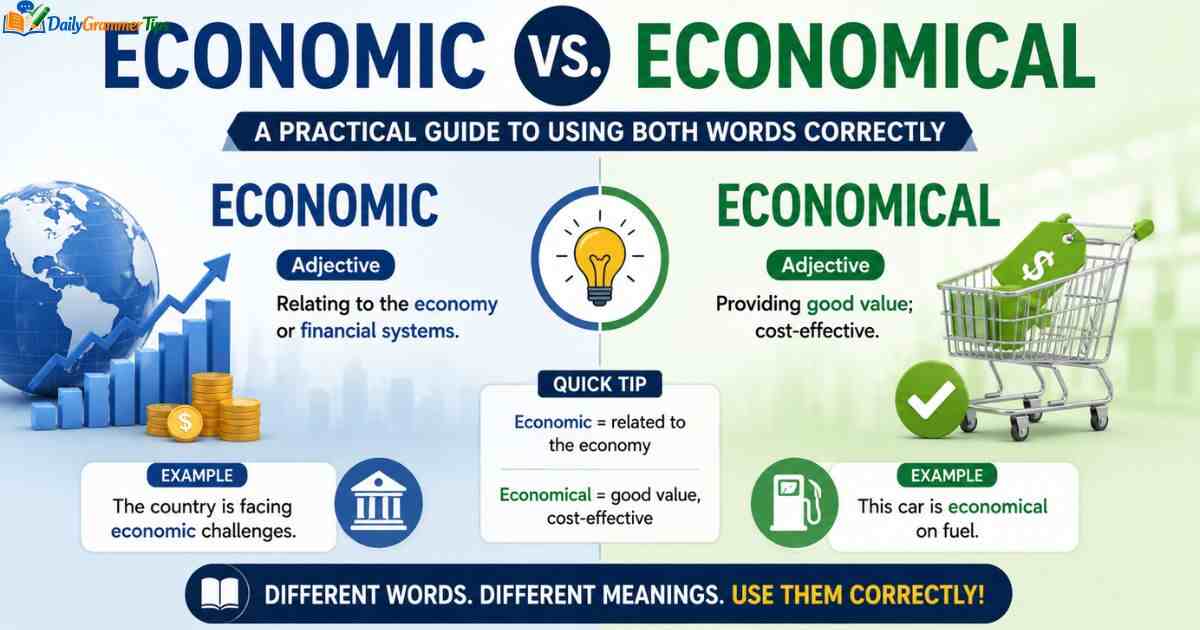
Economic vs Economical explains the difference between two commonly confused English words. Economic relates to the economy, economics, finance, trade, business, economic growth, and wider financial conditions, while economical describes something affordable, efficient, cost effective, or useful for saving money and resources.
The confusion often starts because both words come from the same root and can appear in money related contexts. Once you understand their contextual meaning and natural word usage, you can make the correct word choice more confidently in IELTS writing, academic English, business communication, and everyday vocabulary.
The Common Conundrum: Why Economic and Economical Frequently Cause Confusion
The confusion between Economic vs. Economical mainly comes from their shared connection with the word economy. Because both adjectives can appear in sentences involving money, learners often assume they are interchangeable. In reality, they function differently. Understanding Economic vs. Economical starts with separating economy related meaning from efficiency related meaning.
A quick way to separate them is:
Economic relates to the economy, economics, business, markets, trade, and large scale financial conditions.
Economical relates to efficiency, affordability, saving money, reducing costs, and avoiding waste.
This simple distinction gives you a reliable starting point.
If you are discussing a country’s recession, GDP, inflation, unemployment, economic recovery, or economic policy, you are talking about the economy as a wider system. In these contexts, economic is the correct choice.
If you are talking about a product or method that saves money, fuel, time, energy, or materials, then economical is usually the better word.
For example:
The government introduced new measures to support economic growth.
We bought a smaller car because it was more economical.
The country is facing serious economic problems.
Public transportation is often an economical option for commuters.
The first and third examples relate to the wider economy. The second and fourth focus on efficiency and cost saving.
Understanding Economic vs. Economical is especially useful for IELTS students because topics such as economic development, employment, unemployment, finance, trade, industry, investment, consumer spending, and the global economy often appear in writing and speaking tasks. Learning Economic vs. Economical also improves vocabulary accuracy in academic contexts.
The distinction also matters in professional English. A business may analyze the economic impact of a new policy, while at the same time searching for a more economical method of production. One sentence concerns economics and the financial environment, while the other focuses on cost saving and efficient use of resources.
Decoding “Economic”: Understanding Its Core Meaning, Broad Scope, and Proper Usage
The adjective economic describes something related to the economy or the academic discipline of economics.
When comparing Economic vs. Economical, think of economic as the word associated with governments, industries, financial markets, business activity, trade, production, investment, and large scale financial conditions. This wider scope helps explain Economic vs. Economical clearly.
Economic commonly appears with:
- economic growth
- economic development
- economic crisis
- economic recovery
- economic policy
- economic system
- economic activity
- economic conditions
- economic performance
- economic stability
These combinations help show that economic usually relates to wider financial or commercial systems.
1. Definition Focusing on “The Economy” and the Academic Discipline of Economics
The economic meaning is closely connected with how goods and services are produced, distributed, exchanged, and consumed.
An economy includes many connected areas. Businesses produce goods and services, consumers spend money, governments create economic policy, financial institutions support the financial system, and workers earn income through employment. Economists study how these elements interact and how societies use limited resources.
Economics also examines topics such as:
- supply and demand
- GDP and gross domestic product
- inflation
- recession
- unemployment
- employment
- consumer spending
- investment
- production
- income
- trade
- financial markets
These concepts belong to the study of economics.
This is why phrases such as economic theory and economic analysis belong to the academic field of economics rather than the idea of saving money. Recognizing this distinction helps you use the two words correctly.
For example, economic growth refers to an increase in overall economic activity over time. Economic development refers to wider improvements in prosperity, employment opportunities, infrastructure, productivity, and living standards. An economic crisis describes serious disruption within an economy, while economic recovery describes improvement after a recession or downturn. These examples add useful context to Economic vs. Economical.
Economic policy refers to government actions designed to influence economic conditions. Economic indicators such as GDP growth, inflation rates, unemployment figures, and consumer spending help economists measure economic performance. This terminology belongs naturally to the economic side of Economic vs. Economical.
The term also appears naturally in expressions such as economic environment, economic factors, economic issues, economic impact, and economic stability.
2. Words and Phrases Associated with Economic
Several common phrases help show how the word economic is used naturally. These collocations make Economic vs. Economical easier to recognize.
Economic conditions or economic situation
These expressions describe the general state of an economy.
Example:
Weak economic conditions can reduce consumer spending and business investment.
This is a clear example of Economic vs. Economical because the meaning relates to the wider economy.
Economic boom or economic expansion
These expressions describe a period of strong growth.
Example:
During an economic boom, production, employment, income, and investment often increase.
A period of economy wide growth belongs to the economic side of Economic vs. Economical.
Economic downturn or economic slowdown

These phrases describe weaker economic activity.
Example:
The economic downturn caused several companies to delay expansion plans.
Because the sentence describes economy wide activity, it supports the distinction in Economic vs. Economical.
Economic crisis

An economic crisis refers to serious disruption in the economy.
Example:
The economic crisis affected employment, financial markets, consumer confidence, and investment.
This is another direct example of Economic vs. Economical in a large scale financial context.
Economic recovery
Economic recovery refers to improvement after a recession, crisis, or slowdown.
Example:
Higher consumer spending and stronger business investment supported the country’s economic recovery.
Recovery across an economy further clarifies Economic vs. Economical.
Economic benefits
Economic benefits are financial or wider economic advantages.
Example:
Investment in renewable energy can create economic benefits through new employment opportunities and lower long term costs.
The connection to jobs, investment, and wider financial outcomes is useful when learning Economic vs. Economical.
Economic data and economic indicators
Economists use economic data to understand the condition of an economy.
Common economic indicators include:
- GDP
- inflation
- unemployment
- employment
- production
- investment
- consumer spending
- income
These indicators measure the wider economy and provide another useful context for Economic vs. Economical.
Economic factor or economic issue

An economic factor influences markets, businesses, governments, or consumers.
Example:
Inflation is an important economic factor because it affects purchasing power and consumer spending.
An economic issue may involve recession, unemployment, inequality, inflation, or slow economic growth.
These examples show why Economic vs. Economical cannot be understood simply by linking both words to money. Economic belongs much more naturally with economics, business, finance, government policy, and wider financial systems. This broader perspective strengthens your understanding of Economic vs. Economical.
Defining “Economical”: Grasping Its True Essence of Value, Thrift, and Resource Efficiency
The meaning of economical is much more practical. This practical meaning gives you the second side of Economic vs. Economical.
While economic often refers to markets, governments, financial systems, and economics, economical describes something that uses money, time, fuel, materials, or energy carefully and efficiently. This focus on efficiency is essential in Economic vs. Economical.
The economical side of Economic vs. Economical is therefore about value, efficiency, and avoiding waste.
An economical product or method may be:
- affordable
- cost effective
- efficient
- inexpensive
- budget friendly
- money saving
- low cost
- cost saving
- resource efficient
- fuel efficient
- energy efficient
- practical
These qualities show the practical side of Economic vs. Economical.
A person can also be described as thrifty or frugal if they use money and resources carefully. This idea of careful spending also supports Economic vs. Economical.
rlevent post…….Dought vs Doubt: Meaning, Difference & Which Word Is Correct?
1. Definition Centered on Cost Effectiveness, Savings, and Avoiding Waste
The economical meaning is not simply “cheap.” Something can be economical even if its initial price is not the lowest. This is one of the most important points in Economic vs. Economical.
For example, imagine two cars. One is cheaper to buy but consumes a large amount of fuel. The other costs slightly more but is fuel efficient and requires less maintenance. Over time, the second car may be the more economical car because it costs less to operate. This long term value helps explain Economic vs. Economical.
This distinction is important when studying Economic vs. Economical because economical usually focuses on long term value and efficient use of resources.
A business may choose an energy efficient machine because it reduces electricity costs. Even if the machine has a higher purchase price, it may still be an economical solution in the long run. This cost saving approach gives Economic vs. Economical a clear practical meaning.
An economical decision can help with:
- saving money
- reducing costs
- avoiding waste
- lowering fuel consumption
- using less energy
- making better use of resources
These benefits highlight the efficiency based side of Economic vs. Economical.
An economical method can also save time or materials. For example, a company may use video meetings instead of frequent business travel because this is a more economical method of communication. This practical example supports Economic vs. Economical.
An economical choice therefore often involves a balance between price, performance, durability, operating expenses, and resource efficiency.
2. Words and Phrases Associated with Economical
The word economical commonly appears with practical nouns such as car, method, solution, choice, option, and design. These combinations make Economic vs. Economical easier to remember.
Economical car
An economical car is usually fuel efficient and inexpensive to operate.
Example:
Many commuters prefer an economical car because it helps reduce monthly fuel costs.
Economical solution
An economical solution solves a problem without unnecessary spending.
Example:
Installing energy efficient lighting can be an economical solution for reducing electricity expenses.
This is a practical example of Economic vs. Economical because the focus is on reducing costs.
Economical method
An economical method achieves a useful result while using money, time, or resources efficiently.
Example:
Online training can be an economical method for teaching employees in different locations.
Economical choice
An economical choice provides good value and helps reduce expenses.
Example:
Repairing the existing machine may be the more economical choice.
Economical option
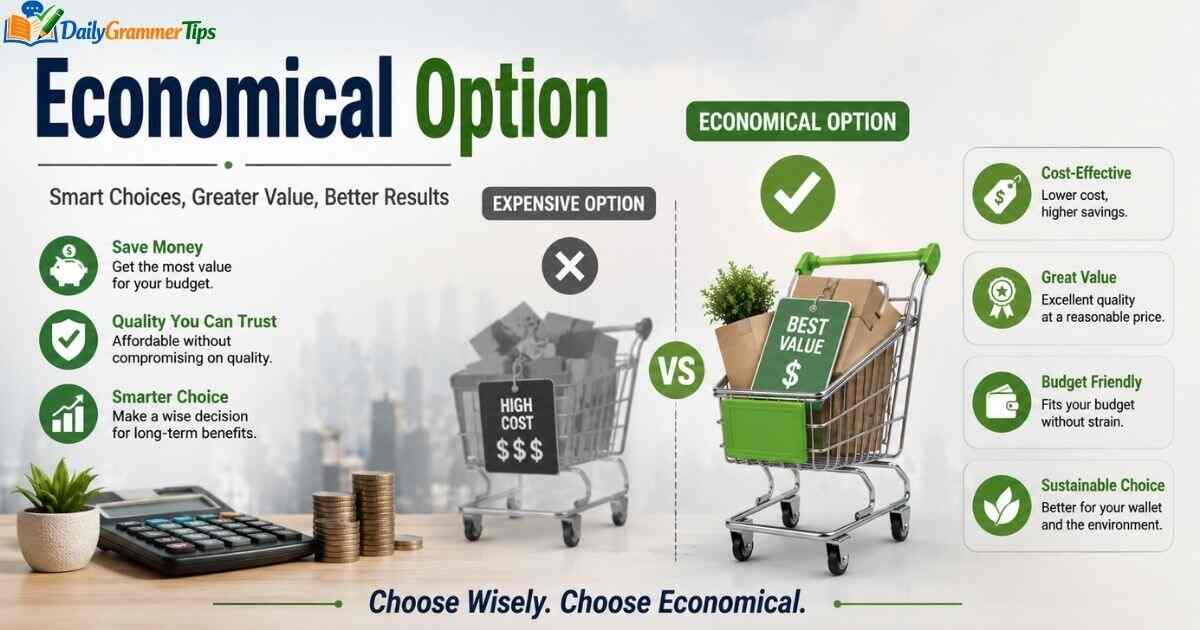
An economical option is an affordable and practical alternative.
Example:
Public transportation can be an economical option for daily commuters.
Economical design
An economical design uses materials, energy, space, or money efficiently.
Example:
The building uses an economical design that reduces energy consumption.
These examples show how economical naturally connects with saving money, avoiding waste, cost saving, low cost, resource efficient, and practical decisions. Together, they reinforce Economic vs. Economical.
Economic and Economical: A Direct Side by Side Comparison for Absolute Clarity
A direct comparison makes Economic vs. Economical much easier to remember. This side by side view is one of the fastest ways to master Economic vs. Economical.
| Feature | Economic | Economical |
| Main association | Economy and economics | Savings and efficiency |
| Typical context | Government, finance, trade, markets, business | Products, methods, choices, personal spending |
| Main question | Does it relate to the economy? | Does it save money or resources? |
| Common examples | economic growth, economic crisis, economic policy | economical car, economical method, economical solution |
| Typical scale | Wider and systemic | Practical and individual |
The easiest memory rule is:
Think economic = economy
Think economical = efficient and money saving
This memory rule makes Economic vs. Economical much easier to recall.
Economic usually appears in broader contexts. For example, a government may try to improve economic performance, strengthen economic stability, or encourage economic development.
Economical usually appears in practical contexts. A family may choose an economical car, while a business may adopt an economical solution to lower operating costs.
Another useful distinction is economy vs economics.
Economy refers to the actual system of production, trade, income, employment, and consumption within a country or region.
Economics refers to the academic discipline that studies those systems and decisions.
Economic works as an adjective for both ideas.
Economical does not mean related to economics. Instead, it focuses on efficiency, thrift, affordability, and wise use of resources.
That is why understanding economy vs economics can also strengthen your understanding of Economic vs. Economical.
Analyzing Typical Errors: Economic and Economical
Writers often make mistakes because they see a sentence related to money and automatically choose economic. To use Economic vs. Economical correctly, you need to focus on the actual meaning of the sentence. Careful context is the best way to master Economic vs. Economical.
1. Confusing Personal Savings with Economic Systems
Incorrect:
My new budget plan is very economic because it helps me save money.
Correct:
My new budget plan is very economical because it helps me save money.
The sentence describes personal money management and saving money. It does not describe the economy, economic policy, or financial markets. Therefore, economical is the correct choice.
Another example:
Incorrect:
This washing machine is very economic.
Correct:
This washing machine is very economical.
The washing machine is efficient, inexpensive to operate, and possibly energy efficient. These are practical qualities, so economical is the correct adjective.
2. Describing National Financial Conditions with Economical
Incorrect:
The country’s economical recovery has been slower than expected.
Correct:
The country’s economic recovery has been slower than expected.
A national recovery involves economic conditions, employment, GDP, investment, production, consumer spending, and other large scale factors.
The same rule applies to:
economic growth
economic development
economic crisis
economic policy
economic stability
economic performance
These expressions describe economic systems rather than personal efficiency.
3. Using Economical for Academic Economics
Incorrect:
Students are studying economical theory.
Correct:
Students are studying economic theory.
Economic theory belongs to the academic discipline of economics. It may examine supply and demand, market behavior, inflation, investment, production, or consumer spending.
Another example:
Incorrect:
The report contains an economical analysis of inflation.
Correct:
The report contains an economic analysis of inflation.
Economic analysis means analysis connected with economics. Economical analysis would suggest that carrying out the analysis itself was inexpensive or resource efficient.
4. Using Economic When You Mean Cost Effective
Incorrect:
We need a more economic solution for reducing office expenses.
Correct:
We need a more economical solution for reducing office expenses.
The goal is reducing costs, saving money, and improving efficiency. Therefore, economical is the correct word.
Now compare:
The government needs an economic solution to rising unemployment.
Here, economic makes sense because unemployment is an economic issue affecting the broader national economy.
5. Thinking Economical Always Means Cheap
Economical and cheap are not exact synonyms.
Something cheap has a low price. Something economical gives good value and uses money or resources efficiently.
An economical product may be:
slightly more expensive initially
cheaper to operate
more durable
fuel efficient
energy efficient
low maintenance
cost effective over time
For example, a very cheap car may use large amounts of fuel and require frequent repairs. A slightly more expensive but fuel efficient vehicle may actually be the more economical choice over several years.
This is why words such as cost effective, practical, frugal, thrifty, money saving, fuel efficient, and energy efficient are useful when learning the economical meaning.
Economic vs Economical Meaning
The economic vs economical difference is easy to understand when you focus on meaning. Economic relates to the economy, economics, finance, trade, business, or the wider financial system. It appears in phrases such as economic growth, economic policy, economic conditions, and economic analysis. This is the broader side of Economic vs. Economical.
Economical describes something that saves money, time, energy, fuel, or resources. It can mean cost effective, affordable, efficient, practical, or inexpensive. An economical car, economical solution, or economical method usually helps with reducing costs and avoiding waste. This is the practical side of Economic vs. Economical.
Difference Between Economic and Economical with Example

The difference between economic and economical depends on context. Use economic for the national economy, global economy, financial markets, trade, industry, or economic issues. For example, “The government introduced a new economic policy to support employment.” This is a simple example of Economic vs. Economical.
Use economical when the focus is on saving money or using resources efficiently. For example, “Buying a fuel efficient car is an economical choice.” This correct word choice helps learners understand English word differences more clearly.
Economic vs Economical Synonym
Synonyms for economic depend on the sentence. Words such as financial, commercial, fiscal, monetary, or market related may work in some contexts. However, phrases like economic growth, economic theory, and economic development usually keep their specific economics meaning.
Synonyms for economical include cost effective, affordable, inexpensive, budget friendly, money saving, low cost, efficient, thrifty, and frugal. For example, an economical car may also be fuel efficient, while an economical method may be practical and cost saving. These synonym differences also support Economic vs. Economical.
Economic vs Economical Examples
Examples make economic vs economical easier to understand. You can say, “The country is experiencing strong economic growth,” or “Inflation is creating serious economic problems.” These sentences relate to the economy, economic conditions, and the financial environment.
For economical, you can say, “This economical car uses less fuel,” or “The company found an economical solution to reduce energy costs.” Here, economical means efficient, affordable, practical, or money saving. These examples give learners a natural way to practice Economic vs. Economical.
Economic vs Economical Exercises
To practice economic vs economical, decide whether the sentence refers to the economy or to efficiency. In “The country is facing a serious downturn,” the correct answer is economic because the sentence is about national economic conditions.
In “This heating system is more because it uses less energy,” the correct answer is economical. It is energy efficient and helps with reducing costs. These exercises improve English vocabulary and correct word usage, while also reinforcing Economic vs. Economical.
Economic or Economical Crisis
The correct phrase is economic crisis, not economical crisis. An economic crisis may involve inflation, recession, unemployment, falling GDP, weak investment, or problems in financial markets. These issues affect the wider economy and financial system. This distinction is an important example of Economic vs. Economical.
Economical crisis is not natural in this context because economical focuses on saving money or resources. Use economic for a national economy, world economy, market economy, or broader financial problem.
Economic vs Economics

Economics is a noun that names the academic field studying production, consumption, finance, trade, supply and demand, investment, income, and employment. Students study economics, while economists use economic theory and economic analysis.
Economic is an adjective that describes something related to the economy or economics. Common examples include economic growth, economic policy, economic system, economic performance, and economic conditions. This difference is important in English grammar and also helps clarify Economic vs. Economical.
Economic or Economical Problems
Use economic problems for issues connected with the economy, such as inflation, unemployment, recession, falling GDP, weak investment, or low consumer spending. These problems can affect businesses, employment, production, and financial markets.
Economical problems are much less common. If the issue involves high costs or poor efficiency, it is usually better to say something is not economical or that a business needs a more economical solution. This distinction is another useful part of Economic vs. Economical.
Frequently Asked Questions
What is the main difference between economic and economical?
Economic relates to the economy, finance, trade, or economic conditions, while economical describes something that saves money, time, or resources. This is the core idea behind Economic vs. Economical.
Is it an economic crisis or economical crisis?
The correct phrase is economic crisis because it refers to problems in the wider economy, such as inflation, recession, unemployment, or falling GDP.
Can economical mean cheap?
Not exactly. Economical means cost effective, efficient, or good value, so something can be economical without being the cheapest option.
What is the difference between economics and economics?
Economics is the academic subject that studies production, trade, finance, and resources, while economic is the adjective used in phrases like economic growth or economic policy.
How can I remember economic vs economical easily?
Think economic = economy and economical = saving money or resources. This simple rule works in most everyday and academic situations.
Conclusion
Understanding Economic vs Economical becomes much easier when you focus on context. Use economic for the economy, economics, financial markets, trade, business, economic growth, inflation, employment, or wider economic conditions. Use economical for choices that are affordable, efficient, cost effective, fuel efficient, or useful for saving money and reducing costs. This practical distinction summarizes Economic vs. Economical clearly.
The best way to remember Economic vs Economical is to connect economic with the wider financial system and economical with the efficient use of resources. With regular practice and the right vocabulary examples, you can make the correct word choice more naturally in IELTS writing, academic English, business communication, and everyday conversation.
