

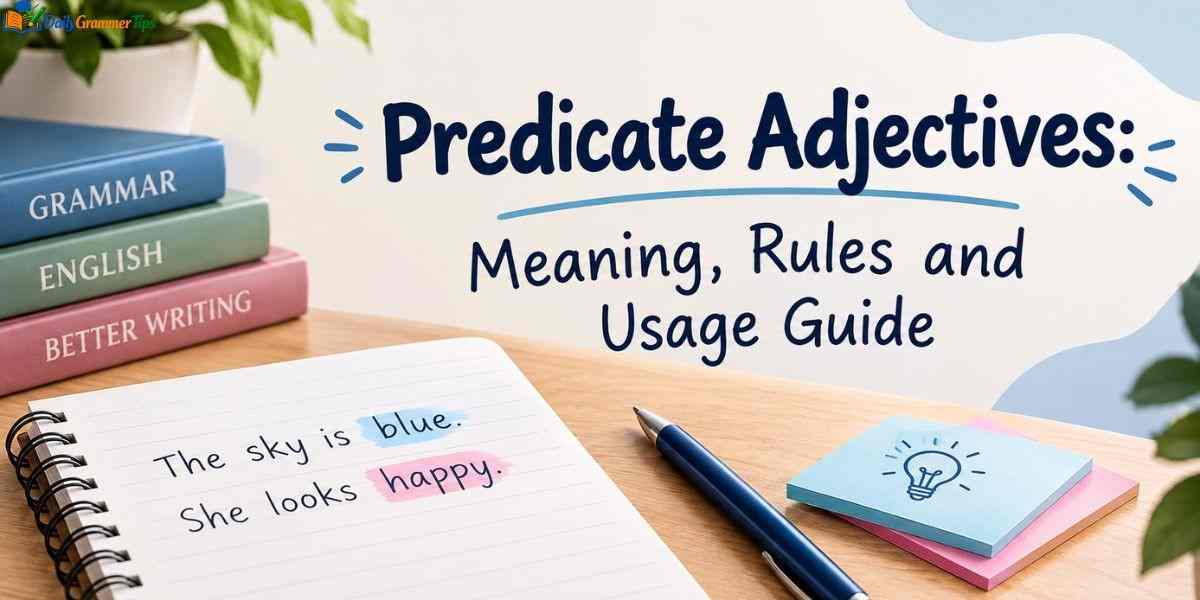
Predicate adjectives are an important part of English grammar because they help describe the subject of a sentence after a linking verb. They tell us about the condition, quality, feeling, or state of a person, place, thing, or idea. Unlike ordinary adjectives that appear before nouns, predicate adjectives usually come after verbs that connect the subject with additional information.
Many English learners find predicate adjectives confusing because they look similar to other adjectives but follow different sentence patterns. Understanding their role makes it easier to create correct sentences, identify sentence structures, and improve both speaking and writing skills. Once you understand how linking verbs connect subjects with descriptions, using predicate adjectives becomes much simpler.
What Is a Predicate Adjective?
A predicate adjective is an adjective that follows a linking verb and describes the subject of a sentence. It gives more information about the subject by explaining its condition, appearance, personality, emotion, or state.
The basic structure of a sentence with a predicate adjective is:
Subject + Linking Verb + Predicate Adjective
The adjective in this structure does not describe a noun directly. Instead, it describes the subject through the linking verb.
For example:
The garden is beautiful.
In this sentence, beautiful describes the subject garden. The verb is connects the subject with the adjective, making beautiful a predicate adjective.
Predicate adjectives are different from action verbs because they do not show an activity. They simply connect the subject to a description.
How Do Predicate Adjectives Work?
Predicate adjectives work with linking verbs to provide information about the subject. A linking verb acts like a bridge between the subject and the adjective that describes it.
Unlike action verbs, linking verbs do not show something happening. Instead, they show a relationship between the subject and its description.
Consider the difference:
Action sentence:
The athlete runs quickly.
The verb runs shows an action.
Predicate adjective sentence:
The athlete is strong.
The verb is does not show an action. It connects the athlete with the adjective strong.
This connection is the main feature that makes an adjective a predicate adjective.
What Is the Role of Linking Verbs in Predicate Adjectives?
Linking verbs are essential because predicate adjectives cannot normally appear alone after a subject. They need a verb that connects the description to the subject.
Common linking verbs include:
- Forms of be: am, is, are, was, were
- Become
- Seem
- Appear
- Feel
- Look
- Sound
- Taste
- Smell
- Remain
- Stay
These verbs describe a condition, change, appearance, or state rather than an action.
For example:
The situation seems difficult.
The verb seems connects the subject situation with the adjective difficult.
The same verb can sometimes act as an action verb or a linking verb depending on the sentence meaning. This is why understanding the role of the verb is important.
Predicate Adjectives vs Regular Adjectives

One of the most common grammar questions is the difference between predicate adjectives and regular adjectives. Both describe nouns or subjects, but their position and function are different.
Regular Adjectives
A regular adjective usually appears before a noun and directly modifies that noun.
Structure:
Adjective + Noun
Example:
She bought a beautiful dress.
Here, beautiful describes the noun dress.
Predicate Adjectives
A predicate adjective appears after a linking verb and describes the subject.
Structure:
Subject + Linking Verb + Adjective
Example:
The dress is beautiful.
Here, beautiful describes the subject dress.
The main difference is not the meaning of the adjective but its position and grammatical role.
Why Are Predicate Adjectives Important in English?
Predicate adjectives help speakers express descriptions more naturally and clearly. They allow writers to explain the condition or quality of something without using unnecessary words.
They are commonly used when describing:
- Feelings and emotions
- Physical conditions
- Opinions
- Changes in state
- Appearances
- Characteristics
Without predicate adjectives, many sentences would become less descriptive and less effective.
For example, instead of simply stating that something exists, a speaker can explain what it is like or how it appears.
This makes communication more detailed and helps readers understand the intended meaning.
How Can You Identify a Predicate Adjective?
Identifying predicate adjectives becomes easier when you follow a few simple steps.
Find the Linking Verb
First, look for a verb that connects the subject to information about itself.
Common examples include forms of be, seem, become, and sensory verbs when they describe a condition.
Check the Word After the Verb
After finding the linking verb, check whether the following word describes the subject.
If the word gives information about the subject’s condition or quality, it is likely a predicate adjective.
Make Sure the Word Is an Adjective
The word should describe a quality, state, or characteristic.
Adjectives answer questions such as:
- What kind?
- What is it like?
- What condition is it in?
If the word performs this role after a linking verb, it functions as a predicate adjective.
Continuing the article:
Rules for Using Predicate Adjectives
Using predicate adjectives correctly requires understanding how they connect with subjects and linking verbs. Although the concept is simple, some grammar rules help prevent common mistakes.
Rule 1: Predicate Adjectives Follow Linking Verbs
A predicate adjective must come after a linking verb because it describes the subject through that verb.
The adjective does not show an action. Instead, it provides information about the subject’s condition or quality.
The most common linking verbs used with predicate adjectives are forms of be, such as:
- am
- is
- are
- was
- were
Other linking verbs can also connect subjects with descriptions when they show a state rather than an action.
Rule 2: Predicate Adjectives Describe the Subject, Not the Object
A predicate adjective gives information about the subject of the sentence. It does not describe an object receiving an action.
Compare these structures:
Subject + Linking Verb + Predicate Adjective
The subject receives the description.
Subject + Action Verb + Object
The object receives the action.
Understanding this difference helps you recognize whether an adjective is functioning as a predicate adjective.
Rule 3: Use Adjectives, Not Adverbs, After Linking Verbs
One common mistake is using an adverb after a linking verb instead of an adjective.
Linking verbs connect to descriptions, so they usually require adjectives.
Incorrect:
The soup tastes wonderfully.
Correct:
The soup tastes wonderful.
In the first sentence, the word describes the action of tasting. In the second sentence, it describes the soup itself.
Rule 4: Sensory Verbs Can Act as Linking Verbs
Some verbs related to the senses can function as linking verbs when they describe a condition.
These include:
- Look
- Feel
- Sound
- Taste
- Smell
When these verbs connect the subject to a description, they are followed by predicate adjectives.
For example:
The music sounds relaxing.
Here, relaxing describes the music, not the action of sounding.
Rule 5: Predicate Adjectives Can Describe Temporary or Permanent Conditions
Predicate adjectives can describe conditions that change over time or characteristics that remain stable.
Temporary conditions may include:
- Feelings
- Physical states
- Situations
Permanent characteristics may include:
- Qualities
- General descriptions
- Personal traits
The function remains the same because the adjective still describes the subject after a linking verb.
Common Linking Verbs Used With Predicate Adjectives
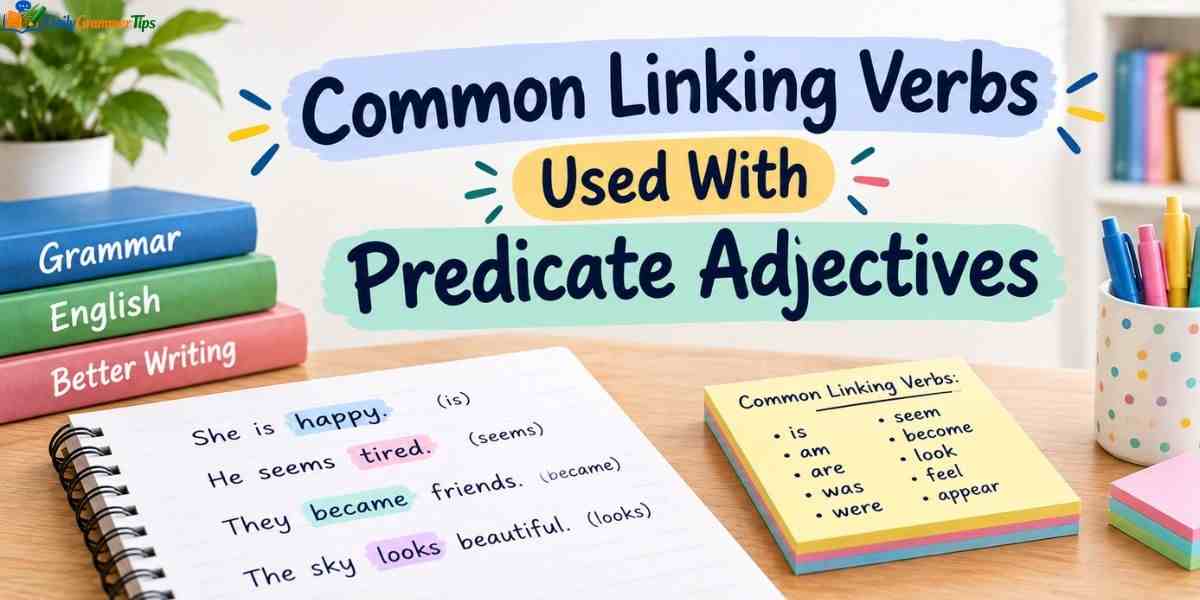
Linking verbs are the foundation of predicate adjective structures. They connect the subject with a description instead of showing an action.
Forms of “Be”
The verb be is the most common linking verb in English.
Forms include:
- Am
- Is
- Are
- Was
- Were
- Been
- Being
These verbs often connect subjects with descriptions of identity, condition, or state.
Learn more……….Adverbs of Place: Meaning, Types, Rules & Examples
Verbs Showing Change
Some linking verbs show that the subject changes into a new condition.
Common examples include:
- Become
- Grow
- Turn
- Get
- Remain
These verbs are useful when describing changes in situations, emotions, or conditions.
Verbs Showing Appearance or Impression
Some verbs describe how something appears or seems.
Common examples include:
- Seem
- Appear
- Look
These verbs help speakers express opinions, observations, or impressions.
Verbs Showing the Senses
Sensory linking verbs connect subjects with descriptions related to the senses.
They include:
- Feel
- Taste
- Smell
- Sound
The meaning of these verbs decides whether they act as linking verbs or action verbs.
Predicate Adjectives in Different Sentence Structures
Predicate adjectives can appear in several sentence patterns. Understanding these structures helps you use them naturally.
Simple Sentence Structure
The most basic pattern is:
Subject + Linking Verb + Predicate Adjective
This structure directly connects the subject with a description.
It is commonly used in everyday English because it clearly explains a condition or quality.
Sentences With Compound Subjects
A sentence can contain more than one subject while still using a predicate adjective.
In this structure, the adjective describes all connected subjects.
For example, when two or more people, objects, or ideas share the same condition, one predicate adjective can describe them together.
Sentences With Compound Predicate Adjectives
Sometimes a subject can have more than one description.
This happens when writers want to provide additional details about the same subject.
Using multiple adjectives can make descriptions stronger and more specific.
However, writers should avoid adding unnecessary adjectives that make sentences difficult to read.
Predicate Adjectives in Academic and Professional Writing
Predicate adjectives are not limited to basic English conversations. They are also common in formal writing because they help explain conditions, results, and observations.
In academic writing, they can describe:
- Research findings
- Conditions
- Characteristics
- Comparisons
In professional writing, they help explain:
- Business situations
- Performance reviews
- Product qualities
- Workplace conditions
Using predicate adjectives correctly improves sentence clarity and creates a more professional writing style.
Common Mistakes When Using Predicate Adjectives
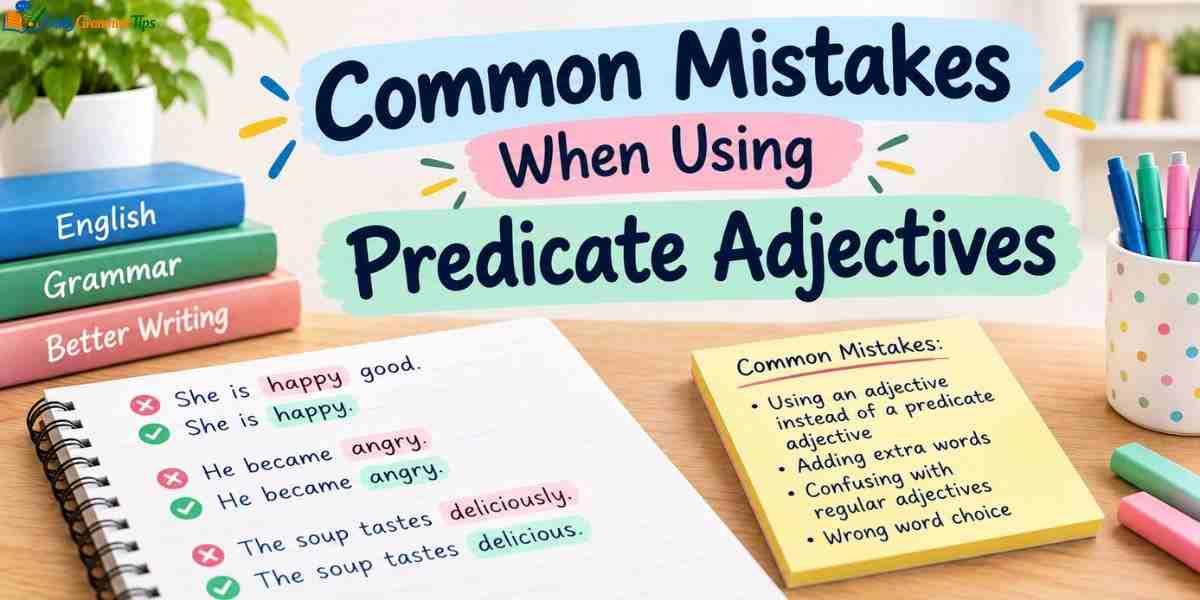
Even advanced learners sometimes confuse predicate adjectives with other grammar structures. Recognizing these mistakes can improve accuracy.
Mistake 1: Confusing Adjectives and Adverbs
Incorrect use of adverbs after linking verbs is one of the most common errors.
The reason is that learners often think every verb requires an adverb. However, linking verbs describe the subject, so they require adjectives.
Remember:
- Action verbs often use adverbs.
- Linking verbs usually use adjectives.
Mistake 2: Treating Linking Verbs as Action Verbs
Some verbs can work in different ways depending on their meaning.
For example, sensory verbs may show an action in one sentence and a condition in another.
The key is to understand whether the verb connects the subject to a description or shows an actual activity.
Mistake 3: Confusing Predicate Adjectives With Objects
Predicate adjectives do not receive actions. They describe subjects.
A sentence with a linking verb does not follow the same pattern as a sentence with an action verb.
Recognizing the difference between these structures prevents many grammar errors.
Mistake 4: Using Incorrect Forms After Linking Verbs
Some learners use noun forms, adverbs, or incorrect word forms after linking verbs.
Always check whether the word after the linking verb describes the subject. If it does, it should usually be an adjective.
Predicate Adjectives vs Predicate Nouns
Predicate adjectives and predicate nouns both appear after linking verbs, but they perform different functions in a sentence.
A predicate adjective describes the subject by giving information about its condition, quality, or state.
A predicate noun identifies or renames the subject by telling what it is.
The main difference is:
- Predicate adjective → describes the subject
- Predicate noun → identifies the subject
For example, a sentence may describe someone’s condition using an adjective or explain their identity using a noun.
Understanding this difference helps you analyze sentence structure and choose the correct word form.
How Are Predicate Adjectives Different From Object Complements?
Predicate adjectives are sometimes confused with object complements because both provide descriptions. However, they work in different ways.
A predicate adjective describes the subject after a linking verb.
An object complement describes the object after an action verb.
The key difference is the word being described.
Predicate Adjective Structure:
Subject + Linking Verb + Adjective
The adjective connects back to the subject.
Object Complement Structure:
Subject + Action Verb + Object + Adjective
The adjective describes the object.
Understanding this difference helps avoid confusion between similar-looking sentence patterns.
How Do Predicate Adjectives Improve Writing?
Predicate adjectives make writing more descriptive and meaningful. They allow writers to explain conditions, emotions, and qualities without adding unnecessary information.
They are especially useful when describing:
- Changes in situations
- Personal experiences
- Observations
- Opinions
- Characteristics
Good writing depends on clear descriptions. Predicate adjectives help readers understand the state or quality of the subject more easily.
For example, instead of writing short statements with limited information, writers can use predicate adjectives to create more detailed and expressive sentences.
Tips for Learning Predicate Adjectives
Learning predicate adjectives becomes easier when you focus on sentence patterns rather than memorizing individual examples.
Understand Linking Verbs First
Since predicate adjectives depend on linking verbs, learning common linking verbs is the first step.
When you recognize a linking verb, you can quickly identify whether the following word describes the subject.
Practice Identifying the Subject
Always ask:
“Who or what is being described?”
The answer will help you find the subject and understand whether the adjective refers to it.
Compare Similar Sentences
Compare sentences that use action verbs and linking verbs. This practice helps you understand why some words need adjectives while others need adverbs.
Read English Regularly

Reading articles, books, and conversations exposes you to natural examples of predicate adjective structures. Over time, you will recognize these patterns more easily.
Frequently Asked Questions
What is a predicate adjective example?
A predicate adjective describes the subject after a linking verb. Example: The sky is blue.
What are 10 predicate examples?
Examples: happy, tall, beautiful, tired, cold, smart, kind, angry, bright, and honest.
What are 10 examples of adjectives?
Examples: big, small, red, old, young, fast, slow, clever, beautiful, and strong.
What is meant by predicate adjective?
A predicate adjective is an adjective that comes after a linking verb and describes the subject of the sentence.
How to find predicate noun and predicate adjective?
Find the linking verb first, then check the word after it. If it describes the subject, it is a predicate adjective; if it renames the subject, it is a predicate noun.
Conclusion
Predicate adjectives are an important grammar element that helps describe the subject of a sentence through linking verbs. They explain qualities, conditions, and states without showing an action. By understanding how they connect with linking verbs, learners can recognize sentence patterns and create more accurate English sentences.
Mastering predicate adjectives improves both writing and speaking because they allow you to express ideas with greater clarity. Regular practice, reading, and attention to sentence structure will help you use them naturally and confidently in everyday English.
