

Prepositions of time are words that show when something happens, how long it lasts, or how often it repeats. The most common ones are at, on, in, for, since, during, before, after, by, and until. In the sentence “The class starts at 9 a.m.,” the word “at” tells us the exact time.
This guide explains each one with simple rules, clear examples, common mistakes, and a practice quiz. Read it from top to bottom, or jump to the section you need. By the end, you will know which word to pick for any time expression.
What Are Prepositions of Time?
A preposition of time is a word that links a noun or pronoun to the rest of the sentence and answers the question “When?” It can also answer “How long?” or “Until when?” Grammar books also call these words temporal prepositions.
A preposition never stands alone. It begins a prepositional phrase, and that phrase ends with an object of the preposition. In “We met on Friday,” the phrase is “on Friday.” The word “on” is the preposition, and “Friday” is its object.
The whole phrase works as an adverbial. It adds time information to the verb, just like words such as “yesterday” or “soon.”
Here are a few quick examples:
- She wakes up at 6:30 every day.
- The museum opens on Mondays.
- They moved to Canada in 2019.
- He has worked here since March.
- I lived in Rome for two years.
Every one of these phrases tells the reader something about time. That is the core job of this group of words.
Why Do Prepositions of Time Matter in English?
Time words show up in almost every conversation, email, and story. You use them to set meetings, give deadlines, describe habits, and tell what happened in the past. A wrong choice can confuse your reader or change the meaning completely.
Compare these two sentences:
- I will finish the report by Friday.
- I will work on the report until Friday.
The first sentence means the report will be done on or before Friday. The second means you will keep working on it through Friday. One small word changes the plan.
Learners often find these words tricky because they do not translate word for word from other languages. Many languages use one word where English uses three. That is why learning the patterns matters more than memorizing a random list. The prepositions of time follow clear rules, and once you see the pattern, the choices feel natural.
List of Common Prepositions of Time
English has dozens of time prepositions, but a small group does most of the work. The table below shows the main ones, what they mean, and a short example for each.
| Preposition | Main Use | Example |
| at | exact times, holidays, night | The train leaves at 7:15. |
| on | days and dates | We have a test on Tuesday. |
| in | months, years, seasons, long periods | It snows here in winter. |
| for | length of time | She studied for three hours. |
| since | starting point up to now | I have known him since 2015. |
| during | within a period or event | He slept during the movie. |
| before | earlier than a point in time | Wash your hands before dinner. |
| after | later than a point in time | Call me after lunch. |
| by | no later than a deadline | Submit the form by noon. |
| until / till | up to a point, then it stops | We waited until midnight. |
| from … to | start and end of a period | The shop is open from 9 to 5. |
| between | within two points in time | Come between 2 and 4 p.m. |
| within | inside a time limit | You will hear back within a week. |
| throughout | the whole period | It rained throughout the night. |
| around / about | approximate time | I will arrive around six. |
| past | after a certain hour | It is ten past three. |
This list is a good starting point. The next sections show how each group works in real sentences.
Prepositions of Time: At, On, and In
The three words “at,” “on,” and “in” cause the most trouble for learners. A simple mental picture helps. Think of a funnel: “at” is the tiny point at the bottom, “on” is the middle, and “in” is the wide top.
How Do You Use “At” for Time?
Use “at” for exact moments and short, specific points in time.
- Clock times: The meeting starts at 10 a.m.
- Moments of the day: I like to walk at sunrise. We eat dinner at sunset.
- Mealtimes: They always talk at lunchtime.
- Holiday periods: Families gather at Christmas and at Easter.
- Weekends (British English): What are you doing at the weekend?
There is one special case. We say “at night” but “in the morning,” “in the afternoon,” and “in the evening.” Native speakers use these fixed patterns, so it is best to memorize them as a set.
How Do You Use “On” for Days and Dates?
Use “on” with days of the week, calendar dates, and named days.
- Days of the week: My dentist appointment is on Wednesday.
- Dates: She was born on June 5.
- Special days: We exchange gifts on Christmas Day.
- Parts of a specific day: I will see you on Friday morning.
- Repeated days: The market is open on Saturdays.
Notice the last pattern. When you name a specific day and add a part of the day, the word switches to “on.” So we say “in the morning” in general, but “on Monday morning” for one particular day.
American English often drops “on” in casual speech, as in “See you Monday.” That is fine in conversation, but “on” is safer in formal writing.
How Do You Use “In” for Longer Periods?
Use “in” for longer stretches of time that have no exact start or end.
- Months: The school year begins in September.
- Years: The company was founded in 1998.
- Seasons: It gets very hot here in summer.
- Decades and centuries: Jazz became popular in the 1920s.
- Parts of the day: I study best in the morning.
- Future time from now: The movie starts in twenty minutes.
The last example deserves a closer look. “In twenty minutes” means twenty minutes from now. It does not name a clock time, so it is different from “at 8:20.”
Quick Summary: At vs. On vs. In
| Word | Time Type | Examples |
| at | exact point | at 5 p.m., at noon, at midnight, at night |
| on | days and dates | on Sunday, on May 1, on my birthday |
| in | longer periods | in July, in 2030, in winter, in the evening |
Keep this table nearby when you write. It solves most everyday problems with the prepositions of time.
Which Prepositions Show How Long Something Lasts?
Some time words describe duration. They answer the question “For how long?” or “During what period?”
For
Use “for” before a length of time, such as minutes, hours, days, weeks, or years.
- We waited for forty minutes.
- She has lived abroad for six years.
- I will stay for a week.
“For” is always followed by an amount of time, never by a starting date. That is the main difference between “for” and “since,” which we cover later.
During
Use “during” with a noun that names an event or a period. It tells us that something happened inside that time.
- The baby woke up three times during the night.
- Please keep your phone off during the exam.
- He took notes during the lecture.
Throughout
“Throughout” means from the beginning to the end, with no break.
- It was windy throughout the weekend.
- She smiled throughout the ceremony.
Over
“Over” can show a period of time, often in a casual way.
- We stayed in touch over the years.
- Prices have risen over the past decade.
Learn more………Predicate Adjectives: Meaning, Rules and Usage Guide
Within
“Within” sets a time limit. Something must happen inside that period.
- The package will arrive within three days.
- Please reply within 24 hours.
These five words all describe length, but each has its own flavor. “For” gives the amount, “during” names the event, “throughout” stresses the whole period, and “within” sets a limit.
Which Prepositions Show Starting Points, Ending Points, and Deadlines?
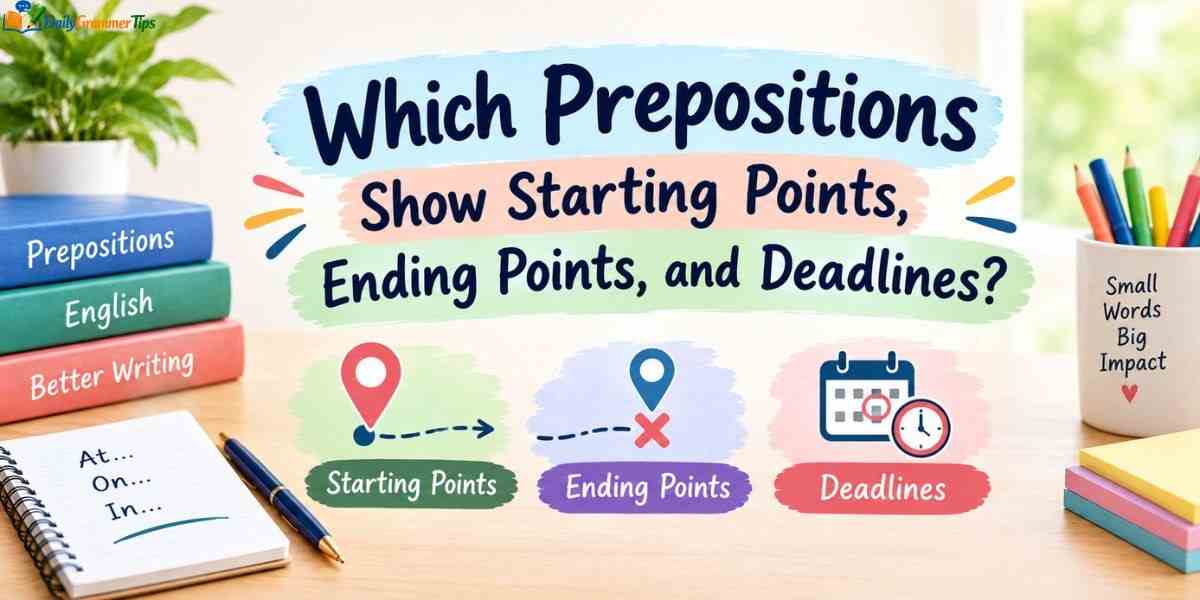
Another group of time prepositions marks the edges of a period. These words answer “Since when?” and “Until when?”
Since
“Since” marks the starting point of an action that continues up to now. It usually appears with the present perfect tense.
- I have lived here since 2020.
- She has been sick since Monday.
- They have not spoken since the argument.
From … To / From … Until
Use “from” to name the start and “to” or “until” to name the end.
- The festival runs from June 1 to June 7.
- He works from nine until five.
Until and Till
“Until” means up to a certain time, and then the action stops. “Till” has the same meaning but sounds more casual.
- We stayed at the party until midnight.
- Wait here till I come back.
- The store is closed until Monday.
By
“By” marks a deadline. It means “no later than.”
- Please send the file by 3 p.m.
- The guests will arrive by evening.
- I need an answer by tomorrow.
Before and After
These two words place one event earlier or later than another.
- Brush your teeth before bed.
- We usually go for a walk after dinner.
- She finished her homework before the show started.
Prior To and Following
These are more formal choices, often found in business and legal writing.
- Please read the rules prior to the test.
- Following the meeting, we sent a summary.
In everyday speech, “before” and “after” are simpler and sound more natural.
What Other Prepositions Can Show Time?
A few more words help with approximate times and special patterns.
Around and About
Both words give an estimate, not an exact time.
- The guests arrived around seven.
- It was about midnight when the storm hit.
Past and To
When you tell the time in English, you use “past” for the first half of the hour and “to” for the second half.
- It is quarter past four.
- It is ten to six.
Between
“Between” names a window of time with two points.
- The plumber will come between noon and 2 p.m.
- Call me between meetings.
Toward and Towards
These words show that a time is getting close.
- The mood improved toward the end of the week.
- Prices rise towards the holidays.
How Do You Choose the Right Preposition? Common Confusions Explained
Some pairs of time words look alike but work differently. This section clears up the most common ones.
For vs. Since
Both words describe an action that continues until now, but they point to different things.
- “For” is followed by a length of time: for five years.
- “Since” is followed by a starting point: since 2021.
Correct: I have taught here for five years. Correct: I have taught here since 2021.
By vs. Until
- “By” shows a deadline. The action happens at or before that time.
- “Until” shows how long an action continues.
Correct: I will finish by 6 p.m. (I might finish at 5:30.) Correct: I will work until 6 p.m. (I keep working all the way to 6.)
During vs. For
- “During” is followed by an event or period: during the summer.
- “For” is followed by an amount of time: for three months.
Correct: It rained during the trip. Correct: It rained for three hours.
In vs. Within
- “In” can mean “after this much time.”
- “Within” means “before this much time has passed.”
Correct: The doctor will see you in an hour. (After an hour.) Correct: The doctor will see you within an hour. (Sometime inside that hour.)
On Time vs. In Time
- “On time” means exactly at the planned time.
- “In time” means early enough to do something.
Correct: The bus arrived on time. Correct: We got there in time to catch the train.
At the End vs. In the End
- “At the end” points to the final point of something.
- “In the end” means “finally” after a process.
Correct: The book gets exciting at the end. Correct: In the end, she chose the smaller house.
Common Mistakes with Prepositions of Time
Even advanced learners slip up on a few patterns. The table below shows frequent errors and the fix for each one. Studying these mistakes is one of the fastest ways to improve your use of the prepositions of time.
| Incorrect | Correct | Why |
| I will see you in Monday. | I will see you on Monday. | Days need “on.” |
| She was born at 1995. | She was born in 1995. | Years need “in.” |
| We meet in 5 p.m. | We meet at 5 p.m. | Clock times need “at.” |
| I live here since five years. | I have lived here for five years. | “For” goes with a length of time. |
| He has worked here for 2018. | He has worked here since 2018. | “Since” goes with a starting point. |
| I work in night. | I work at night. | “At night” is a fixed phrase. |
| See you on the morning. | See you in the morning. | General parts of the day use “in.” |
| I will call you until Friday. | I will call you by Friday. | A deadline needs “by.” |
| It was cold in the whole night. | It was cold throughout the night. | Use “throughout” for the full period. |
| We arrived in time for the 8 o’clock train, but exactly on the time. | We arrived on time for the 8 o’clock train. | “On time” has no “the.” |
| She is meeting him on next Monday. | She is meeting him next Monday. | Skip the preposition before “next,” “last,” “this,” and “every.” |
A Special Rule: No Preposition Before Next, Last, This, and Every
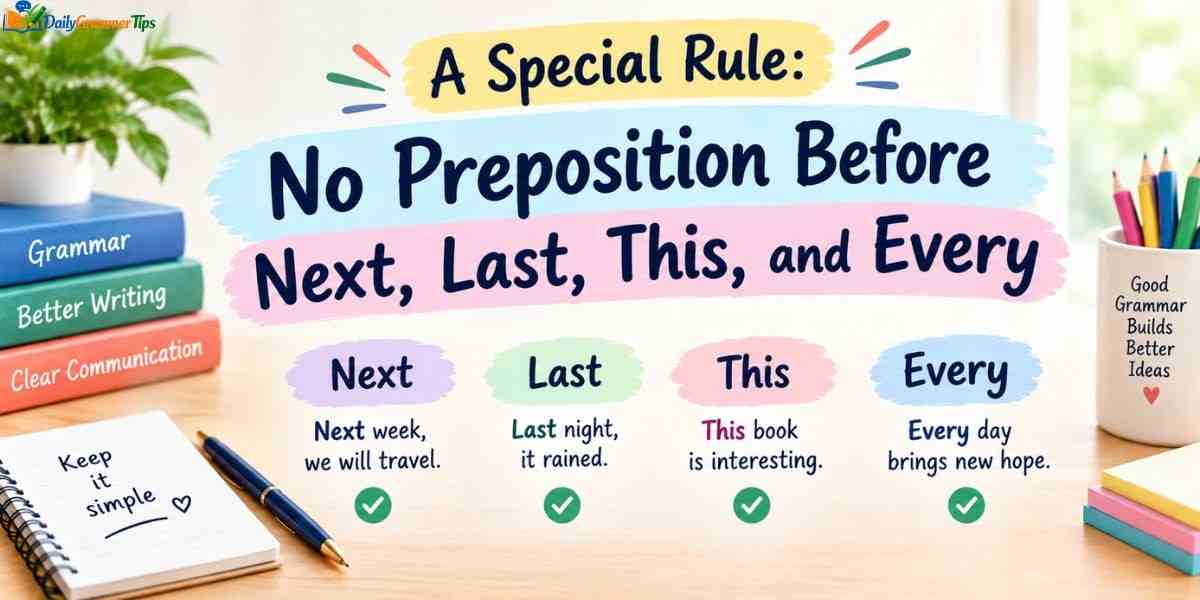
This rule trips up many writers. Do not use “at,” “on,” or “in” before these four words.
- Wrong: We will travel on next month.
- Right: We will travel next month.
- Wrong: I saw her at last Friday.
- Right: I saw her last Friday.
- Right: He calls his mother every Sunday.
- Right: I will see you this evening.
This is one of the easiest errors to fix once you know it exists.
Frequently Asked Questions
What are the 10 examples of the preposition of time?
At, on, in, for, since, during, before, after, by, and until, as in “at 6 p.m.,” “on Friday,” and “in July.”
What is a preposition of time?
It is a word that shows when something happens or how long it lasts, such as “at noon” or “since Monday.”
What is a proposition of time?
This is a common misspelling of “preposition of time.” A proposition is a suggestion or statement, not a grammar term for time words.
What are the 12 prepositions of time?
At, on, in, for, since, during, before, after, by, until, from, and between.
Can you give me 20 examples of preposition words?
In, on, at, by, for, with, from, to, of, about, under, over, above, below, between, behind, beside, near, across, and through.
Conclusion
Prepositions of time may be small words, but they make your writing clear and precise. They tell your reader when something happens, how long it lasts, and when it must be done. Once you know the core patterns, using them becomes easy.
Remember the basics: “at” for exact times, “on” for days and dates, and “in” for longer periods. Use “for” with a length of time, “since” with a starting point, and “by” with a deadline. Practice with real sentences every day, and you will master the prepositions of time in no time.
