

Good writing moves from one idea to the next without making the reader stumble. Much of that smoothness comes from small linking words, and conjunctive adverbs are among the most useful of them. Words such as however, therefore, and meanwhile tell the reader how two statements relate before the second one has even finished.
This guide explains what these words are, how they behave, where they sit in a sentence, and which punctuation they need. Every section includes original examples with a short breakdown, so you can watch the grammar at work instead of only reading about it. By the end, you will be able to recognize and use conjunctive adverbs confidently in essays, emails, reports, and everyday writing.
Definition
A conjunctive adverb is a word or short phrase that links two independent clauses and shows how their ideas are related. It acts like a bridge: the first clause states one idea, and the adverb signals whether the next idea adds to it, opposes it, results from it, or follows it in time.
Grammar books also call these words adverbial conjunctions or transitional adverbs. The labels reflect their double nature. They behave like adverbs because they modify the clause in which they appear, and they behave like linking words because they connect that clause to the one before it. Unlike coordinating conjunctions, however, conjunctive adverbs cannot join two independent clauses by themselves. A semicolon or a period has to do the joining, while the adverb explains the relationship.
An independent clause is a group of words that contains a subject and a verb and expresses a complete thought. When two of them sit side by side, readers need a clue about the connection between them. Supplying that clue is the main job of conjunctive adverbs.
Why These Linking Words Matter in Writing
Sentences that stand next to each other without any signal can feel disconnected, even when the ideas are closely related. A reader has to guess whether the second statement supports the first, contradicts it, or simply comes later. Linking adverbs remove that guesswork and improve sentence flow, coherence, and logical progression.
They are especially valuable in academic and professional writing, where arguments depend on clear relationships between claims and evidence. A carefully placed consequently shows that a conclusion follows from the facts. A carefully placed nevertheless warns the reader that a surprising point is coming. Used with care, these transition words also help you avoid a choppy style made of short, unconnected sentences.
They also save space. Instead of writing a full sentence to explain how two ideas relate, a single word does the work. That efficiency is one reason editors and teachers encourage writers to learn the full range of options rather than relying on the same two or three favorites.
Explanation: What Conjunctive Adverbs Show
Each conjunctive adverb carries a specific meaning, so choosing the right one is a matter of identifying the relationship you want to express. Most of them fall into four broad groups.
Addition
These words add information that supports or extends the first clause. Common choices include also, furthermore, moreover, besides, additionally, and in addition. They work best when the second idea is of similar kind or weight to the first, so the reader feels the point building rather than changing direction.
- The museum is free on Sundays; furthermore, guided tours are offered every hour.
Contrast
These words introduce an idea that opposes, limits, or surprises the first clause. Common choices include however, nevertheless, nonetheless, instead, conversely, and on the other hand. They prepare the reader for a turn in the argument, which makes them some of the most frequently used transition words in essays.
- The trail looked easy on the map; however, the steep final climb tired everyone.
Cause and Effect
These words show that the second clause is a result or consequence of the first. Common choices include therefore, consequently, thus, hence, accordingly, and as a result. The first clause supplies the reason, and the adverb announces the outcome.
- The road was closed for repairs; accordingly, buses were sent along a different route.
Time and Sequence
These words place events in order or show that actions happen at the same moment. Common choices include then, next, meanwhile, subsequently, afterward, finally, and in the meantime. They are the natural tools for instructions, narratives, and step by step explanations.
- The chef chopped the onions; meanwhile, his assistant heated the pan.
Complete List of Conjunctive Adverbs by Function
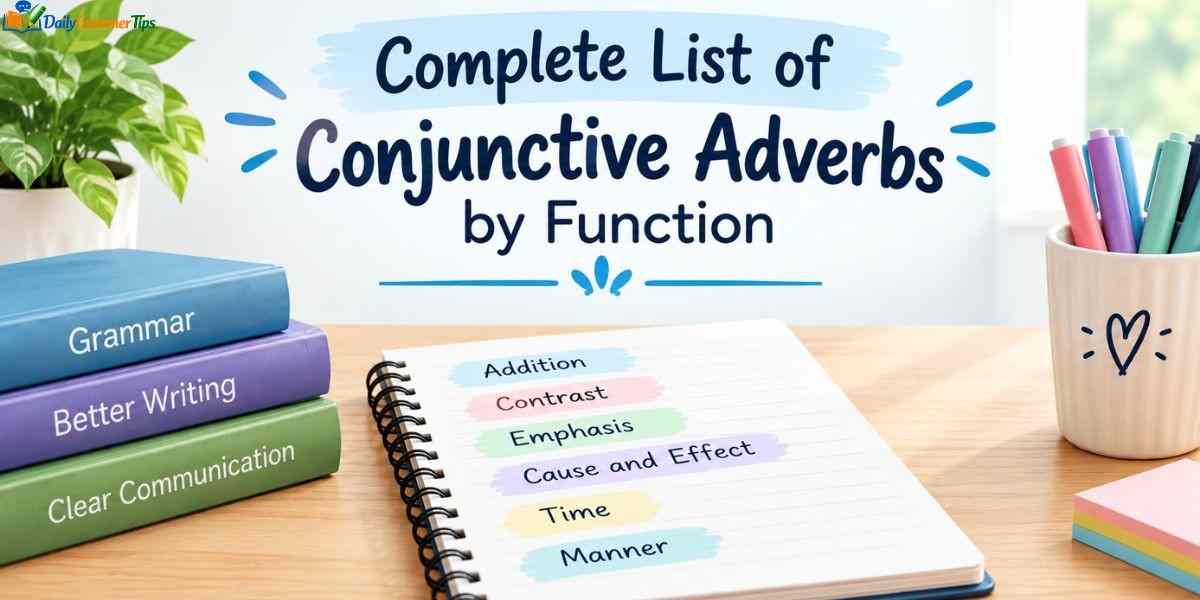
Beyond the four main groups, several other relationships also have dedicated words. The table below collects the most common options in one place so you can scan quickly for the right fit.
| Function | Common words and phrases |
| Addition | also, furthermore, moreover, besides, additionally, in addition |
| Contrast | however, nevertheless, nonetheless, instead, conversely, on the other hand |
| Cause and effect | therefore, consequently, thus, hence, accordingly, as a result |
| Time and sequence | then, next, meanwhile, subsequently, afterward, finally |
| Emphasis | indeed, in fact, certainly, undoubtedly, of course |
| Comparison | similarly, likewise, equally, comparatively |
| Illustration | for example, for instance, namely, that is |
| Concession | granted, admittedly, still, even so |
| Summary | in conclusion, in summary, all in all, to sum up |
Some entries are phrases made of more than one word, such as as a result and on the other hand. Grammarians still treat them as conjunctive adverbs because they perform the same linking job. Ordinal words such as first and second can also play this role when they organize a series of points.
Examples and Breakdown
The following five original sentences are each taken apart clause by clause, so you can see exactly what every part contributes.
Example 1: The bakery ran out of bread by noon; consequently, the owner baked a second batch.
- First clause: The bakery ran out of bread by noon.
- Adverb: consequently, which signals cause and effect.
- Second clause: the owner baked a second batch.
- Breakdown: The shortage is the cause, and the extra baking is the effect. The adverb makes that link explicit instead of leaving the reader to infer it.
Example 2: Maya dislikes crowded places; nevertheless, she attended the festival.
- First clause: Maya dislikes crowded places.
- Adverb: nevertheless, which signals contrast.
- Second clause: she attended the festival.
- Breakdown: The first clause creates an expectation that she would stay away. The adverb tells the reader that the second clause goes against that expectation.
Example 3: The library offers free workshops; moreover, it provides quiet study rooms.
- First clause: The library offers free workshops.
- Adverb: moreover, which signals addition.
- Second clause: it provides quiet study rooms.
- Breakdown: Both clauses describe benefits. The adverb stacks the second benefit on top of the first, strengthening the overall point.
Example 4: The team reviewed the budget; then, they approved the final plan.
- First clause: The team reviewed the budget.
- Adverb: then, which signals sequence.
- Second clause: they approved the final plan.
- Breakdown: The two actions happen in order. The adverb shows that approval followed the review.
Example 5: Many birds migrate long distances; for example, the Arctic tern travels between the polar regions every year.
- First clause: Many birds migrate long distances.
- Adverb: for example, which signals illustration.
- Second clause: the Arctic tern travels between the polar regions every year.
- Breakdown: The first clause makes a general claim, and the second supplies a specific case that supports it.
Notice that all five sentences follow the same pattern: a complete thought, a semicolon, the adverb, a comma, and another complete thought. That is the pattern conjunctive adverbs follow whenever they connect two full clauses inside a single sentence.
About your research……….Prepositions of Time with Definition, Examples, and Exercises
Usage Guidelines
Knowing the definition is only the first step. The guidelines below explain how to apply these words correctly in real sentences.
Connecting Independent Clauses
The standard formula has four parts: the first independent clause, a semicolon, the adverb, and a comma, followed by the second independent clause.
- Our flight was delayed; therefore, we missed the connecting train.
The semicolon matters because the adverb is not strong enough to hold the two clauses together alone. If you replace the semicolon with a comma, you create a comma splice, which is one of the most common punctuation errors in English. When you prefer a firmer break between the ideas, you can use a period instead and begin a new sentence with the adverb. A semicolon suggests that the two thoughts are closely tied, while a period gives each one more independence. When conjunctive adverbs join clauses inside one sentence, that choice is left entirely to the writer.
Showing Relationships Through the Right Word
Every word in the list carries its own meaning, so accuracy matters. A mismatched adverb sends the reader in the wrong direction. Consider this sentence: She loves hiking; however, she goes every weekend. The word however promises a contrast, but the second clause actually supports the first. A better choice is indeed or in fact, which signal emphasis rather than opposition.
A useful habit is to ask one question before you choose: does the second idea add to the first, contradict it, result from it, or follow it in time? The answer points you to the correct group of words immediately.
Placement in a Sentence
Unlike many linking words, these adverbs can move. They can appear at the beginning of the second clause, in the middle of it, or at the end.
- Beginning: The printer jammed; consequently, the report was late.
- Middle: The printer jammed; the report was, consequently, late.
- End: The printer jammed; the report was late, consequently.
The beginning position is the clearest and the most common. The middle position adds a gentle pause and can make the sentence sound more reflective. The end position is the least common and tends to sound informal or emphatic, so use it sparingly. Because conjunctive adverbs are movable, you can test different positions and choose the rhythm that suits your sentence best.
Punctuation Rules for These Linking Words
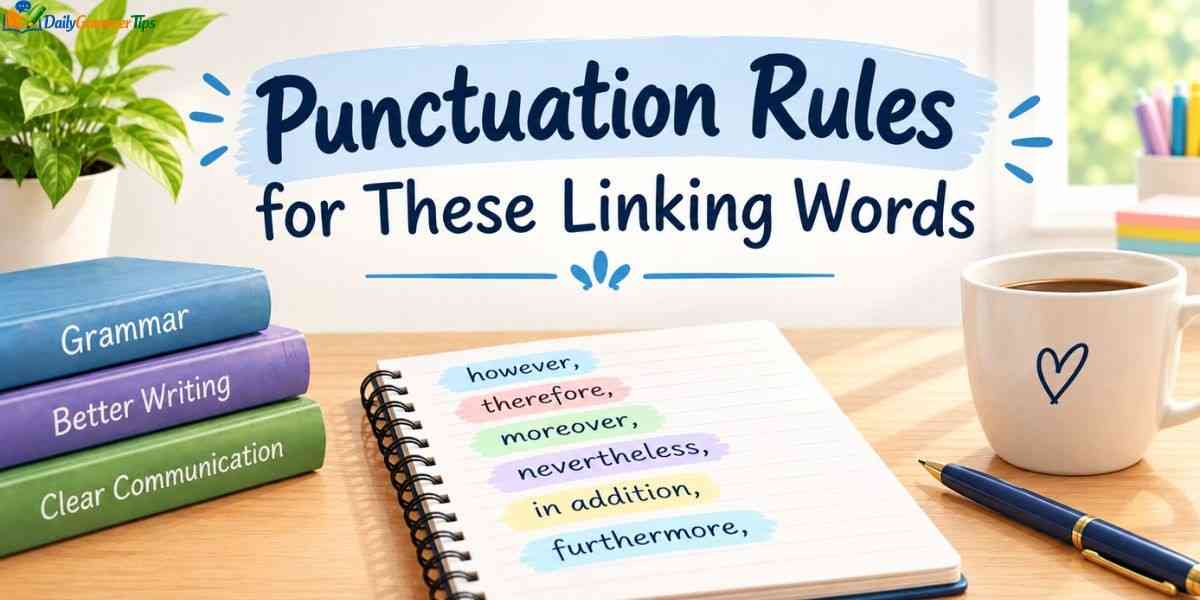
Punctuation is where most mistakes happen, so it helps to keep a short set of rules in mind.
- Semicolon before, comma after. When the adverb begins the second clause in the same sentence, place a semicolon before it and a comma after it.
- Period before, comma after. When the adverb starts a new sentence, end the previous sentence with a period and follow the adverb with a comma. Example: The weather turned stormy. Consequently, the ferry stopped running.
- Commas on both sides in the middle. When the adverb interrupts a clause, set it off with a comma before and after. Example: The ferry, consequently, stopped running.
- Comma before at the end. When the adverb closes a clause, place a comma before it.
- Short words may go without commas. Light, short words such as then, thus, and also are sometimes used without commas inside a clause when no pause is needed, as in: I will therefore leave early. Style guides differ on this point, so stay consistent within a single piece of writing.
Never join two independent clauses with only a comma and an adverb. That pattern produces a comma splice and weakens an otherwise clear sentence.
Conjunctive Adverbs vs. Coordinating Conjunctions
Because both groups connect ideas, learners often mix them up. The difference lies in grammatical strength. Coordinating conjunctions (for, and, nor, but, or, yet, so) can join two independent clauses with just a comma. Conjunctive adverbs cannot; they need a semicolon or a period.
- With a coordinating conjunction: The tickets sold out, so we watched the match at home.
- With a conjunctive adverb: The tickets sold out; therefore, we watched the match at home.
Both sentences carry the same meaning, but the punctuation is different. Another key difference is position. A coordinating conjunction must stay between the two clauses, while an adverb can move around inside the second one.
It also helps to know which common words are not conjunctive adverbs. But and so are coordinating conjunctions. Because, although, and while are subordinating conjunctions that introduce dependent clauses. Many learners mistake these words for conjunctive adverbs, then punctuate them incorrectly. Remember that subordinating conjunctions attach a dependent clause to an independent one and do not take a semicolon.
Common Mistakes to Avoid
Using only a comma between clauses. Incorrect: The bus was late, however, we arrived on time. Correct: The bus was late; however, we arrived on time.
Choosing a word with the wrong meaning. Using therefore when no cause and effect link exists confuses readers and weakens your argument. Match the word to the relationship.
Forgetting the comma after the adverb. When the adverb begins a clause, it is nearly always followed by a comma.
Overusing the words. Placing one in every sentence makes writing feel stiff and mechanical. Strong writing often lets the ideas speak for themselves and keeps linking adverbs for the moments when the relationship is not obvious.
Confusing them with other conjunctions. Treating because or but as if they followed the same punctuation rules leads to errors in both directions.
More Examples and Breakdown
Single sentences are useful for learning, but real writing uses linking words across a whole paragraph. Read the following passage and notice how each adverb guides the reader.
The city introduced a bike sharing program last spring; as a result, thousands of residents began commuting on two wheels. Traffic near the downtown area decreased; likewise, noise levels dropped along the main avenues. Some shop owners worried about parking; nevertheless, most reported higher foot traffic. Finally, the council announced plans to add fifty new docking stations.
Here is what each adverb does in the passage:
- As a result connects the program (cause) to the commuting change (effect).
- Likewise shows that the drop in noise is a similar positive outcome to the drop in traffic.
- Nevertheless introduces a contrast between the owners’ worry and the actual results.
- Finally marks the last step in the sequence of events.
Now look at a short revision exercise. The original version reads: The report was late. We lost the client. We hired a new manager. The sentences are grammatical, but the relationships are hidden. A revised version reads: The report was late; consequently, we lost the client. Afterward, we hired a new manager. The revision shows a cause and effect link in the first pair and a time link in the second, and the paragraph reads more naturally as a result.
10 Sentences Using Conjunctive Adverbs
The ten short sentences below show how different linking adverbs behave in everyday writing. Each one follows the same pattern of a semicolon before the adverb and a comma after it.
- The shop closes early on Sundays; therefore, plan your visit before noon.
- Lena studied all week; consequently, she felt calm on exam day.
- The soup was too salty; nevertheless, the guests finished every bowl.
- Our team won the first match; moreover, we scored the highest points of the season.
- The museum opens at nine; meanwhile, the gift shop stays closed until ten.
- He forgot his umbrella; as a result, he arrived at work completely wet.
- The apartment is small; however, it has a wonderful view of the park.
- Fresh fruit is healthy; likewise, leafy vegetables support a balanced diet.
- Mix the flour and sugar; then, add the eggs one at a time.
- Many cities encourage cycling; for instance, Amsterdam has a vast network of bike lanes.
Read each sentence aloud and notice the pause created by the semicolon. That pause gives the reader a moment to finish one thought before the adverb introduces the relationship to the next.
Conjunctive Adverbs Exercises
Test your understanding with the five exercises below. Choose the better linking adverb for each blank from the two options in brackets, then compare your choices with the answers underneath.
- The train was delayed; (blank), we reached the meeting on time. (however / therefore)
- She loves painting; (blank), she sells her work at local fairs. (also / instead)
- The test was difficult; (blank), most students passed. (nevertheless / consequently)
- Heat the oil first; (blank), add the chopped onions. (similarly / then)
- It rained all day; (blank), the match was cancelled. (as a result / on the other hand)
Answers and explanations
- However, because reaching the meeting on time contrasts with the delay.
- Also, because the second clause adds another fact about her painting.
- Nevertheless, because passing is unexpected after a difficult test.
- Then, because the second action follows the first in time.
- As a result, because the cancelled match is the effect of the rain.
Conjunctive Adverbs Worksheet
This short worksheet has three parts. Complete it on your own first, and then check the answer key at the end.
Part A: Identify the linking adverb in each sentence.
- The road was icy; therefore, we drove slowly.
- I enjoy tea; however, I prefer coffee in the morning.
- The bakery opens at six; meanwhile, the owner prepares the dough.
Part B: Combine each pair of sentences with a suitable adverb and a semicolon.
- Ravi missed the bus. He walked to school.
- The park is quiet. It is very clean.
Part C: Correct the punctuation in each sentence.
- The movie was long, however we enjoyed it.
- She finished early; consequently she helped the others.
Answer key
- Part A: therefore, however, meanwhile.
- Part B (sample answers): Ravi missed the bus; consequently, he walked to school. The park is quiet; moreover, it is very clean.
- Part C: The movie was long; however, we enjoyed it. She finished early; consequently, she helped the others.
Tips for Using Them Effectively
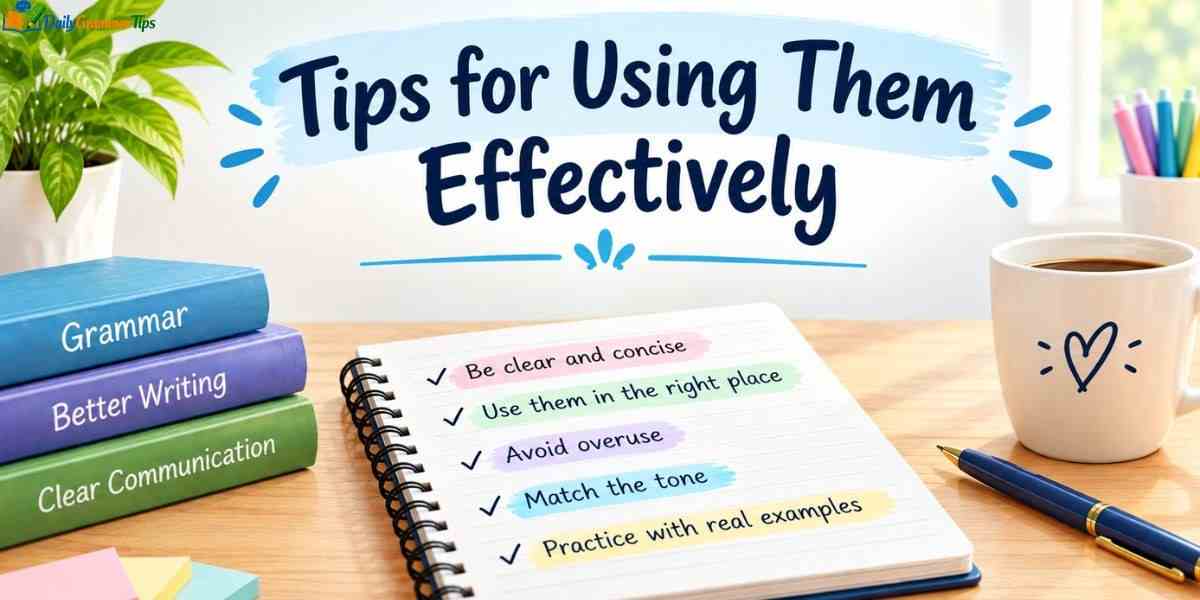
A few habits will help you apply these words well without overthinking them.
- Match meaning first. Decide the relationship before you pick the word.
- Vary your choices. Switching between however, nevertheless, and on the other hand keeps contrast from sounding repetitive.
- Read aloud. If the sentence sounds stiff, try a different position or remove the adverb if the relationship is already clear.
- Keep both clauses complete. Each side of the semicolon must be able to stand alone as a sentence.
- Aim for balance. One carefully chosen adverb per paragraph is often enough; use more only when the argument truly needs it.
Frequently Asked Questions
What is a conjunctive adverb?
It is a word or phrase, such as however or therefore, that links two independent clauses and shows how they relate.
How do you punctuate a conjunctive adverb between two clauses?
Place a semicolon before it and a comma after it, as in: She was tired; therefore, she left early.
What are some common examples?
Common ones are however, therefore, moreover, consequently, nevertheless, meanwhile, and then.
Can a conjunctive adverb start a sentence?
Yes. End the previous sentence with a period, begin the next one with the adverb, and follow it with a comma.
How is it different from a coordinating conjunction?
A coordinating conjunction like and or but can join clauses with just a comma. A conjunctive adverb needs a semicolon or a period.
Conclusion
Linking adverbs may be small, but they carry real weight in clear writing. They connect independent clauses, show relationships such as addition, contrast, cause and effect, and time, and help readers follow an argument from one point to the next. Learning their punctuation, especially the semicolon and the comma that frame them, protects you from the comma splice and keeps your sentences polished.
To use conjunctive adverbs well, identify the relationship first, choose the word that matches it, place it where it sounds natural, and punctuate it correctly. With regular practice, these choices become automatic, and your essays, reports, and emails will gain the smooth logical flow that readers appreciate. Revisit the lists and examples in this guide whenever you need a quick reminder, and your writing will keep improving with every sentence.
