

A sentence often needs extra detail about a place, a time, or a reason. Relative adverbs add that detail by starting a relative clause and linking it to a noun in the main clause. English has three main relative adverbs: where (place), when (time), and why (reason).
This article explains each of these words with clear definitions, examples, and rules. It also covers how relative adverbs differ from relative pronouns, the formal “preposition + which” alternative, comma usage, and common mistakes, along with exercises and a worksheet for practice.
What Is a Relative Adverb?
A relative adverb is a word that starts a relative clause. It links that clause to a noun in the main clause. The noun usually names a place, a time, or a reason.
English has three main relative adverbs. They are where, when, and why. Each one points back to a noun and adds detail about it.
Compare two short sentences. This is the café. We met here. Now join them. This is the café where we met. The word where replaces here and connects the two ideas.
A relative adverb works as an adverbial inside its own clause. It tells us where, when, or why something happens. It does not act as the subject or object of that clause.
Relative Adverb Definition and Examples
In grammar, a relative adverb is an adverb that introduces an adjective clause. An adjective clause is a group of words with a subject and a verb. It describes a noun, but it cannot stand alone as a sentence.
The noun being described is called the antecedent. The clause answers questions such as Which place?, Which time?, and What reason?
- I know the town where you live. The antecedent is town. The clause shows place.
- They remember an era when a promise meant something. The antecedent is era. The clause shows time.
- It is the reason why I left. The antecedent is reason. The clause shows cause.
In each sentence, the relative adverb sits right after the noun it describes.
Relative Adverbs List
The core list is short. Each word has its own job and its own group of nouns.
| Relative adverb | Refers to | Nouns that often come before it | Can replace |
| where | place | place, town, city, house, school, area, situation, case | in which, at which, on which |
| when | time | day, year, time, moment, era, season, period | in which, on which, at which, during which |
| why | reason | reason | for which |
Some references also treat formal words like whereby and wherein as relative adverbs. They appear mostly in legal and academic writing. Most learners only need the three words above.
Examples of Relative Adverbs
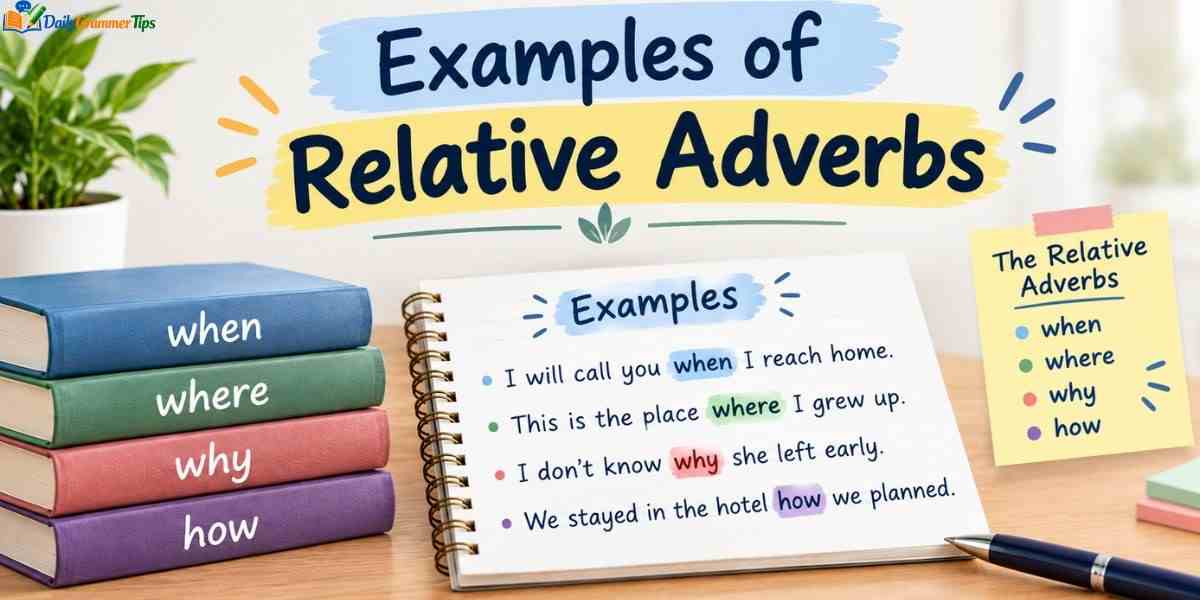
Examples help you see the pattern. Notice the noun in front of each adverb.
Where
- The seat where we sat last Saturday is still free.
- This is the school where I studied philosophy.
- She wants to live in a city where winters are mild.
- Do you remember the restaurant where we celebrated?
When
- I remember the day when we first met.
- There was a time when letters took weeks to arrive.
- Summer is the season when the town feels alive.
- She cannot forget the moment when the lights went out.
Why
- Tell me the reason why you came home late.
- We do not know the reason why he left.
- That is the reason why the plan failed.
How to Use Relative Adverbs in English
Follow four simple steps.
- Find the noun. Look for a noun of place, time, or reason in the main clause.
- Pick the adverb. Use where for place, when for time, and why for reason.
- Add a full clause. After the adverb, write a subject and a verb.
- Check the comma. Add a comma only if the clause gives extra information.
Here is the process in action. Start with That is the park. We played football there. The noun is park, so the adverb is where. The clause is we played football. The result is That is the park where we played football.
Remember one rule. The clause after a relative adverb must be complete. It needs its own subject and verb.
Sentence Structure with Relative Adverbs
The basic pattern is easy to remember.
Noun + relative adverb + subject + verb
She explained the reason why she was late. Here reason is the noun, why is the adverb, she is the subject, and was is the verb.
You can also use a more formal pattern with a preposition and which.
Noun + preposition + which + subject + verb
The hotel at which we stayed was clean. This means the same as The hotel where we stayed was clean.
With when and why, you can often drop the adverb. I remember the day we met. Tell me the reason she left. Both sentences are natural and correct.
Relative Adverb Where
Where refers to a place. It follows nouns such as place, town, house, school, and area.
That was the hospital where my mother worked.
Writers also use where with abstract nouns like situation, case, point, and stage. It is a situation where patience matters. This use is common and correct.
Avoid repeating the preposition. Do not say the house where I live in. Say the house where I live or the house I live in.
Note that that cannot replace where directly. We say the café where we met. We do not say the café that we met. You would need a preposition, as in the café that we met in.
Relative Adverb When
When refers to time. It follows nouns such as day, year, time, moment, era, and season.
I still remember the summer when we travelled north.
In many sentences, you can use that or drop the adverb. The year that we moved was hard. The year we moved was hard. Both are fine.
For a formal tone, use in which, on which, or during which. The era during which teachers used the cane has ended. Most modern writers prefer the simpler when.
Relative Adverb Why
Why refers to a reason. It almost always follows the noun reason.
She never told me the reason why she quit.
The formal version uses for which. She never told me the reason for which she quit. It is correct, but it sounds stiff.
Unlike where, the word why has a narrow job. It does not follow nouns like cause or purpose in standard use. Stick to reason.
Relative Adverbs and Adjective Clauses
A relative clause works like an adjective. It describes a noun and gives more detail about it. That is why grammar books call it an adjective clause.
The clause is dependent. It cannot stand alone because it depends on the main clause. Look at this example. The reason why I was late is traffic. The clause why I was late describes reason.
Relative adverbs are the connectors that open these clauses. They save you from writing two short sentences. Instead of This is the school. I studied there, you can write This is the school where I studied.
The result reads faster and sounds more natural. It also shows the link between the two ideas clearly.
Relative Adverbs vs Relative Pronouns
Both groups introduce relative clauses. They differ in the job they do inside the clause.
| Feature | Relative adverbs | Relative pronouns |
| Words | where, when, why | who, whom, whose, which, that |
| Role in the clause | Adverbial of place, time, or reason | Subject, object, or possessive |
| What the clause already has | A subject and a verb | A missing subject or object |
| Example | The street where I grew up is quiet. | The street that I love is quiet. |
Use this quick test. Look at the clause. If a subject or object is missing, you need a relative pronoun. If the clause is already complete and only lacks a place, time, or reason, use a relative adverb.
In The street where I grew up, the clause I grew up is complete. So where fits. In The street that I love, the verb love needs an object. So that fills the gap.
Learn more………Conjunctive Adverbs: Definition, Types, and Examples
Relative Adverbs and Pronouns in One Sentence
Long sentences often use both groups together. Each word does its own job.
- The teacher who helped me worked at the school where I studied. Here who is a subject. Where adds place.
- That is the house that my uncle built, and it is the place where I learned to cook. Here that is an object. Where adds place.
- I remember the day when the woman whose son won the prize visited us. Here when adds time. Whose shows possession.
Break long sentences into clauses before you check them. Find each relative word and ask what role it plays. This habit prevents most errors.
Relative Adverbs vs Preposition Plus Which
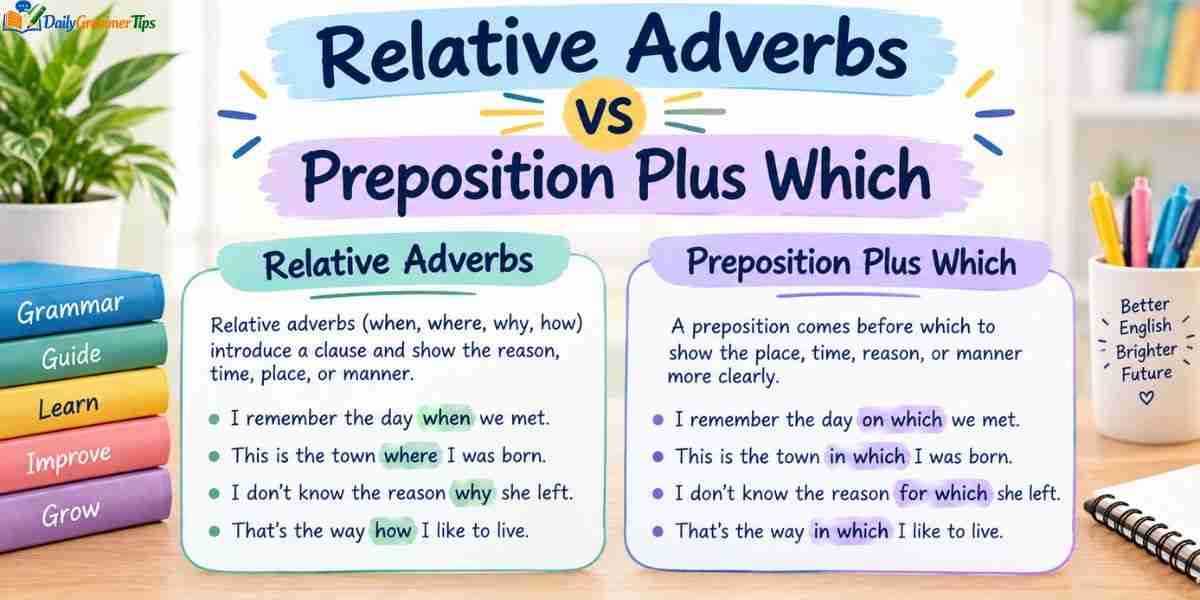
Every relative adverb has a longer twin made of a preposition and which.
| Relative adverb version | Preposition plus which version |
| That is the restaurant where we met. | That is the restaurant in which we met. |
| I remember the day when we met. | I remember the day on which we met. |
| Tell me the reason why you left. | Tell me the reason for which you left. |
Both versions are grammatical. Many guides call the preposition plus which form more formal. Others call it stiff and wordy. In modern writing, the shorter adverb version is usually the better choice.
Choose the longer form only when your tone is very formal, such as in a legal document. In everyday speech and writing, use where, when, and why.
Comma Rules with Relative Adverbs
Comma use depends on the type of clause.
A defining clause identifies the noun. It is essential, so it takes no comma. The seat where we sat is free. Without the clause, we would not know which seat.
A nondefining clause adds extra information. The noun is already clear, so the clause takes a comma. Let us sit on this bench, where we can see the lake. The word this already identifies the bench.
Use this test. Remove the clause. If the noun is still identified, use commas. If the meaning becomes unclear, do not use commas.
Nondefining clauses are less common with relative adverbs than with relative pronouns. Most clauses starting with where, when, or why are defining.
Relative Adverbs vs Nominal Relative Pronouns
A relative adverb needs a noun in front of it. Without that noun, the word works differently.
Compare these two sentences.
- That is the hospital where I was born. The noun hospital comes first. So where is a relative adverb.
- That is where I was born. There is no noun before where. The clause itself works like a noun.
In the second sentence, the clause is called a nominal relative clause. It can act as a subject, an object, or a complement. LanGeek labels the connector in this case a nominal relative pronoun.
The lesson is simple. Look for the antecedent noun. If it is there, the word is a relative adverb.
Using Why Without the Word Reason
The phrase the reason why repeats the idea of cause twice. Many writers drop one word to avoid this repetition.
- I do not know the reason why she left.
- I do not know why she left.
- I do not know the reason she left.
All three sentences are acceptable. The second and third are shorter and cleaner. Formal editors often prefer one of them.
Keep the reason why when you want a clear, slower emphasis. Drop one word when you want tight prose.
Common Mistakes with Relative Adverbs
Learners and native speakers make the same few errors.
- Mixing up the three words. Incorrect: The year where he moved was hard. Correct: The year when he moved was hard.
- Using why with the wrong noun. Incorrect: The day why I left. Correct: The reason why I left.
- Repeating the preposition. Incorrect: The house where I live in. Correct: The house where I live.
- Using an incomplete clause. Incorrect: The city where is famous. Correct: The city where we met is famous.
- Forgetting the comma in a nondefining clause. Incorrect: I love my hometown where I met my wife. If the town is already clear, write: I love my hometown, where I met my wife.
- Awkward combinations. Avoid during when and from where in everyday writing. Use when and where alone.
- Choosing a pronoun when an adverb is needed. Incorrect: The café which we met. Correct: The café where we met.
Why Relative Adverbs Are Important
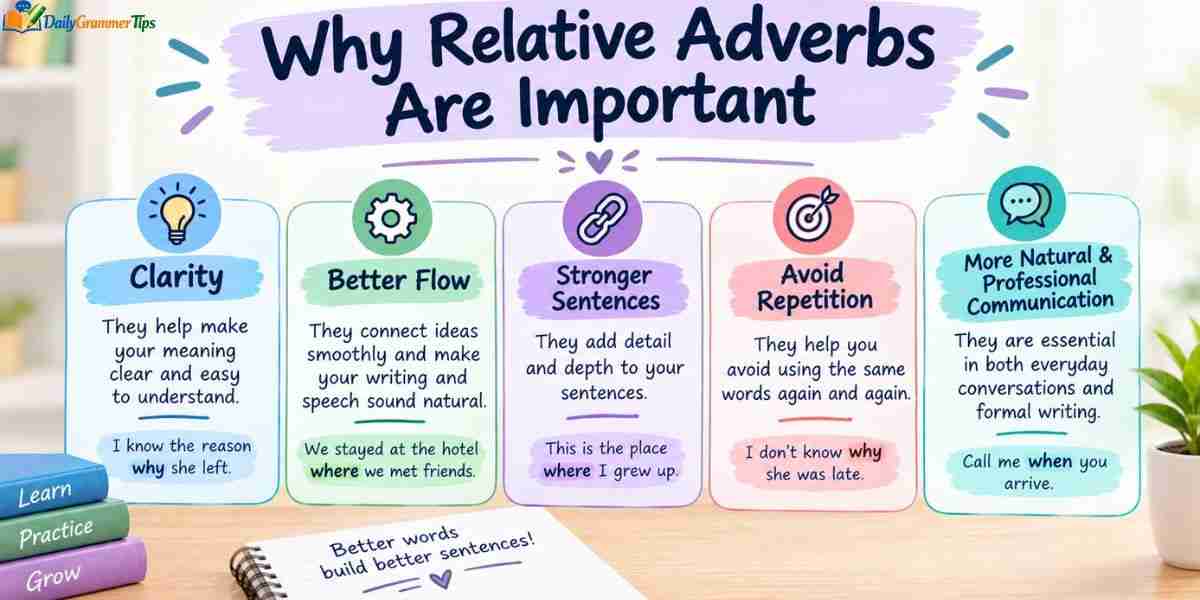
Relative adverbs do real work in your writing. They are small words with big benefits.
They combine short sentences into smooth, longer ones. They make your style less choppy. They also cut wordy phrases like in which and for which.
They add precise detail about place, time, and cause. That detail makes descriptions clearer and arguments easier to follow.
They also help in exams. In IELTS writing and speaking, accurate relative clauses show grammar range. Examiners reward sentence variety and control.
Finally, there are few serious errors tied to them. A learner who masters the three words gains a quick, safe boost in fluency.
More Examples of Relative Adverbs
Here are more examples across daily topics.
School
- This is the classroom where we take our exams.
- Friday is the day when the library closes early.
Travel
- Lisbon is the city where I first learned to surf.
- Spring is the season when the mountains turn green.
Work
- The office where she works faces the river.
- We discussed the reason why sales dropped.
Family
- I miss the years when we lived near my grandparents.
- This is the kitchen where my mother taught me to bake.
Read each sentence again. Find the noun and name its type. That small drill builds speed.
Relative Adverbs for Kids
Children can learn this topic with a simple rule. Each relative adverb matches one question.
- Where tells about a place.
- When tells about a time.
- Why tells about a reason.
Try these easy sentences.
- This is the park where we play.
- I love the day when it snows.
- Do you know the reason why the sky is blue?
Here is a fun game. Read a sentence and ask, Is the word before it a place, a time, or a reason? Then pick the matching word.
Parents and teachers can add a tip. A relative adverb joins two small sentences into one. Ask the child to join This is my school. I learn here. The answer is This is my school where I learn.
Relative Adverb Exercises with Answers
Try these exercises. Then check the answers below.
Exercise 1: Choose the correct word (where, when, why).
- This is the library (blank) I study every evening.
- I remember the winter (blank) it snowed for a week.
- Tell me the reason (blank) you missed the class.
- Is that the stadium (blank) the final was played?
- Sunday is the day (blank) we visit our grandparents.
- She never explained the reason (blank) she moved abroad.
Exercise 2: Rewrite each sentence with a relative adverb.
- That is the beach on which we camped.
- I remember the night during which the storm hit.
- He told me the reason for which he resigned.
- This is the street in which I grew up.
Exercise 3: Correct the mistakes.
- The year where we met was 2015.
- The house where she lives in is old.
- I know the day why he left.
- The city where is my hometown is large.
Answers
- Exercise 1: where, when, why, where, when, why.
- Exercise 2: That is the beach where we camped. I remember the night when the storm hit. He told me the reason why he resigned. This is the street where I grew up.
- Exercise 3: The year when we met was 2015. The house where she lives is old. I know the reason why he left. The city where I was born is large. (Other correct answers are possible for the last two.)
Relative Adverbs Worksheet
This worksheet has three parts. Complete it first and check the key at the end.
Part A: Underline the relative adverb and name the noun it describes.
- The village where my father grew up has one school.
- We talked about the reason why the match was cancelled.
- I miss the evenings when the family sat together.
Part B: Join each pair of sentences with where, when, or why.
- That is the shop. I bought my first guitar there.
- Winter is the season. The lake freezes then.
- Nobody knows the reason. The bus was late for that reason.
Part C: Fill in the blanks with a suitable relative adverb.
- The museum (blank) we met is closed today.
- There are days (blank) I want to stay home.
- That is the reason (blank) I called you.
Answer key
- Part A: where (village), why (reason), when (evenings).
- Part B: That is the shop where I bought my first guitar. Winter is the season when the lake freezes. Nobody knows the reason why the bus was late.
- Part C: where, when, why.
Relative Adverbs Cheat Sheet for Quick Revision
Use this summary for fast review before a test.
| Word | Meaning | Antecedent | Formal twin | Example |
| where | place | place, town, house, situation | in, at, on which | The town where I live is small. |
| when | time | day, year, moment, era | in, on, at, during which | I recall the day when we met. |
| why | reason | reason | for which | Tell me the reason why you left. |
Fast rules
- Use a relative adverb when the clause is complete.
- Use a relative pronoun when the clause lacks a subject or object.
- Do not repeat the preposition after where.
- You may drop when and why in many sentences.
- Use commas only for nondefining clauses.
Key Points to Remember
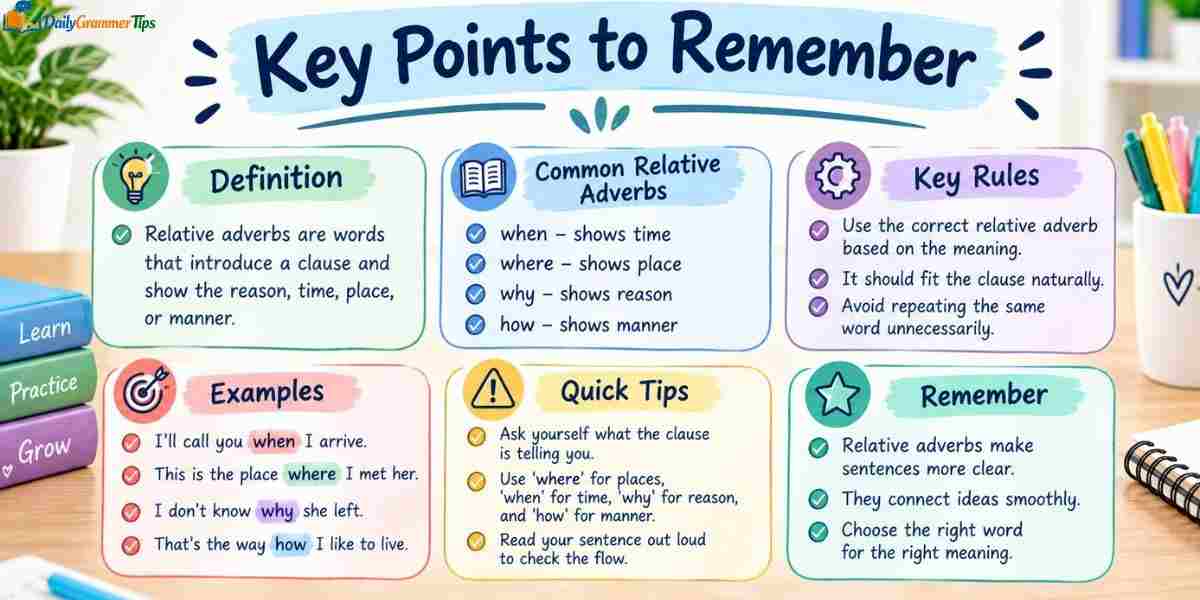
- The three relative adverbs are where, when, and why.
- They introduce relative clauses that describe nouns of place, time, and reason.
- They can often replace preposition plus which, and the shorter form sounds more natural.
- Defining clauses take no comma. Nondefining clauses take a comma.
- You can usually drop why or reason to avoid repetition.
- Without a noun in front, the clause works like a noun clause.
- Check that the clause has its own subject and verb.
Frequently Asked Questions
What is a relative adverb with an example?
A relative adverb is a word like where, when, or why that starts a relative clause. Example: This is the school where I studied.
What are the three relative adverbs?
The three relative adverbs are where for place, when for time, and why for reason.
What is the difference between a relative adverb and a relative pronoun?
A relative pronoun, such as who or which, acts as a subject or object inside its clause. A relative adverb adds place, time, or reason to a clause that is already complete.
Can you use that instead of a relative adverb?
Sometimes. That can often replace when and why, as in the day that we met. It cannot directly replace where without a preposition.
Do you need a comma before a relative adverb?
Only in a nondefining clause that adds extra information, as in We sat on the bench, where we could see the lake. A defining clause takes no comma.
Conclusion
Relative adverbs may be small words, but they make a big difference in writing. By using where for place, when for time, and why for reason, you can join two short sentences into one smooth, natural sentence. They also help you avoid wordy phrases like “in which” or “for which,” making your style clearer and more fluent.
To use them correctly, remember that the clause after a relative adverb must have its own subject and verb. If the clause is missing a subject or object, use a relative pronoun instead. Defining clauses take no comma, while nondefining clauses do, and when and why can often be dropped. With regular practice, these rules will improve both your grammar and your fluency, especially in exams like IELTS.
