

Some words answer one simple question: how much? Adverbs of degree do exactly that. They show the strength, level, or extent of an action, a quality, or another adverb. Compare The soup is hot with The soup is extremely hot. The second sentence tells you the exact intensity. That small change adds emphasis, emotion, and clarity to your message.
This guide explains how these words work in English. You will learn their definition, types, and placement in a sentence. You will also see how to use very, too, enough, quite, and hardly with confidence. Along the way, you will find lists, examples, common mistakes, and practice exercises. Each section builds on the last, so you can use these words correctly in speaking, writing, and exams like IELTS.
What Are Adverbs of Degree?
Adverbs of degree describe intensity. They tell us how much, how far, or to what extent something happens. They answer questions like How much? and To what degree?
These words are modifiers. A modifier adds detail to another word. That word can be an adjective, a verb, or another adverb.
Look at three quick cases. She is very tired shows the level of her tiredness. I completely agree shows the strength of agreement. He drove quite slowly shows the extent of his slowness.
Without them, language feels flat. With them, you can show strong feeling, mild feeling, or a clear limit. They add shades of meaning. Compare fairly good, really good, and almost good. Each phrase says something different.
Definition of Adverbs of Degree
An adverb of degree is a word that shows the intensity or extent of a verb, an adjective, or another adverb. In general, degree means the extent, measure, or scope of something. So an adverb that measures that extent belongs to this group.
Most are single words, such as very, quite, and almost. A few are short phrases, such as a bit, a little, and not at all. Many end in ly, like extremely and incredibly. Others do not. Very, quite, too, enough, and much have no ly ending.
Degree adverbs do three jobs.
- They modify adjectives: incredibly talented.
- They modify other adverbs: very quickly.
- They modify verbs: completely agree.
Grammar books also call them degree adverbs. The strong ones are often called intensifiers.
Adverbs of Degree List
The list is long. New words join it through everyday use. The table below groups common ones by the strength they express.
| Group | Common words |
| Strong | very, really, extremely, incredibly, absolutely, completely, totally, utterly, entirely, thoroughly, highly, deeply, terribly, remarkably, intensely, greatly, strongly, fully, insanely, wonderfully |
| Moderate | quite, pretty, rather, fairly, unusually |
| Weak | slightly, somewhat, a bit, a little, hardly, barely, scarcely |
| Limiting | almost, nearly, just, only, practically, virtually, largely, purely |
| Excess or enough | too, so, enough |
| Comparison boosters | much, far, a lot, a great deal, less, least, most |
Some words fit more than one group. Quite can mean moderately or completely. Just can mean exactly or only. Context decides the meaning.
Examples of Adverbs of Degree
Examples show how these words behave. Notice the word each one modifies.
Modifying an adjective
- The water was extremely cold.
- This cake is absolutely wonderful.
- The class is unusually quiet today.
Modifying another adverb
- She is running very fast.
- You are walking too slowly.
- She sang remarkably well.
Modifying a verb
- We almost missed the bus.
- I completely understand your point.
- He barely noticed the mistake.
In each sentence, the degree word sits right next to the word it changes. That closeness keeps the meaning clear.
Types of Adverbs of Degree
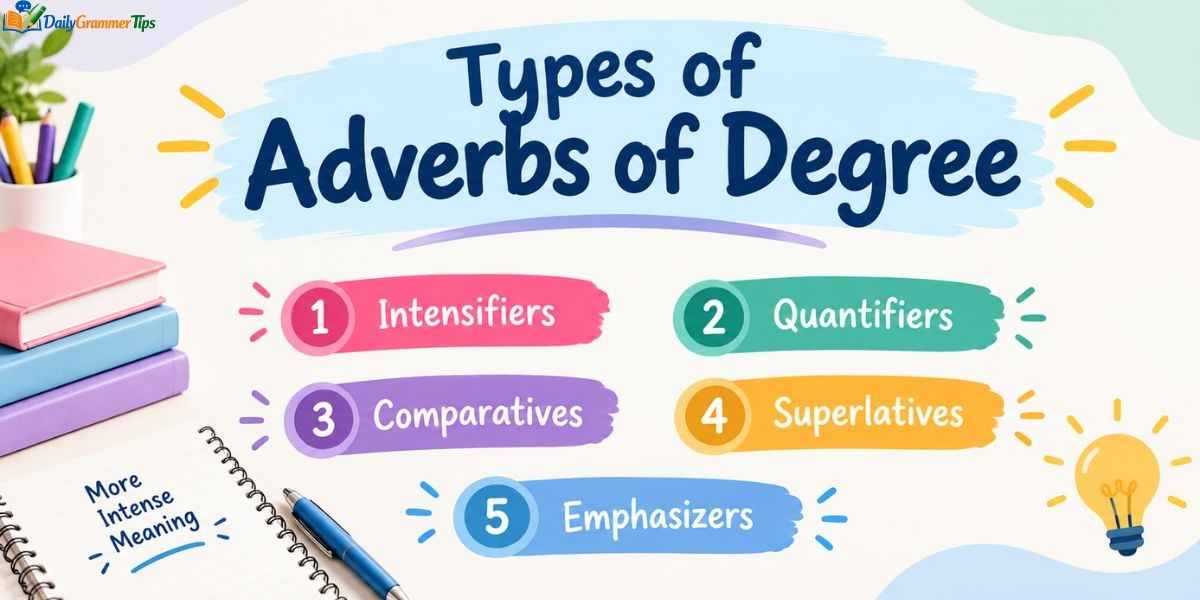
Grammar sources sort these words in a few useful ways. The simplest split is by effect on meaning.
Intensifiers
Intensifiers strengthen the word they modify. They make an idea stronger or more emphatic. Examples include really, very, extremely, absolutely, and totally.
She was completely shocked by the news.
Mitigators or downtoners
Mitigators weaken the impact of a word. They soften the idea. Examples include slightly, a bit, somewhat, and barely.
The weather was slightly chilly this morning.
Limiting adverbs
Limiting adverbs restrict the extent. They show that something is near a point or confined to a small part. Examples include almost, nearly, just, and only.
She almost missed the bus.
Strong, moderate, and weak levels
You can also sort them by strength. Strong ones include completely and absolutely. Moderate ones include pretty, quite, rather, and fairly. Weak ones include slightly, hardly, and a little. Choose the level that matches the feeling you want.
Placement of Adverbs of Degree in Sentences
Position matters. A misplaced word can change meaning or sound wrong. These are the main patterns.
- Before an adjective or adverb. This is the most common spot. He is very talented.
- Before the main verb. She barely passed the exam.
- After the verb be. They were quite exhausted after the trip.
- Around modal verbs. The word can come before or after the modal. She might completely forget. You could almost be done.
- After the auxiliary have. I had completely forgotten the project.
- After the word it modifies, for enough. The coffee is hot enough.
Very and too go before adjectives and adverbs. They do not usually go before verbs. So we say I like it very much, not I very like it.
Sentence Patterns with Adverbs of Degree
A few patterns appear again and again. Learn them as chunks.
| Pattern | Example | Note |
| Adverb + adjective | She is extremely tired. | Most common pattern |
| Adverb + adverb | He spoke very clearly. | Modifies another adverb |
| Adverb + verb | I completely agree. | Not every degree word fits here |
| Too + adjective or adverb | The box is too heavy to lift. | Suggests excess or a problem |
| Adjective or adverb + enough | She is tall enough to reach it. | Shows sufficiency |
| So + adjective + that clause | It was so loud that we left. | Shows a result |
Patterns with too and enough often take to plus a verb. They can also take for plus a person. The coffee is too hot for me.
How to Use Very and Too
Very makes an adjective or adverb stronger. It states a fact. The house is very expensive. She runs very fast.
Very works with many adverbs of manner, such as slowly, quickly, well, easily, badly, and carefully. It does not work well with absolute words like completely or utterly. We do not say very completely.
Very also helps form a polite negative. She was not very helpful sounds softer than She was unhelpful. Speakers use not very to avoid sounding blunt.
Too means excessively. It usually hints at a problem. This soup is too hot to eat. It often takes to plus a verb or for plus a person.
Here is the key difference. Very states a fact. Too suggests a problem.
- It is very hot outside.
- It is too hot outside to go for a walk.
Too has a second meaning, also. In that case it comes at the end of the clause. Can I come too? This use is not a degree adverb. Watch the meaning.
How to Use Enough
Enough is flexible. It can work as an adverb or as a determiner.
As an adverb, enough means to the necessary degree. It goes after the adjective or adverb. Is your coffee hot enough? He did not work hard enough. This is the opposite of most degree words. They come before.
As a determiner, enough goes before a noun. We have enough bread. They don’t have enough food. It works with plural countable nouns and uncountable nouns.
Enough often takes to plus a verb. She is not old enough to vote. It can also take for. The dress was big enough for me.
Learn more……….Relative Adverbs: Definition, Examples, and Rules
How to Use Quite, Fairly, and Rather
These three express a moderate level. Yet each has its own flavor.
Fairly is mild and often positive. The movie was fairly interesting. Pretty works the same way in casual speech. She sang pretty well.
Quite is slightly stronger. It can mean moderately. The book was quite interesting. With ungradable adjectives, it can mean completely. The task was quite impossible. It also pairs with nouns. Quite a surprise. Quite a fascinating collection. Quite some time.
Rather is stronger again. It often points to something unexpected or negative. The lecture was rather boring. The room was rather cold. Do not confuse it with would rather. That phrase shows preference, not degree.
As a rough guide, the order runs from fairly, to quite or pretty, to rather, to very.
How to Use Somewhat, A Bit, Much, and Far
Somewhat, a little, and a bit give mild emphasis. They soften a statement. The price is somewhat higher than expected. It’s a bit cold in here. A bit is informal. The phrase a bit of also works with nouns. My uncle is a bit of an eccentric.
Much, far, and a lot boost comparisons. They go before comparative forms. The pay is much better in my new job. This car is far better than the old one. She feels a lot happier now.
A little and slightly weaken comparisons. The weather is slightly warmer today.
Here is a common trap. Very does not go with comparatives. We say much better, not very better.
How to Use Barely, Hardly, and Scarcely
These three mean almost not. They carry a negative sense by themselves. So do not add not or n’t.
He could barely read or write. I can hardly imagine such a moment. There was scarcely any food left.
They usually sit before the main verb or before an adjective. They often appear with any or ever. We hardly ever meet. She has hardly any time.
Do not mix up hardly and hard. He works hard means he puts in effort. He hardly works means he barely works at all. The meanings are almost opposite.
Gradable and Ungradable Adjectives
Not every intensifier fits every adjective. The reason is gradability.
Gradable adjectives have degrees. You can measure them. Examples include hot, tired, tall, and interesting. They take very, extremely, quite, and slightly. The weather is very hot today.
Ungradable adjectives name an extreme or fixed state. Examples include free, perfect, impossible, unique, freezing, and exhausted. They take absolutely, completely, totally, utterly, and entirely. Everything is totally free here. The plan was utterly useless.
So very perfect sounds wrong. Absolutely perfect sounds right. Remember this when you choose an intensifier.
Adverbs of Degree vs Other Types of Adverbs
Adverbs fall into groups by the question they answer. This table helps you tell them apart.
| Type | Question it answers | Example |
| Degree | How much? To what extent? | She is extremely happy. |
| Manner | How? | He drives carefully. |
| Frequency | How often? | I rarely eat fast food. |
| Time | When? | We arrived yesterday. |
| Place | Where? | They waited outside. |
Intensifiers are a subgroup of degree adverbs. Every intensifier is a degree adverb. But not every degree adverb is an intensifier. Absolutely strengthens meaning. Slightly weakens it. Both still show degree.
Some words change type with position. Just can mean exactly or only. Check the question the word answers.
Inversion with Negative Adverbs
In formal writing, some negative adverbs can open a sentence. When they do, the word order flips. An auxiliary verb comes before the subject. This is called inversion.
Common openers include never, rarely, seldom, hardly, scarcely, and not only.
- Rarely do they have time to relax.
- Never have I seen such courage.
- Hardly had we arrived when it began to rain.
- Not only does she sing well, but she also plays the piano.
Compare the normal order. They rarely have time to relax. Inversion adds emphasis. Use it in writing and formal speech. It sounds unnatural in casual talk.
Note that hardly and scarcely are degree adverbs. Never, rarely, and seldom are frequency adverbs. All of them trigger inversion at the start of a clause.
Adverbs of Degree in IELTS and Everyday Writing
Precise degree words raise the quality of your English. They add nuance. They also widen your vocabulary range, which helps in IELTS and TOEFL.
In speaking, a degree word makes an answer feel natural. I was incredibly nervous before my first presentation. In writing, it adds precision. The results were significantly different from last year.
Use these tips.
- Replace weak pairs with stronger words. Very tired can become exhausted.
- Vary your choices. Try highly, considerably, remarkably, and substantially.
- Match the tone. Really, pretty, and a bit suit casual speech. Highly and considerably suit formal writing.
- Avoid repeating very. Too many copies make writing dull.
- Avoid redundancy. Completely empty is fine. Very completely empty is not.
Common Mistakes to Avoid
Learners often make the same few errors. Here are the main ones.
- Putting enough before the adjective. Incorrect: She is enough smart. Correct: She is smart enough.
- Using very before a verb. Incorrect: I very like this city. Correct: I like this city very much.
- Using very with comparatives. Incorrect: This is very better. Correct: This is much better.
- Adding not to hardly. Incorrect: I can’t hardly hear you. Correct: I can hardly hear you.
- Pairing very with ungradable words. Incorrect: The view was very perfect. Correct: The view was absolutely perfect.
- Confusing hardly with hard. Incorrect: He studies hardly. Correct: He studies hard.
- Stacking intensifiers. Incorrect: very extremely cold. Correct: extremely cold.
Practice Exercises with Answers
Try these exercises first. Then check the answers below.
Exercise 1: Fill in the blanks. Use words from the box: extremely, almost, barely, quite, too.
- The test was (blank) difficult, and nobody finished early.
- We (blank) missed the train.
- She was so tired that she could (blank) keep her eyes open.
- The room is (blank) small for ten people.
- His new song is (blank) good, though it is not my favorite.
Exercise 2: Choose the correct option.
- The soup is (hot enough / enough hot) to burn your tongue.
- I (very like / really like) this city.
- The final exam was (very / much) harder than the quiz.
- The concert was (very / absolutely) perfect.
Exercise 3: Correct the mistakes.
- She is enough smart to solve it.
- The movie was very better than the book.
- I can’t hardly hear you.
- He very enjoyed the trip.
Answers
- Exercise 1: extremely, almost, barely, too, quite.
- Exercise 2: hot enough, really like, much, absolutely.
- Exercise 3: She is smart enough to solve it. The movie was much better than the book. I can hardly hear you. He enjoyed the trip very much.
Frequently Asked Questions
What is the adverb of degree with example?
An adverb of degree shows how much or to what extent something happens. It modifies a verb, an adjective, or another adverb. Example: She is very talented.
Can you give me 20 examples of degrees of comparison?
Degrees of comparison have three forms: positive, comparative, and superlative.
- tall, taller, tallest
- small, smaller, smallest
- fast, faster, fastest
- big, bigger, biggest
- hot, hotter, hottest
- happy, happier, happiest
- easy, easier, easiest
- early, earlier, earliest
- large, larger, largest
- strong, stronger, strongest
- good, better, best
- bad, worse, worst
- far, farther, farthest
- little, less, least
- many, more, most
- beautiful, more beautiful, most beautiful
- interesting, more interesting, most interesting
- careful, more careful, most careful
- expensive, more expensive, most expensive
- comfortable, more comfortable, most comfortable
What is the other name of the adverb of degree?
Adverbs of degree are also called degree adverbs, and some grammar books call them adverbs of extent. The ones that strengthen meaning, like extremely, are often called intensifiers.
Can you give me 20 examples of adverbs?
- Manner: quickly, carefully, loudly, happily
- Time: yesterday, soon, now, later
- Place: here, there, outside, nearby
- Frequency: always, often, never, sometimes
- Degree: very, quite, extremely, almost
What is an example of degree?
In grammar, an example is the sentence The soup is extremely hot. Here, extremely shows the level of the heat.
Conclusion
Adverbs of degree give your sentences strength, softness, and precision. You choose them to show how much, how far, or how strongly something happens. When you place them correctly, your writing sounds clear and natural. Remember the key rules: put most of them before the word they modify, and put enough after it.
Now practice what you learned. Use very for gradable words, too for excess, and absolutely for extreme ones. Avoid the common mistakes, and vary your word choices. Use the lists, tables, and exercises in this guide whenever you need a quick check. Your English will improve with every sentence you write.
