


English has plenty of word pairs that trip people up, and planning or planing is one of the most common. These two words look nearly identical on the page, yet they belong to completely different worlds of meaning. One shows up in your daily conversations about work, travel, and life. The other belongs mostly to a workshop or a boat deck.
If you’ve typed “planing” when you meant “planning,” you’re far from alone. This is one of those commonly confused words that even confident writers mix up, mostly because the spelling rules in English around doubling letters aren’t always intuitive.
Planning Meaning in English
In standard English, planning meaning centers on the process of thinking ahead and organizing the steps needed to reach a goal. It covers everything from small daily tasks, like planning a grocery list, to much larger undertakings, like planning a career path or a company’s growth strategy. At its core, the word always signals preparation before action.
This meaning stays consistent across nearly every context where the word appears, whether it’s used casually in conversation or formally in business and academic writing. Planning meaning in English rarely shifts based on setting, which is part of why it’s such a reliable, frequently used word. Understanding this core definition also makes it easier to recognize when a sentence has accidentally used “planing” instead, since the meanings simply don’t overlap.
Read Also: Dought vs Doubt: Meaning, Difference & Usage Guide
Planing or Planning: Which One Do You Actually Need?
When people search planing or planning, they’re usually trying to settle a quick doubt before hitting send on an email or finishing an assignment. The correct choice always comes down to context.
Reach for “Planning” When You Mean:
- Organizing something
- Getting ready for what’s ahead
- Making arrangements
- Thinking through future steps
Example: “I am planning a vacation.”
This is the version you’ll use in almost every everyday sentence, and it covers everything from event planning to project planning.
Reach for “Planing” When You Mean:
- Smoothing a wooden surface with a tool
- A boat or aircraft gliding across a surface
- Certain technical or engineering processes
Example: “He is planing the wooden board.”
Both spellings are legitimate English words. The trick is matching the word to the situation.
Is It Planing or Planning in Daily Conversation?
For anyone asking is it planing or planning in casual writing, texting, or speaking, the answer is almost always planning.
Common everyday uses include:
- Planning a trip
- Planning a meeting
- Planning your future
- Planning an event
Here’s an incorrect version people often write by mistake:
“I am planing my wedding.”
And the correct version:
“I am planning my wedding.”
Unless you’re literally shaving down a piece of timber or describing a boat skimming across water, planning is what you’re after.
What Planning Actually Means

To fully grasp the planing or planning meaning, it helps to look at each word on its own terms.
Planning refers to:
- Preparing something in advance
- Organizing the steps involved
- Making decisions before you act
- Building out a strategy
You’ll see this word constantly in phrases like strategic planning, financial planning, event planning, project planning, and travel planning. It’s the word behind planning ahead, future planning, organizing and preparing, making arrangements, and scheduling.
Example sentence: “She is planning her next business move.”
The Grammar Rule Behind the Double N
This is where verb conjugation and a specific spelling pattern come into play. “Planning” is built from:
Plan + ing = Planning
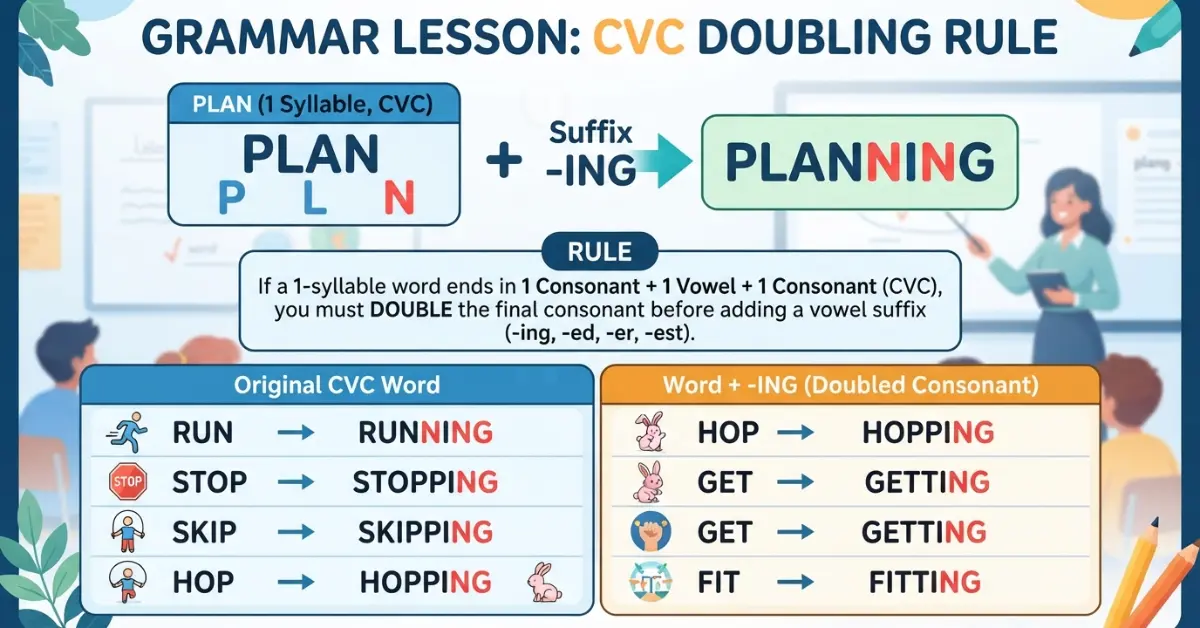
“Plan” ends in a single consonant that follows a short vowel sound. Under the CVC rule (consonant vowel consonant), that final consonant gets doubled before you attach the suffix ing to form the gerund form or present participle.
So the pattern runs:
Plan becomes Planning
Not:
Plan becomes Planing
This consonant doubling rule, sometimes just called the double n rule, is the exact reason planning carries two Ns while planing carries only one.
What Planing Actually Means
It surprises a lot of people to learn that planing is a genuine English word with its own dictionary entry, not simply a typo of planning.
Planing generally describes two things:
1. Smoothing Wood
In carpentry, a plane is a hand tool used to shave down and even out a wooden surface.
Example: “He is planing the surface of the table.”
2. Gliding Over Water or Air
In technical and nautical contexts, a boat or aircraft is said to be planing when it rises and skims smoothly across a surface instead of pushing through it.
Example: “The speedboat was planing across the water.”
This meaning stays largely confined to specialized writing, so you won’t run into it often outside of engineering, aviation, or woodworking content.
Why the Confusion Happens in the First Place
This mix up isn’t random. A few things make planning and planing genuinely easy to blur together:
- They’re near identical in spelling
- Both are real, dictionary approved words
- Adding the suffix ing changes spelling patterns in ways that aren’t always obvious
This is a textbook case of a homophone vs near homophone situation. The words aren’t pronounced exactly alike, but they’re close enough, and spelled closely enough, that silent letter confusion and simple typing slips do the rest.
The underlying grammar rule again: for a short verb like “plan,” the short vowel sound triggers consonant doubling. That single rule explains the entire planning or planing debate, and it lines up with familiar pairs like:
- Run becomes Running
- Sit becomes Sitting
- Stop becomes Stopping
Real Sentence Examples
Correct Uses of Planning
- “We are planning a road trip.”
- “She is planning her studies.”
- “They are planning a surprise party.”
Correct Uses of Planing
- “The carpenter is planing the wood.”
- “The boat began planing over the water.”
A Common Mistake
Wrong: “I am planing my future.”
Right: “I am planning my future.”
Planning or Planing for School Assignments and Exams

This question shows up often in grammar tests and student essays, and the answer still depends entirely on what the sentence is describing.
If your sentence touches on:
- Organizing
- Preparing
- Thinking ahead
Go with planning.
If your sentence touches on:
- Woodworking
- Surface smoothing
- A technical gliding motion
Go with planing.
In academic and professional writing, planning shows up far more often, so when in doubt, that’s usually your safer bet.
A Simple Way to Remember the Difference
Planning equals plans for what’s ahead. Picture yourself “making a plan,” and the double N should click into place naturally.
Planing equals a tool or a motion. Picture a carpenter’s hand plane, or a boat skimming smoothly across open water.
Once that image sticks, you won’t need to pause over the spelling again.
Planing or Planning Meaning
The planing or planning meaning question usually comes down to context rather than pronunciation, since the two words sound almost identical but describe entirely different actions. Planning refers to the mental and practical work of preparing for something ahead of time, whether that’s a trip, a budget, or a career move. Planing, on the other hand, describes a physical action tied to smoothing a surface, most often wood, or an object gliding across water or air.
Getting the plan spelling right matters here because these words carry no overlap in real usage. A grammar rule called the consonant doubling rule explains why planning ends up with two Ns while planing keeps just one, and that single letter difference is what separates an everyday word from a specialized, technical one. Once you understand the meaning behind each spelling, mixing them up becomes far less likely.
Planing or Planning Synonym
When people look for a planing or planning synonym, they’re almost always thinking about the “planning” version of the word, since that’s the one used in daily conversation. Words like organizing, scheduling, arranging, preparing, and strategizing all work as reasonable substitutes depending on the sentence. Someone “planning a wedding” could just as easily be described as “organizing” or “arranging” one without changing the meaning much.
Planing doesn’t really carry everyday synonyms in the same way, since it’s a narrower technical term. In woodworking contexts, words like smoothing, shaving, or leveling come closest to capturing what planing describes. In nautical or aviation contexts, gliding or skimming works as a rough equivalent. The gap between these synonym sets is itself a useful reminder of how different these two words actually are beneath their similar spelling.
Planing or Planning Grammar
From a grammar standpoint, the planing or planning debate is a textbook example of the CVC rule, short for consonant vowel consonant. “Plan” ends in a single consonant preceded by a short vowel sound, and English spelling rules require that final consonant to double before adding a suffix like ing. That’s how a simple verb conjugation turns “plan” into the correct gerund form or present participle, “planning.”
This same doubling pattern applies to plenty of other short verbs, which makes it easier to remember once you see the family resemblance. Words like “run” becoming “running” or “stop” becoming “stopping” follow the identical spelling logic. Recognizing this pattern as part of the broader spelling rules in English means you’ll rarely need to second guess whether a short verb doubles its final letter before ing.
Planing or Planning in a Sentence
Seeing planing or planning in a sentence side by side makes the distinction click faster than any rule explanation on its own. “She is planning her thesis defense” uses the word correctly to describe preparation and organization, while “He is planing the edge of the door” uses it correctly to describe a physical woodworking task. Swapping the words between these two sentences would immediately sound wrong to a native speaker, even before they could explain why.
Context clues almost always signal which word belongs in a given sentence. If the surrounding words involve schedules, goals, budgets, or future events, planning is the safe choice. If the sentence mentions tools, wood, surfaces, or a boat moving across water, planing fits instead. Reading a sentence for its subject matter, rather than just its sound, is the fastest way to avoid picking the wrong spelling.
Planing or Planning Examples
Clear examples make the planing or planning distinction easier to internalize than definitions alone. On the planning side, common examples include “We are planning our summer vacation,” “The team is planning next quarter’s budget,” and “She is planning to study abroad.” Each of these uses the word to describe preparation for something that hasn’t happened yet.
On the planing side, examples look noticeably different: “The carpenter spent the morning planing the tabletop until it was smooth,” or “The boat started planing once it picked up speed.” These examples highlight how planing almost always appears alongside physical, hands on activity, while planning appears alongside goals, timelines, and decisions. Comparing the two example sets side by side makes the underlying pattern hard to miss.
Planning or Planing Wood
The phrase planning or planing wood almost always points to a search for the correct spelling, since only one version of this phrase actually makes sense. Wood doesn’t get “planned,” it gets “planed,” using a hand or power tool designed to shave thin layers off a surface until it’s smooth and level. This is one of the clearest cases where the everyday meaning of planning simply doesn’t apply.
Woodworkers use the term constantly, since planing is a standard step in furniture making, flooring, and carpentry more broadly. A woodworking plane removes small amounts of material with each pass, gradually flattening warped boards or smoothing rough edges. Anyone searching this phrase while working on a project can drop the confusion immediately: the correct term is always planing wood, never planning wood.
Planning Definition in Management
In a management context, the planning definition expands into something more structured than everyday planning. Here, planning refers to the formal process of setting organizational goals, determining the resources needed to reach them, and mapping out a sequence of actions to get there. It’s typically described as the first function of management, since decisions about organizing, staffing, and controlling all depend on a plan being in place first.
Management theory often breaks planning down into types, such as strategic planning for long term direction, tactical planning for department level goals, and operational planning for day to day execution. This structured version of planning still relies on the same core meaning as everyday usage, preparing before acting, but it adds formal tools like timelines, budgets, and measurable objectives. Recognizing this distinction helps explain why planning shows up as a foundational term across business, project management, and organizational behavior courses.
Frequently Asked Questions
What does planing mean?
Planing means smoothing a surface, usually wood, with a hand tool or machine, or an object gliding across water or air.
What do you mean by planning?
Planning means preparing or organizing something ahead of time, like a trip, a budget, or a schedule.
When would I use planning?
Use planning whenever you’re describing preparation or organizing for the future, which covers almost every everyday situation.
Is planing ever the right spelling?
Yes, but only in technical contexts like woodworking, engineering, or a boat gliding across water, never for everyday preparation.
Which is correct: “planed” or “planned”?
Both are correct, but they mean different things: “planed” means smoothed wood, while “planned” means organized or prepared in advance.
Conclusion
At the end of the day, the planing or planning question comes down to one simple test: are you preparing for something, or are you smoothing a surface? Planning carries the double N and covers everyday situations like organizing a trip, a budget, or a schedule, while planing keeps a single N and stays limited to woodworking, engineering, or a boat gliding across water. Once that distinction sits in your memory, the spelling stops being a guessing game.
The confusion between these two words is common, but it’s easy to clear up once you know the grammar rule behind it and see a few real examples side by side. Whether you’re writing a sentence, checking a definition, or just double checking “planed” versus “planned,” matching the word to its actual meaning is all it takes to get it right every time.
