

Think about how people do things. A child laughs loudly, a driver brakes suddenly, and a chef cooks carefully. The words that describe these actions are adverbs of manner. They tell us the way something happens, and they make every sentence clearer.
This guide explains adverbs of manner in simple language. You will learn their meaning, how to form them, and where to place them in a sentence. You will also find many examples, sample sentences, and exercises to practice with.
What Are Adverbs of Manner?
Adverbs of manner tell us how an action happens. They describe the way someone does something. Words like quickly, softly, and happily are common adverbs of manner.
They answer one simple question: how? How did she speak? She spoke gently. How did he run? He ran fast. The answer is always an adverb of manner.
Adverbs of Manner Examples
Simple examples make the idea easy to grasp. Slowly, bravely, kindly, badly, and well are popular adverbs of manner. Each word shows the style of an action.
Read this sentence: “The cat crept silently across the floor.” The word silently tells you how the cat crept. You can spot adverbs of manner the same way in any text.
How Adverbs of Manner Work in a Sentence
These adverbs mostly describe verbs. They sit near the action word and add detail. Without them, a sentence feels plain and flat.
Compare two lines. “She sang” gives a bare fact. “She sang beautifully” paints a picture. This small change shows the power of these words.
Modifying Verbs
The main job is to describe a verb. In “He answered politely,” the word politely changes the verb answered. It tells you the style of the answer.
Readers get a clearer view of the action this way. They can picture the scene more easily. Good writers use this tool often.
Modifying Adjectives and Other Adverbs
Some adverbs of manner also describe adjectives or other adverbs. In “She is a wonderfully kind teacher,” wonderfully describes kind. In “He drove very carefully,” very describes carefully.
These uses are less common. They still add useful detail. Most of them, however, stay close to the verb.
How to Form Adverbs of Manner
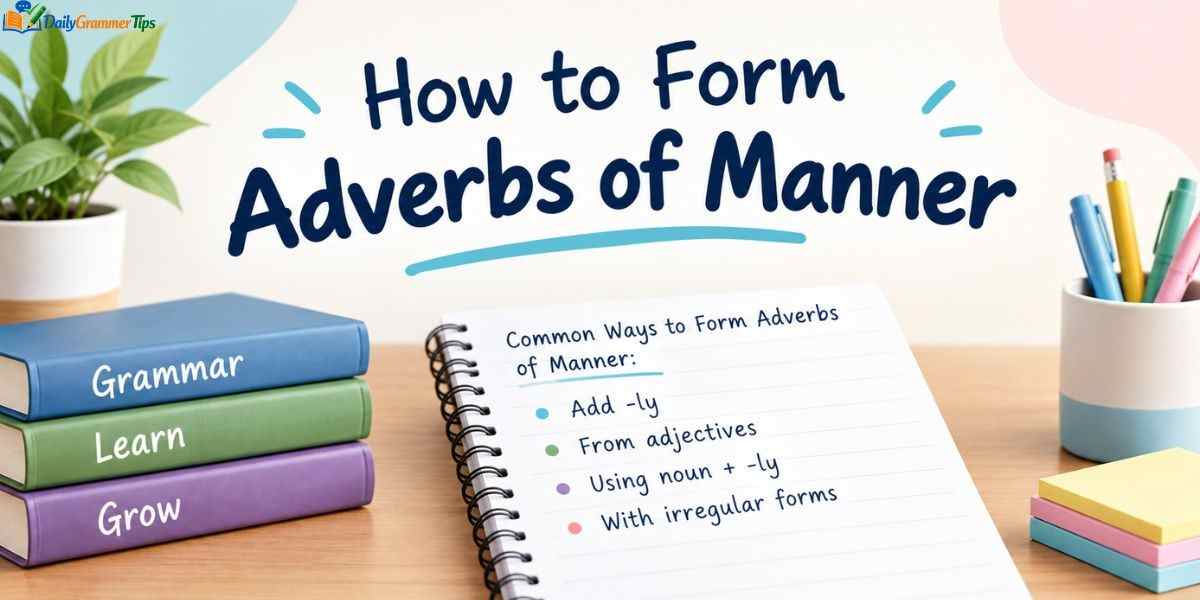
Most of them come from adjectives. You add “ly” to the end of the adjective. Quick becomes quickly, and sad becomes sadly.
A few spelling rules apply. Learn them once and you will use them for life. The sections below explain each rule.
Add ly to the Adjective
This is the simplest rule. Take the adjective and add “ly.” Loud becomes loudly, calm becomes calmly, and slow becomes slowly.
Most of them follow this pattern. Students find it easy to remember. It covers a large share of everyday words.
Change y to i
If an adjective ends in y, change the y to i. Then add “ly.” Happy becomes happily, and angry becomes angrily.
Easy becomes easily and noisy becomes noisily. This rule applies to many common adverbs. Check the spelling each time you write them.
Change le to ly
If an adjective ends in “le,” drop the final e and add “y.” Gentle becomes gently, and simple becomes simply.
Terrible becomes terribly and comfortable becomes comfortably. This rule is short and clear. It saves learners from many small spelling errors.
Change ic to ically
If an adjective ends in “ic,” add “ally.” Basic becomes basically, and energetic becomes energetically.
Dramatic becomes dramatically and artistic becomes artistically. One exception exists: public becomes publicly. Keep this note in mind when you edit your work.
Irregular Adverbs of Manner
Some of them do not end in “ly.” They have their own forms. Well, fast, hard, and late are the best known cases.
The word “good” is an adjective, but its adverb is “well.” We say “She plays well,” never “She plays good.” This is one of the most common errors in English.
Position of Adverbs of Manner in a Sentence
These adverbs can move around in a sentence. The best spot depends on the verb and on what you want to stress. Most of them sit after the verb or after the object.
A clear position keeps your meaning safe. A misplaced word can confuse the reader. The rules below help you place each word with care.
After the Main Verb
This is the most natural spot. Put the adverb right after an intransitive verb. “The baby slept peacefully” is a good example.
The reader sees the action first and the style second. The flow feels smooth and easy. Use this position as your default choice.
After the Object
When the verb has an object, put the adverb after the object. “She opened the door slowly” works well. The adverb stays close to the action.
Do not place it between the verb and the object. “She opened slowly the door” sounds odd. Keep the verb and object together.
Before the Main Verb
You can place some adverbs before the verb. “He quietly left the room” is a fine sentence. This style adds a touch of emphasis.
Writers use it for rhythm and effect. It works best with short adverbs. Do not overuse it in formal writing.
At the Start of a Sentence
You can also open a sentence with an adverb. “Carefully, she lifted the box” is one example. This style draws attention to the manner of the act.
Add a comma after the opening adverb. Use this pattern sparingly. Too many openings tire the reader.
Adverbs of Manner Questions
These adverbs answer the question “how.” You can test any word with this simple check. If the word explains how an action happens, it is probably one of them.
Try it with the sentence “He speaks clearly.” Ask yourself how he speaks. The answer is clearly. That confirms the word as one of these adverbs.
Adverbs of Manner vs Adjectives
Adjectives describe nouns, while these adverbs describe verbs. The two types often look alike. Quick is an adjective, but quickly is an adverb.
Compare “She is a quick runner” with “She runs quickly.” Both sentences carry the same idea. The word class changes with the word it describes. The table below shows the main differences.
| Feature | Adverbs of Manner | Adjectives |
| Job | Describe verbs | Describe nouns |
| Question answered | How? | What kind? |
| Common ending | Often ly | Varies |
| Example | She sings softly. | She has a soft voice. |
| Position | Near the verb | Near the noun |
Adverbs of Manner vs Adverbs of Degree
Adverbs of degree tell us how much or how strongly. The manner type tells us how an action happens. The two types can appear in one sentence.
Look at “He worked very carefully.” Here, very is an adverb of degree and carefully is the manner word. The table below makes the split clear.
| Feature | Adverbs of Manner | Adverbs of Degree |
| Meaning | Show how | Show how much |
| Question answered | How? | To what extent? |
| Examples | Slowly, bravely, well | Very, quite, too |
| Main target | Verbs | Adjectives and adverbs |
| Sample sentence | She spoke kindly. | She was very kind. |
Adverb of Time

An adverb of time tells us when an action happens. Words like today, soon, yesterday, and always belong here. They answer the question “when?”
Compare it with the manner type. “She arrived early” says when she came. “She arrived quietly” says how she came. A sentence can hold both: “She arrived early and quietly.”
Adverb of Place
An adverb of place tells us where an action happens. Words like here, there, outside, and nearby fit this group. They answer the question “where?”
Look at “The children played outside.” The word outside gives the location. Add a manner word and the picture grows: “The children played happily outside.”
20 Examples of Adverbs of Manner
Here are twenty common words: quickly, slowly, quietly, loudly, carefully, happily, sadly, bravely, kindly, politely, gently, easily, badly, well, fast, hard, angrily, eagerly, neatly, and clearly. Each one tells us how an action happens.
Read the list aloud and build a short sentence for each. This habit builds strong vocabulary. It also helps you remember the spelling rules.
Learn more…….Concrete Nouns: Meaning, Types, and Examples
20 Examples of Adverbs in a Sentence
Sentences show how these words behave in real use. Here are twenty to study. Notice how each adverb sits near its verb.
- The children played happily in the park.
- She closed the door quietly.
- He answered the question correctly.
- The runner finished the race quickly.
- They worked hard all day.
- The teacher spoke clearly to the class.
- My sister dances gracefully.
- The dog barked loudly at the stranger.
- He drove carefully through the storm.
- The baby slept peacefully.
- She wrote the letter neatly.
- The soldiers fought bravely.
- He listened patiently to the story.
- The wind blew gently across the field.
- She smiled warmly at the guests.
- The students waited eagerly for the results.
- He ate his lunch slowly.
- The singer performed beautifully.
- They greeted us politely.
- The boy ran fast down the hill.
50 Adverbs of Manner Sentences
A long list gives you more practice. The next five groups hold fifty sentences in total. Each group has ten sentences.
Read each one and find the adverb. Then ask how the action happened. This method trains your eye to spot adverbs of manner with ease.
Daily Life Sentences
These sentences come from home and street life. They show how common adverbs of manner are in plain speech. You use them every day, often without noticing.
- She makes tea carefully every morning.
- He brushes his teeth quickly.
- The mother hugged her son tightly.
- They cleaned the house thoroughly.
- The neighbor knocked loudly on the door.
- He folded the clothes neatly.
- She cooked the rice perfectly.
- The man crossed the road cautiously.
- The old woman walked slowly to the shop.
- The boy tied his shoes carefully.
School Sentences
School life offers many clear examples. Teachers and students rely on these words every day. They add clarity to instructions and stories.
- The student answered confidently.
- The teacher explained the lesson patiently.
- She read the poem aloud beautifully.
- The class listened attentively.
- He solved the problem easily.
- The girl wrote her name neatly.
- The students entered the hall quietly.
- He studied seriously for the exam.
- The boys cheered loudly at the match.
- She raised her hand politely.
Work Sentences
Work settings need clear and exact words. These sentences show how adverbs of manner add detail to reports and routines. They also make instructions easier to follow.
- The manager spoke firmly to the team.
- The engineer checked the machine carefully.
- She handled the complaint professionally.
- The workers finished the job efficiently.
- He typed the report accurately.
- The nurse treated the patient gently.
- The driver delivered the parcels promptly.
- The chef prepared the meal skillfully.
- She presented her idea clearly.
- The tailor stitched the dress neatly.
Nature and Animal Sentences
Nature gives writers plenty of material. These sentences use adverbs of manner to bring scenes to life. They help readers see and hear the world.
- The river flowed smoothly past the village.
- The eagle soared majestically above the hills.
- The cat crept silently toward the bird.
- The rain fell heavily all night.
- The wind howled fiercely through the trees.
- The rabbit hopped quickly into the bush.
- The leaves fell gently to the ground.
- The lion roared loudly across the plain.
- The bees buzzed busily around the flowers.
- The sun shone brightly over the sea.
Feeling and Behavior Sentences
Feelings shape how people act. These sentences show emotion through the style of an action. Adverbs of manner carry that emotion to the reader.
- She cried bitterly at the news.
- He laughed nervously at the joke.
- The child smiled shyly at the visitor.
- They argued angrily over the plan.
- She waited anxiously for the call.
- He thanked her warmly.
- The crowd cheered wildly.
- She spoke sadly about the past.
- He apologized sincerely.
- The girl danced joyfully in the rain.
Adverbs of Manner for Kids

Children learn these words early. They pick up quickly, slowly, and loudly in daily play. These words match actions a child can see and copy.
Parents and teachers can use simple games. Ask the child to walk slowly, then quickly. Then ask the child to describe each walk with the right adverb.
Adverbs of Manner in Writing
Writers use adverbs of manner to add color and detail. A well chosen word shows a mood in one beat. “She whispered nervously” tells more than “She spoke.”
Good writers also use them with care. One precise adverb beats three weak ones. Strong verbs can often replace a verb and adverb pair, such as “dash” in place of “run quickly.”
Adverbs of Manner in Speaking
Speech relies on these words as well. People use them to add tone and feeling. “Please speak slowly” is a clear and useful request.
Your voice also adds meaning to them. A word like “really” or “gently” sounds different with each tone. Practice reading aloud to improve your natural flow.
Common Mistakes with Adverbs of Manner
Many learners mix up good and well. “She sings good” is wrong, while “She sings well” is correct. Always match the adverb to the verb.
Another error is the use of an adjective after an action verb. “He drives careful” should be “He drives carefully.” Check the word class before you finish a sentence.
Tips to Use Adverbs of Manner Well
Choose the most exact word you can find. “Furiously” says more than “very angrily.” A sharp choice makes a sentence stronger and shorter.
Read your draft and mark every adverb. Ask whether each one adds real value. Cut the ones that do not, and keep the ones that paint a clear image.
Adverbs of Manner Exercises
Practice turns rules into habit. Try this short task. Fill each gap with the adverb form of the word in brackets.
- She sings ___ (beautiful).
- He ran ___ (quick).
- They worked ___ (hard).
- The baby cried ___ (loud).
- The teacher spoke ___ (gentle).
Adverbs of Manner Worksheet
A good worksheet builds skill in steps. Start with a short list of mixed words and ask learners to circle each adverb. Then ask them to underline the verb that each adverb describes.
Add a writing task to deepen the lesson. Ask students to write five sentences of their own. Each sentence needs a different adverb of manner and a clear action.
Adverbs of Manner with Answers
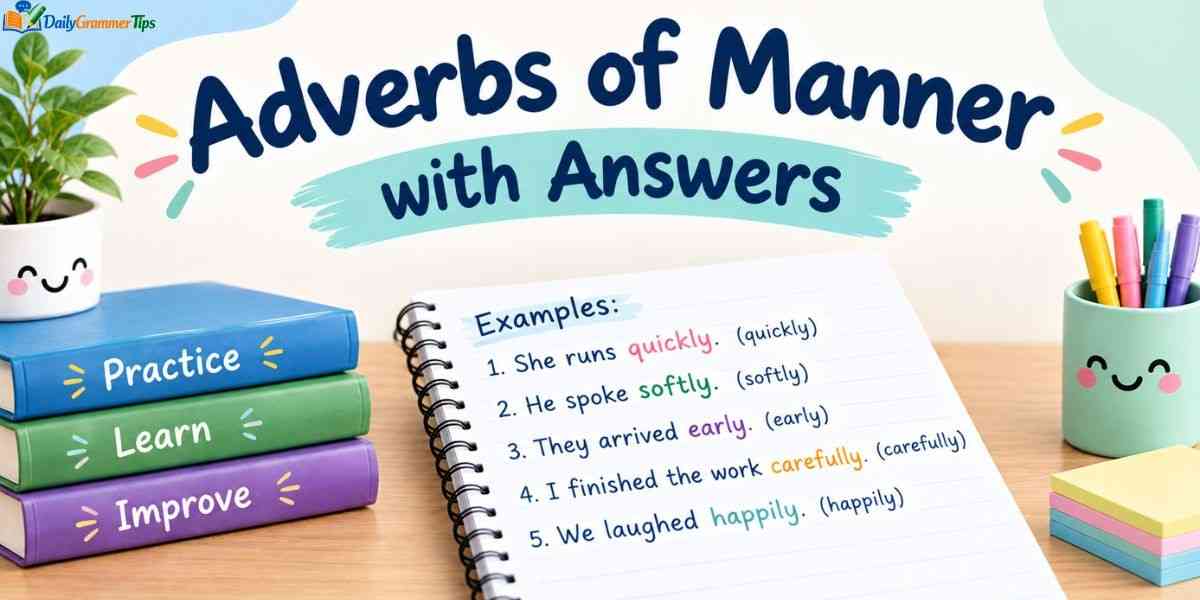
Answers help learners check their own work. For the exercise above, the correct forms are beautifully, quickly, hard, loudly, and gently. Notice that hard keeps its form.
Review each answer against the spelling rules. Ask why quick became quickly and why gentle became gently. This habit locks the rules into memory.
Frequently Asked Questions
What is an adverb of manner with examples?
An adverb of manner tells how an action happens. Examples include slowly, kindly, and carefully.
What are adverbs of manner in English?
They are words that describe how a verb is done. Most end in “ly,” such as quickly and softly.
What are the 50 examples of adverb of manner sentences?
You can find fifty sample sentences in the section above. They cover daily life, school, work, nature, and feelings.
What are 20 examples of adverbs in a sentence?
Twenty full sentences appear in the section above. One example is “She closed the door quietly.”
Can you give me 20 examples of adverbs of manner?
Yes. Try quickly, slowly, quietly, loudly, carefully, happily, sadly, bravely, kindly, politely, gently, easily, badly, well, fast, hard, angrily, eagerly, neatly, and clearly.
Conclusion
Adverbs of manner show us how an action happens. They turn plain sentences into clear and lively ones. Words like slowly, kindly, and well add detail, mood, and meaning to everyday speech and writing. Once you know them, you can describe any action with care.
Learn the rules for forming and placing these words, and practice with the examples and sentences above. Watch for common mistakes, such as mixing up good and well. With steady effort, you will use adverbs of manner with skill and confidence in every piece you write.
