

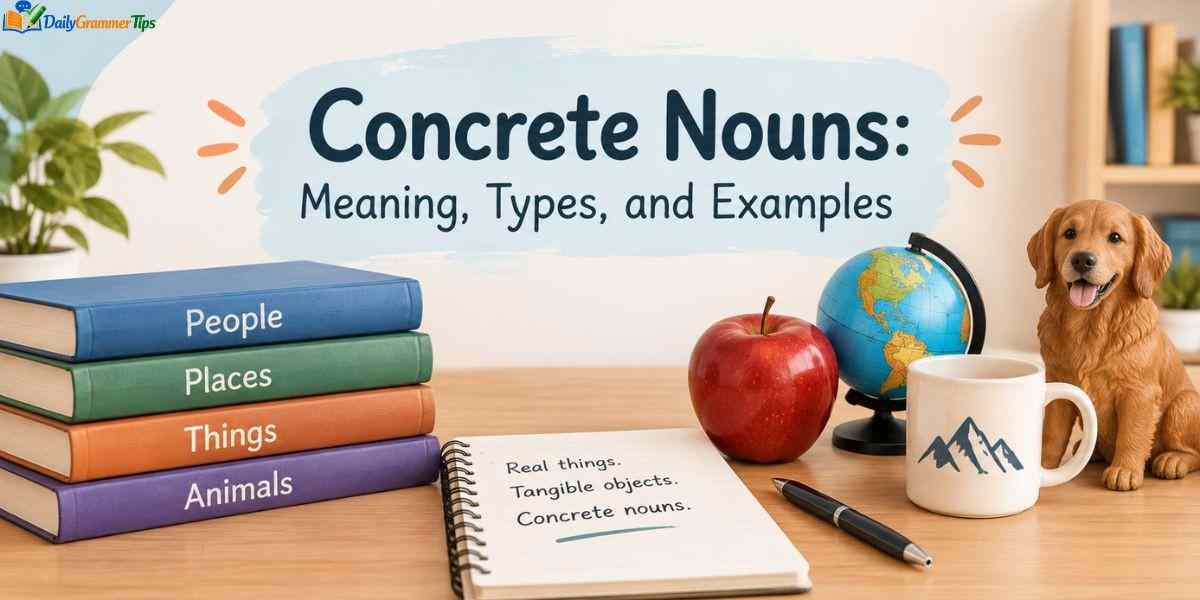
Look around the room right now. You see a chair, a window, a cup, and a phone. Each of these words names something real that you can sense. Grammar calls such words concrete nouns.
This guide explains concrete nouns in plain language. You will learn their meaning, their types, and many clear examples. You will also compare them with abstract nouns and practice with simple exercises.
What Are Concrete Nouns?
Concrete nouns name things you can notice with your five senses. You can see a tree, hear a bell, smell bread, taste a lemon, and touch a blanket. These words point to physical things in the real world.
Every concrete noun refers to something that takes up space. People, animals, places, and objects all belong to this group. Most of the nouns you use each day fit here.
Concrete Nouns Examples
Simple examples make the idea easy to grasp. Table, river, teacher, apple, and mountain are common concrete nouns examples. Each word names something you can point to.
You can spot them in everyday sentences. Take this line: “The dog chased the ball across the yard.” Dog, ball, and yard are all concrete nouns because they name real things.
Abstract Nouns
Abstract nouns name ideas, feelings, and qualities. You cannot see them or touch them. Love, freedom, courage, and honesty are good examples.
These words live in the mind. They help us talk about emotions, values, and big concepts. Writers use them to give their work deeper meaning.
Abstract Noun Examples
Common abstract noun examples include happiness, anger, justice, wisdom, and time. Each word names something with no physical form. You feel or understand these things instead of touching them.
Notice how they work in a sentence. “Her kindness surprised everyone” uses kindness as an abstract noun. The word names a quality, not an object.
Concrete Nouns and Abstract Nouns
The two groups differ in one key way. Concrete nouns name what your senses can detect, while abstract nouns name what your mind understands. The table below shows the main differences.
| Feature | Concrete Nouns | Abstract Nouns |
| Meaning | Name physical things | Name ideas and feelings |
| Senses | Detected by the five senses | Not detected by the senses |
| Examples | Book, cat, river | Hope, truth, beauty |
| Effect in writing | Create clear pictures | Express thoughts and emotions |
| Counting | Often easy to count | Often hard to count |
Strong writers use both types together. Concrete nouns ground the reader in a real scene. Abstract nouns add meaning and emotion to that scene.
How to Identify Concrete Nouns
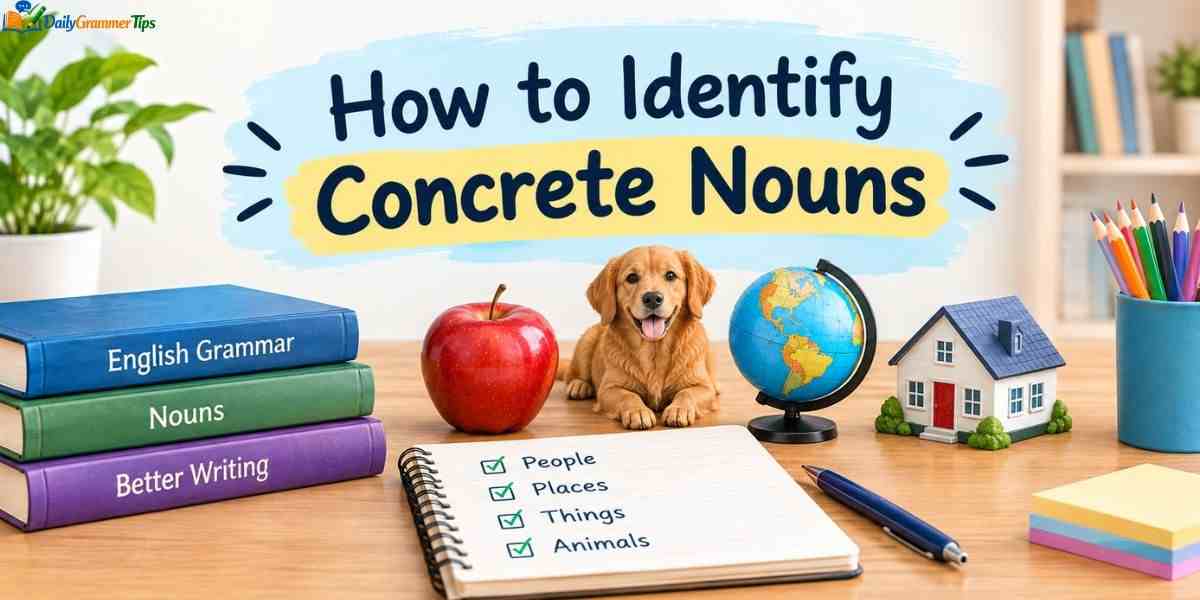
You do not need special training to find them. A few quick tests work well for students and writers alike. Try them on any sentence you read.
Use the Five Senses Test
Ask yourself one question. Can I see, hear, smell, taste, or touch this thing? If the answer is yes, you have found a concrete noun.
Apply the test to the word “soup.” You can see it, smell it, and taste it. Now test the word “bravery.” No sense can detect it, so it is an abstract noun.
Use the Picture Test
Try to draw the word in your mind. A clear image means the word is concrete. A fuzzy or missing image means the word is abstract.
You can picture a bicycle in seconds. You cannot picture justice the same way. This simple trick helps young learners separate the two groups fast.
Types of Concrete Nouns
Concrete nouns come in several forms. Grammar books group them by how they work in a sentence. Knowing these forms helps you write with more precision.
The main groups are common, proper, collective, countable, and uncountable nouns. Each one follows its own small set of rules. Let us look at them one by one.
Common Concrete Nouns
Common nouns name general things. Girl, city, car, and dog are all common nouns. They do not need a capital letter unless they start a sentence.
Most of them fall into this group. They give your writing a wide range of everyday detail. You will use them more than any other type.
Proper Concrete Nouns
Proper nouns name specific people, places, or things. Lahore, Mount Everest, and Amazon River are examples. Each one starts with a capital letter.
These words are concrete because they name real, physical things. You can visit a city or climb a mountain. Proper names simply make the target more exact.
Collective Concrete Nouns
Collective nouns name groups of people or things. Team, herd, flock, and crowd are common examples. You can see these groups with your own eyes.
Most collective nouns count as concrete nouns because the group is visible. A flock of birds fills the sky. A crowd fills a street.
Countable and Uncountable Concrete Nouns
Countable nouns have plural forms. You can say one pen, two pens, or ten pens. Pen, apple, and chair all work this way.
Uncountable nouns name masses you cannot count one by one. Water, sand, rice, and milk are good examples. You measure them in cups, bags, or liters.
Learn more……….Coordinate Conjunctions: Rules, FANBOYS, and Examples for Clear Sentences
10 Examples of Concrete Nouns
Here are ten clear examples: apple, chair, dog, river, book, teacher, car, window, mountain, and phone. Each word names something real. You can see or touch every one of them.
Use these words to build your own sentences. “The teacher opened the window” works well. Both teacher and window are concrete nouns that paint a clear picture.
20 Examples of Concrete Nouns
Here are twenty more to study: pencil, bridge, doctor, horse, garden, bread, lamp, clock, school, farmer, banana, mirror, bottle, table, shoe, tiger, market, camera, door, and bag. Each word names a physical thing.
Try sorting this list by category. You will find people, animals, places, food, and objects. This habit builds your vocabulary and sharpens your grammar skills.
100 Examples of Concrete Nouns
A longer list gives you more practice. The next five groups hold one hundred words in total. Each group has twenty examples.
Read each list aloud and then use the words in sentences. This method helps you remember them. It also shows how widely they appear in daily life.
People
People names are everywhere in speech. You meet these words in school, at work, and at home. Each one names a real person you can see.
Here are twenty: teacher, doctor, farmer, singer, pilot, baker, nurse, driver, student, painter, soldier, judge, chef, tailor, mother, brother, neighbor, athlete, engineer, and child.
Animals
Animals fill books, songs, and stories. Every animal name is a concrete noun. You can see, hear, or even touch many of them.
Here are twenty: dog, cat, horse, tiger, rabbit, eagle, dolphin, elephant, monkey, sparrow, cow, goat, fox, wolf, turtle, zebra, camel, frog, bee, and shark.
Places
Places give every story a setting. These words name spots you can visit and walk through. They help readers imagine where the action happens.
Here are twenty: school, hospital, market, park, bridge, library, beach, mountain, desert, village, airport, kitchen, garden, island, forest, museum, stadium, harbor, castle, and farm.
Food and Drink
Food words bring taste and smell into writing. Readers react strongly to them. A single word like “honey” can make a scene feel warm.
Here are twenty: apple, bread, rice, milk, cheese, tea, coffee, banana, egg, soup, butter, honey, orange, potato, cake, juice, pizza, carrot, sugar, and salt.
Everyday Objects
Objects surround us at all times. We use them without thinking. Each one is a clear case of a concrete noun.
Here are twenty: chair, table, pencil, book, phone, lamp, clock, mirror, key, bottle, window, door, bag, shoe, umbrella, spoon, bicycle, blanket, camera, and hammer.
Concrete Nouns Worksheet
A good worksheet turns theory into practice. Start with a short list of mixed words. Ask students to label each word as concrete or abstract.
Add a second task to deepen the skill. Ask learners to circle every concrete noun in a short paragraph. Then ask them to write five sentences using concrete words of their own choice.
Concrete Nouns in Sentences
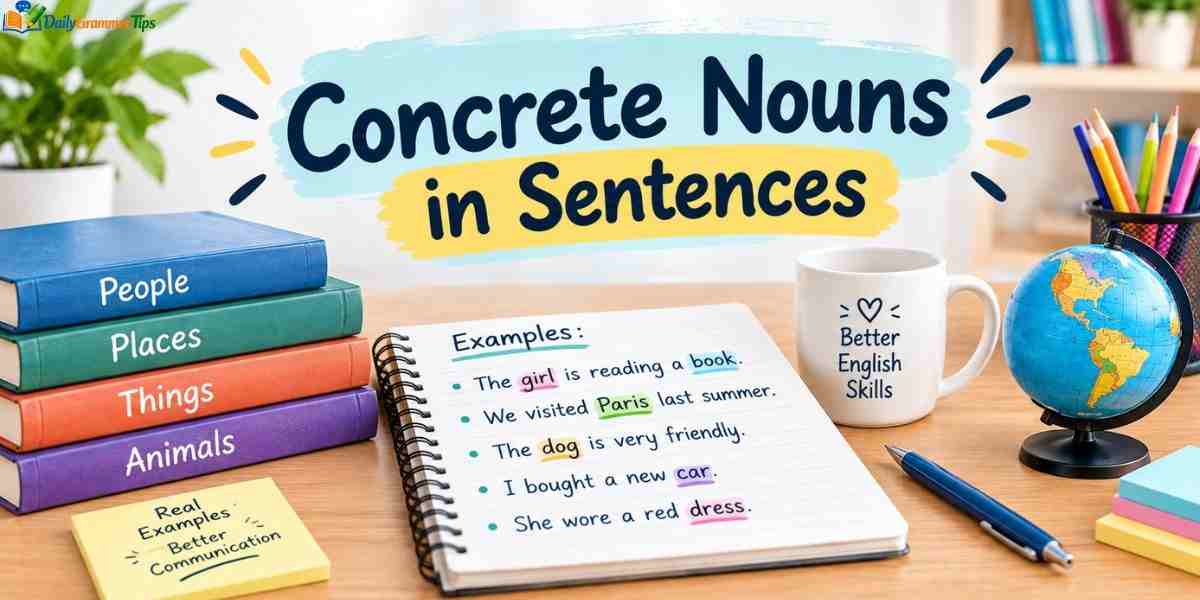
Sentences show how these words behave in real use. “The baker placed fresh bread on the table” holds three of them. Baker, bread, and table each name something physical.
Compare that with a vague line like “The person put something there.” The first sentence paints a picture. The second leaves the reader guessing.
Concrete Nouns in Writing
Writers rely on concrete nouns to show, not tell. A word like “rusty bicycle” gives the reader an image. A word like “old thing” gives nothing.
Good descriptions, stories, and reports all use them often. They keep the reader focused and interested. They also make your message easier to remember.
Why Concrete Nouns Matter
Clear writing depends on clear words. Concrete nouns remove confusion because they name exact things. Readers understand them without effort.
They also build trust and energy in your text. A specific detail feels honest and alive. Businesses, teachers, and storytellers all use this power.
Concrete Nouns for Kids
Children learn concrete nouns first. Words like ball, mom, milk, and dog appear in early speech. These words match the world a child can see and touch.
Parents and teachers can help with simple games. Point to objects at home and say their names. Ask the child to find items that match a given word.
Tricky Concrete Nouns
Some words seem abstract but are not. Air, wind, smoke, and steam are good examples. You cannot always see them, yet your senses still detect them.
You can feel wind on your face. You can smell smoke and see steam rise from a cup. For this reason, these words count as concrete nouns.
Common Mistakes with Concrete Nouns
Many learners mix up the two noun types. They often label words like “music” or “light” as abstract by habit. Always use the senses test before you decide.
Another mistake is using vague nouns when exact ones work better. Words like “thing” and “stuff” weaken your writing. Swap them for precise nouns whenever you can.
Tips to Use Concrete Nouns Well

Choose the most specific word available. Say “sparrow” instead of “bird” when the detail matters. Say “sedan” instead of “vehicle” when the type adds meaning.
Read your draft and mark every vague noun. Replace each one with a sharper choice. This quick edit lifts the quality of any text.
Frequently Asked Questions
What is a concrete noun example?
A simple example is “apple.” You can see it, touch it, and taste it.
What are 5 examples of concrete?
Five examples are table, dog, river, book, and teacher.
What is a concrete and abstract noun?
A concrete noun names something you can sense, like a chair. An abstract noun names an idea, like freedom.
What are 100 concrete nouns?
They include people, animals, places, foods, and objects such as teacher, horse, market, bread, and lamp. The full list of one hundred appears above.
Can you give me 20 examples of concrete nouns?
Yes. Try dog, cat, chair, table, apple, bread, river, mountain, school, teacher, doctor, phone, lamp, book, key, door, car, horse, shoe, and bag.
Conclusion
Concrete nouns name the real things around us. They are easy to spot with the five senses test. Examples such as chair, river, and teacher show how common they are.
Use them to make your writing clear and vivid. Pair them with abstract nouns when you need emotion or ideas. Practice with the lists and worksheet tasks above, and your skills will grow fast.
