

Have you ever written a sentence that felt choppy and stiff? Short sentences are clear, but too many in a row tire your reader. Coordinate conjunctions solve that problem by linking your ideas in a smooth, natural way.
There are only seven of these words: for, and, nor, but, or, yet, and so. This guide shows you how each one works, where the commas go, and which mistakes to avoid. You also get simple examples and quick quizzes along the way.
What Are Coordinate Conjunctions?
Coordinate conjunctions are small words that join equal parts of a sentence. They connect words to words, phrases to phrases, and clauses to clauses.
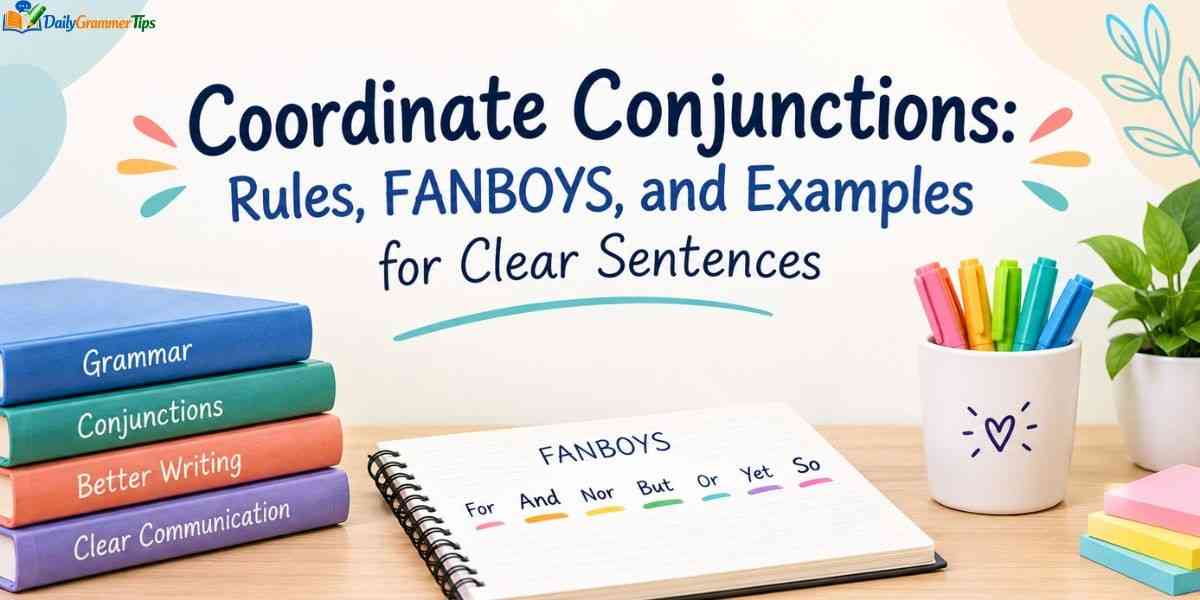
Grammar books also call them coordinating conjunctions. English has seven of them: for, and, nor, but, or, yet, and so.
The FANBOYS Trick
FANBOYS is a memory tool. Each letter stands for one word: For, And, Nor, But, Or, Yet, So. Say it a few times, and it sticks.
Many American teachers use this trick in the classroom. It works for kids, teens, and adult learners alike.
What Does Coordinate Mean?
To coordinate means to join things of equal rank. In a sentence, both parts carry the same weight. Neither part depends on the other.
Take this example: The sun set, and the stars appeared. Each clause could stand alone as its own sentence.
How Coordinate Conjunctions Work in a Sentence
A coordinate conjunction sits between the two parts it joins. It does not change either part. It just links them and shows how they relate.
Read this pair: I like pizza. I like pasta. Now join them: I like pizza and pasta. The joined version flows better.
Why Writers Rely on Coordinate Conjunctions
They keep your sentences varied. They show how ideas connect. They also help readers follow your thinking without effort.
Without them, writing sounds like a list of facts. With them, it sounds like a person talking.
Words, Phrases, and Clauses: A Quick Preview
These words join three kinds of parts. They join single words, short phrases, and full clauses. Each type follows slightly different punctuation rules.
You will see all three in the next sections, with clear examples.
Coordinate Conjunctions for Reason and Addition: For and And
For and and do two different jobs. For explains why. And adds more information.
Both words join equal parts of a sentence, and both need careful punctuation.
For: The Reason Word
For means because, but it sounds more formal. She stayed home, for she was sick. Always put a comma before it.
For joins only full clauses. In casual speech, most people say because instead, so for can sound a bit old-fashioned.
For as a Preposition
For also works as a preposition, and that is a different job. I bought a gift for her. Here, for shows purpose, not a link between clauses.
Check what follows the word. A full clause with a subject and verb means it is a conjunction. A noun or pronoun means it is a preposition.
And: The Addition Word
And is the most common conjunction in English. It joins similar ideas. I packed a sandwich and an apple.
It can join words, phrases, or clauses. The cat slept, and the dog played.
And in Lists
Use and before the last item in a list. We visited Boston, Chicago, and Denver.
Add a comma before and in a list of three or more. Many American style guides prefer this Oxford comma, but newspaper style often skips it.
Coordinate Conjunctions for Negative Choice and Contrast: Nor and But
Nor and but both set ideas apart. Nor joins two negatives. But sets two ideas against each other.
Each one follows its own word-order and comma rules, so take your time with them.
Nor: The Negative Partner
Nor joins two negative ideas. He did not call, nor did he write. Notice the word order after nor.
After nor, the helping verb comes before the subject. Say nor did he write, not nor he did write.
Nor With and Without Neither
Nor can follow a negative clause by itself. She does not eat meat, nor does she drink milk.
Neither pairs with nor too. Neither the coach nor the players knew. That pair is a correlative conjunction, and you will meet it later.
But: The Contrast Word
But shows contrast. I wanted to go, but I was tired. It sets two ideas against each other.
Put a comma before but when it joins two full clauses. Skip the comma when it joins two words. The plan was small but smart.
But as Another Part of Speech
But can also mean except. Everyone but Sam arrived. In that case, it works as a preposition.
It can also mean only. We have but one chance. That use sounds formal and rare.
Which One Should You Choose?
Pick the word that matches your meaning. Use for to explain, and to add, nor to deny, and but to contrast.
Using these four coordinate conjunctions correctly makes your sentences clearer and your ideas easier to follow.
Quick Practice: For, And, Nor, and But
Fill each blank with one of these coordinate conjunctions. I wanted pizza, ___ we had pasta. He did not text, ___ did he call. She packed a coat ___ a scarf. We left early, ___ the road was icy.
Answers: but, nor, and, for.
Coordinate Conjunctions for Choice, Surprise, and Result: Or, Yet, and So
Or, yet, and so finish the FANBOYS set. Or offers a choice. Yet adds surprise. So shows a result.
Each one links two equal parts, and each follows the same comma rule.
Or: The Choice Word
Or offers options. Do you want tea or coffee? You can walk, or you can take the bus.
Use a comma before or when it joins two full clauses. Skip the comma when it joins two words.
Or in Lists and Warnings
In a list of choices, put or before the last item. We can order pizza, pasta, or salad.
Or can also give a warning. Hurry, or you will miss the bus. In that use, it means if not.
Yet: The Surprise Word
Yet shows contrast with surprise. It was freezing, yet we swam anyway. It works like but, with extra drama.
Put a comma before yet when it joins two clauses. Skip the comma when it joins two words, as in She is small yet strong.
Yet as an Adverb
Yet can also mean until now. I have not finished yet. In that case, it is an adverb, not a conjunction.
Look at the job it does. If it joins two parts, it is a conjunction. If it describes time, it is an adverb.
So: The Result Word
So shows a result. It rained, so we stayed in. The first clause is the cause, and the second is the effect.
Put a comma before so when it joins two full clauses.
So Versus So That
So that is different. It shows purpose, as in We left early so that we could avoid traffic.
Here, so that works as a subordinating conjunction. It usually needs no comma before it.
What Do Coordinate Conjunctions Join?
These words join three kinds of parts: words, phrases, and clauses. The parts must match in kind.
Join a noun with a noun, a verb with a verb, or a clause with a clause. Mixing types creates awkward sentences.
Joining Words
At the simplest level, they join single words. I love cats and dogs. She is smart but shy.
Each pair has the same type. Cats and dogs are both nouns. Smart and shy are both adjectives.
Joining Phrases
They also join phrases. We can meet in the park or at the library. He walked down the street and around the corner.
Notice that each phrase matches. Both phrases in each example start with a preposition.
Joining Clauses
At the top level, they join full clauses. A clause has a subject and a verb. I called her, but she did not answer.
Two clauses joined this way make a compound sentence. This is where the comma rule applies.
How Coordinate Conjunctions Build Compound Sentences
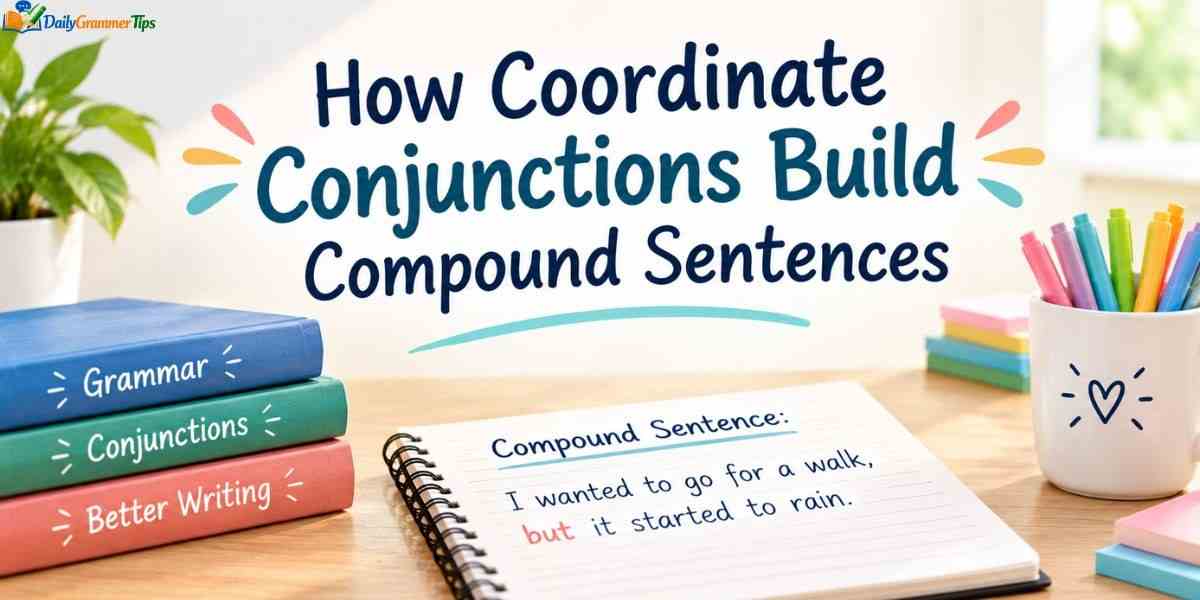
A compound sentence has two independent clauses joined by a comma and a FANBOYS word. The rain stopped, and the sun came out.
Each clause can stand alone. That is why the comma matters. It marks the border between them.
Compound Subjects
A compound subject has two or more subjects. Maria and Jake play soccer. Both subjects share one verb.
Use a plural verb after and in most cases. Maria and Jake are on the team.
Compound Predicates
A compound predicate has two or more verbs for one subject. She opened the door and walked in.
Do not add a comma here. The subject is the same, so the verbs travel together.
Practice: Or, Yet, and So
Try these coordinate conjunctions. Fill each blank with or, yet, or so. It was raining, ___ we took umbrellas. Do you want rice ___ noodles? He studied hard, ___ he failed the test.
Answers: so, or, yet.
Comma Rules for Coordinate Conjunctions
Commas cause the most trouble with these words. The good news is that a few clear rules solve most cases. Learn them one by one.
Always ask one question first: what does the word join?
Rule 1: Use a Comma Before FANBOYS in a Compound Sentence
Put a comma before the conjunction when it joins two full clauses. I wanted to leave, but the rain kept falling.
Each side needs its own subject and verb. If both do, add the comma.
Learn more………Interjections Examples: Types, Rules, and Sentences for Every Emotion
Rule 2: Skip the Comma When the Subject Stays the Same
Do not use a comma when the conjunction joins two verbs that share one subject. She opened the window and let in the breeze.
No second subject appears after and, so no comma is needed.
Rule 3: Skip the Comma With Two Words or Phrases
Do not place a comma between two words or phrases joined by a conjunction. We ordered soup and salad.
The same goes for phrases. He walked to the store and back home.
Rule 4: Use Commas in a Series
In a list of three or more items, separate each item with a comma. She packed shirts, shorts, and socks.
The comma before and is the Oxford comma. It prevents confusion, so many writers keep it.
When Coordinate Conjunctions Join Very Short Clauses
Some style guides let you skip the comma when two clauses are very short. I came and I saw. The sentence feels quick and clean.
When in doubt, keep the comma. It rarely hurts in a true compound sentence.
Comma Splices and Run-Ons: Two Mistakes to Avoid
A comma splice joins two clauses with only a comma. I like tea, I hate coffee. A run-on has no punctuation at all.
Coordinate conjunctions are the easiest cure. Add one after the comma: I like tea, but I hate coffee.
Three Ways to Fix a Comma Splice
You have three main options. Add a FANBOYS word after the comma. Replace the comma with a semicolon. Or split the clauses into two sentences.
I like tea, but I hate coffee. I like tea; I hate coffee. I like tea. I hate coffee.
Starting a Sentence With Coordinate Conjunctions
Many writers learn never to start a sentence with and or but. That rule is a myth. Respected style guides allow it.
Start with a conjunction when you want emphasis. But the plan worked. Use it on purpose, and do not overdo it.
Commas After a Starting Conjunction
Do not put a comma right after and, but, or so. But the plan worked.
A comma appears only if a phrase interrupts. But, in the end, the plan worked.
Practice: Commas
Add a comma where needed: I wanted dessert but I was full. She sang and danced. We missed the bus so we walked.
Answers: I wanted dessert, but I was full. She sang and danced (no comma). We missed the bus, so we walked.
Coordinate Conjunctions vs. Other Conjunctions
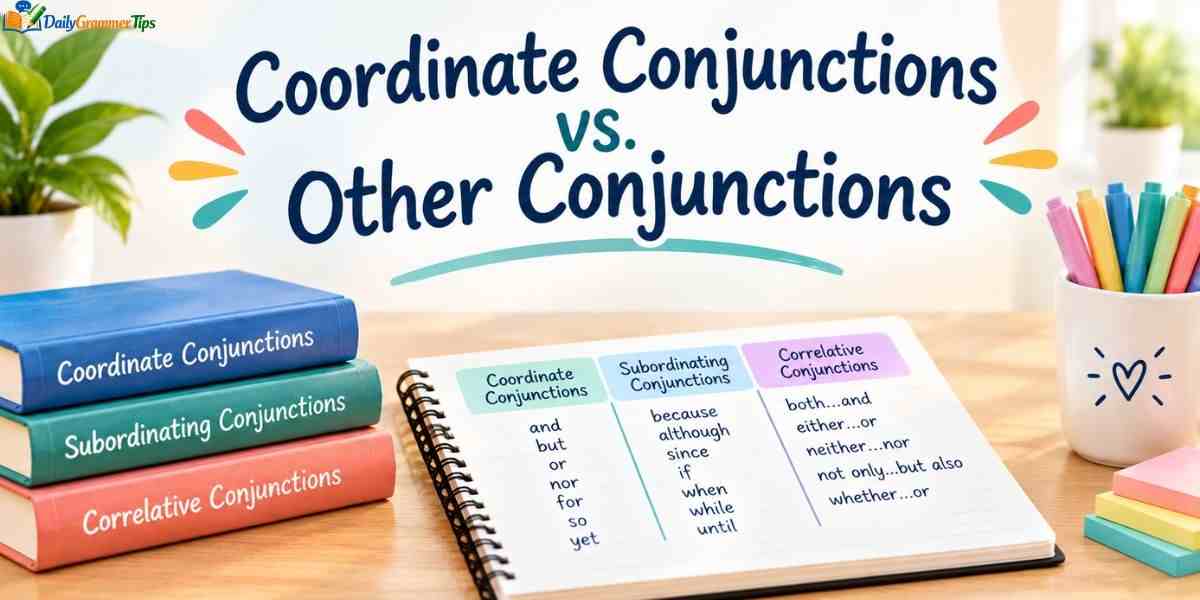
English has three main conjunction types. Coordinate conjunctions join equal parts. Subordinating conjunctions join unequal parts. Correlative conjunctions work in pairs.
The table below shows the difference at a glance.
| Type | What it does | Examples | Sample sentence |
| Coordinate | Joins equal parts | for, and, nor, but, or, yet, so | I was tired, but I kept going. |
| Subordinating | Joins a dependent clause to a main clause | because, although, since, if, when | I kept going because I wanted to finish. |
| Correlative | Works in pairs | either…or, neither…nor, both…and | Both the coach and the players smiled. |
Subordinating Conjunctions
Subordinating conjunctions make one clause depend on another. Because, although, since, and when are common ones. Although it rained, we played.
The dependent clause cannot stand alone. That is the big difference from clauses joined with FANBOYS words.
Correlative Conjunctions
Correlative conjunctions come in pairs. Either…or, neither…nor, both…and, and not only…but also are the main sets.
Not only did she win, but she also set a record. Keep the parts after each word parallel.
Quick Test: Which Conjunction Type?
Ask two questions. Are both parts equal? Can each part stand alone? If you say yes to both, the word is one of the coordinate conjunctions.
If one part cannot stand alone, look for a subordinating conjunction. If the words come in pairs, look for correlative ones.
Why Conjunctive Adverbs Are Not Coordinate Conjunctions
Words like however, therefore, and moreover look like conjunctions. They are not. Grammar books call them conjunctive adverbs.
They need a semicolon before them when they join two clauses. It was late; however, we kept working.
However Versus But
However and but can mean the same thing. But joins clauses with a comma. However needs a semicolon or a period before it.
I was tired, but I stayed. I was tired; however, I stayed. Both sentences work.
Look-Alike Words: Other Jobs for FANBOYS Words
Several FANBOYS words wear other hats. For and but can act as prepositions. Yet and so can act as adverbs.
Always check the job the word does in the sentence.
So as an Adverb
So can mean very. She is so kind. In that use, it does not join anything.
So can also start a casual remark. So, what happened? That use is an opener, not a conjunction.
Quick Practice: Name the Word Type
Decide whether each word is one of the coordinate conjunctions, a subordinating conjunction, or a conjunctive adverb: and, because, however, but, therefore.
Answers: and is coordinate, because is subordinating, however is a conjunctive adverb, but is coordinate, and therefore is a conjunctive adverb.
Subject-Verb Agreement With Coordinate Conjunctions
And and or change how you pick a verb. And joins subjects into a plural group. Or and nor ask you to look at the closest subject.
Each rule is short, and each one has a quick example.
Subjects Joined by And
Use a plural verb when and joins two subjects. The teacher and the students are ready.
One exception: when and joins two parts of a single thing, use a singular verb. Peanut butter and jelly is my favorite lunch.
Subjects Joined by Or and Nor
Make the verb agree with the subject closest to it. Either the manager or the workers are coming. Either the workers or the manager is coming.
Put the plural subject last when you can. The sentence sounds smoother.
Parallel Structure With Coordinate Conjunctions
Parallel structure means joined parts match in form. Because these words often join items, the match matters.
Wrong: She likes swimming, to hike, and biking. Right: She likes swimming, hiking, and biking.
Parallel Words and Phrases
Match nouns with nouns and verbs with verbs. He is kind and generous, not kind and a generous person.
Match phrases the same way. We can meet at noon or at six.
Parallel Clauses
Match clause patterns too. She loves to read, and he loves to write.
This pattern gives your sentences rhythm. Readers hear the balance.
Style Tips for Using Coordinate Conjunctions
Variety keeps readers interested. Do not repeat and and so in every sentence. Mix short sentences with longer ones.
Read your writing out loud. If it sounds like a chain of and, split it.
Avoid the Endless And
A long chain of and sounds childish. We went to the park and we played and we ate and we left.
Break it up. We went to the park. We played, ate lunch, and left.
Choose Stronger Connectors
Sometimes a stronger word works better. Replace so with therefore in formal writing, or use because to flip the order.
It was cold, so we left. We left because it was cold. Try both and pick the better flow.
Formal Versus Informal Use of Coordinate Conjunctions
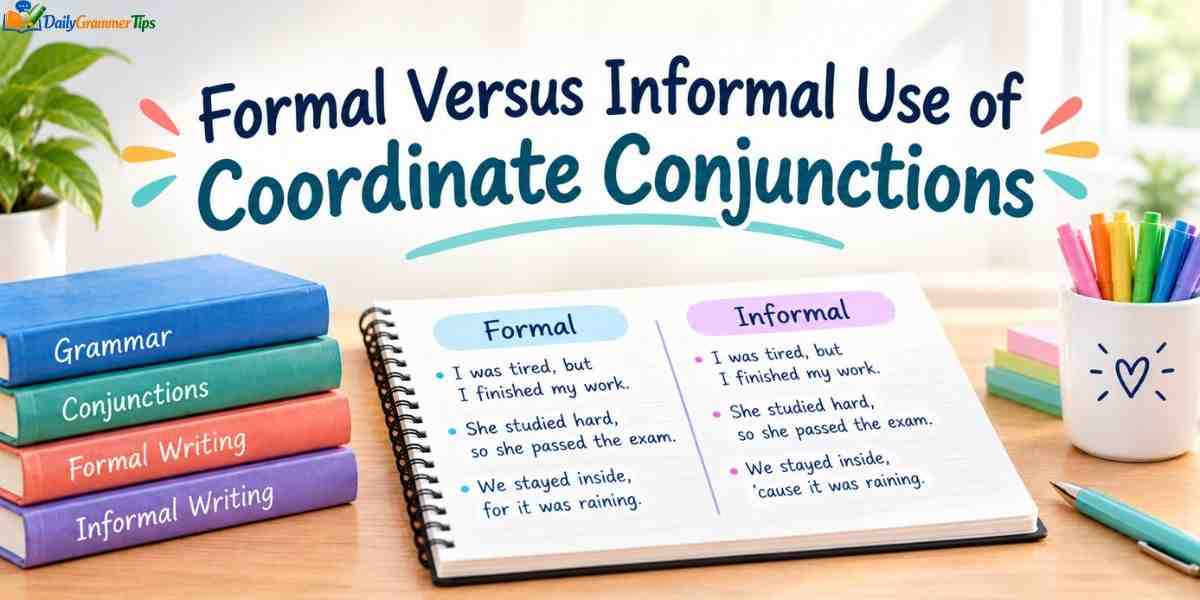
In casual speech, we start sentences with and, but, and so all the time. In formal writing, we use them more carefully.
Academic papers and business reports still allow them. Just keep the sentences clear and the punctuation correct.
So, For, and Yet in Different Settings
So is common in everyday writing and speech. For sounds formal or literary. Yet adds a polished tone.
Pick the word that fits your audience. A text to a friend can say so. A formal essay may prefer for or yet.
Quick Practice: Agreement and Parallelism
Fix each sentence: The teacher and the students is ready. She likes swimming, to hike, and biking.
Answers: The teacher and the students are ready. She likes swimming, hiking, and biking.
Common Mistakes With Coordinate Conjunctions
Even strong writers slip with these small words. Most errors involve commas, word order, or overuse.
Use this table to spot and fix them fast.
| Wrong | Right | Why |
| I like tea, I hate coffee. | I like tea, but I hate coffee. | A comma alone cannot join two clauses |
| She opened the door, and walked in. | She opened the door and walked in. | No comma between two verbs with one subject |
| He did not call, nor he wrote. | He did not call, nor did he write. | Flip the verb and subject after nor |
| I wanted to go but, I was tired. | I wanted to go, but I was tired. | Put the comma before the conjunction |
| She likes swimming, to hike, and biking. | She likes swimming, hiking, and biking. | Keep the items parallel |
| Neither the coach or the players knew. | Neither the coach nor the players knew. | Neither pairs with nor |
The Missing Comma
Many writers forget the comma in compound sentences. I wanted pizza but we had pasta. Add one: I wanted pizza, but we had pasta.
Check long sentences twice. A missing comma makes readers pause in the wrong place.
The Extra Comma
Some writers add commas everywhere. She sang, and danced. That comma does not belong, because both verbs share one subject.
Remove it: She sang and danced.
Overusing So
So is easy to overuse. It rained, so we left, so we missed the show, so we felt sad.
Vary your connectors. Use because, after, or since instead.
Tips for Using Coordinate Conjunctions Well
Read each sentence out loud. Your ear catches missing commas and awkward chains. If a sentence feels too long, split it.
Use FANBOYS as a checklist. Circle the conjunction, then check the parts on both sides.
Edit in Three Passes
First, find each FANBOYS word. Second, test both sides to see if they are full clauses. Third, add or remove the comma.
This quick routine catches most errors in a few minutes.
Teaching Coordinate Conjunctions to Kids
Start with FANBOYS. Make a poster with all seven words and one picture each. Point to it every time you read together.
Then build sentences from two short ones. Kids love seeing small sentences snap together.
Fun Classroom Games
Play sentence builders. Give kids two short sentences and a card with one FANBOYS word. They join the parts and read the new sentence aloud.
Try a conjunction hunt, too. Kids search a story for and, but, or, and so, then count them.
Coordinate Conjunctions for English Learners
Many learners mix up but and yet, or so and because. Focus on meaning first. But contrasts, yet surprises, so shows a result, and for gives a reason.
Practice with short pairs of sentences. Join them with different FANBOYS words and notice how the meaning changes.
Same Sentences, Different Meanings
It was late, so we left. It was late, but we stayed. It was late, yet we stayed.
Notice how one small word changes the whole message.
Final Quiz: Pick the Right Conjunction
Show what you know. Fill each blank with for, and, nor, but, or, yet, or so. I was hungry, ___ I ate lunch. He is tired, ___ he keeps working. She did not call, ___ did she text. Do you want tea ___ coffee? We packed snacks ___ water. I wanted to go, ___ I had homework. He stayed home, ___ he was ill.
Answers: so, yet, nor, or, and, but, for.
A 7-Day Plan to Master Coordinate Conjunctions
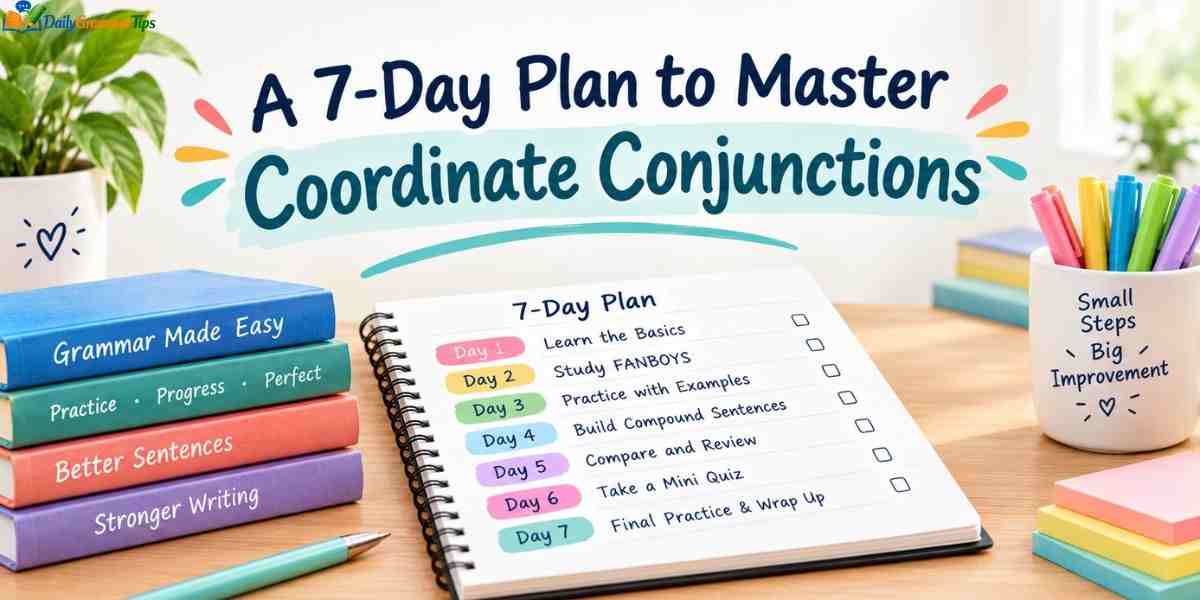
Short daily practice works best. Follow this plan, and you will feel confident by next weekend.
| Day | Focus | What to practice |
| Day 1 | Meet FANBOYS | Say all seven words and write one sentence for each |
| Day 2 | For and and | Reason and addition |
| Day 3 | Nor and but | Negative choice and contrast |
| Day 4 | Or, yet, and so | Choice, surprise, and result |
| Day 5 | Comma rules | Compound sentences and series |
| Day 6 | Other conjunction types | Subordinating and correlative pairs |
| Day 7 | Review | Retake the final quiz and fix your misses |
Frequently Asked Questions
What are coordinate conjunctions?
They are seven small words that join equal parts of a sentence: for, and, nor, but, or, yet, and so.
What does FANBOYS stand for?
FANBOYS stands for for, and, nor, but, or, yet, and so. It helps you remember all seven words.
Do coordinate conjunctions always need a comma?
No. Use a comma when the word joins two full clauses, and skip it when the word joins two words or two verbs.
Can I start a sentence with a conjunction?
Yes. Starting with and, but, or so is acceptable when you want emphasis.
Is yet always a conjunction?
No. Yet can also work as an adverb, as in I have not finished yet.
Conclusion
Coordinate conjunctions look small, but they hold your sentences together. Once you know the seven FANBOYS words, the comma rules, and the common traps, joining ideas becomes easy. Each word tells your reader exactly how two thoughts connect.
Keep the comma rules and the quiz close, and practice a little each day. Read your own writing out loud and check each joining word. With time, using coordinate conjunctions will feel natural.
