


Many English learners and writers often get confused between Challange or Challenge when typing, writing emails, preparing assignments, or creating online content. This confusion happens because both spellings look very similar, but only one version is accepted in standard English.
The correct spelling is challenge. The word challange is a common spelling mistake and is not considered a correct English word. Although many people search for Challange or Challenge to find the right spelling, understanding the difference helps improve writing accuracy and avoid repeated mistakes.
The word challenge has several uses in English. It can describe a difficult task, a problem that needs to be solved, a competition, or an invitation to test someone’s ability. It can also work as both a noun and a verb depending on the sentence.
Challange or Challenge: Which Spelling Is Correct?
The correct spelling is challenge.
The spelling challange is incorrect and usually happens because people add an extra “a” before the final part of the word. The confusion between Challange or Challenge occurs because English pronunciation does not always clearly show the exact spelling pattern.
When writing formal documents, school assignments, business emails, or online content, always use challenge instead of challange. A spell checker or grammar tool may highlight challange as an error because it does not appear as a standard English word.
| Word | Correct or Incorrect | Explanation |
| Challenge | Correct | Standard English spelling |
| Challange | Incorrect | Common misspelling |
Understanding Challange or Challenge helps prevent a simple spelling mistake from affecting the quality of your writing. Using the correct word also makes your communication look more professional and accurate.
Challange or Challenge Meaning
The word challenge refers to something that requires effort, skill, courage, or determination. It can describe a difficult situation, an obstacle, or a task that tests someone’s ability.
For example:
- Learning a new language can be a challenge.
- Completing a difficult project is a challenge.
- The athlete accepted the challenge to compete against a stronger opponent.
The meaning of challenge changes slightly depending on the context. In daily life, it often refers to a problem or difficulty. In competitions, it can mean an invitation to compete. In professional environments, it may describe a situation that requires creative thinking or problem-solving.
The discussion around Challange or Challenge is only related to spelling. The meaning remains connected with the correctly spelled word, challenge.
Definition of Challenge in English
The definition of challenge is:
A difficult task, problem, or situation that requires effort, skill, or ability to overcome.
According to common English usage, challenge can describe:
- A difficult task
- A personal goal
- A competition
- A disagreement or objection
- A test of knowledge or ability
The word is commonly used in conversations, education, business, sports, technology, and research.
For example:
“Starting a new business is a major challenge.”
In this sentence, challenge means a difficult situation that requires planning and effort.
Understanding Challange or Challenge also helps learners recognize that the incorrect spelling does not create a new meaning. Only challenge carries the actual definition and usage in English.
Challenge as a Noun
The word challenge is frequently used as a noun. A noun names a person, place, thing, or idea. When challenge works as a noun, it represents a difficult situation, task, or competition.
Examples:
- Finding a solution to climate problems is a global challenge.
- The final exam was a challenging experience.
- The mountain climb was a physical challenge.
In these examples, challenge refers to something that requires effort or ability. Understanding the difference in Challange or Challenge helps writers recognize that only the correct spelling can be used as a meaningful English word.
Many people searching for Challange or Challenge are actually trying to understand whether the word exists and how to use it correctly. The answer is simple: challenge is the noun form, while challange is only a spelling error.
Challenge as a Verb

Challenge can also be used as a verb. As a verb, it means to question, test, or invite someone to prove their ability.
Examples:
- The teacher challenged students to think creatively.
- The player challenged the referee’s decision.
- New experiences challenge people to improve.
When used as a verb, challenge describes an action. It shows that someone is testing an idea, ability, decision, or person.
The verb form is another reason why learning the correct spelling of Challange or Challenge is important. Whether it is used as a noun or verb, the spelling remains the same.
Why Do People Confuse Challange and Challenge?
The confusion between Challange or Challenge is very common among English learners and even some native speakers. There are several reasons behind this spelling mistake.
Similar Sound Patterns
Many English words contain repeated vowel patterns, which can make spelling difficult. People sometimes write words according to how they sound instead of following the correct spelling.
Because the pronunciation of challenge may sound like it contains an extra “a,” some writers accidentally create the incorrect version challange. Learning the correct pattern helps solve this Challange or Challenge confusion.
Incorrect Memory of Word Structure
The word challenge contains the letters “lenge” at the end. Some writers mistakenly add an extra “a” and create challange because they remember the pronunciation incorrectly.
Remembering the spelling pattern is the easiest way to avoid this common mistake. When thinking about Challange or Challenge, always remember that challenge has only one “a.”
Influence of Other Words
English contains many words with similar structures. People may compare challenge with words that contain “ange” endings and accidentally create the wrong spelling.
This is another reason why Challange or Challenge appears frequently in searches. Writers want to confirm whether the extra letter belongs in the word.
Fast Typing and Digital Communication
Online conversations, social media posts, and quick messages often lead to spelling mistakes. When people type quickly, errors like challange can happen more easily.
However, using proofreading and spell check tools can help identify these mistakes before publishing or submitting written work.
Challenge Spelling: How Do You Spell Challenge Correctly?
The correct spelling is:
C H A L L E N G E
A useful way to remember the spelling is to focus on the middle part of the word:
Chall + enge
Avoid adding an extra “a” before the ending. The incorrect version, challange, changes the spelling pattern and creates a word that is not recognized in standard English.
When asking Challange or Challenge or “how do you spell challenge,” the answer is always challenge.
Some examples:
Correct:
- This challenge requires patience.
- She accepted the challenge.
- They completed a difficult challenge.
Incorrect:
- This challange requires patience.
- She accepted the challange.
Using the correct spelling improves language accuracy and makes your writing look more professional.
Common Spelling Mistakes Related to Challenge
Besides writing challange, people sometimes make other mistakes with this word. Understanding these errors can make the difference between Challange or Challenge clearer and help writers use the correct spelling in every situation.
Adding Extra Letters
Some writers add unnecessary letters because they try to match pronunciation instead of remembering the original spelling.
Incorrect:
❌ Challange
Correct:
✅ Challenge
The same type of spelling confusion happens with many English words because pronunciation and spelling do not always follow the same pattern. Practicing common words and checking unfamiliar spellings can improve accuracy. English learners often use spelling exercises and vocabulary practice to reduce these mistakes.
Incorrect Plural Form
The plural form of challenge is challenges.
Correct:
Many challenges affect modern businesses.
Incorrect:
Many challengs affect modern businesses.
When learning Challange or Challenge, it is also important to understand related forms because incorrect spelling can appear in singular and plural words.
Confusing Challenging With Challenge
Challenge and challenging are related but used differently.
Examples:
This task is a challenge.
This task is challenging.
The first sentence uses challenge as a noun. The second uses challenging as an adjective.
Understanding these small differences improves English vocabulary and helps avoid confusion between Challange or Challenge and other related words.
Meaning of Challenges in Life
Challenges are difficult situations that people face while trying to achieve personal or professional goals. Everyone experiences challenges at different stages of life.
Examples of life challenges include:
- Learning new skills
- Building a career
- Managing responsibilities
- Improving health habits
- Overcoming personal fears
Challenges are often viewed negatively, but they can also create opportunities for growth. Facing challenges helps people develop confidence, patience, problem-solving skills, and resilience.
For example, a student struggling with a difficult subject may see it as a challenge. By practicing and learning, that student can improve and overcome the difficulty.
This broader meaning of challenge shows why the word is commonly used in motivational, educational, and professional discussions. The Challange or Challenge spelling difference does not change the meaning because only challenge is the accepted English word.
About your research….Immigrate vs. Emigrate: What’s the Real Difference and Does It Matter?
Challenges Meaning in Research
In research, the word challenge describes difficulties, limitations, or problems that researchers face while conducting a study. These challenges can appear during data collection, analysis, planning, or the implementation stage.
For example:
- Limited access to research data can be a challenge.
- Researchers may face challenges when studying complex topics.
- Finding accurate information is often a major research challenge.
In academic writing, the word challenge is frequently used to explain barriers that affect research results. Students and researchers should always use the correct spelling instead of challange or challenge when preparing reports, papers, or presentations.
Common research challenges include:
- Lack of reliable sources
- Time limitations
- Budget restrictions
- Difficult data analysis
- Participant availability
- Technical problems
Using proper English vocabulary helps researchers communicate their ideas clearly and professionally.
Challenge Translate Meaning
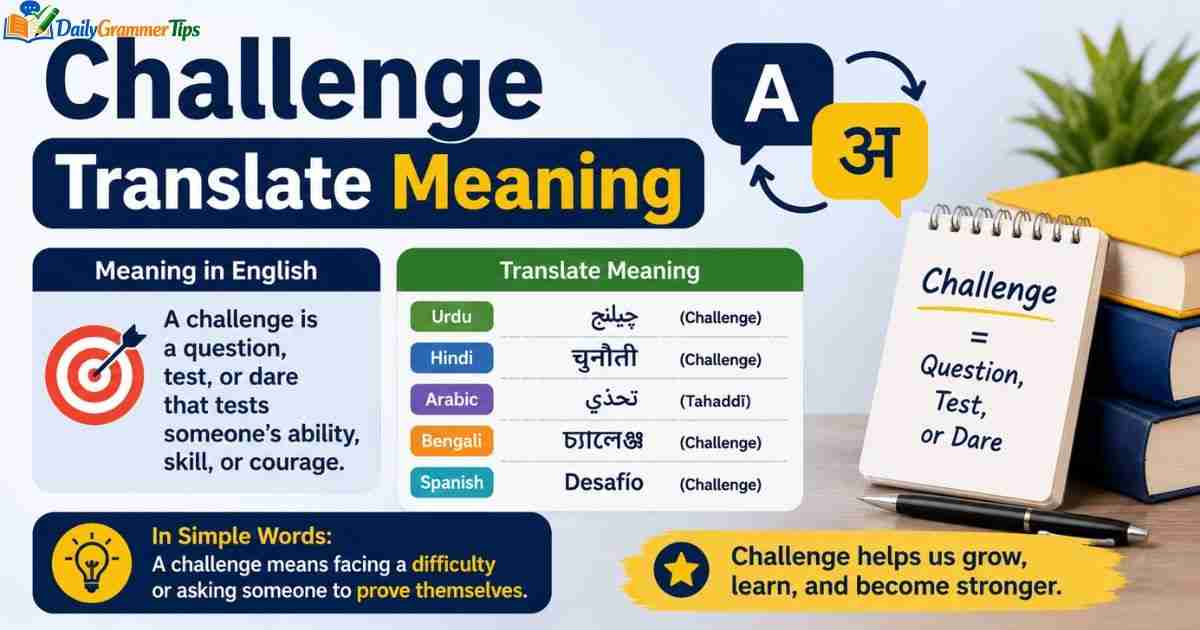
The word challenge can have different translations depending on the language and context. However, the basic meaning usually remains connected with difficulty, testing, or competition.
In general translation:
- Challenge means a difficult task.
- Challenge means a test of ability.
- Challenge means an invitation to compete.
- Challenge means questioning or objecting to something.
For language learners searching for Challange or Challenge, understanding the meaning in different languages can help improve vocabulary. Translation tools may provide different words depending on whether challenge is used as a noun or verb.
For example:
A difficult challenge → a difficult task
Challenge someone → test or question someone
Accept a challenge → agree to complete a difficult task
The meaning depends on the sentence structure.
Challenge Movie Meaning and Context
The word challenge is also commonly used in movie titles, entertainment discussions, and storytelling. A movie with the word challenge in its title often focuses on overcoming difficulties, competition, personal growth, or testing human abilities.
In films and television shows, a challenge may represent:
- A personal journey
- A competition between characters
- A difficult mission
- A conflict that needs to be solved
When people search for Challange or Challenge related to movies, they are often trying to understand the meaning, spelling, or context of the word used in entertainment content.
The spelling remains the same in every context. Whether it appears in a movie title, article, review, or conversation, the correct form is challenge, not challange.
The meaning of challenge in entertainment is similar to its general English meaning. It represents a situation where characters must overcome obstacles, prove their abilities, or face difficult choices. Dictionaries also define challenge as something difficult that requires effort or as an invitation to compete.
How to Use Challenge in a Sentence
Learning through examples is one of the best ways to understand correct word usage. These examples also make the difference between Challange or Challenge easier to remember.
Everyday English Examples
- Cooking a new recipe can be a fun challenge.
- Moving to a new city was a big challenge for her.
- Learning English vocabulary is a challenge for some students.
Professional Communication Examples
- Improving customer satisfaction is a major challenge for many companies.
- The team successfully solved the technical challenge.
- Managing multiple projects can become challenging.
Academic Writing Examples
- This research explores the challenges faced by students.
- Researchers identified several challenges during the study.
- The report discusses challenges in modern education.
These examples show how challenge works naturally in different situations. Using the correct spelling helps readers understand your message clearly and prevents confusion caused by Challange or Challenge mistakes.
Another Word for Challenge
There are many words that can replace challenge depending on the meaning.
| Challenge Meaning | Alternative Words |
| Difficult task | Problem, obstacle, difficulty |
| Test of ability | Trial, examination, test |
| Competition | Contest, match, rivalry |
| Problem situation | Issue, barrier, struggle |
| Questioning something | Dispute, objection, disagreement |
Choosing the right alternative depends on the sentence. While these words may have similar meanings, they are not always interchangeable.
For example:
“Climbing the mountain was a challenge.”
You can replace challenge with difficulty or obstacle, but the exact meaning may slightly change.
Understanding these alternatives also helps learners who search for Challange or Challenge because they can identify the correct word based on context instead of only pronunciation.
Difference Between Challenge and Challange
The main difference between challenge and challange is that one is a correct English word and the other is not.
| Feature | Challenge | Challange |
| Spelling | Correct | Incorrect |
| Dictionary recognition | Accepted word | Not accepted |
| Meaning | Difficult task, test, competition | No official meaning |
| Usage | Used in formal and informal writing | Should be avoided |
The confusion between Challange or Challenge does not happen because both words have different meanings. It happens because of a spelling error.
Whenever you write an email, article, assignment, or report, choose challenge.
How to Avoid Spelling Errors Like Challange
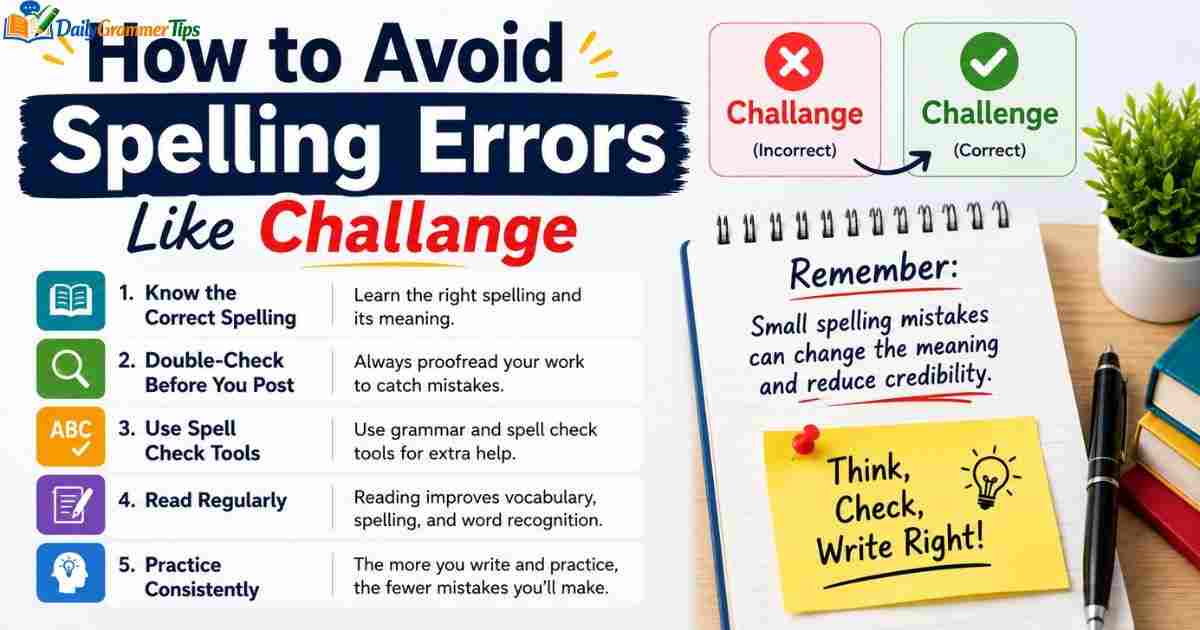
Improving spelling requires regular practice and awareness. Here are some useful tips:
Use Dictionary Tools
Online dictionaries can confirm the correct spelling and meaning of unfamiliar words. Checking reliable sources helps learners understand how words are written and used correctly. citeturn0search0turn0search3
Practice Word Patterns
Learning common English spelling patterns helps reduce mistakes. Remembering that challenge ends with “lenge” instead of “lange” is a simple way to avoid the Challange or Challenge mistake.
Read More English Content
Reading books, articles, and professional content improves vocabulary naturally. Seeing correctly written words repeatedly helps your brain remember the correct spelling.
Use Proofreading
Always review your writing before publishing or submitting it. A quick review can identify simple mistakes like challange.
Use Grammar Checkers
Grammar tools can identify incorrect words and suggest corrections.
Avoiding spelling mistakes improves writing accuracy and creates better communication.
Challenge and English Vocabulary Skills
Understanding words like challenge helps improve overall English vocabulary. Many English learners focus only on memorizing words, but learning meaning, usage, and sentence structure creates stronger language skills.
The word challenge is useful because it appears in many areas:
- Education
- Business
- Technology
- Sports
- Personal development
- Research
Learning the correct spelling of common words helps writers communicate ideas more effectively.
The confusion between Challange or Challenge may seem small, but repeated spelling errors can reduce the quality of professional writing. A correctly written word creates a better impression and makes communication easier for readers.
The word challenge is widely recognized as both a noun and verb. Dictionaries define it as something difficult that requires effort or as an action of questioning, testing, or inviting competition. citeturn0search0turn0search2
Is Challenge a Commonly Confused Word?
Yes, challenge is one of many English words that people sometimes spell incorrectly. Similar spelling confusion happens with many words because English pronunciation does not always clearly show the written form.
Commonly confused words often require:
- Memory practice
- Reading experience
- Spell check
- Vocabulary improvement
The Challange or Challenge confusion happens because people often write words based on their sound instead of their correct spelling. Regular practice and exposure to written English can help avoid these mistakes.
Learning these patterns helps English learners avoid common errors and develop stronger writing habits.
Tips to Remember the Correct Spelling of Challenge
Remember these simple points:
- Challenge has only one “a” after “ch”.
- The ending is “lenge”, not “lange”.
- There is no extra letter before “e”.
- The correct spelling is challenge.
A simple memory trick is:
A challenge is a test, and the correct spelling has no extra “a” in the middle.
This small reminder can help prevent the common Challange or Challenge mistake.
Small spelling rules like this can make a big difference in writing quality.
Frequently Asked Questions
What are challenges?
Challenges are difficult situations or problems that people face in life, work, education, or research. They often require solutions, effort, and decision-making.
What is another word for challenge?
Another word for challenge can be difficulty, obstacle, problem, test, trial, or struggle depending on the situation.
Why do people spell challenge incorrectly?
People often misspell challenge because the pronunciation can make them add an extra “a” while writing. Fast typing and limited spelling practice can also cause this error.
Is challenge a noun or a verb?
Challenge can be both a noun and a verb. As a noun, it describes a difficult task or problem. As a verb, it means to test, question, or invite competition.
How can I remember the spelling of challenge?
Remember that the correct spelling is challenge without an extra “a”. Regular reading and proofreading can help you remember it easily.
Conclusion
The correct spelling is challenge, while challange is a common spelling mistake. Understanding the difference between Challange or Challenge helps improve English writing skills and prevents confusion in professional, academic, and everyday communication.Challenge is a versatile word used to describe difficult tasks, personal obstacles, competitions, and situations that require effort. It can work as both a noun and a verb, making it an important part of English vocabulary.
By learning the correct spelling, practicing sentence examples, and using proofreading methods, you can avoid common spelling errors and improve your overall language accuracy.The main lesson from Challange or Challenge is simple: always choose challenge when describing a difficult task, test of ability, competition, or situation that requires effort. Using the correct spelling makes your writing clearer, more professional, and easier to understand.
