

You are typing a message to a friend who just got engaged, landed a new job, or crossed the finish line of a marathon, and your fingers pause right before that one tricky word. Congratulations or Congradulations, which one do you actually type? If you have ever hesitated over this word, you are far from alone. The Congratulations or Congradulations question trips up native speakers and language learners alike, every single day, in emails, cards, captions, and speeches.
Settles the Congratulations or Congradulations debate once and for all. You will learn the correct spelling of congratulations, why the confusion happens in the first place, how the word is used across different situations, and answers to the most common questions people ask about it.
Congratulations or Congradulations – Quick Answer
Let’s get straight to the point. When comparing Congratulations or Congradulations, only one spelling is correct in standard English: congratulations. The word Congradulations is a misspelling, plain and simple, even though it shows up constantly online.
The correct spelling of congratulations follows this exact order: C-O-N-G-R-A-T-U-L-A-T-I-O-N-S. Notice the letter “t” sitting in the middle of the word, not a “d.” That single letter is the entire Congratulations or Congradulations debate in a nutshell, and it is the detail every guide to congratulations correct spelling comes back to.
A simple trick for remembering the correct spelling of congratulations is to think of the word grateful. Both words share the root “grat,” which comes from gratitude and thankfulness. If you can spell grateful, you can spell congratulations correctly every time.
Examples of correct usage:
- Congratulations on your new job!
- Please accept our warmest congratulations on this achievement.
- Congratulations to the entire graduating class!
Examples of incorrect usage:
- ~~Congradulations on your graduation!~~
- ~~Sending congradulations to the happy couple.~~
Congratulations or Congradulations Meaning
Understanding the Congratulations or Congradulations meaning helps explain why so many people get this word wrong. Congratulations, used correctly, is a noun that expresses praise, joy, or good wishes toward someone who has achieved something meaningful. It is almost always used in its plural form, even when addressing a single person.
Congradulations, on the other hand, has no official meaning of its own in standard dictionaries. It exists purely as a misspelling, or occasionally as an intentional pun blending “congrats” with “grad” for graduation themed content. When people search Congratulations or Congradulations to check the meaning, they are usually trying to confirm which spelling is the real, dictionary recognized word, and that word is always congratulations.
Congratulations or Congradulations in English
In the English language, the Congratulations or Congradulations question has a clear, settled answer. Standard written English, across every major dictionary, style guide, and grammar authority, recognizes only one spelling: congratulations. Congradulations in English is treated strictly as an error, regardless of how often it appears in casual writing or social media captions.
This matters because English learners often assume that if a spelling appears frequently online, it must be acceptable. With Congratulations or Congradulations, frequency does not equal correctness. The correct spelling of congratulations remains fixed and unchanging across formal writing, journalism, education, and professional communication.
The Origin of Congratulations or Congradulations
To fully understand the Congratulations or Congradulations puzzle, it helps to look at where the word came from. Congratulations traces back to the Latin verb congratulari, meaning “to wish someone joy.” This Latin root combines com-, meaning “together,” with gratulari, meaning “to show joy,” itself derived from gratus, meaning “pleasing” or “thankful.”
That same Latin root, gratus, also gives us words like gratitude, grateful, and gratuity. This shared ancestry is the real reason the spelling of congratulation must contain “grat” and never “grad.” The word entered English through French in the mid-1400s and has kept its Latin based spelling ever since.
So why does Congradulations exist at all? Two main reasons explain this side of the Congratulations or Congradulations story:
- Sound blending in speech. In fast, everyday conversation, the “t” sound softens and can be mistaken for a “d,” which leads writers to spell what they hear rather than what is correct.
- The graduation wordplay. Congradulations became a popular pun combining “congrats” and “grad,” especially on graduation cards and social posts, which normalized the misspelling for casual, humorous use.
British English vs American English Spelling

A frequent question in the Congratulations or Congradulations conversation is whether British and American English treat the word differently, the way they do with words like “colour” and “color.” The answer is simple: they do not.
Both British English and American English use the identical correct spelling of congratulations, with no regional variation whatsoever. Whether you are writing in London, Los Angeles, Toronto, or Sydney, congratulations correct spelling stays exactly the same. There is no British version and no American version of Congradulations that is considered acceptable in formal writing. Both dialects settle the Congratulations or Congradulations question the same way.
This consistency makes Congratulations or Congradulations one of the easier English spelling rules to memorize, since you never have to adjust the word based on your audience’s country.
Congratulation or Congratulations on Your Wedding
When celebrating a marriage, people often wonder whether it is congratulation or congratulations on your wedding. The correct form is always plural: congratulations on your wedding. This mirrors the larger Congratulations or Congradulations pattern. The plural form is standard in nearly every context, even when speaking to one couple or one person.
A wedding card might read: “Congratulations on your wedding day, wishing you a lifetime of happiness together.” Notice again that the spelling of congratulations uses a “t,” never a “d,” no matter how joyful or informal the occasion feels.
Congratulation or Congratulations on Your Graduation
Graduation season is where the Congratulations or Congradulations mix-up appears most often, largely because of the popular “congrad” pun. When writing sincerely, the correct phrase is congratulations on your graduation, not congradulations, even though the pun spelling shows up constantly on banners, mugs, and social media captions.
If you are creating something intentionally playful, like a homemade graduation card with a “congrad” theme, that informal use is widely understood as a joke. But anywhere the message needs to be taken seriously, such as a formal card, a school announcement, or a workplace message, the Congratulations or Congradulations answer is the same: congratulations correct spelling is the only appropriate choice.
Learn more……..Planning or Planing: Finally Explained—Which Spelling Is Correct?
My Congratulations Meaning
The phrase “my congratulations” is a common formal expression, and understanding my congratulations meaning helps clarify proper usage within the broader Congratulations or Congradulations discussion. When someone says, “Please accept my congratulations,” they are offering personal, sincere praise for another person’s achievement or happy occasion.
This phrase remains plural even though it refers to a single speaker offering good wishes, another reminder that the correct spelling of congratulations and its grammatical form do not change based on how many people are speaking or being addressed.
Congratulations or Congratulation for One Person
Many people ask about congratulations or congratulation for one person, assuming the singular form might be more appropriate when addressing a single individual. In reality, congratulations remains correct even for one person. You would say, “Congratulations on your promotion,” not “Congratulation on your promotion,” despite speaking to just one recipient.
The singular form, congratulation, technically exists but is rarely used on its own. It typically appears only inside compound phrases, such as “a congratulation message,” and even then, most writers still prefer the plural congratulations for natural, idiomatic English. This is a smaller offshoot of the main Congratulations or Congradulations question, but the spelling of congratulation never shifts.
Common Mistakes with Congratulations or Congradulations
Beyond the core Congratulations or Congradulations confusion, several related spelling mistakes appear regularly:
- Congradulations, substituting “d” for “t”
- Congratualtions, transposing the “u” and “a”
- Congratulaions, dropping the “t” near the end
- Congragulations, replacing “t” with “g”
- Congratulation, dropping the final “s” when the plural is required
| Incorrect Spelling | Correct Spelling |
| congradulations | congratulations |
| congratualtions | congratulations |
| congratulaions | congratulations |
| congragulations | congratulations |
| congratulation (alone) | congratulations |
Knowing the correct spelling of congratulation in all its variations helps writers catch these errors before hitting send. Every one of these mistakes shares the same fix: return to the root “grat” and rebuild the word from there.
Congratulations or Congradulations – Usage Data
Search behavior around Congratulations or Congradulations reveals just how lopsided this comparison really is. Congratulations dominates everyday writing by an enormous margin, while Congradulations appears almost exclusively when people are either checking the spelling of congratulations or using it deliberately as a graduation joke.
Across books, news articles, academic writing, and professional documents, congratulations is used consistently and almost without exception. Spell checkers on every major platform flag Congradulations as an error immediately.
Key insights:
- Congratulations is searched far more often than Congradulations across the year.
- Congradulations spikes mainly during graduation season, driven by people double checking the correct spelling of congratulations.
- Congrats is the most common informal short form used in writing.
- Grammar authorities recognize only congratulations as valid.
Comparison Table: Keyword Variations
This table lays out related terms connected to the Congratulations or Congradulations topic, along with their correct forms and best use cases.
| Term | Correct? | Best Used In |
| congratulations | Yes | All formal and informal writing |
| congratulation | Yes, but rare | Compound phrases only |
| congradulations | Informal pun only | Graduation humor, novelty cards |
| congrats | Yes | Texts, social media, casual speech |
| congratulate | Yes | All contexts, as the verb form |
| congratulatory | Yes | Formal and semi-formal writing |
Congratulations or Congradulations in Everyday Examples
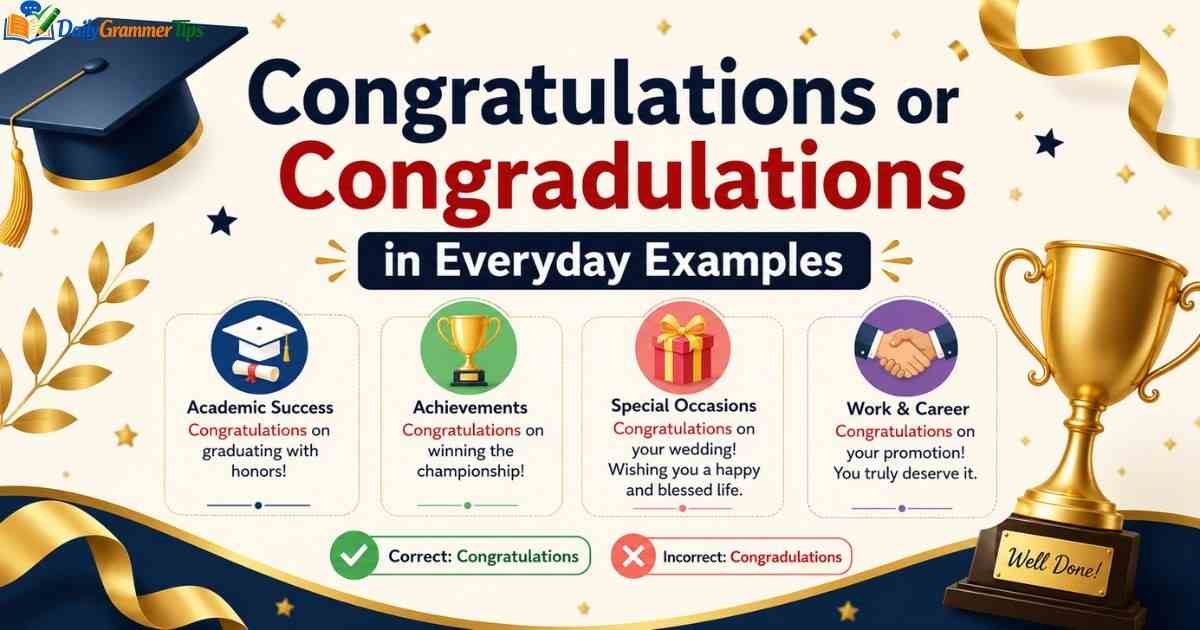
Seeing the Congratulations or Congradulations answer applied across real writing situations makes the rule easier to remember.
In emails: “I wanted to personally offer my congratulations on your well-deserved promotion. Your hard work has clearly paid off.”
In news headlines: “City Extends Congratulations to Local Team After Championship Win”
In social media captions: “Congratulations to my sister on finishing her degree, so proud of you! 🎓”
In formal writing: “The committee wishes to extend its sincere congratulations to the award recipient for her outstanding contributions.”
In every one of these examples, the correct spelling of congratulations is used consistently, reinforcing that Congradulations has no place outside of intentional graduation humor.
Congratulations Short Message
Sometimes you need a congratulations short message rather than a lengthy note. Short, sincere lines work well for texts, cards, and quick social posts:
- “Congratulations! You earned this.”
- “So happy for you, congratulations!”
- “Congratulations on this huge milestone!”
Even in a congratulations short message, the spelling of congratulation still matters. Brevity is never an excuse for the Congradulations misspelling. A short note with the wrong spelling can undercut an otherwise heartfelt gesture.
Congratulations 🎉
The word congratulations is so tied to celebration that it is often paired with the 🎉 emoji across texts, cards, and social captions. Congratulations 🎉 as a phrase is playful, casual, and instantly recognizable, but the spelling underneath the emoji still needs to be correct. Whether you write “Congratulations 🎉” or the more formal “Congratulations on your achievement,” the answer is identical: congratulations, with a “t,” not a “d.”
Frequently Asked Questions
What does “congraduation” mean?
“Congraduation” is not a standard English word. It is an informal blend of “congratulations” and “graduation,” typically used as a playful pun on graduation cards or social posts rather than as a recognized dictionary term.
Is it congradulations or congratulations for graduation?
Even for graduation messages, the technically correct spelling is congratulations. Congradulations is only acceptable as an intentional, humorous pun in casual graduation content, not in formal writing.
Is congradulation a word?
No, congradulation is not a real word in any recognized English dictionary. It is simply a misspelling of congratulation, missing the correct “t” in favor of a “d.”
Is it congrats or congrads?
The correct informal short form is congrats, not congrads. Congrats keeps the same “t” found in the full word congratulations, while congrads mistakenly follows the same “d” error seen in Congradulations.
What is congraduation?
Congraduation is an informal, non-standard term combining “congratulations” and “graduation.” It appears mainly in graduation themed jokes and is not used in formal or professional writing.
Conclusion
After exploring every angle of Congratulations or Congradulations, the answer remains completely clear: congratulations is the only correct spelling in standard English, while Congradulations is a misspelling that only earns a pass as an intentional graduation pun. Remembering the root “grat,” shared with grateful and gratitude, is the simplest way to lock in the correct spelling of congratulations for good.
You are writing a wedding card, a graduation message, a quick text, or a formal professional email, getting the congratulation spelling right shows attention to detail and adds real credibility to your words. The next time you type this word, you can move past the Congratulations or Congradulations hesitation with total confidence. Congratulations, spelled correctly, every time.
