

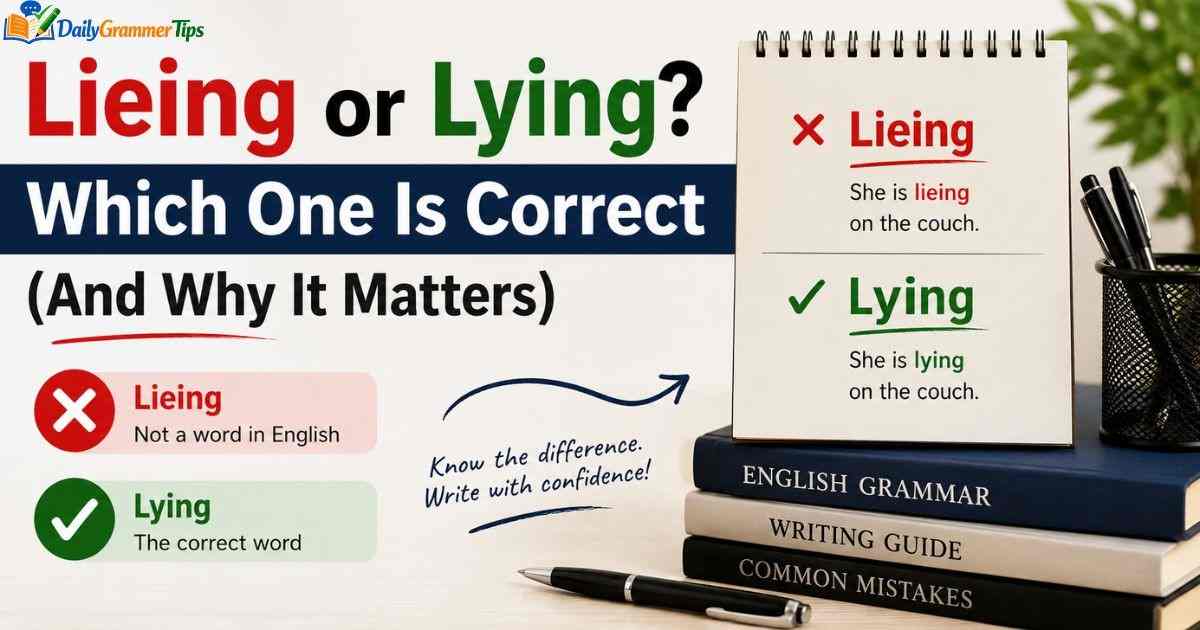
Have you ever paused mid sentence, unsure whether to write lieing or lying? You are far from alone. This is one of the most searched spelling questions in English, and the confusion makes complete sense once you think about it.This confusion between lieing or lying shows up in texts, essays, emails, and even published blog posts, which is exactly why a clear answer matters.
After all, most verbs simply take “ing” at the end, so it feels natural to assume lie should become lieing. In this guide, you will get a clear answer about lieing or lying, backed by the grammar rule, real examples, and simple comparisons you can refer back to any time.Searching for lieing or lying is one of the most common spelling questions in English, right alongside other tricky word pairs.
Lieing or Lying, the Quick Answer
Lying is correct. Lieing is a misspelling and does not exist in standard English.No matter the context, whether someone is resting horizontally or telling a falsehood, the correct present participle of the verb lie is always lying. No dictionary anywhere recognizes lieing as a valid word.
Correct: She is lying on the couch. Incorrect: She is lieing on the couch.
Dictionaries, style guides, and grammar textbooks all agree on this point, which is why the lieing or lying debate has such a definitive answer.Keep that simple answer in mind as you read the rest of this guide, since every section below builds on this one fact about lieing or lying.
What Is Lieing?
Lieing is simply a spelling error. It is a very common one, but it is an error nonetheless.It shows up in text messages, social media captions, student essays, and even some casual blog posts. People write lieing because they assume adding “ing” to lie should follow the same pattern as other verbs, like ride becoming riding or smile becoming smiling.
That logic feels natural, but lie belongs to a small group of English verbs that follow a different rule entirely. Spell check tools in Word, Google Docs, and Grammarly will flag lieing as incorrect every single time.This is exactly why so many people end up searching lieing or lying online, hoping to confirm what their spell checker is already telling them.
Lieing carries no recognized meaning and has no usage history in any major style guide or grammar reference. Anyone asking about lieing or lying can trust that lieing simply is not a real word.Every time lieing shows up in writing, it counts as a spelling mistake, not a valid alternative to lying. That single fact settles most of the lieing or lying confusion right away.
What Is Lying?
Lying is the present participle and gerund form of the verb lie. What makes lying interesting, and sometimes confusing, is that lie actually carries two separate meanings, and both share this exact same spelling.
Lieing or Lying Meaning
The first meaning describes someone or something reclining, resting flat, or being positioned somewhere. The second meaning describes someone being dishonest or making a false statement on purpose.Understanding both sides of the lieing or lying meaning helps you use the word confidently in any sentence you write.
Even though these two meanings come from different roots, English settled on one identical spelling for both. So no matter which meaning you intend, the lieing or lying answer stays exactly the same.This is one of the more interesting quirks of the lieing or lying topic, since two unrelated verbs ended up sharing one identical spelling.
Lieing or Lying Down
This sense of lying describes a person, animal, or object resting in a horizontal position.The cat is lying near the fireplace. He was lying on the hospital bed after surgery. Her phone was lying on the kitchen counter all morning. The keys were lying under the couch.
Every one of these lieing or lying examples uses the exact same correct spelling, no matter what is doing the resting.Notice that lying down never becomes lieing down in any of these examples. That rule holds true across every resting position you can imagine.This is one of the clearest ways to test yourself on lieing or lying, since the phrase lying down appears so often in daily conversation.
Lieing or Lying in Bed

This phrase describes someone resting in bed, whether they are sleeping, reading, or simply relaxing.
Correct: I was lying in bed for an hour before I finally got up. Incorrect: I was lieing in bed for an hour before I finally got up.
Whenever a sentence about beds or sofas comes up, the lieing or lying answer points back to lying every time.Even doctors, nurses, and fitness instructors who use phrases like lying flat rely on the same standard spelling.
Lieing or Lying on the Floor
The same rule applies here too. A pet resting on the floor, or a child doing homework on the floor, is always described as lying on the floor.
Correct:
The dog was lying on the floor near the door. Incorrect: The dog was lieing on the floor near the door.
If you keep typing lieing out of habit, pause for a second and picture this simple example. It is one of the easiest ways to remember lying or lieing correctly.Over time, choosing correctly between lieing or lying becomes automatic, and you stop needing to pause and check.
Learn more……..Planning or Planing: Finally Explained—Which Spelling Is Correct?
Lieing or Lying, Not Telling the Truth
This sense of lying refers to someone being dishonest or making a false statement on purpose.He has been lying to his parents for weeks. The witness was accused of lying in court. Stop lying and tell me what actually happened. She regrets lying about her qualifications.
These lieing or lying examples all confirm the same spelling, whether the sentence is casual or formal.This use of lying carries real weight, since accusing someone of lying is a serious claim. Getting the lieing or lying spelling right matters here too, since a typo can distract from a serious point.
Journalists, lawyers, and teachers in particular need to get lying or lieing right, since their writing is read closely and judged carefully.
Lieing or Lying Grammar, the Rule Explained
So why does lie become lying instead of lieing? The answer comes down to one fundamental English spelling rule that many learners overlook.
When an English verb ends in the letters “ie,” you drop the final “e” and change the “i” to a “y” before adding “ing.” This is often called the ie to y rule, and it applies without exception.
Base verb lie becomes ly after the ie to y swap, and then ing is added, giving you lying.
This three step breakdown is often how teachers explain lieing or lying to students who are just beginning to learn English spelling patterns.
This same pattern appears in other verbs too. Die becomes dying, not dieing. Tie becomes tying, not tieing. Vie becomes vying, not vieing. Once you notice this shared rule, the lieing or lying grammar question becomes far easier to answer, since you can test any similar verb the same way.
Placing “ie” directly before “ing” would create an awkward vowel cluster that disrupts pronunciation. The shift from ie to y keeps the word smooth and consistent with how English normally sounds.
Understanding this grammar helps explain why lieing or lying grammar questions come up so often in classrooms. Once the exception is clearly explained, most learners stop struggling with lying or lieing altogether.
The Origin of Lieing or Lying
The word lie traces back to Old English, where it carried two separate meanings that have survived into modern usage.One Old English root, licgan, meant to rest or be in a horizontal position. A second root, leogan, meant to speak falsely or deceive. Over time, English spelling became standardized, and verb conjugation rules grew more consistent.
Knowing that lieing or lying traces back to two separate Old English words helps explain why the meanings feel so different even though the spelling is identical.The ie to y transformation before ing became a fixed rule in English word formation long before modern grammar guides were written. That history is exactly why every major dictionary lists lying and nothing else.
The lieing spelling likely emerged through simple analogy. When people apply the regular verb pattern, seen in words like file becoming filing or like becoming liking, they sometimes carry that same pattern onto lie, creating the lieing or lying mix up.Knowing this history makes the lieing or lying rule feel less arbitrary and more like a natural part of how English evolved.
British English vs American English Spelling
A common question people ask is whether lieing might be correct in British English while lying is used in American English, or the other way around. The answer is simple.Both British English and American English use lying. There is no regional variation on this point.
This settles yet another common version of the lieing or lying question, since regional dialect never changes the correct spelling.Unlike words that genuinely differ across dialects, such as colour versus color, the word lying stays completely consistent everywhere. Grammar authorities on both sides of the Atlantic agree on one spelling only.
American English uses lying and accepts it. British English uses lying and accepts it. Australian English uses lying and accepts it. No dialect of English accepts lieing, ever.This means the lieing or lying answer never shifts based on where your reader lives, which makes the rule easy to apply no matter your audience.
Which Spelling Should You Use?
Always use lying, in every context, every country, and every type of writing.Here are situations where the lieing or lying choice matters most. In academic writing, an incorrect spelling can cost marks and hurt your credibility. In professional emails and documents, spelling errors signal carelessness to colleagues and clients.
These are the exact moments where a small lieing or lying slip can leave a bigger impression than expected.On social media and in content creation, misspellings reduce perceived authority and can even hurt search rankings. On job applications and resumes, a single spelling slip can leave a poor first impression.
There is no edge case, no dialect, and no style guide where lieing becomes acceptable. When in doubt about lying or lieing, simply type lying, and you will always be correct.Writers who publish content professionally benefit the most from mastering lieing or lying once and for all, since spelling errors can undermine an otherwise strong piece of writing.
Common Mistakes with Lieing or Lying

Beyond the basic lieing or lying confusion, a few related errors trip people up regularly.
Lying vs Laying
This is one of the most widespread mix ups in English. Lying comes from the verb lie, meaning to rest or to be dishonest, and it does not require a direct object.
Laying comes from the verb lay, meaning to put something down, and it always requires a direct object.
Incorrect: He is laying on the bed. Correct: He is lying on the bed. Incorrect: She is lying the book on the table. Correct: She is laying the book on the table.
Keeping lieing or lying separate from lying versus laying will make both grammar topics much easier to master.
Getting the Past Tense Wrong
Many people also struggle with the past tense forms connected to lying or lieing.Present tense: I lie down every afternoon. Past tense for resting: Yesterday, I lay down for an hour. Past tense for dishonesty: She lied about what happened. Past participle: He has lain in bed all morning.
Writing Dieing Instead of Dying
The same ie to y rule applies to the verb die. Dieing is not a word. The correct form is dying, and remembering this sister example is one of the easiest ways to lock in lying or lieing for good.
Keeping lieing or lying and dieing versus dying as connected rules in your mind will make both topics much easier to remember together.
Lieing or Lying Examples
Here are natural, everyday sentences using lying correctly, covering both core meanings.
Lying, meaning reclining or resting:
She was lying on the beach when her phone rang. The injured dog was found lying in the alley. I spent Sunday morning lying in bed with a good book. The documents were lying on his desk for three days.
Lying, meaning being dishonest:
Everyone in the room knew he was lying. Lying on a resume is grounds for immediate dismissal. She felt terrible about lying to someone she trusted. The politician was caught lying about campaign finances.
Every single sentence above uses lying, never lieing, which shows just how consistent this rule stays across both meanings.Try reading each example out loud and swapping in lieing to hear just how unnatural it sounds compared to the correct lieing or lying answer.
Lieing or Lying, Usage and Search Trends
People search for this exact question constantly, and lieing or lying remains one of the most common English spelling searches out there. High search volume around lieing exists mainly because people want to correct themselves, not because the word is valid.Large research tools that track word usage across millions of published books show almost no appearances of lieing in any era of published English. Lying, on the other hand, appears constantly across literature, journalism, and academic writing from every century.
The message is clear. Lieing has essentially never appeared in standard published writing. It remains a modern typing slip, made more common through fast digital typing and autocorrect gaps.Even with all this data, people keep typing lieing or lying into search engines every single day, which is exactly why a clear answer like this one matters.
Comparison, Lieing vs Lying
| Feature | Lieing | Lying |
| Correctness | Incorrect spelling | Correct spelling |
| Grammar Status | Not accepted in standard English | Correct present participle of “lie” |
| Base Verb | Lie | Lie |
| Meaning | No standard meaning | Resting position or telling an untruth |
| Usage | Considered a common spelling mistake | Used in everyday and formal writing |
| Grammar Rule | Does not follow English spelling rules | Follows the rule: -ie changes to -y before adding -ing |
| Example | ❌ He is lieing on the bed. | ✅ He is lying on the bed. |
| Another Example | ❌ She was lieing about the story. | ✅ She was lying about the story. |
| Related Words | No correct forms | Lie → Lying → Lied → Lay |
| Dictionary Recognition | Usually not recognized as a standard word | Recognized as a correct English word |
Lieing or Lying Quiz

Test yourself with a few quick questions about lieing or lying before moving on to the FAQs below.
Question one, fill in the blank. “The blanket was placed on the bed.” Should it be lying or laying?
Question two, true or false. Lieing is an accepted alternative spelling of lying in American English.
Question three, fill in the blank. “He has been to his coworkers for months.” Should it be lying or lieing?
If you answered laying, false, and lying, you have fully mastered the lieing or lying rule.
Feel free to come back and repeat this short lieing or lying quiz any time you want a quick refresher.
Frequently Asked Questions
Is it spelled lying or lieing?
It is always spelled lying. Lieing is a common misspelling and is not recognized as correct in standard English, whether you mean dishonesty or a resting position.
Is it laying or lying on bed?
It is lying on the bed when no object is being placed, such as a person simply resting. Laying is used when something is being placed on the bed, such as laying a blanket down.
How do you spell lying as in being a liar?
Even when referring to someone who is a liar or being dishonest, the correct spelling is still lying, following the same ie to y rule used for every other meaning of the word.
Is it lying down or lieing down?
It is lying down. Lieing down is incorrect in every form of standard English, whether written casually or formally.
When lying down in bed?
Whenever you describe the act of reclining in bed, for sleep, rest, or relaxation, the correct word is lying, as in “lying down in bed for the night.”
Conclusion
English keeps a few quirky spelling rules alive, and the ie to y shift is one of them. Once you learn that lie drops its final letters and swaps in a y before ing, you stop guessing and start writing with confidence. This small grammar rule connects to a wider family of commonly confused words, from lay and lie to die and tie, and understanding one helps you understand them all.
Good writing earns trust, and trust starts with getting the basics right. So the next time you sit down to write, whether you are describing someone resting or someone bending the truth, reach for lying without a second thought. You now know the rule, you have seen the examples, and you can settle the lieing or lying question for anyone who asks.
