

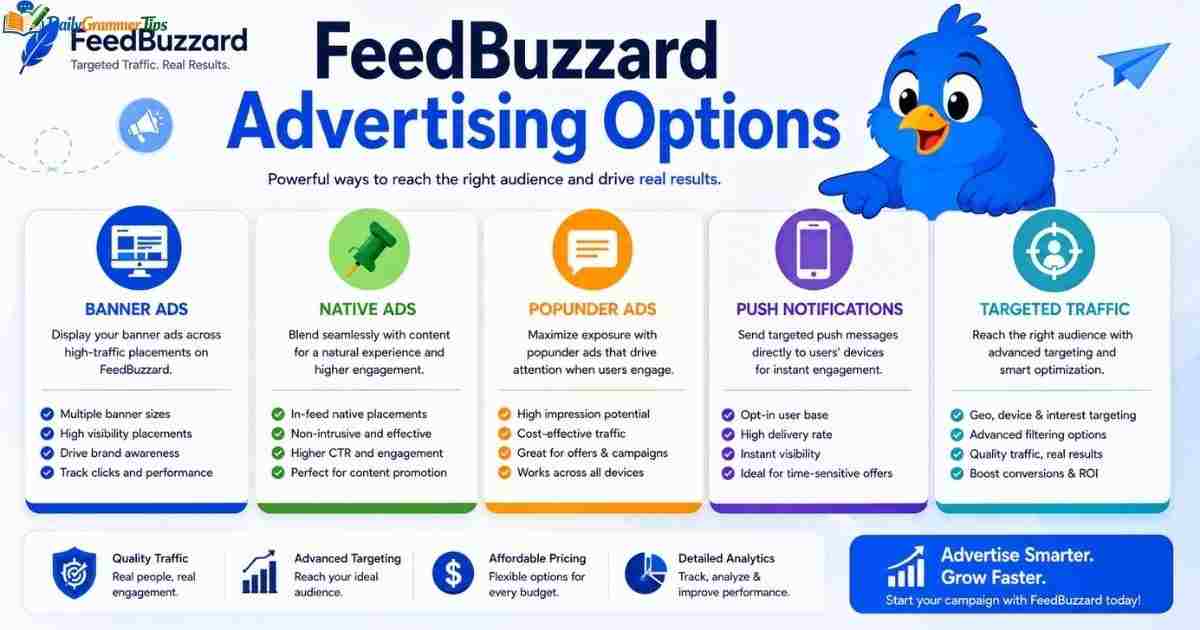
If you want to Advertise FeedBuzzard, start by understanding its advertising options, audience, ad formats, and campaign costs. Businesses can explore native ads, banner ads, video advertising, and sponsored content based on their campaign objectives. A clear advertising strategy helps you choose the right target audience, set a practical advertising budget, and build campaigns that support traffic, leads, or sales.
Effective FeedBuzzard advertising also depends on smart targeting and accurate performance tracking. Advertisers can evaluate impressions, clicks, CTR, CPC, conversions, CPA, and ROAS to understand campaign performance. With proper campaign management, conversion tracking, creative testing, and budget allocation, you can optimize ad campaigns and improve advertising ROI without wasting your paid media budget.
What Is FeedBuzzard?
FeedBuzzard is generally presented as an online content platform with strong connections to technology, digital trends, gadgets, software, and related subjects. That positioning matters when evaluating advertising because audience relevance can influence campaign quality just as much as raw traffic volume. A technology focused publication may be more useful for a SaaS company, app developer, software brand, gadget seller, cybersecurity company, or digital service than for a business whose customers have little interest in technology.
For advertisers, FeedBuzzard should therefore be evaluated as a potential publishing and promotional environment rather than automatically being treated like Google Ads, Meta Ads, or another major self service advertising network. The distinction is important because an advertising platform normally provides standardized campaign tools, bidding controls, audience databases, reporting dashboards, and clearly documented pricing. A publisher may instead offer direct placements, sponsored articles, banners, or customized promotional packages.
Before launching a FeedBuzzard campaign, ask what inventory is currently available, where advertisements appear, which audiences can be reached, how pricing is calculated, and what reporting is supplied. Those questions prevent assumptions from turning into unexpected campaign costs.
Why Advertisers Consider FeedBuzzard
The main reason businesses consider FeedBuzzard is audience relevance. Digital advertising works better when an advertisement reaches people who have some reason to care about the offer. A technology related environment can provide useful context for products such as applications, software, online services, hardware, AI tools, hosting services, productivity products, and other digital solutions.
A second advantage is content alignment. Native advertising and sponsored content can introduce a product within an editorial environment without relying entirely on a conventional banner. When the message matches the subject matter around it, users may find the promotion more useful and less disruptive.
A third consideration is testing. Smaller advertising environments can sometimes be useful for controlled experiments. An advertiser can test two headlines, compare landing pages, evaluate audience segments, and determine whether the traffic produces meaningful conversions before allocating a larger advertising budget.
However, FeedBuzzard should not be selected simply because a website appears attractive or because another marketer mentions it. Campaign quality depends on genuine audience engagement, traffic sources, placement quality, pricing, creative relevance, and measurement. A smaller but relevant audience can outperform a larger audience that has little interest in the product.
FeedBuzzard Advertising
Feedbuzzard advertising should begin with a clear understanding of the commercial goal. A company seeking brand awareness needs different creative and measurement criteria from a company trying to generate purchases. Similarly, an app developer measuring installs needs different conversion tracking from a publisher trying to gain newsletter subscribers.
A practical Feedbuzzard advertising strategy can include native placements, display advertising, sponsored articles, video advertising, or other formats offered by the publisher. The exact availability should be confirmed before campaign launch rather than assumed from third party descriptions.
The most useful starting questions are simple:
- What audience does the placement reach?
- Where does the advertisement appear?
- Is pricing based on CPC, CPM, CPI, sponsorship, or another model?
- What minimum budget applies?
- What targeting controls are available?
- Can advertisers use tracking pixels or conversion events?
- What reporting will be provided?
- How long does campaign approval take?
- Are there restrictions on industries or creative formats?
These questions turn Feedbuzzard advertising from a vague promotional idea into a measurable marketing decision.
FeedBuzzard Advertising Options
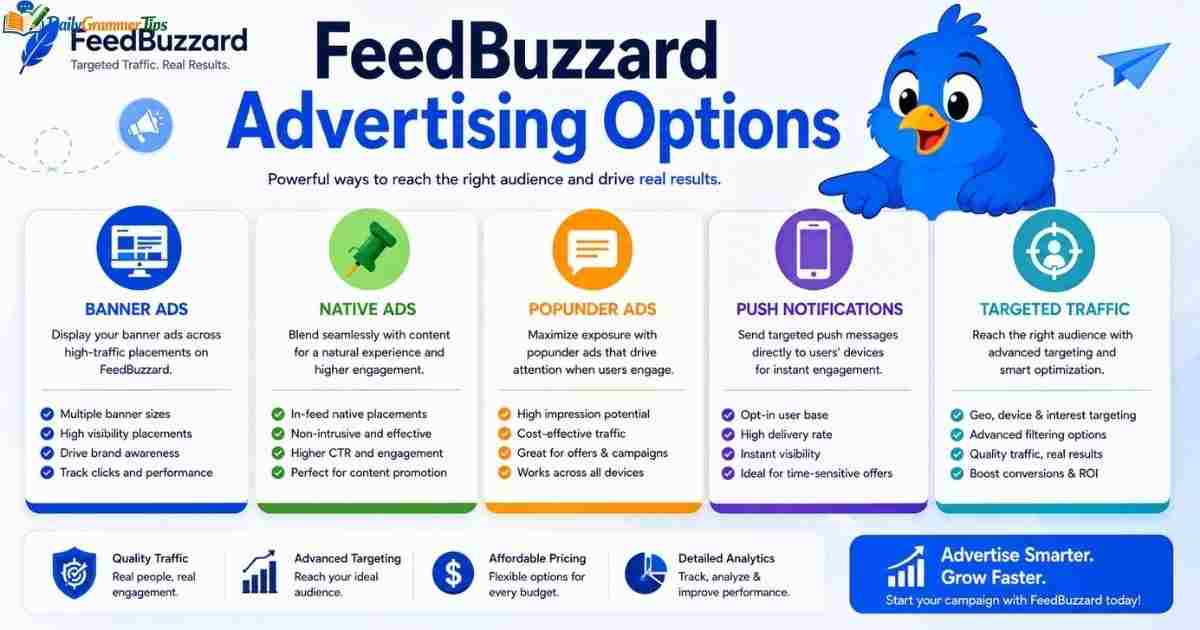
The available FeedBuzzard advertising options should be verified directly before purchase because publisher inventory can change. In general, advertisers evaluating a content focused site may consider several formats.
FeedBuzzard Native Ads
FeedBuzzard native ads can fit naturally into content discovery environments. Native advertising works by presenting promotional material in a format that resembles the surrounding content while still identifying the commercial nature of the placement.
Native ads can work well when the advertiser has a strong headline, useful image, and clear call to action. The message should explain the benefit quickly rather than forcing users to decode the offer.
FeedBuzzard Banner Ads
FeedBuzzard banner ads are visual placements designed to attract attention through imagery, branding, concise text, and a call to action. They can support brand awareness and direct response campaigns, depending on placement.
Banner performance often depends on creative quality. A crowded design, tiny text, weak contrast, or unclear offer can reduce engagement. Advertisers should test multiple ad creatives instead of assuming one banner will work for every audience.
FeedBuzzard Video Ads
FeedBuzzard video ads can communicate product benefits faster than static imagery when users are willing to watch. Video is particularly useful for demonstrations, software interfaces, product features, tutorials, and visual explanations.
A short opening hook matters because users can leave before the main message appears. The final frame should also contain a recognizable brand and clear call to action.
FeedBuzzard Sponsored Content
FeedBuzzard sponsored content can be useful when the advertiser needs more room to explain a product. Sponsored articles can discuss a product, service, feature, use case, or industry problem in greater depth than a small display unit.
Sponsored articles should remain useful to readers. Excessive sales language can damage credibility, while clear disclosure helps users understand the commercial relationship.
FeedBuzzard Ad Formats and Placement
Choosing FeedBuzzard ad formats is only half of the placement decision. Advertisers should also consider where the promotion appears. A highly visible placement may produce more impressions, while a contextually relevant position may produce stronger engagement.
Possible ad placement considerations include feed positions, article pages, mobile environments, desktop environments, newsletter areas, and sponsored content sections. The exact inventory should be confirmed rather than assumed.
The relationship between format and placement can influence campaign performance. A banner that works on desktop may need a different design for mobile advertising. Likewise, a long sponsored article may attract readers who are researching a topic but perform poorly when presented to users who are simply scrolling through a feed.
A strong FeedBuzzard campaign therefore considers creative dimensions, device behavior, page context, user intent, and the action the visitor should take after clicking.
FeedBuzzard Targeting
FeedBuzzard targeting should focus on reaching users who have a reasonable connection to the advertiser’s offer. Broad exposure can increase impressions, but targeted delivery can reduce wasted ad spend when the campaign has a specific customer profile.
Useful targeting categories may include geography, device type, operating system, language, content context, and other controls made available by the advertising system. Advertisers should confirm the actual targeting controls instead of assuming that every platform supports the same audience tools.
FeedBuzzard Audience Targeting
FeedBuzzard audience targeting becomes more effective when the advertiser first defines the target audience. Instead of saying “everyone interested in technology,” build a more specific profile.
For example, an online software company might target:
- Professionals interested in productivity tools
- Small business owners looking for automation
- Developers evaluating software solutions
- Technology readers researching AI products
- Mobile users interested in new applications
Clear audience segments make campaign management easier because performance can be compared between meaningful groups.
Demographic Targeting
Demographic targeting can involve age ranges, gender, location, language, or other audience attributes where supported. Demographic data should support the campaign strategy rather than become a collection of unnecessary restrictions.
Too many restrictions can reduce audience reach and make an otherwise promising campaign difficult to scale.
Geographic Targeting
Geographic targeting is useful when products are available only in certain countries, regions, or cities. An advertiser should avoid paying for visitors who cannot purchase the product or use the service.
For international campaigns, separate campaigns by major market when budget allows. That approach makes it easier to compare audience reach, clicks, conversions, and customer acquisition costs.
Keyword Targeting
Keyword targeting can be valuable when available because it connects advertising with subject relevance. A technology company could focus on terms associated with software, applications, cybersecurity, cloud services, or productivity.
However, keyword targeting should not replace broader testing. Some users convert without searching for a specific term, while others may click on a relevant advertisement but have no buying intention.
Device Targeting
Device targeting helps advertisers distinguish mobile advertising from desktop advertising. A landing page that works beautifully on a large monitor may provide a poor mobile experience.
Compare conversion rate by device before increasing budget. If mobile receives many clicks but produces few conversions, investigate page speed, form usability, payment flow, and creative fit.
FeedBuzzard Advertising Costs
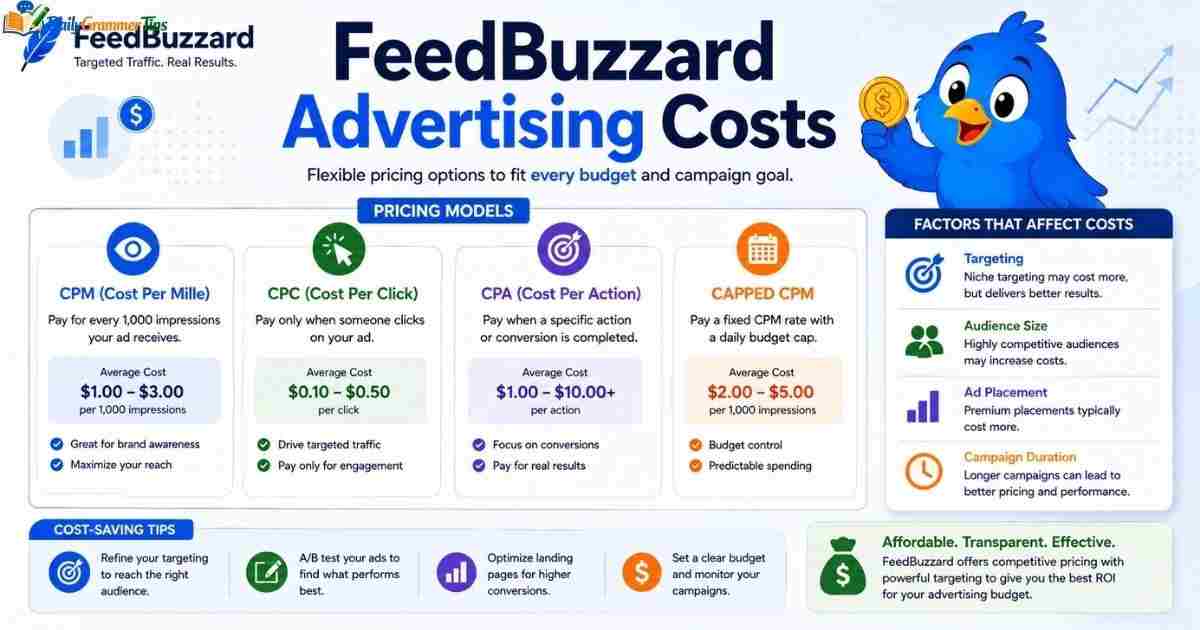
One of the most important questions is Feedbuzzard advertising costs. Public discussions do not establish one universally verified rate card that applies to every advertiser, placement, and campaign. Pricing may depend on format, inventory, audience, duration, placement, campaign objective, and negotiation.
That means marketers should avoid treating an unverified number from another website as a guaranteed FeedBuzzard price. Ask for a current media kit or quotation and clarify exactly what the quoted amount includes.
Common digital advertising pricing models include:
| Pricing model | Meaning | Best used for |
| CPC | Payment for each click | Traffic and direct response |
| CPM | Payment per thousand impressions | Reach and awareness |
| CPI | Payment for an install | App acquisition |
| CPA | Payment for a defined acquisition | Conversion focused campaigns |
| Sponsorship | Fixed fee for an agreed placement | Brand exposure and content |
| Sponsored content | Fee for promotional editorial content | Education and product discovery |
CPC Pricing
CPC pricing means the advertiser pays when a user clicks the advertisement. It can be attractive when website traffic is the main objective, but clicks alone do not guarantee sales.
A campaign with a low CPC can still be expensive if visitors do not convert. Always compare CPC with conversion rate and cost per acquisition.
CPM Pricing
CPM pricing charges based on impressions, normally per thousand. CPM advertising is often suitable for brand awareness because advertisers can purchase visibility without requiring a click.
The important metric is not simply the number of impressions. Advertisers should evaluate whether the audience is relevant and whether the campaign produces measurable engagement.
CPI Pricing
CPI pricing is associated with app installations. It can make sense for mobile applications when the primary goal is acquisition.
An advertiser should still measure what happens after the install. A cheap installation has limited value if users uninstall quickly or never complete the desired conversion event.
CPA and Performance Pricing
CPA focuses on a defined acquisition, such as a sale, registration, or lead. It can provide a closer connection between advertising spend and business outcomes.
Advertisers should understand exactly what counts as an acquisition and how conversion events are validated before agreeing to a performance based model.
How to Estimate FeedBuzzard Advertising Costs
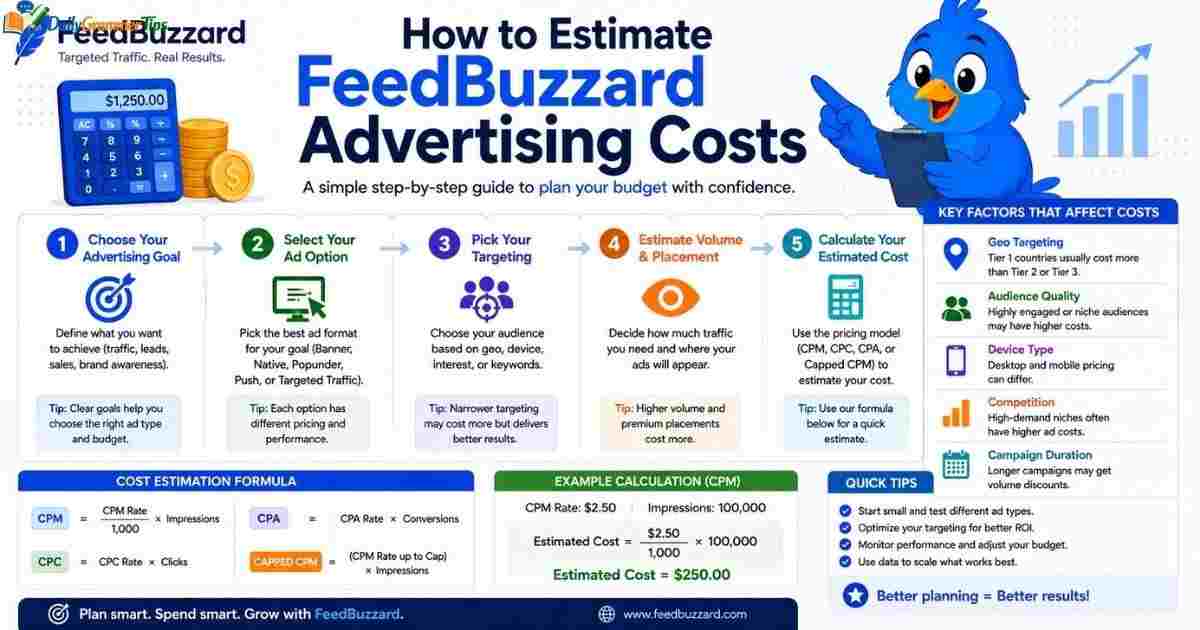
Instead of asking only for the cheapest available placement, calculate the maximum amount the campaign can reasonably spend.
Suppose a business earns $80 in gross profit from a new customer and wants to keep acquisition spending below $25. The campaign should be optimized around a cost per acquisition below that internal limit.
For a CPC campaign, the basic relationship is:
Cost per acquisition = CPC ÷ conversion rate
If the average click costs $0.50 and 5% of visitors convert, the estimated acquisition cost is $10. The example is only a planning calculation, not a FeedBuzzard benchmark.
For CPM campaigns, use:
Estimated cost per click = CPM ÷ clicks per thousand impressions
These calculations help an advertiser understand whether a quoted price can potentially support the business model.
FeedBuzzard Campaign Setup
A successful FeedBuzzard campaign begins before the first advertisement is uploaded. The advertiser should define campaign objectives, audience segments, budget limits, creative requirements, tracking, and success criteria.
A practical campaign setup process looks like this:
- Define the marketing objective.
- Identify the target audience.
- Select relevant placement options.
- Choose the advertising model.
- Prepare ad creatives.
- Build or select the landing page.
- Install conversion tracking.
- Set the campaign budget.
- Launch a controlled test.
- Monitor early performance.
- Optimize based on meaningful results.
- Scale only after the economics work.
The process prevents a common mistake: launching an advertisement before knowing what success looks like.
FeedBuzzard Campaign Objectives
Your campaign objectives should determine the campaign structure. Common objectives include brand awareness, website traffic, lead generation, app installs, product sales, and customer acquisition.
A brand awareness campaign may prioritize impressions, audience reach, and engagement. A direct response campaign should usually prioritize conversions, CPA, revenue, and ROAS.
Do not combine unrelated objectives inside one campaign when doing so makes measurement difficult. A campaign designed for traffic can produce excellent clicks but still fail to generate customers.
FeedBuzzard Ad Campaigns
FeedBuzzard ad campaigns should use a clear testing framework. Instead of changing the audience, creative, landing page, and bid simultaneously, isolate important variables where possible.
For example, create two headlines while keeping the audience and landing page unchanged. After collecting enough data, compare the results. This is more useful than changing five elements and then trying to guess which change caused the improvement.
Good FeedBuzzard ad campaigns also establish spending limits. A campaign should never continue spending simply because the budget remains available.
Campaign Budget and Budget Allocation
Your campaign budget should reflect both the value of a conversion and the amount of data required for testing. A tiny budget may not produce enough information to judge performance, while an oversized first campaign can create unnecessary risk.
Use budget allocation to divide spending between audiences, creatives, devices, or markets. Once results become clear, move more budget toward combinations that meet your performance targets.
An advertising budget should also include room for creative testing. Spending the entire budget on one advertisement leaves no opportunity to discover whether a different message could perform better.
Bidding Strategy
A bidding strategy should match the campaign objective and available pricing model. Manual control can help experienced advertisers manage costs closely, while automated bidding can be useful when the platform has enough data to optimize delivery.
Do not increase bids simply because traffic volume is low. First investigate audience size, placement availability, creative quality, approval status, and targeting restrictions.
The goal is not to win every auction. The goal is to acquire valuable users at an acceptable cost.
Campaign Management
Good campaign management continues after launch. Advertisers should review performance regularly, identify weak segments, pause inefficient combinations, and test new creatives.
Early data can be noisy, so avoid making major decisions from a handful of clicks. At the same time, do not let obvious problems continue for days. If tracking is broken, the landing page does not load, or the advertisement attracts completely irrelevant traffic, fix the problem immediately.
Effective campaign management balances patience with active monitoring.
Landing Page Optimization
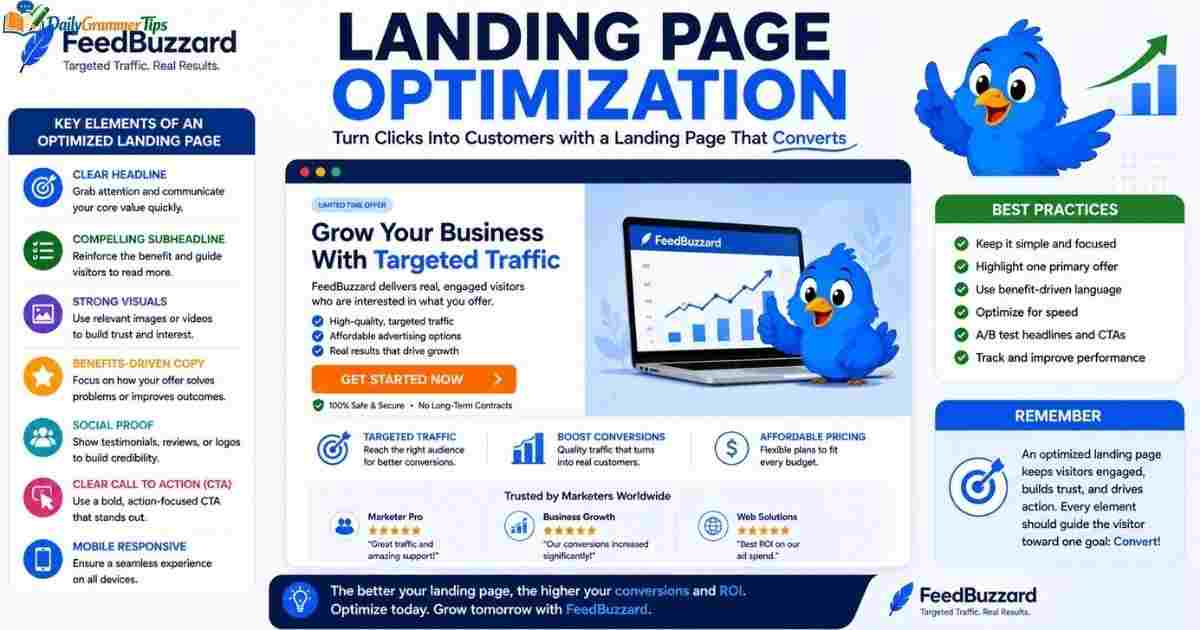
A strong advertisement cannot compensate for a poor landing page. When users click an ad, they expect the destination to match the promise made in the creative.
Keep the headline consistent with the advertisement, explain the value clearly, reduce unnecessary distractions, and make the desired action obvious. Forms should request only information that is genuinely necessary.
For mobile traffic, test buttons, forms, page speed, images, menus, and checkout steps on smaller screens.
Landing page quality can strongly influence conversion optimization because the visitor experience continues after the advertisement ends.
Conversion Tracking
Conversion tracking connects advertising activity with business outcomes. Without it, an advertiser may know how many impressions and clicks occurred but remain uncertain about actual revenue or leads.
Use appropriate tracking pixels, conversion events, analytics tools, unique campaign parameters, or server side tracking where supported. The tracking method should record the actions that matter to the business.
Useful conversion events can include:
- Form submission
- Account registration
- Purchase
- App installation
- Trial activation
- Subscription
- Phone inquiry
- Download
- Qualified lead
Reliable measurement is essential for performance tracking and campaign optimization.
Advertising Metrics You Should Monitor
The most important advertising metrics depend on the campaign objective. A traffic campaign and a sales campaign should not use the same success criteria.
Key metrics include:
- Impressions
- Clicks
- CTR
- CPC
- Conversions
- Conversion rate
- CPA
- ROAS
- Ad spend
- Audience reach
- Engagement
- Revenue
Impressions
Impressions show how often an advertisement was displayed. High impressions indicate delivery, not necessarily success.
Clicks and CTR
Clicks measure interaction with the advertisement. The click-through rate compares clicks with impressions.
CTR can help evaluate creative relevance, but a high CTR with poor conversions may indicate that the advertisement attracts curiosity rather than qualified buyers.
Conversion Rate
The conversion rate measures the percentage of visitors who complete the desired action. It is especially important for lead generation and sales campaigns.
Cost Per Click
Cost per click tells you how much you pay for each click. Compare it with conversion rate to understand the real acquisition economics.
Cost Per Acquisition
Cost per acquisition connects advertising spend with completed customer actions. It is often more meaningful than CPC when the ultimate goal is sales or leads.
Return on Ad Spend
Return on ad spend compares revenue generated with advertising expenditure. A campaign that produces substantial revenue can still be weak if the cost of generating that revenue is too high.
Campaign Performance and Ad Performance
Campaign performance should be evaluated at several levels. Look at the entire campaign, then break results down by creative, audience, geography, device, placement, and other available dimensions.
Ad performance can reveal which messages attract qualified users. A headline that generates many clicks may not be the best performer if another version produces more customers.
This distinction helps advertisers avoid optimizing only for superficial metrics.
Campaign Optimization
Campaign optimization is the process of using performance data to improve delivery and economics. Start with the largest sources of waste.
If one audience produces expensive conversions, reduce its budget. If one creative receives strong engagement but weak conversions, review the landing page and message alignment. If one device produces profitable customers, consider increasing its allocation.
Good campaign optimization is continuous rather than a one time activity.
A/B Testing and Creative Testing
A/B testing allows advertisers to compare controlled variations. You can test headlines, images, calls to action, offers, landing pages, or audience groups.
Creative testing should focus on meaningful differences. For example, test a benefit focused headline against a problem focused headline rather than changing punctuation.
Strong ad creatives usually communicate three things quickly: what the product is, why the user should care, and what action should happen next.
A clear call to action can be as simple as “Learn More,” “Start Free Trial,” “Download Now,” or “Get a Quote,” depending on the offer.
FeedBuzzard Advertising Strategy
A practical Feedbuzzard advertising strategy combines audience relevance, controlled spending, strong creative, and measurable outcomes. The strategy should start with a small test instead of a large commitment.
During the first phase, collect data on traffic quality, audience response, conversion behavior, and costs. During the second phase, remove weak combinations and increase investment in promising segments. During the third phase, expand carefully into new audiences or formats.
This approach treats advertising as a learning process rather than a one time purchase.
FeedBuzzard and Digital Advertising
FeedBuzzard sits within a wider digital advertising environment where advertisers have many options. Search advertising captures active demand, social advertising uses large audience datasets, display advertising emphasizes reach, and native advertising blends promotion with content discovery.
The best choice depends on the customer journey. Someone searching for “best accounting software” may have stronger purchase intent than someone casually reading a technology article.
For that reason, online advertising should usually use more than one channel when the budget and business model support diversification.
Native Advertising vs Display Advertising
Native advertising usually emphasizes contextual integration and content discovery. Display advertising generally relies on visual units such as banners.
Native placements can work well for products that require explanation. Display can work well when brand recognition, visual impact, or repeated exposure is important.
Neither format is automatically superior. The correct choice depends on audience behavior, campaign objectives, creative strength, and economics.
Video Advertising
Video advertising can combine sound, motion, text, demonstrations, and storytelling. It is particularly helpful when a product is easier to understand visually.
However, production quality should match the campaign budget. A simple, clear demonstration can outperform an expensive video that takes too long to explain the value proposition.
Content Promotion and Sponsored Posts

Content promotion can extend the reach of educational material, product guides, research, or useful resources. Sponsored posts can support awareness while giving users more information than a standard banner.
The content should provide genuine value. Promotional content that reads like an aggressive sales pitch may generate lower trust.
Sponsored articles should clearly communicate the relationship between the advertiser and publisher while keeping the information useful and relevant.
Mobile Advertising and Desktop Advertising
Learn More……..Borrow vs Barrow: Essential Meaning, Spelling, and Usage Explained
Mobile advertising requires careful attention to screen size, page speed, touch controls, and short attention spans. Buttons should be easy to tap, while forms should remain simple.
Desktop advertising provides more screen space, which can support larger creative layouts and more detailed landing pages.
Compare mobile and desktop results separately. A campaign can appear successful overall while hiding a major performance difference between devices.
Publishers and Advertising Inventory
For publishers, advertising creates an opportunity to monetize audience attention. For an advertiser, the same inventory represents a chance to reach potential customers.
Advertising inventory can include feed positions, article placements, banners, videos, sponsored content, newsletters, or other promotional spaces. Availability depends on the publisher’s current commercial offering.
Advertisers should ask how inventory is distributed and whether placements are exclusive, rotating, guaranteed, or auction based.
How to Measure Campaign Performance
To measure campaign performance, connect advertising data with website analytics and conversion information. Impressions and clicks explain what happened before the visitor arrived. Conversion and revenue data explain what happened afterward.
Create a simple reporting framework:
| Area | What to measure |
| Reach | Impressions and audience reach |
| Engagement | Clicks and CTR |
| Traffic cost | CPC and CPM |
| Lead generation | Leads and conversion rate |
| Sales | Purchases and revenue |
| Efficiency | CPA and ROAS |
| Quality | Engagement and downstream behavior |
A useful campaign reporting system should make these numbers easy to compare over time.
Advertising Dashboard and Campaign Analytics
An advertising dashboard can bring campaign metrics together in one place. If the platform does not provide enough reporting, use your own analytics system to fill the gaps.
Campaign analytics should answer practical questions rather than simply display numbers. Which audience converts? Which creative produces qualified traffic? Which device performs best? Which market has the lowest acquisition cost?
The purpose of analytics is decision making.
Campaign Monitoring
Campaign monitoring is especially important immediately after launch. Check whether ads are approved, impressions are arriving, clicks are being recorded, landing pages work correctly, and conversions are firing.
Once the campaign stabilizes, daily checks may be enough for smaller campaigns, while larger budgets may require more frequent monitoring.
Do not optimize based only on CTR. A campaign can have an impressive CTR while producing poor commercial results.
How to Optimize Ad Campaigns

To optimize ad campaigns, follow a structured process.
First, confirm measurement. Second, identify weak areas. Third, make one or two meaningful changes. Fourth, allow enough time for new data. Fifth, compare results against the previous version.
Avoid changing everything simultaneously. Controlled optimization makes it easier to identify what actually improved the campaign.
Advertising ROI and Performance Marketing
Advertising ROI matters because visibility has little value if the campaign cannot support the business model. Performance marketing focuses strongly on measurable actions such as leads, sales, registrations, or installs.
A useful formula is:
ROAS = Revenue attributed to advertising ÷ Advertising spend
For example, $2,000 in tracked revenue from $500 in ad spend produces a 4x ROAS. That calculation does not automatically mean the campaign is profitable because product margins, operating costs, refunds, and other expenses also matter.
FeedBuzzard Advertising: Pros and Cons
Before you Advertise FeedBuzzard, consider both potential benefits and limitations.
Potential advantages
- Access to a technology oriented content environment
- Opportunity for contextual promotion
- Multiple possible creative formats
- Potential for sponsored content
- Ability to test a smaller advertising channel
- Useful environment for digital products
- Opportunity to compare audience segments
Potential limitations
- Public pricing information may be limited
- Available inventory can change
- Audience data may not be as extensive as major ad networks
- Reporting capabilities should be confirmed
- Traffic quality must be evaluated through tracking
- Not every business will have strong audience fit
The best decision comes from evidence rather than assumptions.
Is FeedBuzzard Worth Advertising On?
Whether FeedBuzzard is worth using depends on the economics of your campaign. A business should compare audience relevance, placement quality, pricing, conversion behavior, and reporting against alternative channels.
If the audience closely matches your customer profile and a small test produces profitable conversions, scaling may make sense. If traffic generates clicks but no meaningful business outcomes, increasing the budget will not solve the underlying problem.
Start with a controlled experiment, define a maximum acceptable acquisition cost, and stop or adjust the campaign when the evidence does not support continued spending.
Feedbuzzard App
Search interest around the Feedbuzzard app can create confusion because users may interpret the term as a dedicated advertising application. Before building an advertising strategy around an app, verify what product or service the term actually refers to.
For marketers, the important question is not the name of the interface but whether the available advertising tools provide useful inventory, targeting, tracking, and reporting.
Feedbuzzard Review
A Feedbuzzard review should evaluate more than design or general impressions. Advertisers need evidence about audience quality, placement, pricing, traffic sources, conversion behavior, and support.
Independent reviews can provide ideas for questions to ask, but they should not replace campaign level measurement. Your own tracked results are more valuable than a generic performance claim.
TurboGeek
TurboGeek appears in related search interest around technology and digital publishing topics. If a marketer encounters the name while researching advertising opportunities, it should be evaluated separately from FeedBuzzard.
Never assume that similar technology focused websites share the same audience, pricing, inventory, or advertising policies.
Embedtree
Embedtree is another name that may appear in related searches. Advertisers should distinguish between a search related entity and a confirmed advertising product.
A useful comparison should always examine actual audience fit, placement, cost structure, targeting, and conversion performance rather than relying on keyword association.
Programgeeks
Programgeeks can also appear in technology related search results. When researching publishers, make a clear list of candidate websites and compare them using the same evaluation criteria.
This prevents one familiar name from receiving an unfair advantage simply because it appears more frequently in search results.
ThinkofGames
ThinkofGames represents a more specialized type of content interest when compared with a broader technology publication. An advertiser should ask whether the audience matches the product before considering any placement.
A gaming product may find stronger relevance in a gaming environment, while business software may require a different audience.
Gamearchives
Gamearchives is another example of why niche relevance matters. A website can have visitors without necessarily having the right visitors for your offer.
Advertising success depends on qualified attention, not only total traffic.
Revolvertech
Revolvertech may also appear during research for technology publishing and advertising opportunities. Treat each publisher as a separate media property and request current information before allocating budget.
The same evaluation framework applies: audience, inventory, placement, pricing, targeting, tracking, and results.
Common Mistakes When You Advertise FeedBuzzard
One common mistake is focusing on impressions instead of outcomes. Thousands of impressions do not automatically produce customers.
Another mistake is launching without conversion tracking. Without tracking, you cannot confidently connect advertising spend with leads or sales.
A third mistake is using one creative indefinitely. User behavior changes, and audiences can develop creative fatigue.
Other common errors include:
- Spending the entire budget immediately
- Using an irrelevant landing page
- Targeting too broadly
- Targeting too narrowly
- Ignoring mobile performance
- Measuring clicks without conversions
- Changing too many variables at once
- Trusting unverified pricing claims
- Failing to define a stopping point
Avoiding these problems can improve advertising effectiveness without requiring a larger budget.
A Practical FeedBuzzard Campaign Checklist
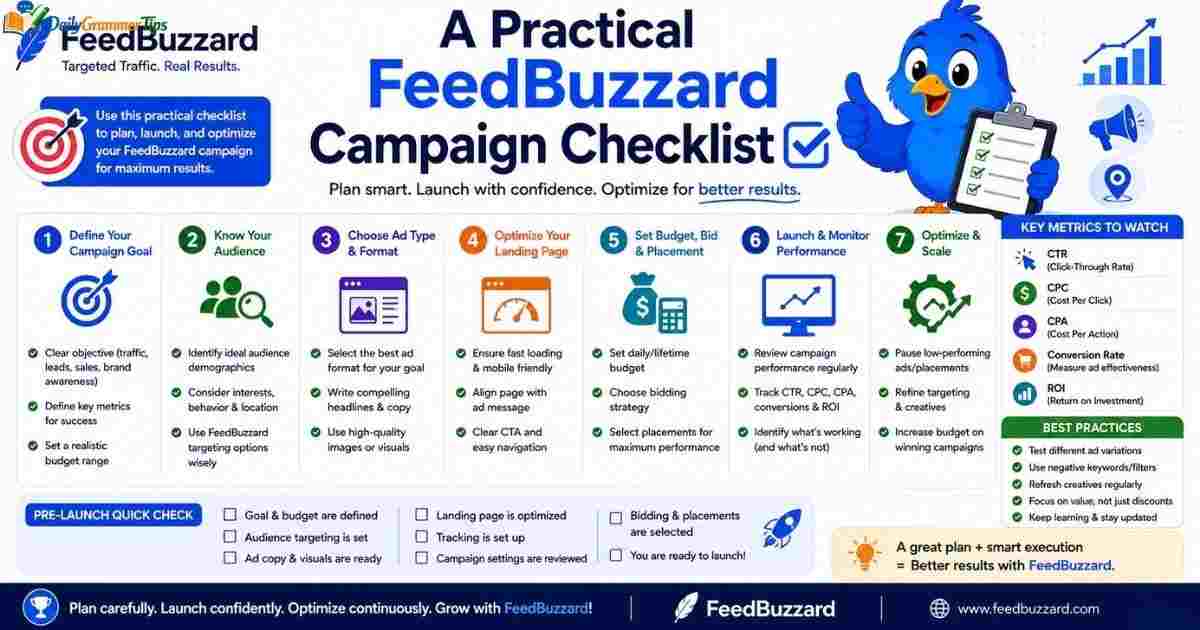
Before you Advertise FeedBuzzard, use this checklist:
- Define one primary objective.
- Identify your most valuable target audience.
- Confirm current advertising options.
- Request current pricing.
- Confirm available targeting.
- Select the most relevant ad format.
- Prepare several ad creatives.
- Build a relevant landing page.
- Configure conversion tracking.
- Set a controlled campaign budget.
- Define acceptable CPC and CPA limits.
- Launch a small test.
- Monitor impressions and clicks.
- Compare conversion rates.
- Pause weak combinations.
- Test new creatives.
- Reallocate budget toward winners.
- Calculate ROAS and overall profitability.
- Scale gradually.
- Review campaign results before the next launch.
This process makes FeedBuzzard part of a measurable advertising strategy rather than an untested expense.
Frequently Asked Questions
Is FeedBuzzard suitable for small businesses?
FeedBuzzard can be considered by small businesses that have a clear audience fit and a controlled test budget. Start with measurable objectives before committing to a larger campaign.
How much does FeedBuzzard advertising cost?
Exact Feedbuzzard advertising costs can vary by format, placement, audience, and commercial agreement. Request current pricing before setting your campaign budget.
Which FeedBuzzard ad format should I choose?
Choose the format according to your objective. Native ads and sponsored content suit education, while banners and video can support awareness and product promotion.
How can I measure FeedBuzzard campaign results?
Use conversion tracking with impressions, clicks, CTR, CPC, conversions, CPA, conversion rate, and ROAS. Compare these numbers against your business goals.
Conclusion
If you plan to Advertise FeedBuzzard, approach the opportunity like any other paid media experiment. Confirm what inventory exists, request current Feedbuzzard advertising costs, understand the pricing model, define the target audience, prepare relevant creative, and install reliable tracking before spending heavily. Public descriptions of the platform can differ, so current commercial terms should always take priority over assumptions or old third party claims.
The strongest FeedBuzzard strategy is not necessarily the one with the largest budget. It is the one that connects the right audience with the right message, sends visitors to a relevant landing page, tracks meaningful conversions, and uses campaign data to improve results. Start small, test systematically, measure campaign performance, and increase ad spend only when the numbers support the decision.
