

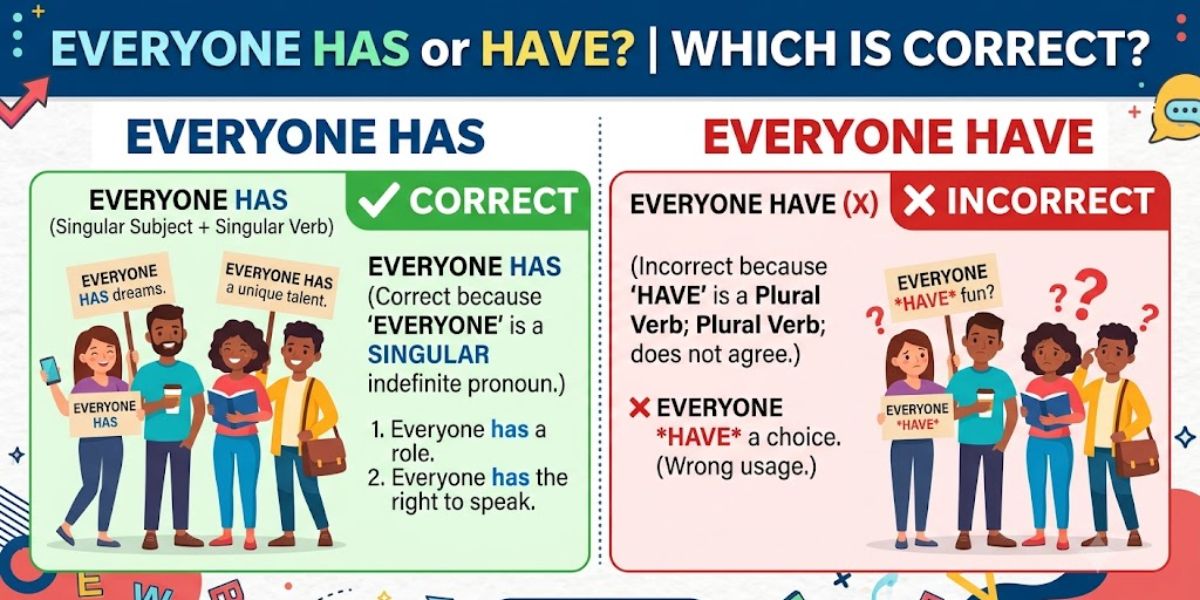
You’ve typed the sentence, paused, and stared at it: does it say “everyone has” or “everyone have”? It’s one of those small grammar moments that trips up native speakers and English learners alike, mostly because “everyone” sounds like it’s talking about a whole room full of people. But English doesn’t grade this one on how many people you mean it grades it on a grammatical number, and that’s exactly where everyone has or has confusion starts.
This guide breaks down the rule in plain terms, walks through real sentence examples, and clears up why words like everybody, someone, and anyone all follow the same subject-verb agreement pattern. By the end, you won’t just know the correct grammar, you’ll understand the logic behind it well enough to never second-guess has vs have again.
Why “Everyone” Acts Singular (Even Though It Sounds Like a Crowd)
This is where most people trip up. “Everyone” feels plural because it’s talking about a whole group of people. But grammatically, it’s built to mean “every one” as in, each person considered on their own, one at a time. That’s the whole trick behind the confusion: the word is describing a group, but the grammar treats it like a single unit, similar to “he” or “she.”
So when you’re deciding between everyone has vs everyone have, remember that “everyone” is a singular in
definite pronoun, and singular indefinite pronouns take singular verbs. That’s the rule, and it doesn’t bend based on context or how many people you’re actually referring to.
The same logic applies to a whole family of similar words. This isn’t a one-off exception; it’s a consistent verb agreement rule that governs an entire category of pronouns.
The Rule in Plain English
Whenever you’re facing everyone as your only two options, he wins. Use has (never have) with:
- Everyone
- Everybody
- Someone
- Somebody
- Anyone
- Anybody
- No one
- Nobody
These are all singular indefinite pronouns, which is just a grammar term for words that refer to an unspecified person or people but are treated as one grammatical unit.
Real Examples
Correct:
- Everyone has their own opinion.
- Everyone has to turn in the form by Friday.
- Everyone has been invited to the meeting.
- Everyone has a part to play.
Incorrect:
- Everyone has their own opinion.
- Everyone has to turn in the form by Friday.
Notice the pattern? In every one of these, he is doing the work, because everyone is functioning as a singular subject, exactly like it would if you swapped in “he” or “she.”
Has or Have How to Tell Them Apart With Other Pronouns

A helpful shortcut when you’re second-guessing has vs have: check whether your subject is one of the singular indefinite pronouns above, or an actual plural noun.
Reach for HAS when your subject is:
- Everyone has
- Everybody has
- Someone has
- Somebody has
- Anyone has
- Anybody has
- No one has
- Nobody has
Reach for HAVE when your subject is:
- They have
- We have
- All people have
- Many people have
- Most students have
Once you see the two lists side by side, when to use has and when to use have stops being a guessing game. It’s really just asking, “is my subject grammatically singular or grammatically plural?”
Everyone vs. All People: Same Meaning, Different Grammar
Here’s a comparison that trips a lot of writers up: “everyone” and “all people” mean nearly the same thing, but they don’t take the same verb.
- Everyone has finished. (singular verb, because everyone is grammatically singular)
- All people have finished. (plural verb, because “all people” is a genuinely plural noun phrase)
This is the clearest way to see the everyone vs all people distinction in action. The meaning barely shifts, but the subject-verb agreement flips completely because the grammatical number of the subject changes.
What About “Everyone Is or Are”?
The same singular logic shows up with “to be,” too it’s everyone is, not everyone are, for exactly the same reason: everyone is grammatically singular, full stop.
The Same Rule Applies to Everyone’s Cousins
Since these pronouns all follow identical logic, the has/have question comes up just as often with:
- Everybody has or have same answer, has
- Someone has or have same answer, has
- Somebody has or have same answer, has
- Anyone has or have same answer, has
- Anybody has or have same answer, has
- No one has or have same answer, has
- Nobody has or have same answer, has
If you’ve internalized why everyone has or has worked the way it does, you’ve basically solved this entire category of grammar questions in one go.
Everyone Has or Have Meaning

When people search for the meaning behind what everyone has or have, they’re usually trying to understand why one form sounds right and the other doesn’t. The answer comes down to how English treats individual vs group subjects. “Everyone” looks like it’s talking about a whole crowd, but grammatically it functions as a stand-in for “every single one” person, considered separately rather than as a collective noun. That’s why the correct grammar always points to has.
This distinction matters more than it seems for anyone trying to sound polished in writing or speech. Treating people as individuals rather than as a group is the whole logic behind proper English usage here, and once that clicks, the has vs have question stops being confusing. It’s one of those common grammar mistakes that disappears the moment you understand the reasoning instead of just memorizing the rule.
Everyone Has or Have Synonym
There’s no single-word synonym that replaces “everyone has or have” directly, but there are related phrases that follow the exact same English grammar rules. “Everybody has,” “each person has,” and “every individual has” all carry a similar meaning and all demand the same singular verb, because each one treats the subject as one unit rather than many. If you’re building out sentence examples for a lesson or a grammar checker tool, these synonyms are useful stand-ins that reinforce the same pattern.
What ties them together is the individual vs group framing. Swap “everyone” for “each person” in any sentence and the logic holds perfectly, which is a handy trick for ESL grammar learners who want a quick way to double-check their instinct. If the substitute phrase sounds natural with has, the original almost certainly needs has too.
Everyone Has or Have Done Their Homework

This is one of the most common real-world versions of the question everyone has or has question, especially in classrooms and ESL grammar practice. The correct sentence is “Everyone has done their homework,” because “everyone” stays grammatically singular no matter what verb phrase follows it, whether that’s a simple present tense or a present perfect construction like “has done.”
Teachers often use this exact sentence example because it shows students that the rule doesn’t change with more complex grammar. Some learners assume that adding “done” or extending the sentence shifts the verb toward have, but it doesn’t. The subject is still one grammatically singular pronoun, so has stays locked in as the correct grammar choice from start to finish.
Everybody Has or Have Sentences
“Everybody” follows the identical pattern as “everyone,” and mixing them up is one of the more common grammar mistakes among English learners. Since everybody has or has both point back to the same singular indefinite pronoun family, the correct answer is always has. Sentence examples like “Everybody has a favorite subject” or “Everybody has to wait their turn” show the rule holding steady across different contexts.
Building a small bank of sentence examples is one of the best ways to lock this in for grammar practice. Once you’ve written or read enough of them, the ear starts to catch “everybody have” as wrong before the brain even explains why, which is exactly the instinct a good grammar checker is trying to help you develop.
Read More : 60+ Strong Adjectives That Replace ‘Very’ and Sharpen Your Writing
Everyone Has or Have Grammar
From a pure English grammar rules standpoint, this comes down to subject-verb agreement, one of the foundational pieces of proper English usage. “Everyone” is classified as a singular indefinite pronoun, meaning it refers to an unspecified person but is treated grammatically as one unit, similar to “he,” “she,” or “it.” That classification is what forces the verb into its singular form, has, rather than the plural have.
This is a useful example for anyone studying English grammar rules more broadly, because it shows how grammatical number doesn’t always match real-world meaning. “Everyone” refers to many people in real life, yet it behaves like a single subject on paper. Recognizing that gap is often the turning point where correct grammar starts to feel intuitive instead of arbitrary.
Everyone Has or Have in a Sentence
Seeing the rule in a sentence example makes it far easier to apply than reading the rule in isolation. “Everyone has arrived,” “everyone has to submit their work,” and “everyone has an opinion” all follow the same structure: a singular subject paired with a singular verb, regardless of what comes after it in the sentence.
For ESL grammar learners building confidence, practicing full sentences rather than isolated words tends to work better. Reading or writing several sentence examples back to back trains the ear to expect something after everyone, which turns proper English usage into a habit rather than a rule you have to consciously recall every time you write.
Everyone Has or Have Their Own Opinion
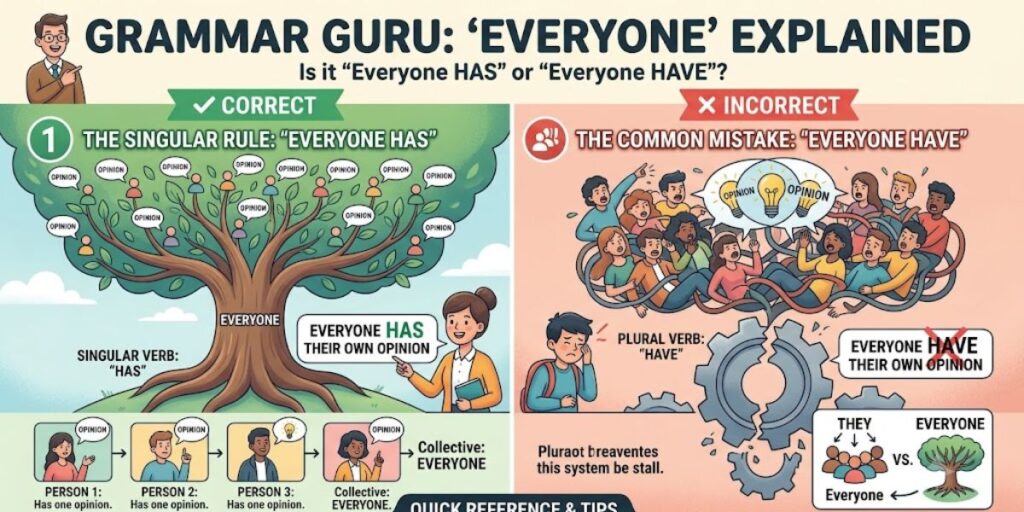
This phrase is one of the most commonly searched versions of the rule, likely because it shows up constantly in everyday conversation and writing. “Everyone has their own opinion” is correct grammar, and it’s a good example of how the singular verb rule holds even when the rest of the sentence includes plural-sounding words like “their.”
That word “their” trips a lot of people up, since it often functions as a gender-neutral singular pronoun in modern English. But it doesn’t change the subject-verb agreement at the start of the sentence. Everyone still governs the verb, so it remains correct no matter how the rest of the sentence is phrased.
Not Everyone Has or Have
Adding “not” in front of the sentence doesn’t change any of the underlying English grammar rules, which is something a lot of learners don’t expect. “Not everyone has finished” is correct, while “not everyone has finished” is not, because negation doesn’t affect subject-verb agreement. The subject is still the same singular indefinite pronoun, so the verb still has to match it.
This version of the sentence is worth extra grammar practice because negative sentences sometimes feel like they follow different logic than positive ones. They don’t. Whether you’re affirming or denying something, “everyone” stays grammatically singular, and has is the correct grammar choice in both directions.
Frequently Asked Questions
Which is correct, good morning everyone or everybody?
Both work and mean the same thing. “Good morning everyone” and “good morning everybody” are simply informal vs slightly more casual choices, not a grammar difference.
Can “everyone” be used in both ways?
Yes, “everyone” and “everybody” are interchangeable in almost every context, though “everyone” tends to sound a touch more formal in writing.
Is it correct to say everyone is?
Yes, “everyone is” is correct because “everyone” stays grammatically singular, just like it does with has instead of have.
Is everyone singular or plural?
“Everyone” is grammatically singular, even though it refers to a group of people, so it always pairs with singular verbs.
Where is everyone correct?
“Where is everyone?” is correct because the singular verb “is” matches the singular pronoun “everyone,” the same rule that applies throughout this whole family of words.
Conclusion
At the end of the day, everyone has or has debate comes down to one simple idea: “everyone” acts as a single grammatical unit, even though it points to a whole group of people. Once that clicks, the rest falls into place naturally. Has is the correct choice every time, whether you’re writing a casual text, a school assignment, or a professional email, and the same logic carries over cleanly to everybody, someone, anyone, and the rest of that pronoun family.
Grammar rules like this tend to stick best when you see them in action rather than just memorize them, so keep an eye out for “everyone” in your own writing and double-check that he is doing the work. With a little practice, choosing between has and have won’t feel like a decision at all; it’ll just be second nature.
