


Every writer has paused over laid out vs. layed out at some point, unsure which spelling belongs on the page. The confusion makes sense since lay is an irregular verb, and English rarely applies its rules evenly. Once you see where the mix-up starts, the correct choice becomes easy to remember.
This guide covers the correct spelling, the grammar rule behind it, and how the phrase shows up in everyday writing, from a floor plan an architect arranged to someone left exhausted by illness. By the end, you will know exactly why laid out is correct and layed out never earned a place in standard English.
Laid Out vs Layed Out Examples
Seeing the correct form in real sentences makes the rule stick faster than any explanation on its own. In business writing, academic writing, and legal writing, laid out shows up whenever something is arranged, planned, or presented clearly, such as when a manager laid out a project schedule or a lawyer laid out the facts of a case. In graphic design and publishing work, you will also see it describe a floor plan, a website homepage, or a magazine layout that a team structured before launch.
Layed out never belongs in any of these sentences, no matter how casual the writing gets. Whether you are describing a brochure design a studio organized, a report that explained a company’s finances, or a schedule someone spent hours building, the correct spelling is always laid out. Once you compare a few side by side examples like these, the difference between laid out vs layed out stops feeling confusing and starts feeling automatic.
Read More: Everyone Has or Have? Which Is Correct? | TypoGrammar
Breaking Down the Verb: Lay, Lays, Laid, Laying

Understanding the full verb conjugation makes the laid-out-versus-layed-out question disappear almost instantly.
| Form | Word | Example |
| Base form | lay | Lay the folder on the desk. |
| Present tense | lays | She lays the folder on the desk. |
| Past tense | laid | She laid the folder on the desk. |
| Past participle | laid | She has laid the folder on the desk. |
| Present participle | laying | She is laying the folder on the desk. |
Notice that “layed” never shows up anywhere in that chart. So when you’re deciding between lay out, lay out, laid out, or laying out, the tense you need determines the form, never the -ed pattern.
- Lay out present, future, or a command (“Lay out the tools before you start.”)
- Lays out present tense with a singular subject (“He lays out his notes every morning.”)
- Laid out simple past (“They laid out the schedule last week.”)
- Has laid out present perfect (“She has laid out the entire plan.”)
- Will lay out future (“We will lay out the details tomorrow.”)
- Laying out an action currently in progress (“I’m laying out the slides right now.”)
Because lay is a transitive verb meaning it needs a direct object to complete its meaning you’ll almost always see something being laid out: papers, plans, tools, ideas.
What Does “Laid Out” Actually Mean?
The phrase shifts meaning slightly depending on context, which is part of why it shows up across so many types of writing, from casual conversation to formal business writing.
Something Was Physically Arranged or Spread Out
This is the most literal sense of objects placed in a visible, organized way.
- She laid out her clothes the night before the interview.
- The chef laid out every ingredient before starting the recipe.
- He laid out the tools across the workbench.
Something Was Planned or Structured
In design and architecture especially, “laid out” describes how something was organized or built.
- The architect laid out the floor plan around a central courtyard.
- The team laid out a full project schedule before the sprint began.
- The designer laid out the website homepage with the navigation up top.
This is where terms like floor plan, project schedule, website homepage, magazine layout, and brochure design naturally fit; they’re all things that get laid out, not layed out.
Something Was Explained Clearly
When ideas, facts, or steps are presented in order, “laid out” fits just as well as “explained” or “outlined.”
- The report laid out the biggest risks facing the company.
- The lawyer laid out the facts of the case point by point.
- The manager laid out next steps for the whole team.
This usage shows up often in academic writing, legal writing, and business writing, where clarity and structure matter.
Money Was Spent
Less common today, but still alive in informal English: “laid out” can mean money was paid or spent.
- They laid out nearly $2,000 for the repairs.
- She laid out a large sum just to get the equipment running.
In more formal contexts, you might swap this for spent, paid, or invested all synonyms that fit the same idea without sounding dated.
Someone Was Exhausted, Sick, or Knocked Out
In casual speech, “laid out” can describe being incapacitated by illness, exhaustion, or even a physical blow.
- The flu laid her out for nearly a week.
- One hit laid the fighter out cold.
This meaning stays firmly in informal English. In medical or professional writing, you’d reach for something more precise, like unable to work or knocked unconscious.
Laid Out vs. Layout: Two Different Jobs
Here’s another mix-up worth clearing up while we’re at it: laid out and layout are not interchangeable, even though they look related.
- Laid out is a verb phrase that describes an action that happened.
- Layout is a noun it names the finished design or arrangement.
Compare:
- The designer laid out the brochure. (action verb phrase)
- The brochure layout looks clean and professional. (the result noun)
A quick test: swap the phrase for “arranged.” If it still makes sense, you want laid out. If you’re describing the design itself rather than the act of arranging it, you want layout.
Lay vs. Lie: The Confusion That Started It All
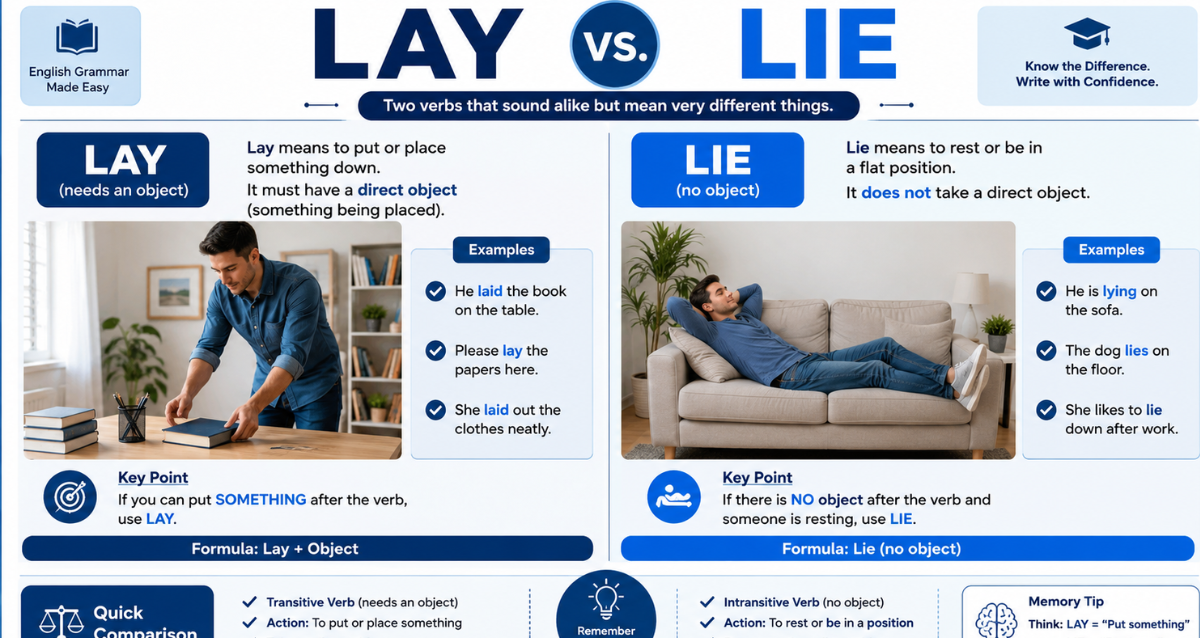
Part of why “layed” feels tempting is that lay gets tangled up with its close cousin, lie a completely different verb with its own past tense and past participle.
| Verb | Present | Past | Past Participle |
| lay | lay | laid | laid |
| lie | lie | lay | lain |
Lay takes a direct object you lay something down. Lie, don’t simply lie down yourself.
- I lay the book on the table every evening. (lay + object)
- I lie down after lunch. (no object)
- I lay down after lunch yesterday. (past tense of “lie” confusingly, it’s “lay”)
- I have lain down for an hour. (past participle of “lie”)
That overlap between “lay” as the past tense of lie and “lay” as the present tense of lay is genuinely confusing and it’s a big reason writers second-guess themselves and end up inventing “layed” as a workaround. It isn’t one.
Why “Layed Out” Keeps Showing Up
A few things keep this misspelling alive:
Regular verb habits. English is full of verbs that add -ed for the past tense play/played, stay/stayed, clean/cleaned. It’s natural to assume lay follows suit. It doesn’t.
Identical sound. Spoken aloud, “laid” and the incorrect “layed” sound exactly the same, so your ear gives you zero clues about the correct spelling.
Repetition online. Because “layed out” shows up so often in social posts, comments, and casual messages, it starts to look normal even though frequency online has nothing to do with whether something is actually standard English.
A Simple Trick to Lock It In
Pair lay with pay. Both verbs follow the exact same irregular pattern:
- pay → paid
- lay → laid
Try this sentence to cement it: “I paid for the table and laid out the dishes.” Both past-tense forms end in -aid. If you remember that one pairing, you’ll never second-guess laid out vs. layed out again.
Laid Out vs. Layed Out in Everyday Writing
Here’s the correct form used across a few different settings:
Daily life
- I laid out my clothes for tomorrow.
- She laid out the dishes before dinner.
Work and school
- The teacher laid out the assignment requirements.
- The consultant laid out three possible solutions.
- The report laid out the main findings clearly.
Design and layout work
- The editor laid out the newsletter.
- The architect laid out the rooms around a shared courtyard.
Informal health context
- The flu laid me out for several days.
Laid Out Synonym

Because laid out carries several meanings, its closest synonyms shift depending on what exactly happened in the sentence. When something was arranged, spread out, organized, or structured, words like positioned, displayed, or set out work as natural substitutes. When laid out means something was planned or designed, such as a floor plan or a project schedule, synonyms like outlined, mapped, or structured capture the same idea in academic writing or medical writing.
When the phrase means something was explained or presented clearly, alternatives such as detailed, described, or spelled out fit comfortably in formal contexts. And when laid out refers to spending or being paid out, words like spent, allocated, or invested carry the same weight. Choosing the right laid out synonym depends entirely on context, but every option still assumes the base spelling is laid, never layed.
Laid Out vs Layed Out Grammar
From a pure grammar standpoint, this comparison comes down to one fact: lay is an irregular verb, so it refuses the standard past tense pattern that regular verbs follow. Its full verb conjugation runs through lay, lays, laid, and laying, with laid serving double duty as both the past tense and the past participle. This is exactly why laid out and will lay out are grammatically correct, while any version using layed is not part of standard English.
Grammar rules around irregular verbs often confuse English language learners because the pattern breaks the -ed rule that regular verbs rely on for correct spelling. Lay behaves like a transitive verb, always requiring an object, which is part of what separates it from lie in most verb tense charts. Once you treat lay out as a phrasal verb with its own irregular verb list entry, the grammar behind laid out vs layed out becomes far easier to apply correctly.
Laid Out vs Layed Out Past Tense
The past tense question has one clean answer: laid is correct, and layed is not a recognized past tense form in any dictionary. Since lay is irregular, its past tense skips the expected -ed ending that regular verbs use, landing on laid instead, the same way pay becomes paid rather than payed in most contexts. This single irregular verb rule explains every instance where laid out appears correctly in past tense sentences.
Writers usually stumble here because laid and the incorrect spelling played sound identical out loud, so pronunciation offers no clue about correct spelling. Whether you are writing about a team that laid out a floor plan, a designer who laid out a website homepage, or an illness that left someone exhausted and unable to continue, the past tense form stays the same. Locking in laid as the only valid past tense removes the guesswork the next time laid out vs layed out comes up in your writing.
Laid Out Meaning
At its core, laid out means something was arranged, spread out, or organized in a clear and visible way, whether that is physical objects on a table or ideas presented clearly in a report. In professional settings like architecture, publishing, and graphic design, laid out often means something was planned, designed, or structured, such as a brochure design a team laid out before printing.
Beyond the literal sense, laid out meaning stretches into informal territory as well, where it can describe money that was spent or paid out on something significant. It can also describe someone who became incapacitated, exhausted, or knocked out by illness, injury, or overwhelming fatigue, leaving them unable to continue their normal routine. Understanding these layers of laid out meaning helps you use the phrase accurately across both formal writing and casual conversation.
Laid Out or Layed Out in the Sun

When people describe relaxing outdoors, the correct choice remains laid out, even though laid out shows up constantly in casual online writing. Someone who spent an afternoon laid out in the sun was simply positioned or spread out on a towel or lounge chair, resting in a relaxed and organized way rather than doing anything active.
This casual, everyday use follows the exact same irregular verb rule as every formal example in this guide, since laid stays fixed as the past tense of lay regardless of context. So whether you are writing about a person who laid out on the beach for hours or a report that laid out quarterly numbers, the spelling never changes. Laid out or layed out in the sun is really just laid out vs layed out wearing a more relaxed outfit.
Laid Out in the Sun
Describing someone as laid out in the sun paints a picture of a person stretched out, spread out, and resting somewhere warm, usually without much movement or effort. It is a common, informal phrase in everyday English, distinct from the more structured, professional uses tied to a project schedule or a website homepage, yet it follows identical grammar rules.
The verb conjugation behind this phrase never bends for casual settings, so laid remains correct whether someone is describing a lazy weekend or a formal event. If exhaustion or heat eventually leaves that same person feeling drained or unable to continue, laid out can shift naturally from a relaxing image to a more literal one. Either way, the spelling stays anchored to laid, reinforcing why laid out vs layed out has only one correct answer no matter the setting.
Frequently Asked Questions
Is it laid out or layout?
It depends on the job the word is doing. Use layout for the noun, like a design, and laid out for the verb phrase describing an action.
Which is correct, layout or layout?
Both are correct, just for different purposes. Layout names a finished design, while lay out is the verb form meaning to arrange or plan something.
What does “laid out” mean?
It usually means something was arranged, planned, or explained clearly. It can also describe someone left exhausted or incapacitated by illness or exertion.
Is it laid or layed in bed?
It’s laid, not layed. Layed isn’t a real word in standard English, so laid is always the correct past tense of lay.
Do you say laid out or layed out?
You say laid out. Layed out is a common misspelling that never made it into standard English.
Conclusion
At the end of the day, laid out vs. layed out comes down to one simple rule: lay is an irregular verb, so laid is always correct, and played never earned a spot in standard English. Whether you’re describing a project schedule someone arranged, a brochure design, a team structure, or a person left exhausted after a long day, the spelling never changes.
Keep the pay to paid pairing in mind, and you’ll never second guess this one again. Once you internalize that laid out is the only valid form across formal writing and everyday conversation alike, the phrase stops being a stumbling block and becomes second nature.
