

Kindergarten or Kindergarden is a common spelling question because the two forms sound almost identical when spoken. Many parents, teachers, students, and language learners hesitate between them, especially because the English word “garden” makes Kindergarden look natural at first glance. However, only one spelling is standard in English. Kindergarten or Kindergarden is therefore not a choice between two accepted spellings, but a question about correct spelling, word origin, pronunciation, and usage.
The correct form is Kindergarten, with a t before the final part of the word. Kindergarten or Kindergarden can also raise questions about meaning, British and American English, preschool education, and the history of early childhood education. Understanding the German roots makes the spelling much easier to remember. Once you learn why the word contains “garten,” the Kindergarten or Kindergarden confusion becomes much simpler.
Kindergarten or Kindergarden Quick Answer
The answer to Kindergarten or Kindergarden is straightforward: Kindergarten is the correct spelling, while Kindergarden is a common misspelling. The standard English word keeps the spelling of its German source, which uses “Garten” rather than the English “garden.”
For Kindergarten or Kindergarden, remember that the correct word contains the letter t. You should write “kindergarten” in school documents, educational materials, applications, articles, emails, and everyday writing. “Kindergarden” may appear in searches because people make the same spelling mistake, but frequent use does not make it standard.
| Form | Correct | Explanation |
| Kindergarten | Yes | Standard English spelling |
| Kindergarden | No | Common spelling mistake |
| Kindergartener | Yes | A child who attends kindergarten |
| Kindergartner | Yes | Shorter accepted form |
| Kindergarten teacher | Yes | Standard educational expression |
| Kindergarten classroom | Yes | Common school related expression |
The main point about Kindergarten or Kindergarden is that “Kindergarten” is the spelling you should use. The second form replaces the German “garten” with the familiar English “garden,” which explains why the error feels so natural.
Kindergarten or kindergarden pronunciation
Pronunciation creates another reason for the Kindergarten or Kindergarden confusion. In English, the word is commonly pronounced something like “KIN der gar ten.” Depending on accent and speaking speed, the middle sounds may become less distinct.
The pronunciation of Kindergarten or Kindergarden can make the written difference difficult to notice. A listener may hear a sound that resembles a “d,” particularly in rapid speech. The spelling, however, remains “kindergarten.” Learning the written form alongside the pronunciation helps prevent the mistake.
The Origin of Kindergarten or Kindergarden
The history behind Kindergarten or Kindergarden explains the spelling more clearly than memorizing letters alone. The word comes from German and is associated with Friedrich Fröbel, an influential German educator who developed an early childhood educational approach in the nineteenth century.
Fröbel used the word “Kindergarten” for an educational setting designed around the development of young children. The German compound combines “Kinder,” meaning children, with “Garten,” meaning garden. The literal idea is therefore a “children’s garden.”
That German word formation is the key to Kindergarten or Kindergarden. English speakers already know the word “garden,” so “kindergarden” may seem logical. However, the borrowed word retained the German spelling “Garten.” The letter “t” is not an accidental part of the English word.
Kindergarten meaning
The meaning of Kindergarten or Kindergarden becomes easier when the German roots are understood. “Kinder” refers to children, while “Garten” means garden. The combined idea describes a place where children can grow, learn, explore, and develop under guidance.
In modern English, kindergarten generally refers to an early school year or educational program for young children. The exact age and organization vary between education systems. In many settings, kindergarten prepares children for more formal elementary school learning.
Kindergarten definition
A useful Kindergarten or Kindergarden definition is an educational program for young children that introduces foundational academic, social, emotional, and practical skills.Children may learn early reading, writing, counting, communication, classroom routines, cooperation, and problem solving.
The Kindergarten or Kindergarden distinction is strictly about spelling, not about two different educational programs. “Kindergarten” names the standard concept, while “kindergarden” is simply the incorrect written form.
Kindergarten in English
In English, Kindergarten or Kindergarden is usually discussed when someone wants to confirm the correct vocabulary used for early childhood education. The English language adopted the German term and kept its original spelling.
The use of Kindergarten or Kindergarden can differ slightly in meaning depending on the country. In the United States, kindergarten commonly refers to a school year before first grade. In other English speaking education systems, the term may be used differently or may overlap with preschool or nursery education.
British English vs American English Spelling
Many spelling questions exist because British and American English use different forms for certain words. That is not the situation with Kindergarten or Kindergarden. Both major varieties use kindergarten as the standard spelling.
For Kindergarten or Kindergarden, changing from British English to American English does not justify replacing the “t” with a “d.” The spelling remains the same in standard English, even though the educational system, age group, and use of the term can vary between countries.
| English variety | Standard spelling | Incorrect spelling |
| American English | Kindergarten | Kindergarden |
| British English | Kindergarten | Kindergarden |
| Canadian English | Kindergarten | Kindergarden |
| Australian English | Kindergarten | Kindergarden |
The important lesson from Kindergarten or Kindergarden is that the spelling difference is not regional. You should not treat “kindergarden” as a British version or an American alternative.
Kindergarten or preschool
The comparison between Kindergarten or Kindergarden and preschool involves meaning rather than spelling. Preschool usually describes education that comes before formal school, while kindergarten often represents a later stage of early childhood education.
The exact relationship between preschool and kindergarten depends on the local education system. A preschool program may focus strongly on social development, play, language, and school readiness, while kindergarten may introduce more structured academic learning.
Learn more……….Active vs Passive voice. Which One to Choose?
Which Spelling Should You Use?
When deciding between Kindergarten or Kindergarden, always choose “kindergarten” in standard English writing. The correct spelling is important in school enrollment, educational content, classroom materials, applications, professional communication, and online publishing.
The spelling of Kindergarten or Kindergarden should remain consistent even when the surrounding vocabulary changes. You can write “kindergarten teacher,” “kindergarten student,” “kindergarten classroom,” “kindergarten curriculum,” or “kindergarten program,” but the core word always retains the “t.”
Use “kindergarten” in situations such as:
- School enrollment documents
- Classroom instructions
- Educational websites
- Teacher communication
- Academic writing
- Parenting resources
- School announcements
- Learning materials
The choice in Kindergarten or Kindergarden is especially important for language learners because repeating the incorrect form can reinforce a spelling mistake. Seeing the standard form regularly helps develop spelling accuracy and stronger English vocabulary.
A Simple Trick to Remember the Correct Spelling
A useful way to remember Kindergarten or Kindergarden is to return to the German origin. The word contains “Kinder” plus “Garten.” Since the German word is “Garten,” the spelling needs the letter “t.”
Another memory method for Kindergarten or Kindergarden is to think of the phrase “children’s garden.” The garden part is not being translated into English inside the compound. The original German structure remains visible in the spelling.
Try breaking Kindergarten or Kindergarden into two parts:
Kinder + Garten = Kindergarten
The “t” belongs to “Garten,” so removing it creates the misspelling “kindergarden.”
A final trick for Kindergarten or Kindergarden is to connect the “t” with “teacher.” A kindergarten has a teacher, and both words can remind you to keep the “t” in kindergarten.
Common Mistakes with Kindergarten
The main mistake in Kindergarten or Kindergarden is replacing “garten” with the familiar English word “garden.” Because “garden” is common English vocabulary, writers may automatically spell the whole word as “kindergarden.”
Other forms can also cause confusion. Some people write “kindergardener” instead of “kindergartener,” or “kindergardners” instead of “kindergartners.” These forms usually come from the same misunderstanding about the original spelling.
| Incorrect form | Correct form | Reason |
| Kindergarden | Kindergarten | The German root is Garten |
| Kindergardener | Kindergartener | The base word is kindergarten |
| Kindergardner | Kindergartner | The shortened form keeps the t |
| Kindergarden teacher | Kindergarten teacher | The adjective uses the correct base |
| Kindergarden student | Kindergarten student | The school term remains unchanged |
The Kindergarten or Kindergarden issue also appears in searches, social media posts, informal messages, and school related discussions. A spelling error may look harmless, but using the standard form makes educational writing clearer and more professional.
This remains true whether you are writing about a kindergarten student, kindergarten teacher, kindergarten classroom, or kindergarten curriculum.
Kindergarten or Kindergarden in Everyday Examples
Seeing Kindergarten or Kindergarden in complete sentences can make the distinction easier to remember. The examples below show how the correct spelling works in everyday communication.
Correct examples include:
- My daughter starts kindergarten next year.
- The kindergarten teacher planned a creative activity.
- Our local kindergarten offers a play based learning program.
- The kindergarten classroom has books, puzzles, and art materials.
- Parents attended a kindergarten enrollment meeting.
- The student developed strong social skills in kindergarten.
- Kindergarten provides an important foundation for later learning.
- The school offers a full day kindergarten program.
Incorrect examples would include sentences such as “My daughter starts kindergarden next year” or “The kindergarden teacher planned a lesson.” The intended meaning is clear, but the spelling is not standard.
The Kindergarten or Kindergarden distinction matters in professional writing because school documents, educational websites, and learning resources benefit from consistent spelling.
Kindergarten – Google Trends & Usage Data
Online searches can make Kindergarten or Kindergarden seem more complicated than it really is. People frequently search the incorrect spelling precisely because they are uncertain about the correct form.
The presence of “kindergarden” in search queries does not mean that it has become an accepted spelling. Search engines often receive misspellings because users want confirmation, definitions, corrections, or explanations.
| Search expression | Typical purpose | Standard status |
| Kindergarten | Educational term | Correct |
| Kindergarden | Spelling check | Misspelling |
| Kindergarten spelling | Language question | Correct phrase |
| Kindergarten teacher | Education term | Correct |
| Kindergarten age | School information | Correct |
| Kindergarten classroom | Education term | Correct |
For Kindergarten or Kindergarden, search behavior is useful because it shows how common the confusion is. It does not change the dictionary spelling or the established form used in education.
Kindergarten or Kindergarden Answer
The short Kindergarten or Kindergarden answer is kindergarten. The spelling contains a “t” because the word comes from German “Kindergarten,” formed from “Kinder” and “Garten.”
If you only remember one point from Kindergarten or Kindergarden, remember “Kinder plus Garten.” That immediately explains why the word ends with “garten” rather than the English “garden.”
Kindergarten or Kindergarden in School Use

The meaning of Kindergarten or Kindergarden becomes more practical when you consider how the term appears in education. Kindergarten may be a child’s first year of formal school or an important transition between preschool education and elementary school.A kindergarten program can introduce basic literacy, numeracy, language development, classroom routines, cooperation, creativity, and independent learning habits.
Children may participate in songs, stories, drawing, games, reading activities, counting exercises, and group tasks.The Kindergarten or Kindergarden spelling also appears in terms such as kindergarten enrollment, kindergarten age, kindergarten curriculum, kindergarten lessons, and kindergarten activities. Each expression uses the same correct base word.
Kindergarten age
There is no single worldwide kindergarten age because education systems organize early schooling differently. Many children enter kindergarten around the ages of four, five, or six, depending on local rules and school policies.When discussing Kindergarten or Kindergarden, the age should therefore be treated as a country specific education question rather than a fixed definition.
Kindergarten classroom
A kindergarten classroom often provides an educational environment where children can develop academic and social skills together. Learning through play can support language development, cognitive skills, communication, cooperation, and confidence.
The Kindergarten or Kindergarden distinction remains unchanged regardless of classroom style. Whether children learn through structured lessons, creative activities, games, or guided exploration, the school term is spelled “kindergarten.”
Kindergarten student
A child attending kindergarten may be called a kindergarten student, kindergartener, or kindergartner. The preferred term can vary by region and writing style.
The word “kindergartner” is especially useful for writers who want a shorter noun. Remember that Kindergarten or Kindergarden concerns the spelling of the school term, while “kindergartner” describes the child who attends it.
Comparison Table – Keyword Variations
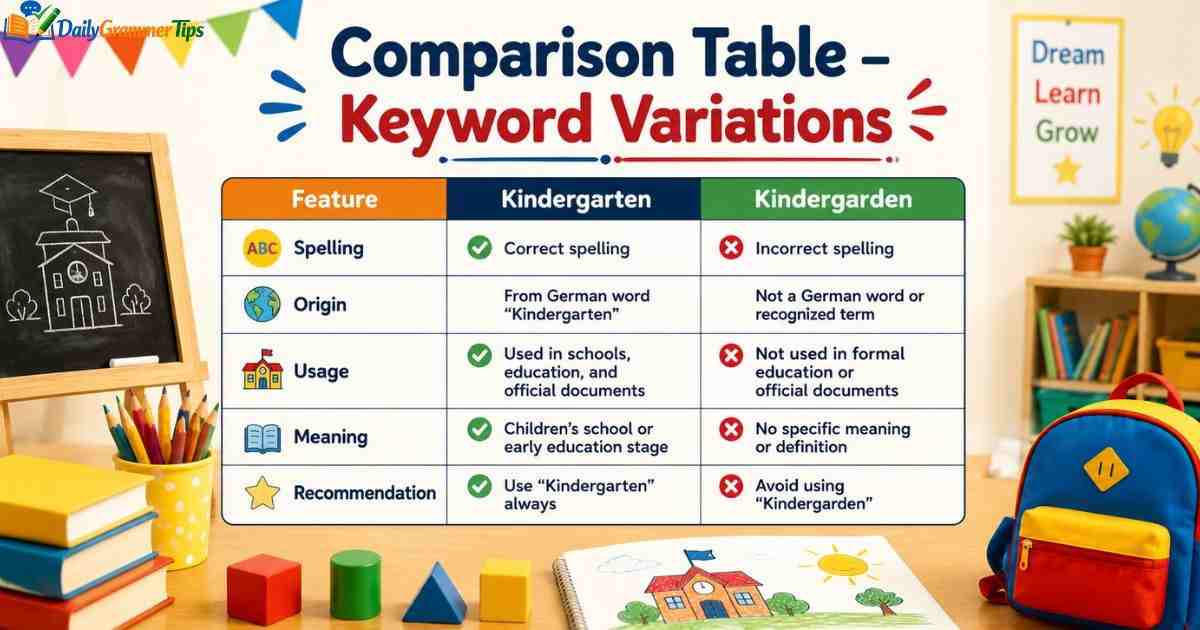
The following table makes Kindergarten or Kindergarden easier to distinguish from related terms and common search variations.
| Keyword or phrase | Correct? | Meaning or use |
| Kindergarten | Yes | Standard educational term |
| Kindergarden | No | Common misspelling |
| Kindergarten spelling | Yes | Search phrase about spelling |
| Kindergarden or kindergarten | Yes | Comparison search phrase |
| Kindergarten vs kindergarden | Yes | Spelling comparison |
| Kindergartener | Yes | Child attending kindergarten |
| Kindergartner | Yes | Shorter noun for a kindergarten child |
| Pre kindergarten | Yes | Education before kindergarten |
| Kindergarten teacher | Yes | Teacher working with kindergarten children |
| Kindergarten curriculum | Yes | Planned learning content |
| Kindergarten activities | Yes | Classroom learning tasks |
| Kindergarten enrollment | Yes | Process of registering a child |
| Kindergarten pronunciation | Yes | Search phrase about spoken form |
A reader searching Kindergarten or Kindergarden may encounter many related expressions, but the central spelling rule does not change. The standard form remains “kindergarten.”The comparison between Kindergarten or Kindergarden is therefore useful for parents, teachers, students, writers, editors, and language learners. Once the German origin is understood, the spelling becomes much easier to recognize.
Frequently Asked Questions
Is “Kindergarden” or “Kindergarten” the correct spelling in English?
“Kindergarten” is the correct standard spelling in English. “Kindergarden” is a common misspelling caused by confusion with the English word “garden.”
Why does America say kindergarten?
American English uses “kindergarten” because the term was borrowed from German educational vocabulary. The spelling remained close to the original German form.
Is kindergarten a British word?
Yes. British English uses “kindergarten,” although the term can refer to an educational setting that differs somewhat from the American use of the word.
Do Germans say kindergarten?
Yes. “Kindergarten” is a German word and remains a normal term in German. Its literal parts relate to children and a garden, reflecting the original educational idea.
How do you spell kindergarten?
If you are wondering how do you spell kindergarten, write it as:
K I N D E R G A R T E N
The easiest way to remember the middle is “Garten,” the German word for garden. The spelling Kindergarten or Kindergarden becomes much easier once you remember that the original compound uses the German form.
Conclusion
Understanding the origin makes Kindergarten or Kindergarden easier to remember. Friedrich Fröbel used the German term for an educational environment where children could learn and develop through guided experiences. “Kinder” means children and “Garten” means garden, giving the word its familiar idea of a children’s garden.
For anyone still confused about Kindergarten or Kindergarden, the easiest rule is to remember “Kinder plus Garten.” Keep the “t,” and you will have the standard spelling. Whether you are discussing early childhood education, preschool, a kindergarten classroom, a kindergarten teacher, or school preparation, use kindergarten in standard English writing.
