

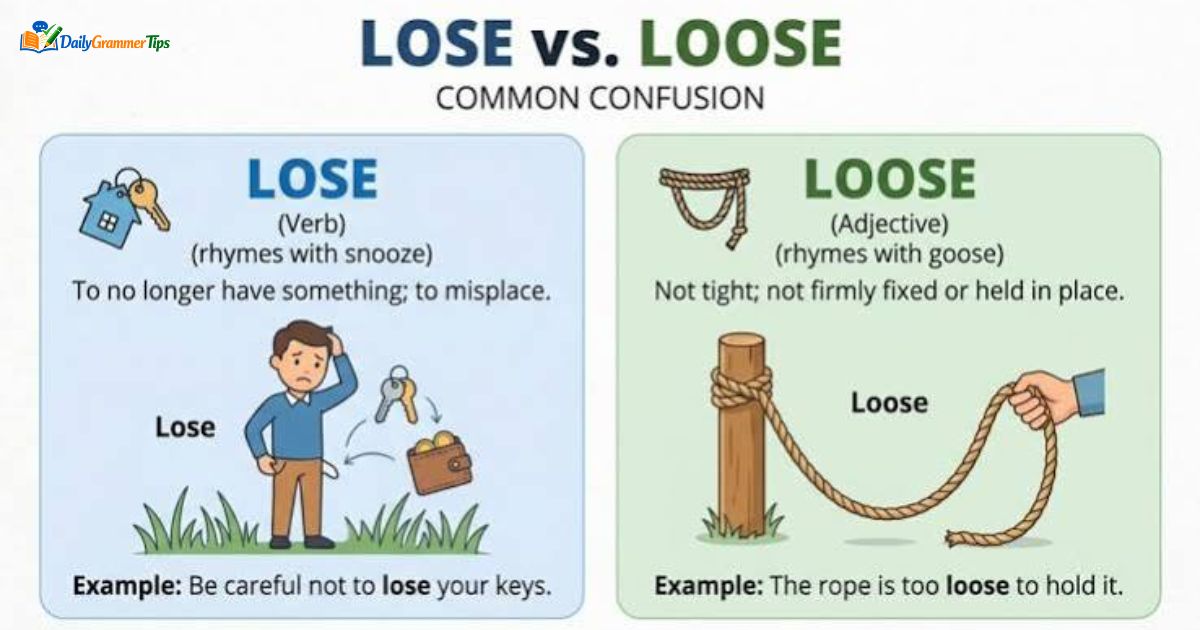
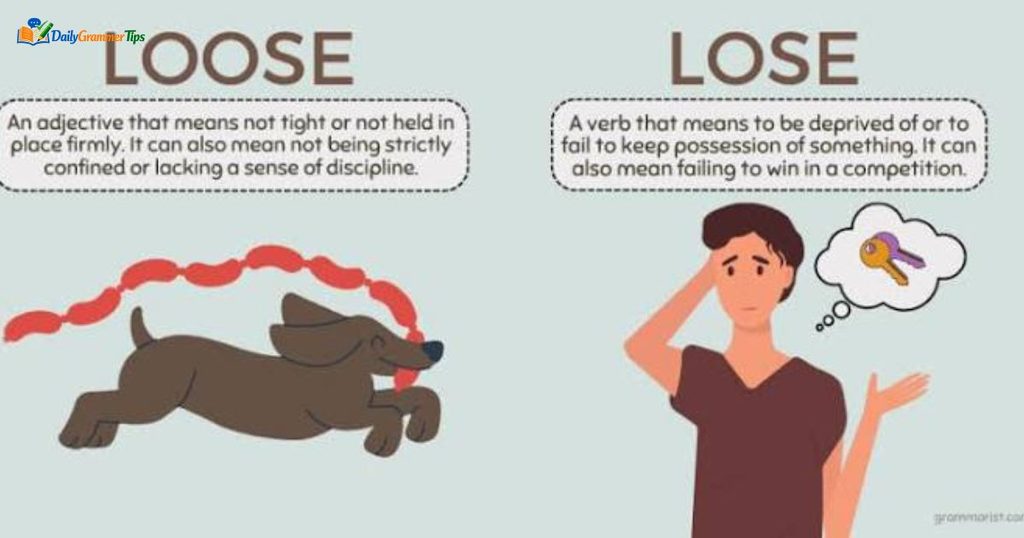
Many people confuse lose and loose because they look and sound similar, but they have completely different meanings. Lose is a verb that means to no longer have something, fail to win, or be unable to find something. For example, you can lose a game, lose your keys, or lose confidence. On the other hand, loose is usually an adjective that describes something not tight, fixed, or secure, such as loose clothing or a loose connection.
Understanding the difference between lose vs loose can help you avoid common spelling and grammar mistakes in everyday writing. A simple way to remember is that lose is about something going away or being missed, while loose describes something that is free, relaxed, or not firmly attached. Learning how to use these words correctly with examples will make your communication clearer and more accurate.
What Is the Meaning of Lose?
Lose means to no longer have something, fail to keep something, or be unable to win or achieve a goal. It is commonly used when something is missing, taken away, or when someone does not succeed in a competition or situation. The word lose can describe many situations, such as losing a personal item, losing a game, losing time, or losing an opportunity.
For example, if you cannot find your phone, you can say, “I lost my phone.” If a team does not win a match, you can say, “They lost the game.” The meaning of lose always connects with something that is gone, missed, or not achieved.
Lose as a Verb
Lose is a verb because it shows an action or a change of situation. It describes what happens when someone no longer has something or fails to achieve a desired result. The past tense of lose is lost, which is used when the action has already happened.
Examples:
- I don’t want to lose my important documents.
- She might lose the competition if she does not practice.
- He lost his wallet while traveling.
- They lost the final match yesterday.
Read Also: Signalling or Signaling: Complete Guide, Uses, Examples
Examples of Lose in Everyday Sentences
- I always check my bag because I don’t want to lose my keys.
- Many people try to lose weight by exercising regularly.
- She was afraid she would lose her chance to apply for the job.
- Our team could lose the match without better teamwork.
- Don’t lose hope during difficult times.
What Is the Meaning of Loose?
Loose means something that is not tight, firmly attached, or securely fixed. It is usually used to describe objects, clothing, or situations where something has extra space or freedom of movement. Unlike lose, the word loose does not refer to something disappearing or failing.
For example, a shirt that does not fit tightly can be called loose clothing. A loose screw means the screw is not properly tightened. The word can also describe something relaxed or not strictly controlled, such as loose rules or loose arrangements.
Loose as an Adjective
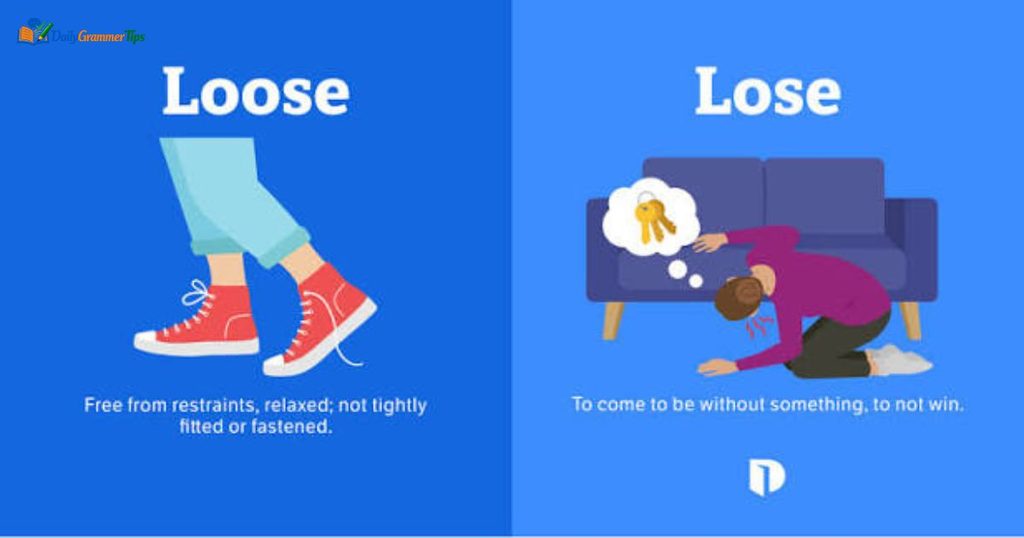
Loose is mainly used as an adjective because it describes the condition or quality of something. It gives more information about a person, object, or situation by showing that it is free, relaxed, or not tightly connected.
Examples:
- She wore a loose dress for comfort.
- The door handle is loose and needs repair.
- The dog got loose from the fence.
- He prefers wearing loose clothes while exercising.
Examples of Loose in Everyday Sentences
- My shoes feel loose because they are too big.
- The table has a loose leg that needs fixing.
- Her hair was tied loosely with a ribbon.
- The company introduced loose rules for casual workdays.
- Make sure the cable is not loose before turning on the device.
Lose vs Loose: Key Differences Explained
Although lose and loose look very similar, they have different meanings and uses. The main difference is that lose describes the action of no longer having something or failing to achieve something, while loose describes something that is not tight, fixed, or secure.
Lose is always connected with loss, failure, or something disappearing. For example, you can lose a game, lose your phone, or lose interest in something. Loose, however, describes the condition of an object or situation, such as loose clothes, a loose button, or a loose connection.
Understanding this difference makes it easier to choose the correct word and avoid common grammar mistakes.
Lose Refers to Losing Something
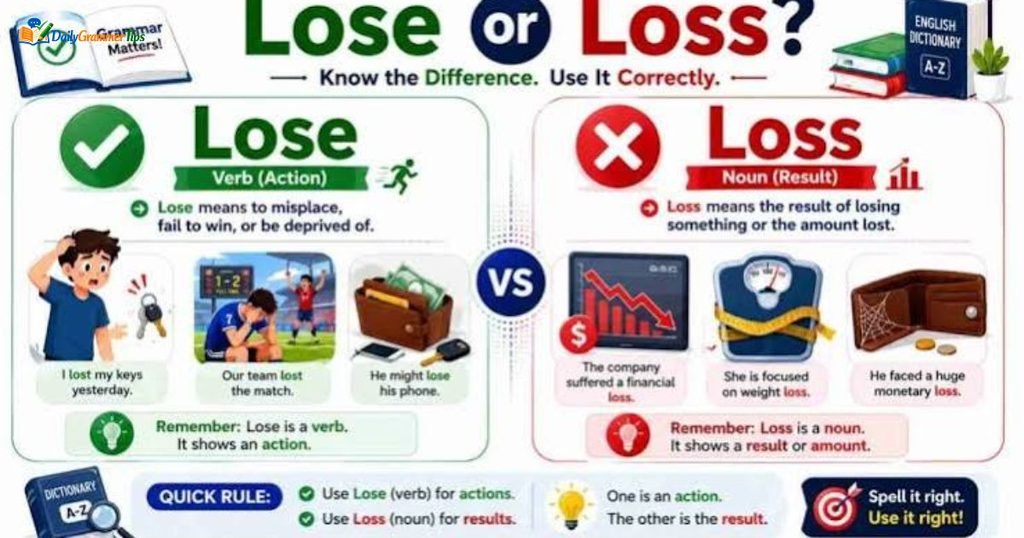
The word lose is used when something is gone, unavailable, or not achieved. It can refer to physical things, emotions, opportunities, competitions, or personal goals.
Examples:
- I don’t want to lose my wallet.
- Our team may lose the match.
- She doesn’t want to lose her chance for success.
- Many people try to lose weight through healthy habits.
A simple way to remember lose is that it involves something leaving your possession or a result that does not go in your favor.
Loose Describes Something Not Tight or Fixed
The word loose describes something that has extra space, is not firmly attached, or is free to move. It is often used for clothing, objects, and physical conditions.
Examples:
- He wears loose clothes for comfort.
- The door handle is loose and needs repair.
- The wire became loose after several years of use.
- The dog was running loose in the park.
Remember that loose is about being free, relaxed, or not tightly connected.
Lose vs Loose Comparison Table
| Word | Meaning | Word Type | Example |
| Lose | To no longer have something or fail to win | Verb | I don’t want to lose my keys. |
| Loose | Not tight, fixed, or secure | Adjective | My shirt feels loose. |
| Lose | Related to loss or failure | Verb | They lost the game yesterday. |
| Loose | Describes something free or relaxed | Adjective | The screw is loose. |
By remembering that lose = something is gone and loose = something is not tight, you can easily tell these two words apart.
How to Remember the Difference Between Lose and Loose?
Remembering the difference between lose and loose becomes easier when you focus on their meanings. Lose is connected with something being gone, missing, or not achieved, while loose describes something that is free, relaxed, or not tight.
Think of lose as a word related to loss. If you lose your phone, you no longer have it. If you lose a match, you do not win. On the other hand, loose means something has extra space or is not firmly attached, like loose clothes or a loose screw.
Simple Trick to Avoid Confusion
A simple trick is to remember that lose has one “o” because something is missing or lost. The word loose has two “o’s,” just like something that has extra room or space.
You can use this quick rule:
- Lose = Loss, missing, or failure
- I don’t want to lose my keys.
- Our team might lose the game.
- I don’t want to lose my keys.
- Loose = Not tight or fixed
- My shoes are too loose.
- The button is loose.
- My shoes are too loose.
Whenever you are unsure, ask yourself: “Is something disappearing or being lost?” Use lose. “Is something not tight or secure?” Use loose.
Pronunciation Difference Between Lose and Loose
Although lose and loose look similar, they have a slight difference in pronunciation. Both words have a “z” sound, but loose has a longer “oo” sound, while lose has a shorter sound.
The pronunciation difference can help you identify the correct word, but the meaning is the best way to choose between them.
Lose vs Loose Examples in Real-Life Sentences
Seeing lose and loose in real sentences makes the difference much clearer. While lose talks about losing something or failing, loose describes something that is not tight, attached, or controlled.
Examples Using Lose
- I don’t want to lose my important files.
- She worked hard because she didn’t want to lose the competition.
- Many people try to lose weight through exercise.
- He was worried he might lose his job.
- Don’t lose your confidence after making a mistake.
Examples Using Loose
- These pants are too loose for me.
- The door handle is loose and needs fixing.
- The dog broke free and ran loose outside.
- She likes wearing loose clothes during summer.
- The cable became loose after repeated use.
Comparing Lose and Loose in Sentences
| Lose | Loose |
| I don’t want to lose my wallet. | My wallet’s strap is loose. |
| They might lose the match. | The shoe lace is loose. |
| She doesn’t want to lose her chance. | The screw is loose. |
| He wants to lose weight. | The shirt feels loose. |
By practicing these examples, you can quickly understand when to use lose and when to use loose. Remember: lose means something is gone, while loose means something is not tight.
Common Mistakes People Make with Lose and Loose
Many people confuse lose and loose because they have similar spellings and sounds. However, using the wrong word can change the meaning of a sentence completely. These mistakes often happen in everyday writing, social media posts, emails, and conversations.
The easiest way to avoid confusion is to understand that lose is related to losing something, while loose describes something that is not tight, fixed, or secure.
Using Loose When You Mean Lose
A common mistake is using loose when the correct word should be lose. This usually happens when someone wants to describe losing an object, failing a competition, or missing an opportunity.
Incorrect:
- I don’t want to loose my phone.
Correct:
- I don’t want to lose my phone.
More examples:
- She doesn’t want to lose her chance to study abroad.
- Our team cannot afford to lose this match.
Remember that lose always connects with something being gone, missed, or not achieved.
Using Lose When You Mean Loose
Another common mistake is using lose when the sentence needs loose. This happens when describing something that is not tight, attached, or secure.
Incorrect:
- My shoes are too lose.
Correct:
- My shoes are too loose.
More examples:
- The screw is loose and needs tightening.
- He prefers wearing loose clothes for comfort.
Remember that loose describes the condition of something, not the act of losing.
Tips to Use These Words Correctly
Here are some simple tips to use lose and loose correctly:
- Use lose when something disappears, is taken away, or you fail to win.
- Example: I don’t want to lose my keys.
- Example: I don’t want to lose my keys.
- Use loose when something is not tight, fixed, or secure.
- Example: The wire is loose.
- Example: The wire is loose.
- Associate lose with the word loss to remember its meaning.
- Think of the extra “o” in loose as extra space, like something that is not tight.
- Always check the meaning of the sentence before choosing the word.
When to Use Lose and When to Use Loose?
Choosing between lose and loose depends on what you want to describe. If you are talking about losing something or failing to achieve a result, use lose. If you are describing something that has space, freedom, or is not firmly attached, use loose.
For example:
- I might lose my wallet. (The wallet may go missing.)
- My wallet chain is loose. (The chain is not tight.)
Understanding the purpose of each word will help you use them correctly in both speaking and writing.
How to Identify Lose in a Sentence
You can identify lose in a sentence by checking if the word refers to losing, missing, or failing. It is usually used as an action word (verb).
Examples:
- I don’t want to lose my important documents.
- They may lose the final game.
- She doesn’t want to lose her motivation.
Ask yourself: “Is something being lost or not achieved?” If yes, lose is the correct choice.
How to Identify Loose in a Sentence
You can identify loose by checking if it describes something that is free, relaxed, or not tightly connected. It is usually used as a describing word (adjective).
Examples:
- The door knob is loose.
- He wears loose clothing.
- The dog was running loose in the yard.
Ask yourself: “Is something not tight or securely attached?” If yes, loose is the correct choice.
Frequently Asked Questions About Lose vs Loose
Is Lose and Loose the Same Thing?
No, lose and loose are not the same thing. They have different meanings and are used in different situations.
What Is an Easy Way to Remember Lose vs Loose?
An easy way to remember the difference is to connect lose with the word loss. Both words relate to something going away, disappearing, or not being achieved. If something is missing or you fail at something, use lose.
Is Loose a Verb or an Adjective?
Loose is mainly used as an adjective because it describes the condition or appearance of something. It tells us that something is free, relaxed, or not tightly connected.
- The button on my shirt is loose.
- The wire became loose after years of use.
How Do You Use Lose in a Sentence?
Lose is used as a verb when talking about something that is no longer available, something that goes missing, or a situation where someone does not succeed.
Conclusion: Lose vs Loose Made Simple
Understanding the difference between lose and loose can help you avoid common English mistakes and improve your writing skills. Although these two words look and sound similar, their meanings are completely different. Lose is used when something goes away, becomes unavailable, or when someone fails to achieve a goal. You can lose a game, lose your keys, or lose an opportunity. Loose describes something that is not tight, fixed, or secure, such as loose clothing, a loose button, or a loose connection.
The easiest way to remember the difference is to associate lose with loss and loose with extra space or freedom. By paying attention to the meaning of the sentence, you can quickly decide which word fits correctly. With regular practice and real-life examples, using lose and loose will become simple and natural in everyday communication.
Learn the difference between lose vs loose with clear meanings, examples, and simple tips to understand when to use each word correctly.
