

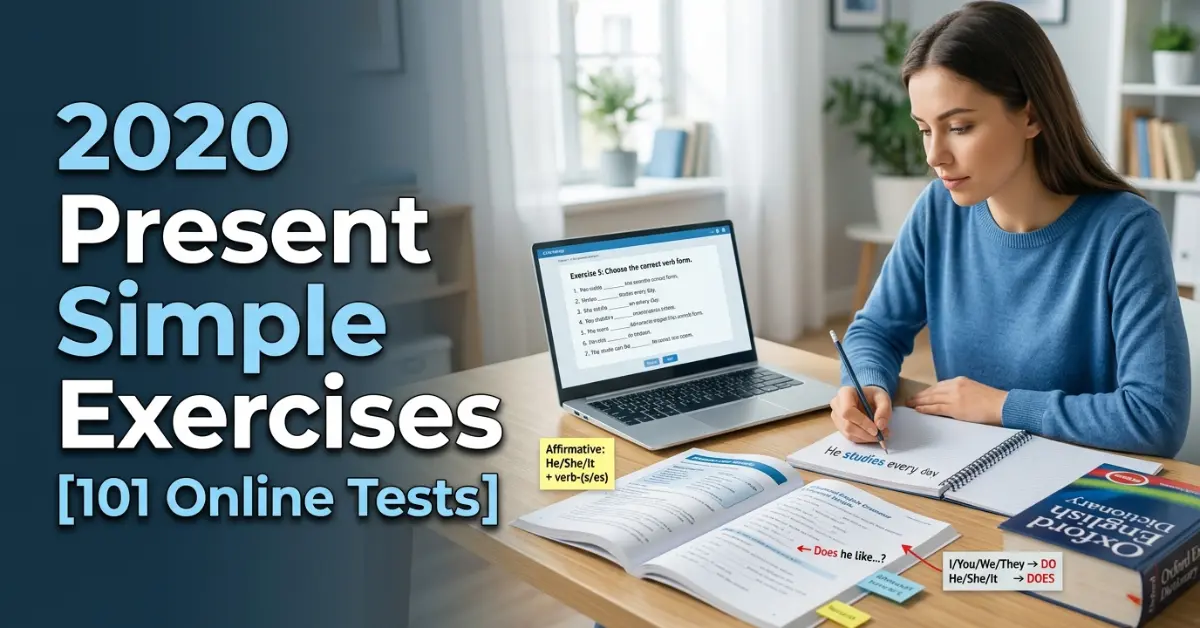
Getting comfortable with the present simple tense really comes down to practice, and that’s exactly what present simple exercises are for. Each drill pushes you to apply verb conjugation and subject-verb agreement in a real sentence, not just memorize a rule. Work through a batch of present simple mixed exercises here, and spotting the right verb form will soon feel automatic.
Have you ever second-guessed a sentence, unsure whether it needed an “s” at the end or the word “does” instead? That tiny hesitation trips up beginner and intermediate ESL learners more than almost any other rule. Stick with this guide, and third person singular endings and the do/does auxiliary verb will start to feel natural.
What Is the Present Simple Tense?
The simple present tense describes things that are generally true, happen regularly, or repeat as part of a routine. Think of facts, habits, schedules, and permanent situations.
- I drink coffee every morning.
- The sun rises in the east.
- She works at a hospital.
Notice the pattern: with I, you, we, and they, the verb stays in its base form. But with he, she, and it, the third person singular, the verb takes an -s/-es ending. This one rule causes most of the mistakes learners make, so it’s worth slowing down and drilling it with a few present simple exercises until it becomes automatic.
Read Also: Best 2020 Mixed Conditionals Exercises [101 Online Tests] – Grammarism
Present Simple Sentence Types
English grammar rules divide present simple sentences into three types, and each one follows its own pattern. Good present simple exercises always cover all three, since mixing them is the best way to build real fluency.
1. Affirmative (Positive) Sentences
Used for daily routine sentences and habitual actions.
- He plays football on weekends.
- They live in Lahore.
2. Negative Sentences
This is where the do/does auxiliary verb comes in. Negative sentences pair “do” or “does” with “not,” and the main verb drops its ending.
- I don’t like spicy food.
- She doesn’t watch TV at night.
A common slip here is subject-verb agreement. Learners often write “she don’t” instead of “she doesn’t.” Watching for this is a big part of what these present simple exercises are designed to fix.
3. Interrogative (Question) Sentences
Yes/no questions and wh-questions both rely on the same auxiliary system.
- Do you speak English?
- Does he work on Sundays?
- What do you want?
Getting comfortable switching between affirmative, negative, and interrogative forms, what grammarians call the affirmative negative interrogative pattern, is really the heart of learning this tense.
Do vs. Does: The Rule That Confuses Everyone
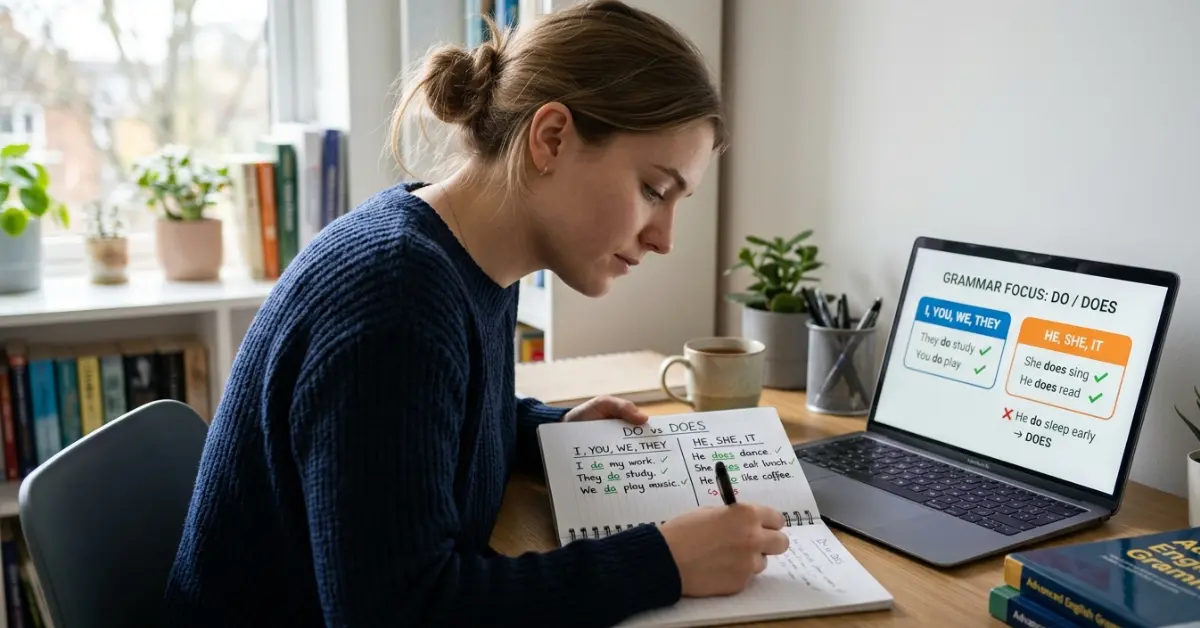
Here’s the simple version: use “does” with he, she, it, and singular nouns. Use “do” with I, you, we, and they. Once “does” enters a sentence, the main verb loses its -s ending, because “does” already carries that agreement.
- ❌ Does she goes to school?
- ✅ Does she go to school?
This single rule solves most of the errors learners make with third person singular verbs, and it’s one of the first things any set of present simple exercises should test.
Present Simple vs. Present Continuous
A frequent point of confusion is knowing when to reach for present simple instead of present continuous. As a rule of thumb:
- Use present simple for routines, facts, and permanent states: I work in Karachi.
- Use present continuous for actions happening right now: I am working right now.
If you’re still shaky on this distinction, working through a few present simple exercises alongside present continuous exercises is a good next step.
Present Simple Exercises: Practice Time
Now it’s time to put the rules into action. Below are sample present simple mixed exercises, a blend of affirmative, negative, and question sentences. These present simple exercises cover the most common trouble spots, so choose the correct form for each one, then check your answer.
Fill in the blanks / multiple choice grammar test:
- She ______ (not/like) horror movies.
- ______ you ______ (speak) French?
- My brother ______ (work) in a bank.
- We ______ (not/have) much time today.
- ______ he ______ (want) anything to eat?
- The shop ______ (close) at 9 PM.
- I ______ (not/understand) this question.
- ______ they ______ (live) near the city center?
- It ______ (not/make) any sense to me.
- What ______ you ______ (think) about this plan?
Answer key:
- doesn’t like
- Do / speak
- works
- don’t have
- Does / want
- closes
- don’t understand
- Do / live
- doesn’t make
- do / think
Try covering the answer key and testing yourself first, that’s where real learning happens. If you got most of these right, you’ve already got a solid grip on subject-verb agreement and auxiliary usage. If a few tripped you up, go back and reread the do/does section above, then repeat these present simple exercises before trying again.
Tips for Mastering Present Simple Exercises Faster
- Say it out loud. Hearing “doesn’t” instead of “don’t” helps your ear catch mistakes before your pen does.
- Write five daily routine sentences about your own day. Real-life practice sticks better than abstract examples.
- Do a few grammar drills every day rather than one long session once a week. Short, repeated present simple exercises beat cramming.
- Read your sentences back and check every verb against its subject. This single habit eliminates most present simple negative form examples of errors.
Present Simple Exercises PDF
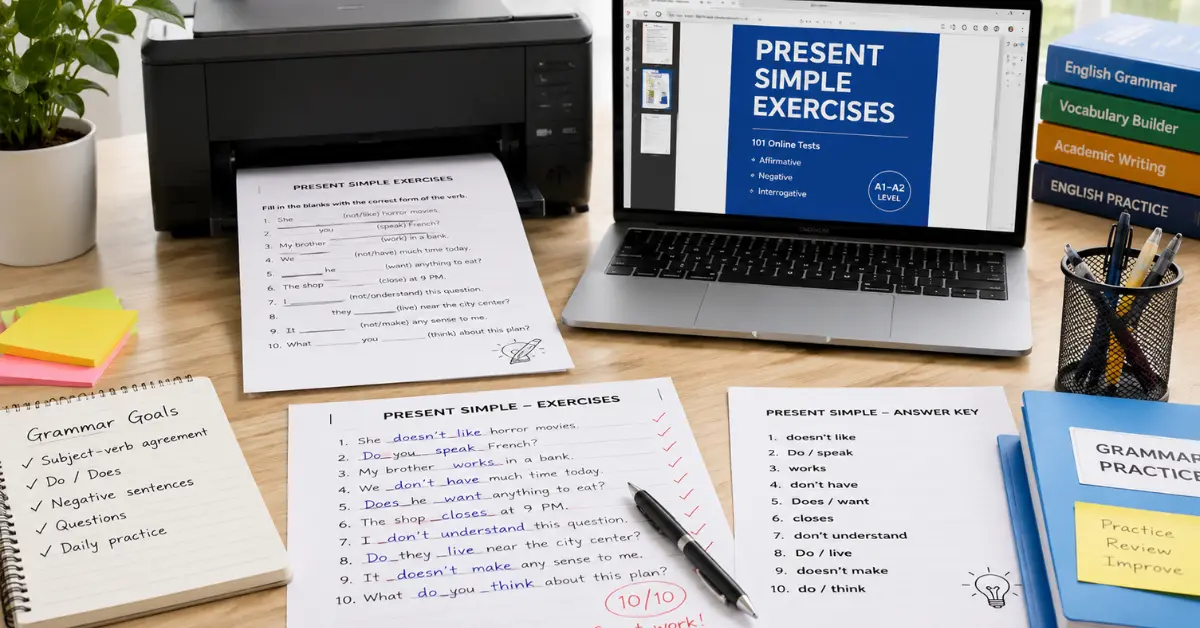
A downloadable PDF gives you something a browser quiz can’t: a printable worksheet you can keep in a folder, mark up with a pen, and revisit whenever you want. Most present simple exercises PDF packs bundle affirmative, negative, and question sentences on one page, so you practice all three sentence types in a single sitting instead of jumping between separate pages.
Teachers also lean on PDF worksheets because they’re easy to hand out in class or assign as homework without needing internet access. If you’re building a personal study routine, printing a few present simple exercises PDF sheets each week is a simple way to track your progress on paper over time.
Present Simple Exercises Worksheet
A worksheet works differently from an interactive quiz. It slows you down and forces you to write out full answers instead of just clicking an option. This hands-on approach strengthens verb conjugation and subject-verb agreement because you physically form each word rather than recognizing it from a list.
Good present simple exercises worksheet sets usually mix daily routine sentences with third person singular practice, since that combination covers the two areas learners struggle with most. Working through a worksheet before attempting an online quiz often makes the digital version feel noticeably easier.
Present Simple Exercises With Answers
Nothing kills motivation faster than guessing and never finding out if you were right. Present simple exercises with answers solve that problem instantly, letting you check each sentence the moment you finish it and correct mistakes while the grammar rule is still fresh in your mind.
This immediate feedback loop is especially useful for tricky areas like do/does auxiliary verb usage, where a single wrong ending can change the whole sentence. Reviewing the answer key line by line, rather than just scanning your final score, helps the correct pattern actually stick.
Present Simple Exercises for Kids
Younger learners need shorter sentences, simpler vocabulary, and more visual cues than adult ESL students, so present simple exercises for kids are usually built around everyday topics like pets, school, and family routines. Bright colors, pictures, and short fill-in-the-blank formats keep young learners engaged without overwhelming them.
Repetition matters more for kids than for older learners, so these exercises often recycle the same handful of common verbs across many sentences. This steady repetition builds confidence with basic verb forms before children move on to trickier structures like negative sentences and questions.
Present Simple Exercises Online
Online practice adds instant scoring, sound effects, and progress tracking that printed worksheets simply can’t offer. Present simple exercises online let you test yourself in a few spare minutes on your phone or laptop, which makes it far easier to practice consistently instead of saving grammar work for one long weekly session.
Interactive present simple mixed exercises online are especially useful because they shuffle affirmative, negative, and question sentences together, mimicking how the tense actually shows up in real conversation. That mixed format trains your brain to switch between sentence types quickly rather than relying on a fixed pattern.
Present Simple Exercises A1
A1 marks the very beginning of the Common European Framework, so present simple exercises A1 focus on the simplest possible sentence structures with high-frequency verbs like live, work, like, and have. Learners at this stage benefit most from short, predictable patterns rather than complex vocabulary or idiomatic phrasing.
Because A1 students are still building basic confidence, these exercises usually isolate one sentence type at a time (affirmative first, then negative, then questions) instead of mixing them immediately. Mastering each stage separately before combining them makes the transition to mixed exercises much smoother later on.
Present Simple Exercises Multiple Choice

Multiple choice removes the pressure of spelling and lets learners focus purely on choosing the grammatically correct option, which makes present simple exercises multiple choice a great warm-up before writing full sentences from scratch. Seeing several answer options side by side also highlights common mistakes, since wrong choices often mirror errors learners actually make.
This format works particularly well for testing do vs does exercises and third person singular endings, where the difference between right and wrong can come down to a single letter. Comparing options directly makes that small but important distinction much easier to notice and remember.
Present Simple Exercises Wordwall
Wordwall turns grammar practice into a game, and present simple exercises Wordwall activities use formats like matching, spin-the-wheel, and timed quizzes to make repetitive drilling feel less like homework. That gamified approach is especially effective in classrooms, where a bit of friendly competition keeps students more engaged than a plain worksheet would.
Because Wordwall activities are quick and interactive, they’re ideal for short review sessions at the start or end of a lesson. Teachers often pair a Wordwall activity with a traditional present simple exercises worksheet, using the game for a fun recap after the more focused written practice.
Frequently Asked Questions
What is the present simple tense used for?
You use the present simple tense to talk about facts, habits, and routines that repeat regularly, like daily schedules or general truths.
How do I know when to use “does” instead of “do”?
Use “does” with he, she, it, or a singular noun, and use “do” with I, you, we, and they.
What’s the difference between present simple and present continuous?
Present simple describes routines and permanent facts, while present continuous describes actions happening right now.
Do present simple exercises help beginners the most?
Yes, present simple exercises work well for beginners because they build core habits like subject-verb agreement before moving to harder tenses.
Where can I practice present simple exercises with instant feedback?
Online quizzes and interactive worksheets both give instant feedback, so you can check your answers right after each sentence.
Conclusion:
The present simple tense looks small on the surface, but it carries most other tenses on its back. Once verb conjugation, subject-verb agreement, and auxiliary usage feel natural, present perfect and past simple both become much easier to pick up, since they build on the same core habits you’ve just practiced.
Keep coming back to present simple exercises whenever a sentence starts to feel shaky, and don’t rush the process. A few minutes of practice most days beats one long cram session. Bookmark this page, revisit the drills often, and watch these rules turn from confusing to second nature.
