


Quantum computing is one of the most talked about breakthroughs in modern technology, and for good reason. Unlike the computers sitting on our desks or in our pockets, quantum computing relies on principles borrowed directly from physics, including superposition, entanglement, and interference, to process information in ways that classical machines simply cannot match.
In this guide, we’ll walk through what the technology actually is, how it works, who invented it, how it compares to artificial intelligence, what career and salary opportunities exist, and where you can go to learn more. Whether you’re a student exploring a new career path, an investor evaluating stocks in this space, or simply someone who wants a clear explanation, this article breaks it down step by step.
Our Work
Quantum computing has moved rapidly from academic theory into applied engineering. Research teams around the world are now building physical quantum computers using different underlying technologies, including superconducting circuits, trapped ions, photonics, and neutral atoms. Each is attempting to solve the same core challenge: how do you keep a fragile quantum state stable long enough to perform useful calculations?
Progress today isn’t measured only in the number of qubits a machine has, but in how reliably those qubits behave. A processor with hundreds of qubits that produces noisy, error prone results is often less useful than a smaller, more stable system. This is why so much current research effort in this area is focused on error correction and error mitigation.
Beyond hardware, software development has become just as central to quantum computing. Engineers need programming frameworks that let them design quantum circuits, simulate outcomes on classical machines before running them on real hardware, and translate abstract algorithms into instructions a physical processor can execute. This growing software ecosystem is what allows universities, startups, and enterprise research labs to experiment with the technology without needing to build their own machines from scratch.
Real world applications are beginning to emerge in chemistry, where the field is being used to model molecular interactions with a level of precision classical simulations struggle to achieve. In finance, early experiments are exploring how it could optimize investment portfolios and assess risk. In logistics, companies are testing whether the technology can solve complex routing problems faster than existing methods.
What Is Quantum Computing With Example
At its core, quantum computing is a method of processing information using the rules of quantum mechanics rather than the classical rules that govern everyday computers. A regular computer stores and processes information as bits, each one either a 0 or a 1. Quantum computing instead uses qubits, which can represent a 0, a 1, or thanks to a property called superposition, a combination of both at the same time.
Here’s a simple example to make the concept easier to picture. Imagine you’re trying to find your way out of a massive maze with thousands of possible paths. A classical computer would check one path, hit a dead end, back up, and try another path, one at a time, until it stumbled onto the exit.
A machine built on the subject principles could, in a simplified sense, explore many paths at once because its qubits exist in multiple states simultaneously. This is why the technology shows so much promise for problems involving massive numbers of possible combinations, such as optimizing delivery routes or testing chemical compounds.
Another everyday example often used to explain this area involves a coin. A classical bit is like a coin lying flat on a table, showing either heads or tails. A qubit, because of superposition, behaves more like a coin spinning in the air. It hasn’t “landed” yet, and in a sense it represents a probability of being either heads or tails until it’s measured.
Quantum Computing Explained
To really understand the topic, it helps to break it into three foundational ideas: superposition, entanglement, and interference. Superposition is the concept that a qubit doesn’t have to be strictly 0 or 1. It can hold a blend of both states until it’s observed or measured.
This is one of the defining features that separates the field from classical computing, because it allows a quantum processor to represent and process a huge number of possibilities at once rather than working through them one by one.
Entanglement is a phenomenon where two or more qubits become linked in such a way that the state of one instantly influences the state of another, even if they are physically far apart. Entanglement is what allows quantum systems to coordinate information across many qubits simultaneously, creating computational power that grows exponentially as more qubits are added.
Interference is the third pillar, used to increase the probability of correct answers while canceling out the probability of incorrect ones. Quantum algorithms are carefully designed so “wrong” possible outcomes cancel each other out, while “right” outcomes reinforce each other and become more likely to appear when the qubits are finally measured.
Put simply, the technology explained in everyday terms means using the strange, probabilistic behavior of subatomic particles to explore many possible solutions to a problem at once, then using clever algorithms to filter those possibilities down to the most likely correct answer. It’s not magic, it’s physics applied to computation, and it’s still a young, rapidly evolving field.
Who Invented Quantum Computing
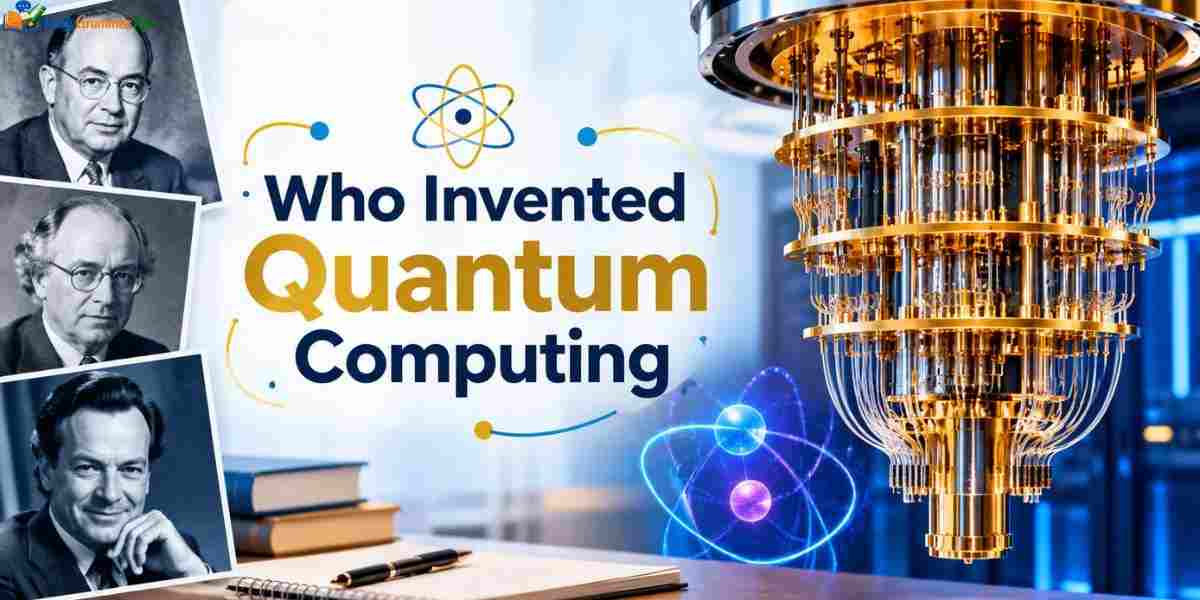
There isn’t a single inventor in the way a specific product might have one. Instead, this technology emerged gradually through the contributions of several physicists and computer scientists across the late twentieth century.
The theoretical roots trace back to the early 1980s, when physicist Richard Feynman proposed that classical computers would never be able to efficiently simulate quantum systems, and suggested that a machine built on quantum mechanical principles could do the job instead. Around the same period, physicist Paul Benioff described how quantum mechanics could theoretically be used to build a computer.
Later in the 1980s, physicist David Deutsch expanded on these ideas by describing a universal quantum computer, essentially proving that a machine based on quantum mechanics could, in principle, simulate any physical process. This gave quantum computing its theoretical foundation as a general purpose computing model.
The field gained major momentum in 1994 when mathematician Peter Shor developed an algorithm, now known as Shor’s algorithm, showing that a sufficiently powerful quantum computer could factor large numbers exponentially faster than the best known classical methods. This pushed the field from an academic curiosity into a topic of serious commercial interest.
Qiskit: Open-Source Quantum Development
One of the biggest barriers to entry in this field has historically been access. Building an actual quantum computer requires extremely specialized equipment, ultra cold environments, and highly controlled laboratory conditions. Open source software development kits have changed that, allowing anyone with a laptop and an internet connection to write and test programs.
These frameworks let developers write quantum circuits using familiar programming languages, simulate how those circuits would behave on an ideal machine, and then submit the same code to run on actual processors hosted by research labs. This has dramatically lowered the barrier to learning quantum computing.
The open source movement has also created a large, collaborative community. Developers contribute new algorithms, optimization techniques, and educational tutorials, helping newcomers understand core concepts through hands on coding rather than abstract theory alone. Many of the leading cloud based research platforms, including offerings tied to quantum ibm technology and other quantum computer ibm systems, allow users to queue their code for execution on physical qubits located in labs around the world.
This accessibility matters enormously for the future of quantum computing, because it means the next major breakthrough might not come from a giant corporate lab. It could just as easily come from a university student experimenting with freely available tools online.
Quantum Computing Course
Given how fast the field is growing, interest in taking a quantum computing course has surged among students, software engineers, and career changers alike. Fortunately, there are now more accessible learning paths than ever before.
Most people beginning this type of course should expect to start with the mathematical foundations: linear algebra, probability, and complex numbers. These concepts form the backbone of how qubits are represented and manipulated, so a solid grounding here makes the rest of the subject much easier to absorb.
A well structured course will usually combine theory with hands on programming, letting learners write simple circuits and run them on simulators before eventually testing them on real quantum hardware through cloud platforms. Many universities now offer dedicated degree tracks or elective courses in quantum information science.
For learners without a strong physics or computer science background, beginner focused courses often use visual tools and simplified explanations, much like the coin analogy mentioned earlier, before gradually introducing the mathematical notation used by more advanced practitioners.
Quantum Computing Salary

As demand for quantum computing talent grows, so does curiosity about quantum computing salary ranges across different roles and experience levels. Because the field is still relatively young and specialized, professionals with genuine expertise are in short supply relative to demand.
Entry level positions, often filled by graduates with strong physics, mathematics, or computer science backgrounds, typically involve roles like quantum software developer or research assistant. These positions usually offer competitive starting compensation.
Mid level and senior roles, such as quantum algorithm developer, quantum hardware engineer, or quantum research scientist, tend to command significantly higher compensation, particularly at companies with dedicated quantum computing divisions or well funded research labs.
Salary figures can vary widely depending on geography, the size and funding of the employer, and whether the role is focused on hardware engineering, software development, or theoretical research. As the field continues to mature, salary trends across the board are expected to keep climbing.
Quantum Computing vs AI
One of the most common points of confusion for newcomers is the relationship between quantum computing and AI. While both are cutting edge technologies frequently mentioned in the same breath, they solve fundamentally different problems and work in fundamentally different ways. The table below breaks down the key differences.
| Aspect | Quantum Computing | Artificial Intelligence |
| Core principle | Uses qubits, superposition, and entanglement | Uses statistical models and neural networks |
| What it processes | Explores many possible solutions at once | Learns patterns from large volumes of data |
| Hardware | Specialized quantum processors, still experimental | Runs on classical computers and GPUs |
| Current maturity | Early stage, mostly research and pilot projects | Widely deployed in everyday products |
| Best suited for | Optimization, simulation, cryptography | Prediction, recognition, language and content generation |
The relationship isn’t purely competitive, it’s often complementary. Researchers are actively exploring how the technology could eventually accelerate certain machine learning tasks, particularly those involving complex optimization across enormous datasets. This emerging area is sometimes called quantum machine learning.
It’s important to temper expectations though. Quantum computing is not on the verge of replacing AI, nor is it a more advanced version of artificial intelligence. They are different tools designed for different kinds of problems, and classical AI is already deeply embedded in everyday products while quantum computing remains an emerging technology.
Learn more………..Support Akron: Complete Guide to Local Help Services
Quantum Computing Stocks
As public interest in quantum computing has grown, so has interest from investors looking to gain exposure to the sector through quantum computing stocks. This is a young and volatile corner of the market, and it’s important to understand both the opportunity and the risk.
Publicly traded companies connected to the sector generally fall into a few categories. Some are large, diversified technology corporations that have dedicated divisions alongside many other business lines. Others are smaller, specialized companies built entirely around quantum hardware or software.
Because commercially transformative applications are still, by most expert estimates, several years away from widespread deployment, quantum computing stocks, particularly the smaller, pure play companies, tend to be highly speculative and can experience significant price swings.
This article is for informational purposes only and isn’t financial advice. Anyone interested in this space should do independent research or consult a qualified financial professional before making investment decisions.
Publication Collections
Academic publishing has played a central role in advancing quantum computing from theory into practice. Peer reviewed journals, conference proceedings, and open access research repositories are where new breakthroughs are formally documented, scrutinized, and built upon by the wider scientific community.
Major scientific conferences dedicated to the field bring together physicists, computer scientists, and engineers to present new findings on topics ranging from error correction techniques to novel qubit designs.
For students and professionals looking to go deeper into quantum computing, following these publication collections offers a window into where the field is actually headed, not just the headline grabbing announcements but the incremental, peer reviewed progress that shapes the next generation of hardware and software.
Collectively, this growing body of published quantum computing research reflects just how collaborative and global the field has become, with contributions coming from research institutions, national laboratories, and corporate research divisions worldwide.
Topics
Quantum computing is a broad field that branches into several specialized sub areas, each tackling a different piece of the larger puzzle. Quantum hardware focuses on the physical engineering challenges of building and stabilizing qubits.
In the world of quantum computing, quantum software and circuit design deals with the programming frameworks, compilers, and algorithms used to translate problems into instructions a processor can execute. Quantum error correction and mitigation is dedicated to keeping fragile quantum states stable and accurate.
Quantum chemistry is one of the most promising application areas, using this technology to simulate molecular structures and chemical reactions. Quantum machine learning explores the overlap between quantum computing and artificial intelligence.
Quantum finance examines how the technology might eventually be applied to portfolio optimization and risk modeling. Quantum communication and cryptography is another major topic, focused on both the risks quantum computers pose to current encryption and the opportunities for more secure communication.
Quantum Computing PDF

Many learners and researchers prefer studying quantum computing through downloadable reference material, which is why searches for a quantum computing PDF remain consistently popular. PDFs offer a convenient, offline friendly way to work through dense technical material at your own pace.
When looking for a reliable quantum computing PDF, it’s worth prioritizing material published by recognized universities, research institutions, or established educational platforms, since the quality of introductory material on this subject can vary significantly.
A good resource will typically start with foundational mathematics and physics concepts before progressing into qubits, quantum gates, and basic algorithms, mirroring the structure used in most formal courses on the topic.
For beginners, shorter, well illustrated PDF guides that use analogies, similar to the maze and spinning coin examples covered earlier, tend to be far more approachable than dense academic papers written primarily for specialists.
Collaborate With Us
Quantum computing has become one of the most collaborative fields in modern science and technology, and that spirit of shared progress continues to shape how the industry grows. No single company, university, or country is expected to unlock every breakthrough required to make it commercially transformative.
Universities partner with technology companies to give students hands on access to real hardware. Startups collaborate with established research labs to test new algorithms on more advanced systems than they could otherwise access alone.
National research programs fund academic quantum computing research while also partnering with private industry to accelerate the transition from laboratory experiments to practical applications.
This collaborative approach extends to the broader public as well. Open source software, publicly available research papers, free online courses, and cloud based access to real quantum processors have all lowered the barrier for individuals to get involved.
You’re a student taking your first quantum computing course, a developer experimenting with quantum circuits, or a business tracking quantum computing research trends alongside quantum computer ibm systems and quantum ibm platforms, this is a field that rewards curiosity and continuous learning. Many of the biggest breakthroughs are almost certainly still ahead, and that’s exactly what makes quantum computing one of the most exciting areas of science and technology to follow today.
Frequently Asked Questions
What is quantum computing in simple words?
Quantum computing is a way of processing information using qubits, which can represent multiple states at once, allowing certain complex problems to be explored far more efficiently than with traditional computers.
Will quantum computing replace AI?
No, quantum computing and AI solve different types of problems and are more likely to complement each other, particularly in emerging areas like quantum machine learning, rather than one replacing the other.
What did Elon Musk say about quantum computing?
Elon Musk has publicly expressed skepticism about near term commercial quantum computing, suggesting it’s still many years away from being broadly useful compared to classical computing for most practical tasks.
What is a real life example of quantum computing?
It’s currently being tested for simulating molecules in drug discovery, optimizing complex logistics routes, and modeling financial risk more efficiently than classical methods.
Is ChatGPT a quantum computer?
No, ChatGPT runs on classical computing infrastructure using machine learning models; it does not use qubits or any quantum hardware.
Conclusion
Quantum computing has come a long way from a physics theory scribbled on a chalkboard. Scientists now build real machines, run real experiments, and push qubits further every year. Businesses watch closely, students sign up for courses, and investors track the sector’s early moves.
You don’t need a physics degree to follow along. Learn the basics, try a beginner course if you’re curious, and keep an eye on new breakthroughs. Quantum computing is still young, but it’s shaping up to be one of the defining technologies of the coming decade.
