

Every business holds information that others would love to see. Customer records, passwords, contracts and source code all fall in this group. When any of it slips out by mistake, the harm can last for years. That slip is the heart of data leakage.
This guide looks at the topic from two sides. First, it shows how information escapes from companies. Then it shows how machine learning models get spoiled by facts they should never see. You will learn the meaning, types, real cases, warning signs and practical fixes for data leakage.
What Is Data Leakage?
Data leakage means private information reaches people who were never meant to see it. Nobody has to break in for this to happen. A wrong email recipient or an open storage folder is enough. The exposure is usually a side effect of daily work.
The term also has a second meaning in machine learning. There, it describes a model that sees answers while it is still learning. This article covers both meanings, starting with the business side.
- Customer details: Names, phone numbers and home addresses are the most common items to slip out.
- Login secrets: Passwords, access keys and tokens give outsiders a direct way into your systems.
- Money records: Bank details, invoices and payment logs attract fraudsters.
- Business plans: Contracts, price sheets and strategy files help rivals plan against you.
- Technical assets: Source code and product designs can be copied and sold.
- People files: Staff records and health data carry strict legal duties.
Two Meanings of the Term
In security, the word points to exposed files, records and secrets. The harm is privacy loss, fraud and legal trouble. The fix lies in access control and good habits.
In machine learning, the word points to a flawed training setup. The harm is a model that scores high in tests and fails in real use. The fix lies in careful handling of data.
Data Leakage vs. Data Breach: What’s the Difference?
Data leakage is usually a slip. A breach is usually an attack. Knowing which one you face changes how you respond.
One can lead to the other. An open database that nobody notices may later be found by criminals. At that point, a quiet mistake becomes a full breach.
| Feature | Leak | Breach |
| Main cause | Human error or poor settings | Deliberate attack |
| Who is behind it | Staff, admins or vendors | Hackers or criminal groups |
| How it starts | Wrong setting, wrong recipient | Malware, phishing, stolen logins |
| Detection | Often silent for months | Often triggers alerts quickly |
| Intent | No plan to cause harm | Clear plan to steal or damage |
| Speed | Slow and gradual exposure | Fast and forceful entry |
| First response | Close the gap, remove exposure | Contain the attack, then investigate |
| Legal impact | Fines for poor protection | Fines plus duty to notify victims |
How a Leak Turns Into a Breach
Data leakage creates the opening. Attackers scan the internet all day for exposed storage and forgotten servers. Once they find an open door, they walk in and copy what they like.
At that moment the story changes. The company now faces theft, not just exposure. This is why fixing a leak fast matters so much.
Data Leakage in Cyber Security
Security teams see data leakage as an exposure problem. They ask where sensitive files live and who can reach them. Every extra copy, account or app makes the answer harder to find.
Modern companies run on dozens of cloud tools. Each tool stores data and shares it in its own way. The more tools you use, the more doors you must watch.
Why Leaks Stay Hidden
A leak makes no noise, so data leakage often goes unnoticed for months. Nothing crashes and no alarm rings. Files simply sit in the wrong place until someone finds them.
Standard alerts focus on attacks. They rarely flag a harmless looking file that is simply too open. That gap lets exposure grow quietly.
- Cloud sprawl: Cloud tools multiply the places where files live.
- Remote work: Company data moves onto personal laptops and phones.
- Forgotten accounts: Old logins stay active after staff leave.
- Endless links: Shared links keep working long after a project ends.
- Stray copies: Test files and old backups are rarely tracked.
- Shadow tools: Teams sign up for apps that IT never approved.
Types of Data That Can Be Exposed in a Data Leak
Not every case of data leakage carries the same risk. A public price list does little harm. A folder of scanned passports does a lot. The type of data decides how serious the fallout will be.
Criminals value some records more than others. Login details let them enter systems. Payment and identity records let them commit fraud. Trade secrets let rivals get ahead.
| Data type | Examples | Main risk |
| Personal details | Names, ID numbers, addresses | Identity theft |
| Financial data | Card numbers, bank statements | Fraud and theft |
| Credentials | Passwords, API keys, tokens | Account takeover |
| Intellectual property | Designs, code, formulas | Lost market advantage |
| Health records | Test results, prescriptions | Privacy harm and fines |
| Business records | Contracts, salary sheets | Legal trouble |
| Customer chats | Support tickets, call notes | Loss of trust |
Which Data Hurts Most When Lost
Credentials and identity records tend to cause the fastest damage. Criminals can use them within hours. Trade secrets cause slower but deeper harm.
Health and financial records bring the heaviest legal duties. Regulators expect strong protection for both. Missing that bar can mean large fines.
Common Causes of Data Leakage
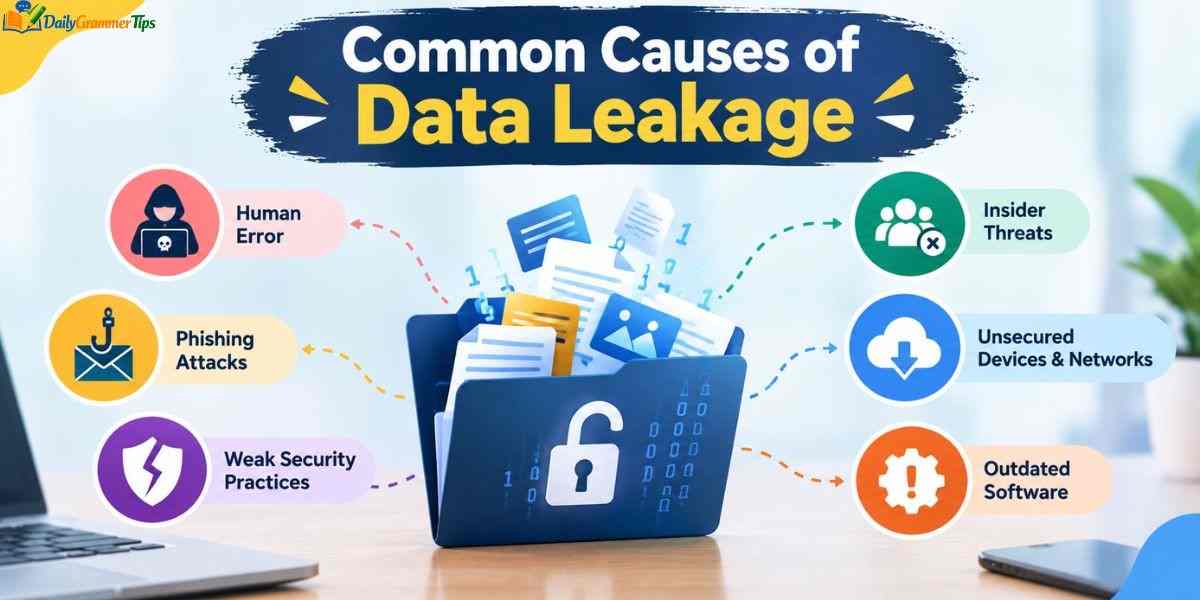
Most data leakage traces back to ordinary mistakes. Few cases involve clever attackers. That is good news, because ordinary mistakes can be prevented.
Pressure makes these slips more likely. Rushed staff skip checks and reuse old habits. A calm process with simple rules cuts the risk a lot.
- Wrong recipient: A file goes to the wrong inbox because of autofill.
- Open sharing: A document is shared through a link that anyone can use.
- Phishing: An employee enters a password on a fake login page.
- Lost devices: A laptop or USB drive disappears on a train or in a cafe.
- Insiders: An unhappy employee copies files before leaving.
- Third parties: A partner mishandles the data you trusted them with.
Technical Causes
Systems can also fail without any single careless act. Weak setup and old software leave gaps that stay open for a long time.
Growth adds to the problem. New apps, new vendors and new teams each add settings to manage. One missed setting is all it takes.
- Open storage: Cloud buckets are left readable by the whole internet.
- Excess access: Users and apps hold far more rights than they need.
- Hidden secrets: Passwords and keys sit inside code or shared notes.
- Old software: Security updates never get installed.
- Weak APIs: Interfaces skip proper login checks.
- No encryption: Data travels or rests in plain, readable form.
Data Leakage in Transit, at Rest, and in Use
Data has three states, and each one has its own weak spots. Data leakage can strike in all three. Knowing them helps you place your defenses in the right spot.
A strong plan covers every state. Protecting only one leaves the other two wide open. Review each state on a regular schedule.
- In transit: Files moving through email, chat, APIs and transfers can be read if they are not encrypted.
- At rest: Stored data in databases and cloud buckets leaks when permissions are loose.
- In use: Data on screens, clipboards, printers and USB drives leaks through careless habits.
Simple Protection for Each State
Protection does not need to be complex. A few basic controls handle most of the risk. Start with encryption and access reviews.
Then add monitoring. Alerts on unusual downloads and large transfers give early warning. Test these alerts so you know they work.
- In transit: Use encrypted connections and block unknown file transfer tools.
- At rest: Encrypt storage and review who holds access every quarter.
- In use: Lock screens, restrict USB ports and limit copy and print rights.
Data Leakage Example: Real World Cases
Real cases of data leakage show how small mistakes grow. In 2023, Microsoft researchers shared AI training files through a cloud link that allowed too much access. About 38 terabytes of internal data became reachable, including private keys and passwords.
A recruiting software firm named TalentHook left a cloud storage container open. Around 26 million resumes could be viewed by anyone who found it. Scammers later used that information to target job seekers.
What These Cases Teach
Both cases share one theme. The data was not stolen by a genius. It was left open by a simple setting.
Fixing such settings takes minutes. Finding them takes routine checks. Companies that skip those checks pay later.
- Check sharing links: Look at who can open each link and for how long.
- Close public storage: Test your cloud buckets from an outside account.
- Keep secrets out of code: Use a vault for passwords and keys.
- Review access often: Remove rights that nobody uses.
- Watch your vendors: Ask partners how they store and protect your data.
- Practice a response plan: Know who acts first when exposure is found.
Learn more………..Cyber Hacking: Types, Techniques, and How to Stay Safe
What Is Data Leakage in Machine Learning?
In machine learning, data leakage means a model learns from facts it will not have in real use. The result looks great in testing. Then it fails once it meets fresh data.
Think of a student who sees the exam answers early. The score looks perfect, but the knowledge is missing. Models behave the same way.
- Fake accuracy: Test scores look far better than real performance.
- False trust: Teams rely on a model that does not work.
- Wasted budget: Time and money go into a broken system.
- Bad decisions: Wrong predictions reach real customers.
- Hidden risk: Nobody notices until live results disappoint.
- Costly rebuilds: Fixing the flaw often means retraining from scratch.
Why Models Fail After Launch
Once live, the model meets data without the shortcuts. The hidden clue is gone. Predictions drop to what the model truly learned.
That drop surprises teams that trusted the test score. It also hurts customers who relied on the output. Early checks prevent both problems.
Types of Data Leakage in Machine Learning
This kind of data leakage falls into a few clear types. Each one lets outside information reach the model in a different way. Knowing the type helps you find the fix faster.
The two most talked about types are target leakage and train test contamination. The others are close relatives. All of them break the same rule: the model must only use what it will truly know at prediction time.
| Type | What happens | Simple example |
| Target leakage | A feature gives away the answer | Using a refund flag to predict fraud |
| Train test contamination | Test rows reach the training step | Testing on rows the model already saw |
| Preprocessing leakage | Scaling is done before the split | Normalizing the full dataset first |
| Temporal leakage | Future facts predict the past | Using next month’s sales to forecast this month |
| Feature leakage | Built features use facts from later | Average spend counted with later purchases |
| Group leakage | Related rows land in both sets | Same customer in training and testing |
Target Leakage and Train Test Contamination
Target leakage happens when a column reveals the outcome. The model then copies the clue instead of learning a pattern. Clues often hide in fields created after the event.
Train test contamination happens when test data influences training. Even small overlaps inflate results. Strict splits before any processing stop it.
Data Leakage Machine Learning Examples
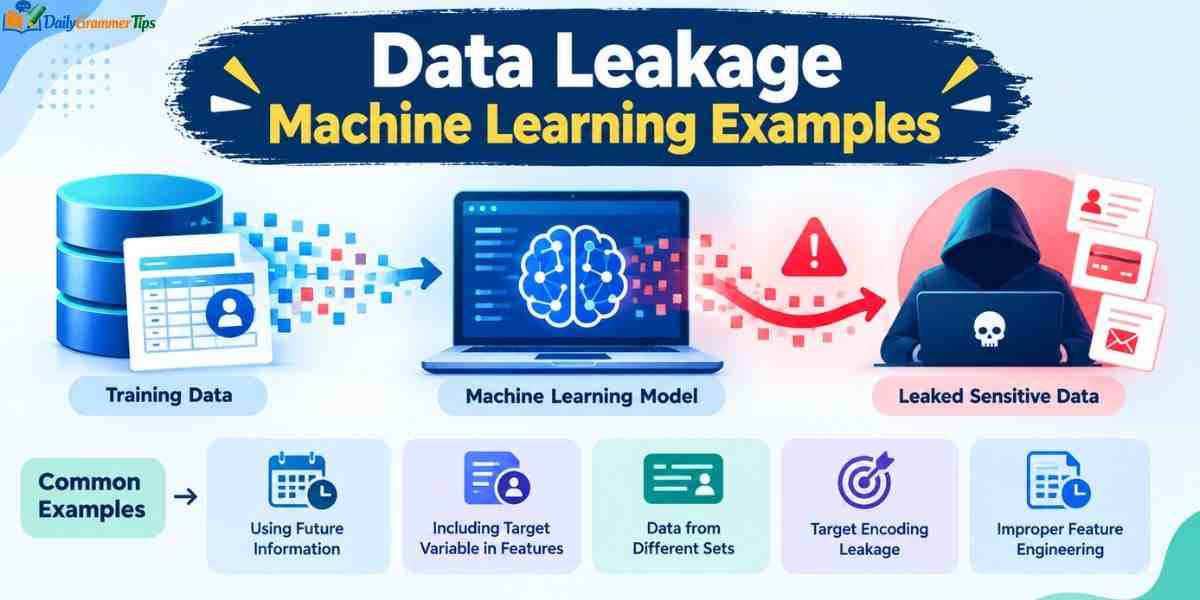
Picture a bank building a fraud detector. The training table has a column showing whether the customer disputed the charge. A dispute only happens after fraud is found. The model learns this shortcut and scores very high in testing.
Now picture a house price model. The team scales every number before splitting the data. Test rows quietly shape the scale. The model looks sharper than it really is.
- Churn model: It uses the cancellation date, which only exists after the customer leaves.
- Hospital model: It reads notes written after discharge to predict readmission.
- Sales model: It uses a tax field that was calculated from the sales figure.
- Loan model: It uses the final payment status to predict default.
- Hiring model: It uses the exit interview result to predict who will quit.
- Ad model: It uses conversion time to predict who will click.
Spotting the Pattern
Each example shares a timing problem. The clue exists in the data but not at prediction time. Ask when each column is created.
This simple question catches most cases. Ask it for every feature before training. Involve someone who knows how the data is produced.
Data Leakage in Data Science
Data scientists meet data leakage in daily work. It often hides inside long notebooks and messy pipelines. A single misplaced line can spoil weeks of effort.
Research is not safe either. A large review in 2023 found hundreds of papers across many fields that were hurt by it. That shows how easy the mistake is, even for experts.
- Full dataset cleaning: Cleaning steps run before the split.
- Random splits on timed data: Future rows slip into training.
- Duplicate rows: The same record lands in both train and test sets.
- Late labels: Targets are built with facts from later dates.
- Repeated tuning: The same test set guides many rounds of changes.
- Copied features: A column quietly repeats the target in another form.
A Quick Habit That Helps
Write down what the model will know at the moment of prediction. Compare every column against that list. Remove anything that fails the test.
Share the list with teammates. A second pair of eyes often finds the flaw you missed. Reviews take minutes and save weeks.
Data Leakage in Deep Learning
Deep learning models are large and hungry for data. They train on millions of samples, which makes overlap easy to miss. Images, text and audio can appear in both training and test sets.
Scale makes checking hard. Nobody can read every sample by hand. Automated tools must scan for overlap before training starts.
- Near duplicate images: Slightly edited copies sit on both sides of the split.
- Same patient twice: Scans from one person appear in training and testing.
- Overlapping text: Web pages in training also appear in the test set.
- Pretrained exposure: A base model already saw the benchmark data.
- Video frames: Frames from one clip are spread across both sets.
- Augmented copies: Flipped or cropped versions of a test image train the model.
Memorization Risk
Big networks can memorize what they see. Rare details from training data may show up later in outputs. That turns a modeling flaw into a privacy problem.
Attackers can try to pull such details out with clever questions. Testing for this risk is now part of responsible model release.
Data Leakage in AI
AI tools add a new path for data leakage. People paste work files, code and client notes into chat tools. Once shared, that content leaves the company’s control.
Rules often lag behind habits. Many firms have no policy on AI tools at all. A clear policy closes the biggest gap quickly.
How AI Systems Leak Information
Models trained on private data may repeat parts of it. Poorly guarded AI apps may also reveal stored chats or files. Both risks grow as more staff adopt AI tools.
Vendors differ in how they handle prompts. Some keep chats for review, others delete them fast. Read the data terms before staff use any tool.
- Pasted secrets: Staff drop confidential text into public chat tools.
- Personal training data: Datasets contain names, emails or health details.
- Wide plugins: AI add ons get access to more company files than needed.
- Open logs: Prompts and answers are stored without protection.
- Repeated text: Outputs echo private material from training data.
- Shared workspaces: One team sees another team’s chats by mistake.
Consequences of Data Leakage
The price of data leakage goes beyond the first fix. Customers lose trust fast. Regulators may act, and rivals may gain an edge.
For machine learning teams, the cost is different but real. Models must be rebuilt, and bad decisions may already be live.
- Legal fines: Laws such as GDPR and HIPAA carry heavy penalties.
- Lawsuits: Affected customers may claim damages.
- Lost sales: Buyers move to competitors they trust more.
- Cleanup costs: Investigation, notices and repairs take money and time.
- Fraud and scams: Stolen data is sold or used against your customers.
- Wasted models: Leaky models must be retrained and tested again.
- Damaged reputation: News of a leak stays online for years.
Hidden Costs Teams Miss
Staff time is a big hidden cost. Engineers and lawyers stop regular work to handle the incident. Morale can also drop.
Insurance prices may rise afterward. Partners may ask for extra audits. These effects last long after the headlines fade.
How to Detect Data Leakage
Early detection of data leakage saves money. On the security side, watch for odd file access, strange downloads and open storage. Scans that map sensitive data help you see what is exposed.
Regular audits add another layer. Check sharing settings, review access lists and test your storage from outside. Small checks done often beat large checks done rarely.
Warning Signs in Machine Learning Models
In modeling, the clue is a result that looks too good. Accuracy far above what experts expect deserves a second look. So does a model that leans on one feature.
Add checks to your workflow. Compare training results with fresh data each month. A widening gap is an early alarm.
- Perfect scores: Validation results are almost flawless.
- Live drop: Real world results fall far below test results.
- Dominant feature: One column carries most of the weight.
- Unstable folds: Scores swing wildly between cross validation folds.
- Odd features: A column would not exist at prediction time.
- Strange logic: The model relies on facts that make no business sense.
Data Leakage Prevention: Best Practices
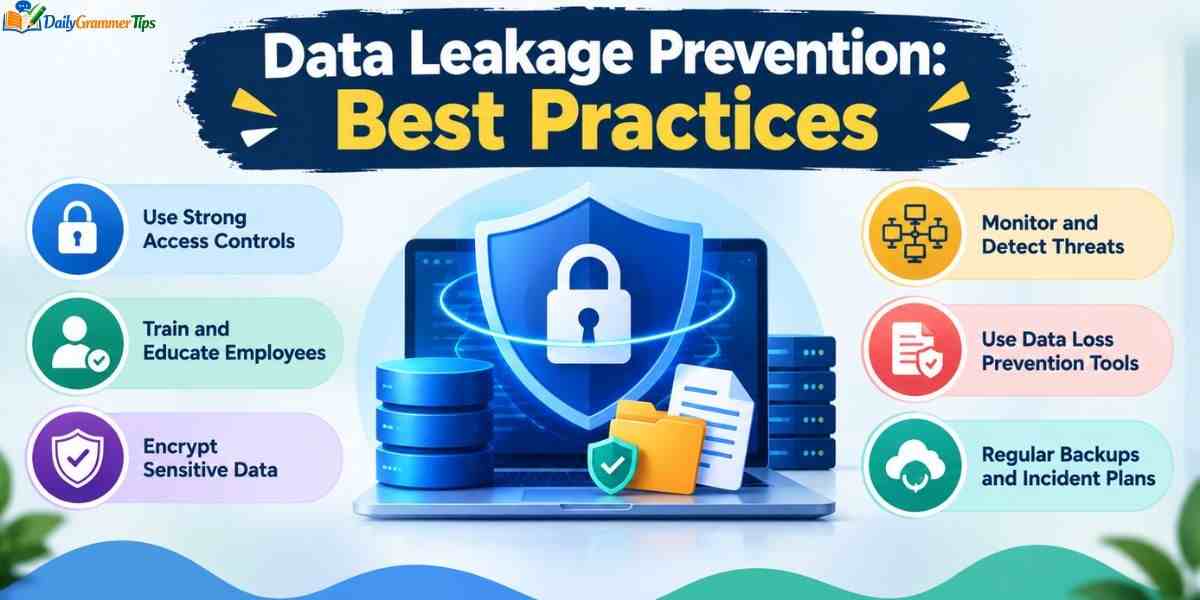
Preventing data leakage works best in layers. No single tool covers people, systems and models. Combine controls and review them often.
Culture matters as much as tools. When staff feel safe to report mistakes, leaks get fixed faster. Blame hides problems, while openness surfaces them.
- Data loss prevention tools: They watch data movement and block risky sharing.
- Least access: Give people only the rights they need for their job.
- Multifactor login: A second step stops many stolen password attempts.
- Encryption: Protect data in transit and at rest.
- Staff training: Teach people to spot phishing and unsafe sharing.
- Vendor checks: Review partner security before you sign a contract.
- Storage scans: Search your cloud for public or forgotten data.
Steps for Machine Learning Teams
Split your data first, then do everything else. Fit scalers and encoders on training rows only. Keep a final test set untouched.
Document your pipeline in plain words. Anyone joining the team should see how data flows. Clear notes make silent errors easier to catch.
- Time based splits: Train on the past and test on the future.
- Feature reviews: Confirm each column exists at prediction time.
- Pipelines: Run every step in a fixed and repeatable order.
- Duplicate checks: Make sure no record sits in two sets.
- Group splits: Keep all rows from one person or device together.
- Regular audits: Check the pipeline again whenever data or code changes.
Frequently Asked Questions
What are examples of data leakage?
Sending a file to the wrong person, leaving cloud storage open and pasting secrets into a chat tool are common cases. In machine learning, using future data during training is a typical example.
What is the biggest data leak in history?
The largest known is the 2024 Mother of All Breaches, with about 26 billion records. It was a collection of data from many earlier incidents.
What is the difference between a data breach and a data leak?
A leak is usually accidental, while a breach is a deliberate attack. A leak can turn into a breach if criminals find the exposed data.
What is another term for data leakage?
Common alternatives are data leak, data exposure and information leak. Some people also say data spill.
Will ChatGPT leak my data?
It can if you paste sensitive details into it, since chats may be stored or reviewed. Avoid sharing passwords, client files and private records with any public AI tool.
Conclusion
Data leakage is rarely dramatic. It grows from small habits, weak settings and rushed work. That is why it stays hidden so long and costs so much.
The answer is steady care. Limit access, watch your storage, split data the right way and train your people. Do these things well, and most data leakage never happens.
