

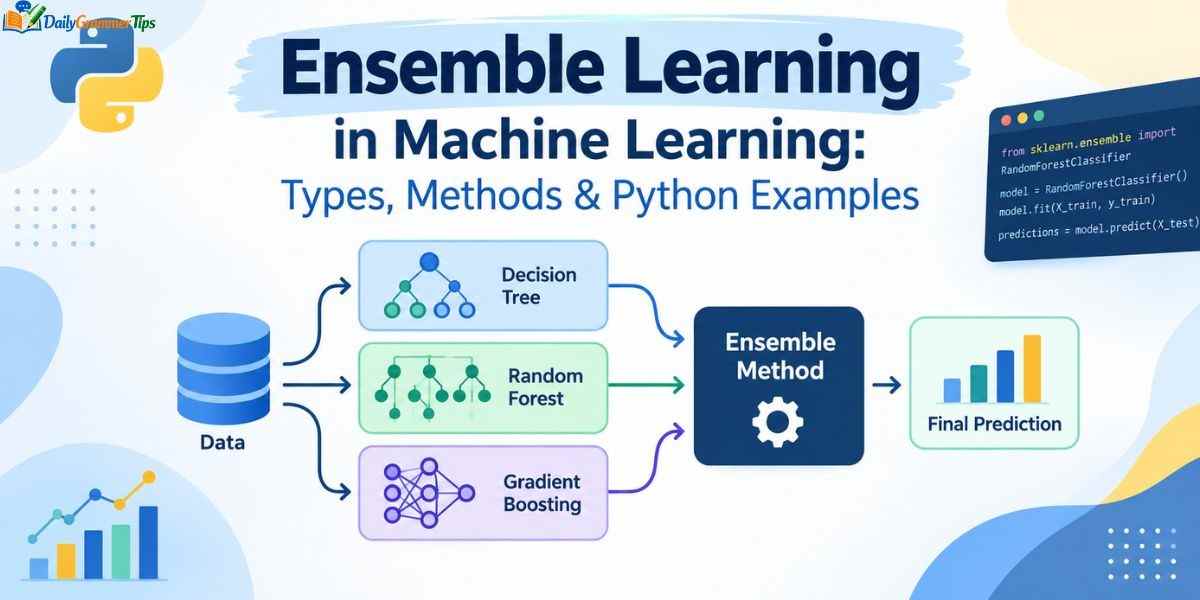
A single model is like a single witness. It may be honest, but it can still be wrong. Ask five witnesses and the story becomes clearer. That habit is the heart of ensemble learning in machine learning, a way to join many models and reach one better answer.
This guide walks you through the full picture. You will learn the main types, the famous algorithms, a worked example and runnable Python code. You will also see the limits, so you can decide when ensemble learning in machine learning is worth the effort and when a simpler model is the wiser pick.
What Is Ensemble Learning in Machine Learning?
Ensembling means training many models and merging their answers into one better prediction. This section covers the idea, the key terms and a little history.
The Core Idea
In simple terms, ensemble learning in machine learning means training several models and merging their answers into one final output. Each model is called a base learner. The merged result is usually more accurate than any single learner that helped build it.
Think of a panel of judges at a talent show. One judge may love singing and ignore dance. Another may do the opposite. The average score is fairer than either opinion, and models behave the same way when they share a decision.
Where Ensembles Fit in a Project
An ensemble is not a separate task. It is a strategy that sits on top of ordinary algorithms. You still choose a goal, clean the data and pick a metric. The ensemble only changes how the final answer is built.
This view keeps projects simple. First, get a clean baseline. Then ask whether combining models can lift the score. If the answer is yes, add the extra layer. If not, stop and save your time.
Weak Learners and Strong Learners
A weak learner is only slightly better than a coin flip. A strong learner reaches high accuracy alone. Many ensembles begin with weak learners and grow them into one strong predictor through careful teamwork.
Weak parts are not required, though. Some teams combine strong models like neural networks and forests. What matters is that each model adds a fresh view, which is why ensemble learning depends on variety and not on size.
Where the Idea Came From
The roots go back to the 1990s. In 1990, Robert Schapire showed that weak learners can be boosted into strong ones. That result opened the door to boosting and inspired years of research.
Leo Breiman then introduced bagging in 1996 and random forests in 2001. David Wolpert had already described stacking in 1992. These three ideas still form the base of modern ensembles today.
Why Diversity Matters Most
If every model makes the same mistake, combining them fixes nothing. Errors must point in different directions. Then they cancel out, and the group answer moves closer to the truth.
You can create diversity in four ways. Change the algorithm, the features, the data sample or the settings. Any one of these can make models disagree in a helpful way.
Ensemble Learning Pronunciation
This section shows how to say the term aloud. It helps you sound clear in classes, interviews and team calls.
How to Say It
The word ensemble comes from French. Most speakers say ahn SAHM bul, with the stress on the middle part. Some British speakers say on SOM bul, and both forms are accepted.
Pick one style and stay with it. Clear speech helps in interviews, classes and team calls. If you say ahn SAHM bul learning, people will understand you right away.
Why the Word Fits
In music, an ensemble is a group that plays together. No single player carries the piece. Each one adds a part, and the blend creates the final sound.
The same picture works for ensemble learning in machine learning. Every learner plays a small part. The combined result is richer than any solo, and that link makes the name easy to remember.
Why Use Ensemble Learning?

The bias variance tradeoff is the balance between a model that is too simple and one that is too sensitive. Ensembles help you manage both sides.
Three Sources of Error
Every prediction error has three parts. The first is bias. The second is variance. The third is irreducible noise, which no model can remove because it lives inside the data itself.
Ensembles target the first two parts. You cannot erase noise, but you can shrink bias and variance with the right method. That is the main reason ensembles earn so much trust.
Bias in Simple Words
Bias is the gap between what a model learns and the real pattern. A model with high bias is too simple. It misses trends even in its own training data, and this problem is called underfitting.
Boosting is the main fix for this problem in ensemble learning in machine learning. It adds learners one at a time. Each new learner repairs what the last one missed, so the pattern becomes clearer and the error falls.
Variance in Simple Words
Variance shows how much a model changes when the training data changes. A high variance model memorizes noise. It shines in training and fails on new data, and this problem is called overfitting.
Bagging is the main fix. It trains many models on different samples and averages them. Random ups and downs smooth out, and the final answer becomes steady.
The Wisdom of Crowds Rule
Crowds are smart only under certain conditions. Members must think for themselves, and they must bring different information. A crowd that copies one leader is no wiser than the leader. Models follow the same rule.
That is why independent training matters. Models trained on different samples or with different features act like independent voters. Models that share the same flaws act like one loud voice. Aim for the first case.
Why Many Models Beat One
A single model carries one set of assumptions. If those assumptions are wrong for a slice of data, it fails there. A group carries many assumptions, so a weak spot in one is covered by another.
This is also why ensemble learning often wins on messy tabular data. The blend adapts to patterns that a lone model would miss. That gives you a wider safety margin.
Ensemble Learning Types
Ensemble types are the different ways to build and group a set of models. They differ in training order and in model variety.
Parallel and Sequential Ensembles
In a parallel ensemble, every model trains alone. No model waits for another. Bagging and random forests follow this path, and training can be spread over many processor cores to save time.
In a sequential ensemble, models train in a line. Each new model learns from earlier errors. Boosting is the classic case. It runs slower, but it often reaches very high accuracy.
Homogeneous and Heterogeneous Ensembles
A homogeneous ensemble repeats one model type many times. A random forest is a set of decision trees. A heterogeneous ensemble mixes types, such as a tree, a linear model and a neural network.
Both styles are common in ensemble learning in machine learning. The right pick depends on your data and your compute budget. Homogeneous sets are easier to build, while mixed sets often add more diversity.
The Four Main Families
The four main families are bagging, boosting, stacking and voting. Bagging trains on random samples. Boosting fixes errors in a chain. Stacking learns how to blend, and voting simply counts opinions.
Each family attacks a different weakness. The table below places the main families of ensemble learning side by side.
| Feature | Bagging | Boosting | Stacking |
| Training style | Parallel | Sequential | Layered |
| Main goal | Lower variance | Lower bias | Best blend |
| Base models | Same type | Same type | Often mixed |
| Overfitting risk | Low | Medium to high | Medium |
| Typical example | Random forest | XGBoost | Meta learner blend |
Choosing a Type
Start with your biggest problem. If the model overfits, try bagging. If the model underfits, try boosting. If you already have several good models, try voting or stacking.
Also weigh your limits. Low latency favors fewer models. Strict clarity favors simple voting. Keep the choice tied to a real need and not to fashion.
Ensemble Learning Methods: Bagging
Bagging trains many models on random samples of the data and averages their answers. Its main aim is to cut variance.
What Bagging Does
Bagging stands for bootstrap aggregating. It trains many copies of one model on different samples of the data. Then it merges their answers. The goal is to calm down unstable models, such as deep decision trees.
It is simple, fast and easy to run in parallel. That makes it a friendly starting point for anyone new to ensemble learning in machine learning. You can test it in minutes.
How Bootstrap Sampling Works
Start with a dataset of n rows. Draw n rows at random with replacement. Some rows appear twice and others never appear. The new set is called a bootstrap sample.
Repeat this many times, and each sample trains one model. About 63 percent of the unique rows land in each sample. The remaining 37 percent or so sit out that round.
Combining the Results
For classification, the models vote. The class with the most votes wins. For regression, the predictions are averaged. Averaging cancels random errors and gives a smoother answer.
This is why bagging works so well for high variance models in ensemble learning in machine learning. Steady results matter more than one lucky guess. The final output rarely swings wildly.
Out of Bag Testing
The rows left out of each sample are useful. Every model can be tested on rows it never saw. Averaged across models, this gives an honest score without a separate split.
This trick is called out of bag evaluation. It saves data on small projects. In scikit learn, you switch it on with a single setting.
Random Forest
A random forest is bagging with one extra twist. At each split, a tree sees only a random slice of the features. That keeps the trees from looking alike.
Less similar trees make a better team. Forests are a safe first choice on tabular data. They need little tuning and rarely fail badly, which is why ensemble learning in machine learning often starts here.
Key Bagging Settings
Bagging has only a few settings that matter. The number of models is the first. More models give a steadier result, with little risk of overfitting. Returns fade after a few hundred.
The sample size and the feature share come next. Smaller samples add diversity. Fewer features per split do the same. Tune these two when a forest feels too similar or too weak.
Boosting: AdaBoost, Gradient Boosting and XGBoost

Boosting trains models one after another, and each new model corrects the last. Its main aim is to cut bias.
The Boosting Idea
Boosting builds models in a chain. Each new learner pays extra attention to earlier mistakes. Small, weak models grow into one strong model through many careful steps.
The chain gives boosting great accuracy. It also gives risk. Because each step chases errors, noisy labels can mislead it. Clean data and gentle steps keep it safe.
AdaBoost
AdaBoost gives every training row a weight. Wrong predictions get a higher weight. The next model then focuses on those hard rows and tries to fix them.
At the end, all models vote. Better models get a louder voice. Very shallow trees, called stumps, are the usual base. Noisy labels can hurt it, so clean data matters.
Gradient Boosting
Gradient boosting does not change row weights. It fits each new model to the residuals, which are the leftover errors. The final answer is the sum of all model outputs.
A small learning rate keeps each step gentle. More steps with smaller jumps often generalize better. This method is the backbone of ensemble learning in machine learning on tabular data.
XGBoost
XGBoost is an optimized form of gradient boosting. It adds regularization, smart pruning and fast parallel work inside each tree. It also handles missing values on its own.
These upgrades made it a favorite in contests and in business projects that rely on ensemble learning in machine learning. Careful tuning still matters. Early stopping is a simple and powerful safety brake.
Key Boosting Settings
Boosting has more knobs, and each one matters. The learning rate sets the size of each step. Tree depth sets how complex each learner can be. The number of trees sets how long the chain runs.
Lower the learning rate and raise the number of trees for a smoother fit. Keep trees shallow at first. Add row and column sampling to inject a little randomness. Adjust one setting at a time.
Boosting vs Bagging
Both methods combine many models, yet they work in opposite ways. Bagging reduces variance by averaging. Boosting reduces bias by correcting. The table shows the key gaps.
| Feature | Bagging | Boosting |
| Training order | Parallel | Sequential |
| Main target | Variance | Bias |
| Data focus | Random samples | Hard rows |
| Speed | Faster | Slower |
| Noise handling | Strong | Sensitive |
| Example | Random forest | XGBoost |
Neither is always better. Pick the one that fits your error type. That habit keeps ensemble learning in machine learning practical and cheap.
Learn more…………Data Leakage: Meaning, Causes, Examples and Prevention
Stacking (Meta Learning)
Stacking feeds the predictions of several models into a final model. That final model learns the best way to blend them.
The Two Layers
Stacking is an advanced tool in ensemble learning in machine learning. It asks a second model to learn how to combine the first group. That second model is the meta learner. It learns who to trust and when.
Layer one holds diverse base models, such as a forest, a linear model and a neural network. Each predicts on data it did not train on. Layer two takes those predictions as inputs.
Choosing the Meta Learner
A simple meta learner is usually best. Logistic regression is a common pick for classification. Ridge regression is common for numbers. Simple models are easier to trust and to debug.
A complex meta learner can memorize the mistakes of the base models. Keep it small. Test it on fresh data before you trust it.
Avoiding Leakage
Leakage is the biggest risk. If the meta learner sees predictions made on training rows, it learns false confidence. Use cross validation so base predictions come from folds the model has not seen.
Scikit learn handles this inside its stacking classes. Still, keep a final test set untouched. Stacking shines in ensemble learning in machine learning only when the setup is clean.
Blending as a Simple Cousin
Blending is a lighter form of stacking. Instead of cross validation, it holds out one slice of data. Base models predict on that slice, and a small model learns to combine those predictions.
It is quicker to build and harder to leak. The cost is that you use less data for training. Blending suits large datasets, where a single hold out slice is still big enough to trust.
When Stacking Is Worth It
Stacking pays off when your base models are strong and different. If they are all similar, the meta learner has little to learn. Gains then stay tiny while cost grows.
Test it on a fresh split before you commit. A gain of a fraction of a percent may matter in fraud or ranking. In a simple app, it rarely justifies the extra code and run time.
Voting and Averaging
Voting and averaging merge model outputs with a fixed rule, such as a majority count or a mean.
Hard Voting and Soft Voting
Hard voting counts class labels. The majority label wins. Soft voting averages predicted probabilities and picks the class with the highest average.
Soft voting often does better because it uses confidence and not just labels. It needs models that give reliable probabilities. If your probabilities are poor, hard voting may be safer.
Weighted Averaging
In regression, you average the numeric outputs. You can also give stronger models a bigger weight. Set those weights from validation scores and never from a guess.
This method is fast, clear and easy to audit. It is a smart pick when a team wants a quick gain at a small cost. Setup takes only a few lines of code.
When Voting Fails
Voting fails when models are too alike. Ten copies of the same tree will vote the same way every time. The result equals one model with extra cost.
It also fails when one model is far weaker than the rest. A poor voter can drag the group down. Check each model on its own first, and drop the ones that add noise.
Voting vs Stacking
Both merge model outputs, but they differ in effort and power. Voting uses a fixed rule. Stacking learns the rule. The table shows how they compare.
| Point | Voting | Stacking |
| Combiner | Fixed rule | Learned model |
| Extra training | None | Required |
| Leakage risk | Low | Higher |
| Clarity | High | Lower |
| Best for | Quick gains | Maximum accuracy |
If you need speed and clarity, choose voting. If you need the last bit of accuracy, test stacking. Many teams that use ensemble learning in machine learning start with voting and move up later.
Ensemble Learning Algorithms

These are the named tools that turn ensemble ideas into working code. Each one belongs to a family such as bagging or boosting.
Popular Algorithms at a Glance
Many famous algorithms are ensembles in disguise. Knowing their names helps you read code and papers on ensemble learning in machine learning with less effort. The table groups the most popular ones.
| Algorithm | Family | Key strength | Watch out for |
| Random Forest | Bagging | Stable and easy to tune | Large model size |
| Extra Trees | Bagging | Very fast training | Extra randomness |
| AdaBoost | Boosting | Simple and clear | Sensitive to bad labels |
| Gradient Boosting | Boosting | High accuracy | Slower training |
| XGBoost | Boosting | Speed and regularization | Many settings |
| LightGBM | Boosting | Fast on large data | May overfit small data |
| CatBoost | Boosting | Strong with category columns | Longer training on some sets |
Random forests and extra trees belong to bagging. The rest of the list belongs to boosting. Stacking and voting are strategies, not single algorithms.
LightGBM vs XGBoost
Both are gradient boosting libraries. LightGBM grows trees leaf wise and uses histogram tricks, so it is often quicker on big data. XGBoost grows trees level wise by default and offers a steady, well documented setup.
| Point | LightGBM | XGBoost |
| Tree growth | Leaf wise | Level wise by default |
| Speed on big data | Often faster | Fast and steady |
| Small data risk | Can overfit | Lower risk |
| Category columns | Basic support | Basic support |
| Community and docs | Strong | Very strong |
Neither wins every time. Test both on your data with the same folds and the same metric. That habit settles arguments fast in ensemble learning in machine learning.
CatBoost and Category Columns
CatBoost was built to handle category columns with little prep work. It uses a method called ordered boosting to lower a hidden form of leakage. It often works well with default settings.
If your data holds many text like categories, such as city or product code, try it early. It can save hours of encoding work. That makes it a handy tool for busy teams.
Built In Options in Scikit Learn
Scikit learn ships most of what you need. It includes forests, extra trees, AdaBoost, gradient boosting, voting and stacking. It also offers histogram based gradient boosting, which is fast on larger tables.
For extra speed or features, add XGBoost, LightGBM or CatBoost. All three offer a scikit learn style interface. That means they fit into the same pipelines and cross validation tools you already use.
How to Pick an Algorithm
In ensemble learning in machine learning, begin with a random forest as your baseline. It is strong, steady and hard to break. If you need more accuracy, move to a boosting library and tune it with care.
Try stacking last. It adds power, but it also adds cost and risk. A clean workflow beats a fancy model every time.
How Ensemble Learning Works in Practice
This section shows the practical path from raw data to a working ensemble, one step at a time.
Step by Step Workflow
A good project in ensemble learning in machine learning follows a clear path. The steps are almost the same for every ensemble type. Follow them in order and you avoid most beginner mistakes.
- Split the data into training, validation and test sets.
- Train a simple single model as a baseline.
- Pick base models that differ from each other.
- Train them with your chosen ensemble method.
- Combine outputs by voting, averaging or a meta learner.
- Compare the ensemble with the baseline on the test set.
The baseline is the most skipped step. Without it, you cannot prove that the ensemble helps. It also tells you when a simple model is enough.
Choosing Diverse Models
Diversity comes from four places. Change the algorithm, the feature set, the data sample or the settings. Any one of them can make models disagree in a useful way.
Check diversity by looking at how often models fail on the same rows. If they all fail together, more models will not help. Fresh views matter more than extra copies.
Handling Imbalanced Data
Many real tasks have rare targets, such as fraud. A model can reach high accuracy by always saying no. Ensembles do not fix this on their own. You must plan for it.
Use class weights or resampling inside each base model. Judge results with precision, recall and the area under the precision recall curve. Then tune the decision threshold to match the real cost of each error.
Tuning and Validation
Use cross validation to measure performance. For boosting, tune the learning rate, the tree depth and the number of trees. Keep test data locked until the very end.
Also check results by segment, such as region or customer type. An ensemble can win overall and still fail for one group. This check is a key habit in ensemble learning in machine learning.
Ensemble Learning Example
A worked example turns the theory into numbers that you can follow with a pencil.
A Loan Approval Story
Here is a simple example of ensemble learning in machine learning. A bank wants to predict whether a borrower will repay a loan. It trains three models. Model A is a decision tree. Model B is logistic regression. Model C is a neural network.
For one applicant, A says repay, B says default and C says repay. Majority voting returns repay. Two of the three models agree, so the ensemble follows them.
Seeing the Numbers
Now look at the probabilities. The table lists what each model believes about the same applicant.
| Model | Prediction | Probability of repay |
| Decision tree | Repay | 0.70 |
| Logistic regression | Default | 0.45 |
| Neural network | Repay | 0.80 |
Soft voting averages the three probabilities and gets 0.65. That is above the usual cutoff of 0.50, so the answer is repay. This tiny case shows how ensemble learning in machine learning blends opinions into one calm decision.
A Regression Example
Averaging also works for numbers. Suppose three models predict a house price. The first says 205 thousand. The second says 195 thousand. The third says 225 thousand.
The average is about 208 thousand. If the true price is 209 thousand, the blend misses by under 1 thousand. The single models miss by 4, 14 and 16 thousand.
Ensemble Learning in Python
Python and scikit learn let you build and compare ensembles in only a few lines of code.
Voting, Bagging and Boosting Code
Scikit learn makes ensemble learning in machine learning easy to try. The code below uses a built in dataset, so you can run it as it is. Every model trains on the same split for a fair test.
from sklearn.datasets import load_breast_cancer
from sklearn.model_selection import train_test_split
from sklearn.pipeline import make_pipeline
from sklearn.preprocessing import StandardScaler
from sklearn.linear_model import LogisticRegression
from sklearn.tree import DecisionTreeClassifier
from sklearn.ensemble import (
VotingClassifier,
BaggingClassifier,
RandomForestClassifier,
AdaBoostClassifier,
GradientBoostingClassifier,
)
X, y = load_breast_cancer(return_X_y=True)
X_train, X_test, y_train, y_test = train_test_split(
X, y, test_size=0.2, random_state=42
)
logit = make_pipeline(StandardScaler(), LogisticRegression(max_iter=1000))
tree = DecisionTreeClassifier(max_depth=4, random_state=42)
forest = RandomForestClassifier(random_state=42)
models = {
“Single tree”: tree,
“Voting”: VotingClassifier(
[(“logit”, logit), (“tree”, tree), (“forest”, forest)],
voting=”soft”,
),
“Bagging”: BaggingClassifier(estimator=tree, n_estimators=50, random_state=42),
“AdaBoost”: AdaBoostClassifier(n_estimators=100, random_state=42),
“Gradient boosting”: GradientBoostingClassifier(random_state=42),
}
for name, model in models.items():
model.fit(X_train, y_train)
print(name, round(model.score(X_test, y_test), 3))
The script trains five models and prints the test accuracy of each. Scores depend on your library version and your split. Focus on how the models compare and not on one single number.
Stacking Code
Stacking needs one more class. The code below reuses the models and the split from the first script.
from sklearn.ensemble import StackingClassifier
stack = StackingClassifier(
estimators=[
(“logit”, logit),
(“forest”, RandomForestClassifier(random_state=42)),
(“boost”, GradientBoostingClassifier(random_state=42)),
],
final_estimator=LogisticRegression(max_iter=1000),
cv=5,
)
stack.fit(X_train, y_train)
print(“Stacking”, round(stack.score(X_test, y_test), 3))
The classifier uses cross validation inside, which protects you from leakage. Run it after the first script and compare the scores. Small gaps are normal on a clean dataset like this one.
Tips for Better Results
Scale features for linear models and neural networks. Trees do not need scaling. Set random_state so your runs repeat. On scikit learn versions older than 1.2, use base_estimator in place of estimator.
Start with default settings. Then tune one thing at a time. Keep a simple log of every run. Good notes matter as much as good code.
Advantages of Ensemble Learning

The advantages are the gains you get over a single model, such as better accuracy and steadier results.
Higher Accuracy
Combined models in ensemble learning in machine learning usually beat a single model. Errors that one model makes are often fixed by another. Even small gains matter when every wrong decision has a cost.
On tabular data, boosted trees are hard to beat. That is why they appear so often in business projects and contests. Teams return to them again and again.
Stability and Robustness
One noisy row can throw off a single model. An ensemble spreads that risk across many voters. Results change less from run to run.
This steadiness builds trust with teams that rely on predictions every day. It is a major reason to use ensemble learning in machine learning in live systems.
Better Generalization
Ensembles tend to do well on new data. They avoid leaning on the quirks of one training set. Bagging cuts variance, and boosting cuts bias.
Because of this, they suit messy data where patterns are subtle and mixed. The extra layers of opinion act like a safety net.
Handling Mixed Data Types
Tree based ensembles cope well with mixed columns. They accept numbers and encoded categories without much scaling. They also capture curved patterns and feature interactions on their own.
This saves prep time on business tables. You still need clean labels and sensible features. Even so, you often reach a strong result with far less manual work than a linear model needs.
Flexibility
Ensemble learning in machine learning works for classification, regression, ranking and anomaly detection. They accept almost any base model. You can start with trees and add other types later.
This freedom lets a team grow a solution step by step. You do not need to rebuild everything to try a new idea.
Challenges and Limitations
The challenges are the costs and risks that come with running many models instead of one.
Cost of Training and Serving
More models mean more time and memory. Prediction also slows down, since every model must run for each request. Apps that need instant answers feel this first.
Fewer trees, pruning and model distillation can cut the cost. Weigh the gain against the bill before you commit. This trade sits at the center of ensemble learning in machine learning.
Hard to Explain
A single tree is easy to read. A forest of hundreds is not. Regulators and customers may ask why a decision was made, and a simple answer may not exist.
Feature importance and SHAP values give partial answers. They help, but they do not make the model fully open. Plan for this need early.
Risk of Overfitting
Boosting can chase noise and bad labels. Watch the gap between training and validation scores. Early stopping and a low learning rate both help.
Stacking can fail too when data leaks into the meta learner. Careful splits are the cure. Sloppy setup is the top reason ensemble learning in machine learning disappoints in practice.
Maintenance Burden
An ensemble is a system of models. When results drift, you must find which part changed. Log every model version and watch both the parts and the final output.
Teams that skip this step often struggle months later. A little discipline now saves long debugging sessions.
Data Quality Still Matters
No ensemble can rescue bad data. Wrong labels, leaked columns and broken joins will fool every model in the group. The group then agrees on a wrong answer with great confidence.
Spend time on data checks before you add models. Look for duplicates, missing values and columns that reveal the answer. A clean table with a simple model often beats a messy one with a large stack.
Real World Applications of Ensemble Learning
Applications are the real jobs where ensembles already help, from banking to farming.
Finance and Banking
Banks use ensemble learning in machine learning for credit scoring and fraud alerts. Boosted trees spot odd spending patterns fast. A small lift in recall can save a large sum.
Insurance firms use the same tools to price risk and predict claims. Stable predictions help keep prices fair across many customer groups.
Healthcare
Ensembles help predict disease risk, hospital readmission and patient outcomes. Combining models trained on different signals gives steadier forecasts than one model alone.
Doctors still need reasons behind a score. So teams pair ensembles with clear explanation tools. This careful use makes ensemble learning in machine learning valuable in medicine.
Retail and Marketing
Shops predict churn, demand and product interest with ensembles. Recommendation engines often blend several models, each reading a different signal such as clicks, price or season.
Forecasts that blend models handle seasons, promotions and local habits better than one model. It is a proven use in daily planning.
Agriculture and Climate
Farmers and researchers predict crop yield from rainfall, soil and temperature. Different models read different signals, and the blend gives a safer estimate.
Weather and ocean forecasts use the same principle. Many runs give one combined view. Uncertainty becomes easier to measure and to share.
Modern Uses with Large Language Models
The idea behind ensemble learning in machine learning also reaches modern AI. A common trick is to ask a language model the same question several times and pick the most frequent answer. This is a form of voting.
Teams also compare answers from different models before acting. The core lesson stays the same. Several views are safer than one, so this skill will stay useful in the years ahead.
Data Contests and Public Benchmarks
Blending has a long record in data contests. The Netflix Prize is a famous case, where winning teams merged many models to improve movie ratings. Since then, top contest entries often use boosted trees and blends.
Use this record with care. A contest rewards the last small gain. A live product also pays for speed, upkeep and clarity. Borrow the ideas, but match them to your own limits.
When to Use (and When Not to Use) Ensemble Learning
This section helps you decide whether an ensemble is worth its extra cost for your task.
Good Times to Use It
Use ensemble learning in machine learning when a single model stops improving. They fit noisy data, tabular data and problems where small gains carry big value. Fraud, risk and forecasting are strong examples.
Also use them in data contests, where the last decimal counts. Just remember that contest tricks do not always suit a live product.
When to Skip It
Skip ensembles when one simple model already meets your goal. Skip them when you need very low latency, tiny memory or a fully clear decision. A plain logistic regression can be the wiser choice.
Complexity has a price. If your team cannot maintain the ensemble, the gain will fade. Sometimes the best plan in ensemble learning in machine learning is not to build one.
Single Model vs Ensemble
The table below sums up the trade at a glance.
| Factor | Single model | Ensemble |
| Accuracy | Good | Often higher |
| Speed | Fast | Slower |
| Clarity | Easier | Harder |
| Maintenance | Light | Heavier |
| Best for | Simple, clear needs | High value predictions |
Read it as a guide and not as a rule. Your data, your budget and your risk level make the final call.
A Quick Decision Checklist
Use this list before you build an ensemble. If most answers are yes, the extra work is likely to pay off.
- Does a simple baseline still miss your target?
- Would a small gain in accuracy change a real decision?
- Do you have time to tune and to monitor several models?
- Can your app run more than one model per request?
- Can you explain the results to the people who need them?
If several answers are no, keep the model simple. You can return to ensembles later, once the need is clear.
Ensemble Learning PDF: Books, Papers and Free Resources

Here you will find books and papers that go deeper, so you can keep learning offline.
Books
Many readers search for a PDF to study offline. Below is a reading list for ensemble learning in machine learning. Titles are given so you can find legal copies through libraries and publishers.
- Ensemble Methods: Foundations and Algorithms by Zhi Hua Zhou
- Ensemble Methods for Machine Learning by Gautam Kunapuli
- Hands On Ensemble Learning with Python by George Kyriakides and Konstantinos Margaritis
- Pattern Classification Using Ensemble Methods by Lior Rokach
Classic Papers
These papers mark the key steps in the field. Reading even a few will show you where each idea began.
- Stacked Generalization by David Wolpert (1992)
- Bagging Predictors by Leo Breiman (1996)
- Random Forests by Leo Breiman (2001)
- Greedy Function Approximation: A Gradient Boosting Machine by Jerome Friedman (2001)
- A Decision Theoretic Generalization of On Line Learning and an Application to Boosting by Yoav Freund and Robert Schapire (1997)
- XGBoost: A Scalable Tree Boosting System by Tianqi Chen and Carlos Guestrin (2016)
How to Study Them
Start with a practical book and run its code. Then move to the original papers to see the source of each idea. If theory feels heavy, read the code first and return to the math later.
Search these titles on publisher pages, university libraries or open paper archives. Many papers are shared legally there. Avoid sites that offer pirated copies.
Frequently Asked Questions
Is XGBoost an ensemble learning?
Yes. XGBoost builds many trees in a chain, and each tree fixes the errors of the one before it. That makes it a boosting ensemble.
What are the disadvantages of ensemble learning?
Ensembles cost more to train and run, are harder to explain and can overfit when set up badly. They also need more upkeep.
What are the main 3 types of ML models?
The three main types are supervised, unsupervised and reinforcement learning. Ensemble learning in machine learning is used mostly with supervised models.
What is an example of an ensemble?
A random forest is the classic example. It merges many decision trees into one prediction, which is a clear case of ensemble learning in machine learning.
What is better, LightGBM or XGBoost?
Neither wins every time. LightGBM is often faster on big data, while XGBoost is steady and well documented, so test both.
Conclusion
Ensemble learning in machine learning turns many average models into one dependable predictor. Bagging cuts variance, boosting cuts bias, stacking learns the best blend and voting keeps things simple. Diversity is the secret behind all of them. Models that fail in different ways make a strong team.
Build a solid single model, then test a random forest and a boosted model against it. Add stacking only when the gain is clear. Used with care, ensemble learning in machine learning stays useful whatever new tools arrive. Keep measuring, and let your data decide.
